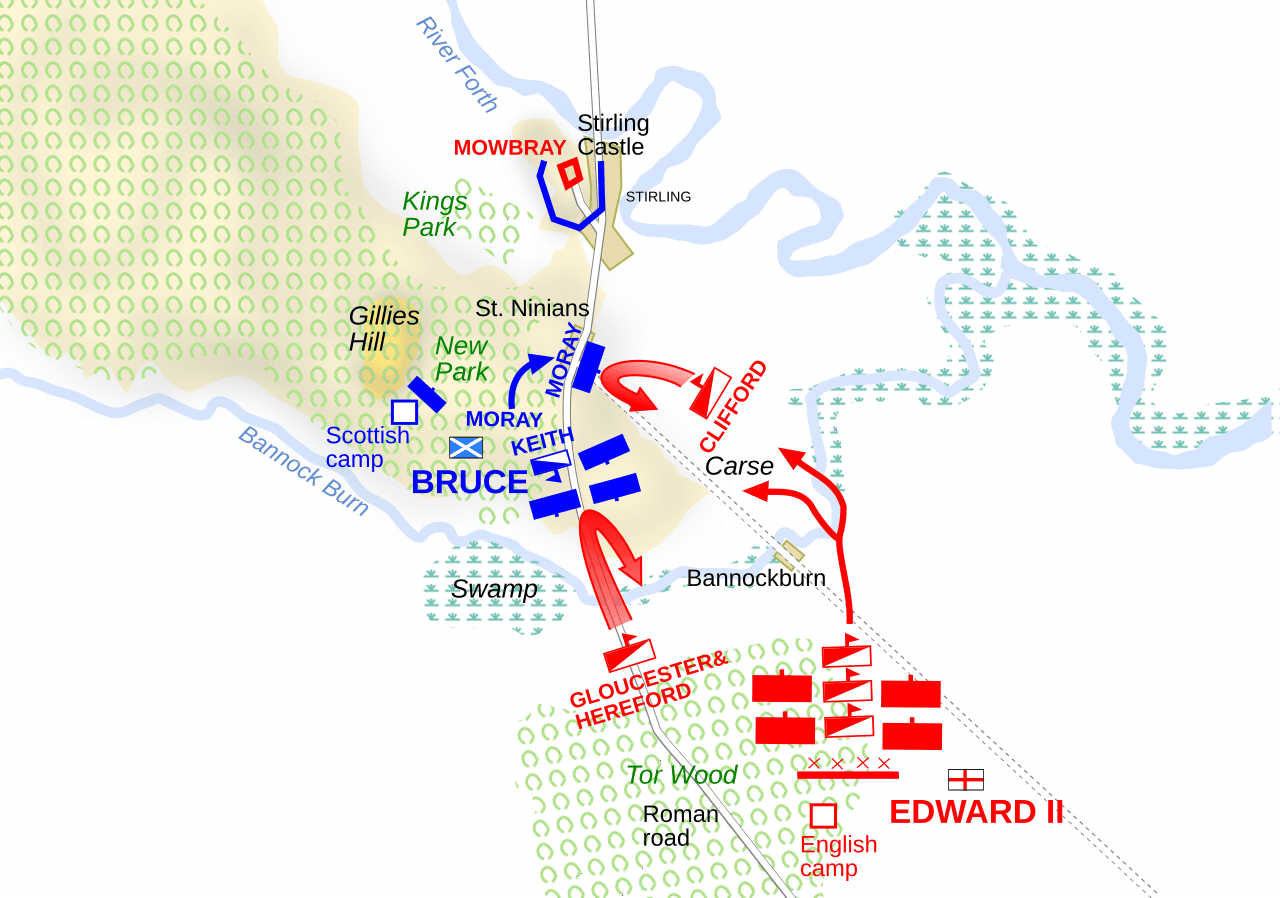
The Battle of Bannockburn, fought on 23–24 June 1314 near Stirling, Scotland, was one of the most decisive military victories of the medieval era. A Scottish army of roughly 6,000–8,000 men under King Robert the Bruce routed an English force estimated at 15,000–20,000 troops commanded by King Edward II, securing Scotland's de facto independence and cementing Robert's legitimacy as king. The battle did not formally end the Wars of Scottish Independence — that required the Treaty of Edinburgh-Northampton in 1328 — but it shattered English dominance over Scotland and became the defining moment of Scottish national identity.
What Were the Origins of the Wars of Scottish Independence?
Scotland's struggle for independence began in 1296 when King Edward I of England — later nicknamed 'Hammer of the Scots' — invaded Scotland, deposed King John Balliol, and effectively annexed the kingdom. Edward seized the Stone of Destiny from Scone, imprisoned Balliol in the Tower of London, and installed English administrators. Scottish resistance ignited almost immediately. William Wallace led a famous uprising and defeated the English at the Battle of Stirling Bridge in September 1297, but was captured and executed in 1305. After Wallace's death, Robert the Bruce — a Scottish nobleman with a strong claim to the throne — seized the initiative, killing his rival John Comyn at Greyfriars Church in Dumfries in February 1306 and having himself crowned King of Scots at Scone on 25 March 1306. Edward I died in 1307 while marching north to crush Robert, passing the crisis to his far less capable son, Edward II. Over the next seven years, Robert systematically dismantled English-held castles and consolidated Scottish territory, leaving Stirling Castle — one of the last major English-held fortresses — isolated and besieged by 1313.
Why Did Edward II March to Stirling in 1314?
The immediate trigger for Bannockburn was an agreement struck in 1313 between Robert's brother Edward Bruce and the English commander of Stirling Castle, Sir Philip de Mowbray. Under a chivalric pact, Mowbray agreed to surrender the castle if an English relief army did not arrive by Midsummer's Day — 24 June 1314. Edward II could not ignore this challenge without catastrophic loss of prestige. He mustered one of the largest armies England had ever assembled: chronicles cite approximately 2,000–2,500 heavily armoured cavalry (including earls and barons), around 15,000 infantry drawn from England, Wales, and Ireland, and a significant supply train. The host departed Berwick around 17 June, giving Edward little time to cover the roughly 100 miles to Stirling. The haste would prove costly, as the army arrived tired and failed to properly scout the terrain.
How Did Robert the Bruce Prepare the Battlefield at Bannockburn?
Robert the Bruce's tactical genius was central to the Scottish victory. He selected a carefully chosen killing ground on the Carse of Stirling, where the Bannock Burn meandered through boggy, waterlogged ground. He positioned his forces on the higher, firmer ground of the New Park woodland to the south of Stirling, exploiting the terrain to neutralise England's overwhelming advantage in heavy cavalry. Bruce ordered his men to dig concealed pits — known as 'pottes' — filled with stakes, in the open ground likely to be used by charging horsemen. He organised his infantry into four schiltron formations: dense, disciplined spear-phalanxes that had evolved from the defensive rings used at Falkirk in 1298 into offensive units capable of advancing under command. The schiltrons were led by Edward Bruce (the king's brother), Thomas Randolph (Earl of Moray), James Douglas, and Robert himself. A fourth division under Walter Stewart and Douglas provided reserve support. Bruce estimated the risk clearly: if the English broke his schiltrons, Scotland's cause was likely finished. But the terrain and preparation gave him a genuine chance.
What Happened on Day One of the Battle (23 June 1314)?
The battle effectively began on 23 June with two significant preliminary engagements. In the first, a cavalry advance by Sir Henry de Bohun — a young English knight who spotted Bruce riding a small palfrey near the New Park — charged the Scottish king alone, hoping to end the war in a single blow. Bruce deftly sidestepped de Bohun's lance and split his skull with a single axe blow, shattering the weapon in the process. The dramatic duel electrified the Scottish army and shamed the English vanguard. In the second engagement, a mounted English column under the Earls of Gloucester and Hereford attempted to outflank the Scots via the eastern road toward Stirling. They were blocked and bloodied by Thomas Randolph's schiltron near St. Ninians church, suffering significant casualties before being driven back. These reverses unnerved Edward II's commanders and boosted Scottish confidence enormously. The English army camped overnight in the boggy Carse of Bannockburn — a poor position that Robert had anticipated.
How Did the Main Battle Unfold on 24 June 1314?
At dawn on 24 June, the Scots surprised the English commanders by advancing — rather than waiting to be attacked. As the Scottish schiltrons moved forward onto the flat Carse, the English cavalry had little room to manoeuvre between the Bannock Burn to their south and the River Forth to their north. The tight ground nullified their numerical advantage. The English archers, who had devastated Scottish spearmen at Falkirk sixteen years earlier, were positioned poorly and largely unable to fire into the Scottish lines without hitting their own cavalry. A belated English archery advance on the Scottish left flank was routed by a charge of 500 Scottish cavalry under Sir Robert Keith — one of the few mounted units Bruce committed. The English formation began to compress, with men and horses unable to swing weapons effectively or manoeuvre past fallen comrades. When the schiltrons pressed forward with disciplined momentum, chanting 'On them! On them! They fail!', the English line buckled. A legendary episode — possibly mythologised but widely recorded — saw a mass of Scottish camp followers, servants, and non-combatants appear over a nearby hill carrying makeshift banners, which the panicking English mistook for a fresh Scottish army. The psychological blow completed the rout. Edward II, reportedly unwilling to leave the field, was physically led away by the Earl of Pembroke and fled to Stirling Castle (which Mowbray refused to shelter him in) and ultimately to Dunbar, where he escaped by ship to Berwick. The slaughter of retreating English forces was extensive; the Bannock Burn and surrounding bogs claimed thousands of lives. Among the English dead was Gilbert de Clare, Earl of Gloucester, one of England's most powerful magnates. Hundreds of English knights and nobles were captured, generating vast ransoms that enriched the Scottish crown.
Comparing the Two Armies at Bannockburn
| Factor | Scotland (Robert the Bruce) | England (Edward II) |
|---|---|---|
| Commander | Robert the Bruce | Edward II |
| Estimated infantry | 6,000–8,000 | 15,000–17,000 |
| Heavy cavalry | ~500 light horse | 2,000–2,500 knights |
| Tactical formation | Offensive schiltrons (spear phalanxes) | Cavalry vanguard, massed archers |
| Terrain advantage | Yes — chose boggy, confined ground | No — hemmed in by rivers and bogs |
| Key commanders | Edward Bruce, Randolph, James Douglas | Earls of Gloucester, Hereford, Pembroke |
| Outcome | Decisive victory | Catastrophic defeat; king fled by sea |
| Notable casualties | Minimal | Earl of Gloucester killed; hundreds captured |
What Were the Immediate Consequences of the Battle?
The immediate aftermath of Bannockburn transformed the strategic balance of the Anglo-Scottish conflict. Stirling Castle surrendered to Robert on 25 June 1314, fulfilling the original terms of the relief pact. The enormous ransoms paid for captured English nobles — the Earl of Hereford was exchanged for Robert's wife, daughter, and other Scottish prisoners held since 1306 — demonstrated Scotland's new leverage. English authority in Scotland collapsed almost entirely. Robert the Bruce launched devastating cross-border raids into northern England, including County Durham, Yorkshire, and Lancashire, extracting tribute payments from towns as far south as Ripon. By 1318 the Scots had recaptured Berwick, England's most valuable northern town. In 1320, the Declaration of Arbroath — a letter from Scottish nobles to Pope John XXII — made a remarkable philosophical argument for Scottish sovereignty and Robert's kingship, asserting that even Robert himself could be deposed if he submitted to English rule. It is one of the most celebrated documents of the medieval world. Edward II, weakened by Bannockburn and by domestic baronial opposition, was eventually deposed in 1327 and murdered at Berkeley Castle. His son, Edward III, concluded the Treaty of Edinburgh-Northampton on 1 May 1328, formally recognising Scottish independence and Robert the Bruce as king.
Why Was Robert the Bruce Such an Effective Military Commander?
Robert the Bruce's victory at Bannockburn reflected years of hard-won military learning. Born on 11 July 1274, he had initially wavered between English and Scottish allegiances — even fighting for Edward I at one stage — before committing fully to independence after 1306. His early campaigns after his coronation were near-disastrous, and he spent time as a fugitive hiding in the western islands and Ireland. The famous story of the spider — which inspired his perseverance through its repeated attempts to spin its web — may be apocryphal but reflects historical reality: Robert rebuilt his campaign from almost nothing. His strategic approach was shaped by guerrilla warfare: avoiding pitched battle when disadvantaged, dismantling castles rather than garrisoning them to prevent English reoccupation, and striking fast across wide distances. At Bannockburn, he broke his own rule by accepting pitched battle, but only because the terrain was so carefully chosen. His decision to advance on 24 June rather than withdraw — a choice that surprised even his own commanders — demonstrated an intuitive grasp of enemy psychology. Robert died on 7 June 1329, less than a year after seeing his life's work confirmed by the Treaty of Edinburgh-Northampton. He was approximately 54 years old.
What Is the Legacy and Historical Significance of Bannockburn?
Bannockburn occupies a foundational place in Scottish national consciousness that few battles in any nation can match. The site near Stirling is today managed by the National Trust for Scotland and attracts hundreds of thousands of visitors annually. A major memorial was opened in 2014, marking the 700th anniversary, featuring an interactive battlefield experience and an equestrian statue of Robert the Bruce by Pilkington Jackson, erected in 1964. The battle is embedded in Scottish culture through Robert Burns's 'Scots Wha Hae' (1793), written as a stirring anthem for Wallace and Bruce, and in film, fiction, and political discourse. During Scotland's 2014 independence referendum, Bannockburn's anniversary provided powerful symbolic context. Historically, Bannockburn represents one of the most remarkable upsets in medieval warfare: a smaller, less well-equipped force defeating the combined chivalric might of England through superior strategy, terrain selection, and unit cohesion. Military historians frequently cite it alongside Crécy (1346) and Agincourt (1415) as a battle that challenged assumptions about the dominance of heavy cavalry. Yet unlike those battles, Bannockburn was won primarily by infantry spearmen rather than archers — a testament to the unique tactical evolution Bruce brought to Scottish warfare. The battle's legacy extends beyond Scotland: it demonstrates that national determination, intelligent leadership, and intimate knowledge of terrain can overcome numerical and technological inferiority.