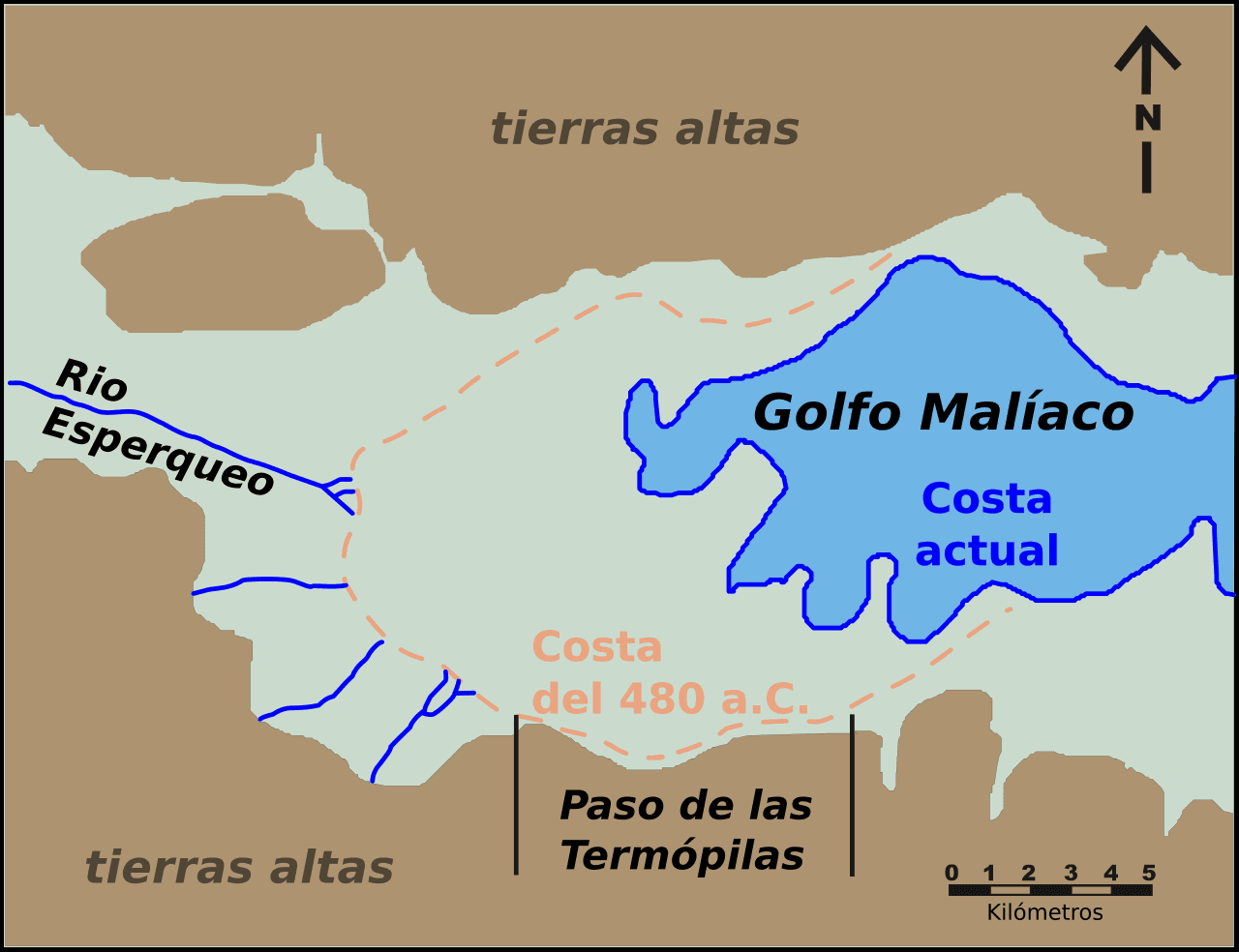
The Battle of Thermopylae, fought in August 480 BC, was a three-day engagement in which a Greek coalition of roughly 7,000 soldiers — including the legendary 300 Spartans under King Leonidas I — held the narrow coastal pass of Thermopylae against the invading Persian army of Xerxes I, estimated at between 100,000 and 300,000 men. Although the Greeks ultimately lost the battle after a local resident named Ephialtes betrayed the secret mountain path that allowed Persians to outflank them, the heroic last stand of Leonidas and his rearguard became one of antiquity's most celebrated acts of military sacrifice. The battle delayed the Persian advance long enough to enable the Greek naval victory at Salamis two months later, ultimately saving Greek independence and, with it, the foundations of Western democracy, philosophy, and art.
What Was the Strategic Context of the Battle of Thermopylae?
By 480 BC, Persia under Xerxes I had assembled the largest invasion force the ancient world had yet seen, seeking revenge for the Persian defeat at Marathon in 490 BC and the complete subjugation of Greece. The Achaemenid Empire already stretched from Egypt to the Indus River, and Xerxes viewed the fractious Greek city-states as a manageable obstacle. In response, a coalition of 31 Greek city-states — led by Sparta on land and Athens at sea — convened at the Hellenic League to coordinate resistance. Greek strategists, including the Athenian statesman Themistocles, devised a two-pronged defensive plan: the army would block the narrow mountain pass at Thermopylae ('Hot Gates' in Greek), named for its sulfurous hot springs, while the fleet engaged the Persians at the nearby strait of Artemisium. The geography was the Greeks' greatest ally. At its narrowest point, the pass measured only 15 metres wide — barely enough for a handful of soldiers to stand abreast — rendering Persia's vast numerical superiority almost meaningless.
Who Fought at Thermopylae? The Greek Coalition and Leonidas I
The Greek force assembled at Thermopylae was far larger than popular culture suggests. Herodotus records approximately 7,000 soldiers: 300 Spartiate warriors, 700 Thespians, 400 Thebans, 1,000 Lacedaemonians (perioikoi, free non-citizens of Sparta), 1,000 Phocians, 1,000 Malians, 400 Corinthians, 200 Phliasians, and 80 Mycenaeans, among others. The force was commanded by King Leonidas I of Sparta, a member of the Agiad dynasty believed to be a direct descendant of Heracles. Leonidas was around 60 years old at the time of the battle — a seasoned warrior who had passed the brutal agoge, Sparta's legendary military training system that began at age 7. According to Herodotus, Leonidas deliberately selected the 300 Spartiates from men who already had living sons, suggesting he anticipated — and accepted — their deaths. The Spartans were accompanied by their helot servants, bringing the total Greek presence to perhaps 11,000 individuals. Crucially, a much larger Greek force was expected to reinforce Thermopylae, but religious festivals — including the Olympic Games and the sacred Carneia — delayed Spartan mobilization, leaving Leonidas with a fraction of the intended army.
How Did Xerxes' Persian Army Compare to the Greek Defenders?
Ancient sources offer wildly varying estimates of the Persian force. Herodotus claimed 2.6 million combatants, a figure modern historians reject as impossible to logistically sustain. Contemporary scholarship, based on analysis of supply lines, marching routes, and comparative army sizes of the era, estimates between 100,000 and 300,000 soldiers, with a fighting force of perhaps 70,000–150,000. Xerxes' army was a multinational force drawn from across the empire's 46 subject peoples, including Medes, Bactrians, Ethiopians, Indians, and Egyptians. His elite infantry, the 10,000 Immortals — so named because their number was always maintained at exactly 10,000 — formed the backbone of his assault force. The Persian cavalry, numbering in the tens of thousands, was entirely useless in the narrow confines of the pass. The Persian navy, according to Herodotus, numbered 1,207 triremes, though again modern estimates suggest a smaller but still formidable force of 600–800 ships.
| Factor | Greek Coalition | Persian Empire |
|---|---|---|
| Commander | King Leonidas I of Sparta | King Xerxes I of Persia |
| Fighting strength | ~7,000 infantry | ~100,000–300,000 (est.) |
| Elite troops | 300 Spartiates + hoplites | 10,000 Immortals |
| Tactical advantage | Narrow 15-metre pass | Overwhelming numbers |
| Naval support | 271 triremes at Artemisium | 600–1,207 triremes |
| Outcome | Tactical defeat, strategic delay | Pyrrhic tactical victory |
| Casualties (est.) | ~4,000–5,000 Greek dead | ~20,000+ Persian dead |
What Happened During the Three Days of Fighting?
For the first two days of battle, the Greeks inflicted catastrophic losses on the Persians. Xerxes waited four days after arriving — reportedly stunned that the Greeks did not immediately flee — before ordering his first assault. The Medes and Cissians attacked first and were slaughtered in the confined pass, their lighter wicker shields and shorter spears no match for the overlapping bronze shields and eight-foot (2.4-metre) spears of the Greek hoplites fighting in phalanx formation. Even the elite Immortals fared no better; in the narrow corridor, their superior numbers became a liability and their formation broke against the Spartan phalanx. The Greeks employed a devastating tactical innovation: feigned retreats that lured pursuing Persians into disordered clumps, then turned and cut them down. Herodotus writes that Xerxes 'leapt from his throne three times' in anguish watching his best troops fail. Casualties on the first two days were devastating for Persia — estimates suggest 10,000–20,000 killed — while Greek losses remained comparatively minimal. On the evening of the second day, a Malian Greek named Ephialtes of Trachis approached Xerxes and revealed the existence of the Anopaea path, a mountain track that wound behind the Greek position. Xerxes dispatched his general Hydarnes with the Immortals overnight on the third day. A contingent of 1,000 Phocians guarding the path was surprised and quickly driven back. When scouts reported at dawn on the third day that they were being outflanked, Leonidas dismissed most of the Greek allies — possibly ordering them to withdraw so they could fight another day. He retained the 300 Spartans, the 700 Thespians who famously refused to leave under their commander Demophilus, and the 400 Thebans (who later surrendered). In the final stand, Leonidas was killed in the fighting. The Greeks rallied four times to recover his body, as Spartan code forbade abandonment of a fallen king. Eventually overwhelmed on both sides, the survivors were pushed onto a small hill where they were killed by Persian arrows and javelins. Not a single Spartan or Thespian chose to surrender.
Why Did the Battle of Thermopylae End in Greek Defeat?
The Greek defensive strategy at Thermopylae was always contingent on holding the Anopaea mountain path, which the Phocians failed to do. The betrayal by Ephialtes — whose name literally became a Greek word for 'nightmare' — was the decisive factor. Without the flanking manoeuvre, Xerxes could never have dislodged the hoplite phalanx from the pass. However, historians also point to broader strategic failures: the promised reinforcements never arrived in sufficient numbers due to religious festival delays, and the Greeks had insufficient troops to defend both the main pass and the mountain track simultaneously. Some scholars, including Victor Davis Hanson, argue that Leonidas may have known the position was doomed from the third day onward and consciously chose martyrdom to inspire Greek resistance, fulfilling a Delphic oracle that had told Sparta: 'Either Lacedaemon must be laid waste by the barbarians, or one of her kings must die.' The fall of the pass did not immediately end Greek resistance; a storm had already destroyed perhaps one-third of the Persian fleet before Thermopylae concluded, and the Greek naval engagement at Artemisium, fought simultaneously, further degraded Persian sea power.
What Were the Immediate Consequences of Thermopylae?
Despite the defeat, Thermopylae bought Greece approximately six weeks of crucial preparation time. Persian forces advanced to sack Athens — whose citizens had been evacuated by Themistocles — in September 480 BC. However, on September 29, 480 BC, the Greek fleet under Themistocles lured the Persian navy into the narrow Strait of Salamis, where the Athenian and allied triremes destroyed perhaps 200–300 Persian ships. Herodotus records that Xerxes watched the disaster from a golden throne on the shore. Fearing his supply lines and retreat route were endangered, Xerxes withdrew to Asia with much of his army, leaving his general Mardonius in Greece with a force of perhaps 120,000. The following summer, in August 479 BC, the Greeks decisively defeated Mardonius at the Battle of Plataea, ending the Persian invasion permanently. The story of Thermopylae, carried home by survivors and spread by Simonides of Ceos in his famous epitaph — 'Go, tell the Spartans, stranger passing by, that here, obedient to their laws, we lie' — became a rallying cry for Greek unity and resistance.
How Did Thermopylae Shape the Legacy of Sparta and Western Civilization?
The cultural impact of the Battle of Thermopylae is difficult to overstate. In the immediate aftermath, the battle transformed Greek morale: if 300 men could hold the greatest empire in the world for three days, then Greece could fight and win. Leonidas was venerated as a hero-king; his bones were eventually returned to Sparta around 440 BC and interred with divine honors at a memorial shrine called the Leonidaion, where annual games, the Leonideia, were held in his memory. The philosopher Plato cited Thermopylae as the supreme example of virtue over self-interest. For Western civilization more broadly, the battle represents a foundational myth of freedom versus tyranny — the concept that a small society of free men, fighting for their homes and laws, could resist overwhelming imperial force. This narrative directly influenced Roman republican ideology, the rhetoric of the American Revolution ('Don't tread on me'), and countless military traditions across Europe. Modern scholarship has complicated this binary: Persia was not a crude despotism, and the Greek 'freedom fighters' themselves practiced slavery on a massive scale. Nevertheless, the battle's legacy as a symbol of courage and sacrifice has endured for 2,500 years. The site of Thermopylae today bears a bronze statue of Leonidas, inscribed with his legendary reply when Xerxes demanded the Greeks lay down their arms: 'Molon labe' — 'Come and take them.' This phrase remains in use by military units and governments worldwide.
How Accurate Are Ancient Sources on the Battle of Thermopylae?
The primary source for Thermopylae is Herodotus of Halicarnassus, writing approximately 40–50 years after the battle in his Histories, supplemented by Diodorus Siculus (writing in the 1st century BC) and Plutarch (1st–2nd century AD). Herodotus is generally considered reliable on broad outlines but prone to exaggeration — his 2.6 million Persian troops figure is universally rejected by modern historians. Archaeological evidence from the pass itself is limited; the coastline has shifted significantly in 2,500 years due to silt deposition from the Spercheios River, and the battlefield is now several kilometres inland from the sea. A mound called the Kolonos Hill, where the final stand took place, has been identified, and excavations in the 1930s recovered arrowheads, spearheads, and skeletal remains consistent with an ancient battle. The inscription by Simonides, recorded by Herodotus, is widely considered authentic. Modern historians generally agree on core facts: the Greek coalition defense, the three days of fighting, the betrayal by Ephialtes, and the final stand of Leonidas' rearguard.