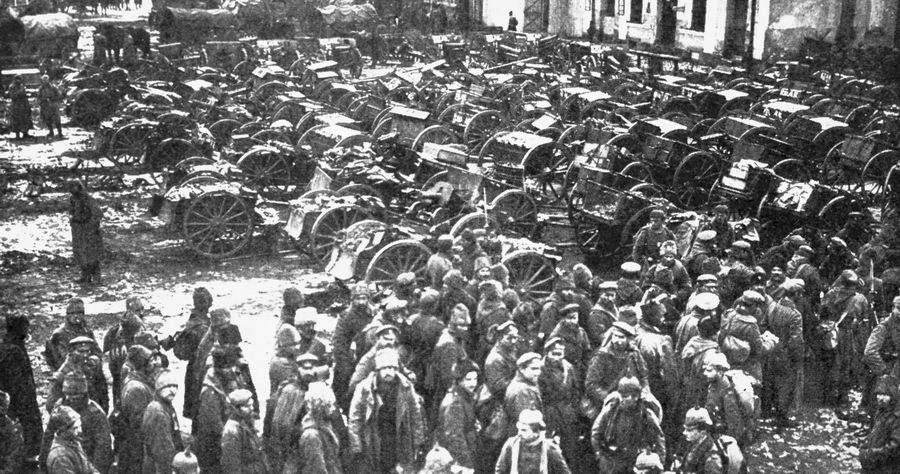
The Battle of Tannenberg, fought from August 26–30, 1914, was a catastrophic German victory over the Russian Second Army in East Prussia during the opening weeks of World War I. German commanders Paul von Hindenburg and Erich Ludendorff encircled and destroyed General Alexander Samsonov's force of roughly 150,000 men, capturing approximately 92,000 prisoners and eliminating an entire field army in under five days. Samsonov, facing total defeat, shot himself on August 30. The battle shattered Russia's early offensive momentum and made Hindenburg a national hero.
What Caused the Battle of Tannenberg?
Russia mobilised faster than Germany's Schlieffen Plan had anticipated, launching two armies into East Prussia in mid-August 1914. Tsar Nicholas II was under intense pressure from France to relieve pressure by threatening Berlin from the east. General Paul von Rennenkampf's First Army advanced from the northeast while Samsonov's Second Army pushed from the south, aiming to trap the German Eighth Army between them. The plan had strategic logic, but the two Russian armies failed to coordinate. Their radio communications were transmitted in the clear and unencrypted, giving German intelligence precise knowledge of Russian movements. When the original German commander, General Maximilian von Prittwitz, panicked and proposed abandoning East Prussia entirely, he was immediately replaced by the retired Hindenburg, with Ludendorff assigned as his chief of staff.
How Did Germany Win at Tannenberg?
Ludendorff, the true operational brain, executed a bold double envelopment. Recognising that Rennenkampf's First Army was advancing too slowly to intervene, he shifted the bulk of German forces by rail to encircle Samsonov from both flanks simultaneously. By August 29, German units had closed the ring around the Russian Second Army near Neidenburg. Trapped in dense forests with supply lines severed, five Russian corps collapsed. Over 78,000 were killed or wounded and roughly 92,000 taken prisoner. Germany seized 500 artillery guns at a cost of fewer than 15,000 casualties.

| Factor | Germany | Russia |
|---|---|---|
| Commander | Hindenburg and Ludendorff | General Samsonov |
| Troops Engaged | ~150,000 | ~150,000 |
| Casualties | ~12,000–15,000 | ~78,000 killed or wounded |
| Prisoners Taken | N/A | ~92,000 |
| Artillery Captured | N/A | ~500 guns |
What Was the Legacy of the Battle of Tannenberg?
Tannenberg had profound strategic and psychological consequences. For Germany, it neutralised the Russian threat to East Prussia for over a year and elevated Hindenburg into a towering propaganda figure who would later become President of the Weimar Republic. For Russia, the destruction of the Second Army exposed deep flaws in command and logistics that contributed to the revolutionary collapse of 1917. The battle's name was deliberately chosen by Hindenburg to echo a 1410 defeat of the Teutonic Knights at the same location, reframing the victory as historical revenge. In 1927, a massive Tannenberg Memorial was built on the battlefield; the Nazis demolished it in 1945 to prevent its capture by the Soviet Red Army.
