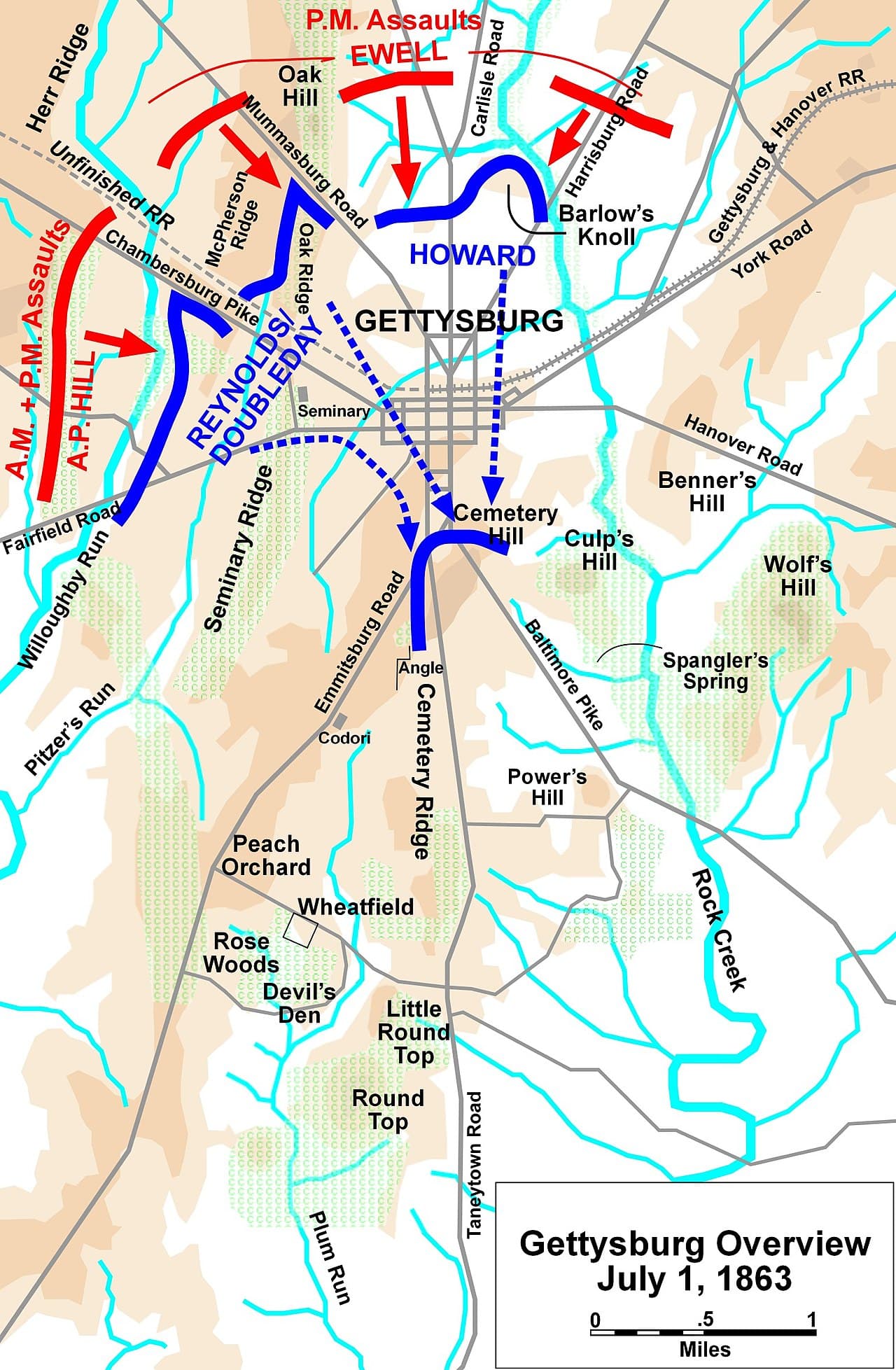
The Battle of Gettysburg, fought July 1–3, 1863, in and around Gettysburg, Pennsylvania, was the deadliest engagement of the American Civil War, producing roughly 51,000 combined casualties across three days. Confederate General Robert E. Lee's Army of Northern Virginia was repulsed by Major General George G. Meade's Army of the Potomac in what historians widely regard as the war's decisive turning point — ending Lee's second and final invasion of the North.
Why Did Lee Invade the North in 1863?
By the summer of 1863, the Confederacy faced mounting pressure on multiple fronts. Ulysses S. Grant was tightening his siege around Vicksburg, Mississippi, threatening to split the Confederacy in two along the Mississippi River. Lee argued to Confederate President Jefferson Davis that a bold strike into Pennsylvania could relieve that pressure, resupply his army from northern farms, threaten Washington and Philadelphia, and potentially draw European powers — particularly Britain and France — into recognizing the Confederacy. A dramatic victory on Union soil might also demoralize the Northern public and boost Peace Democrats (Copperheads) ahead of the 1864 elections. Lee launched his second northern invasion in June 1863, his 75,000-strong army crossing the Potomac River between June 15 and 26 and fanning out across southern Pennsylvania, reaching as far as Carlisle and York before Federal resistance forced concentration at Gettysburg.
How Did the Battle of Gettysburg Begin?
The battle began almost by accident on the morning of July 1, 1863. Confederate infantry from General A.P. Hill's corps marching toward Gettysburg in search of shoes (reportedly) collided with dismounted Union cavalry troopers under Brigadier General John Buford on the Chambersburg Pike west of town. Buford's 2,748 men used repeating carbines to delay two Confederate divisions, buying time for the Union I Corps under Major General John Reynolds to arrive. Reynolds was killed by a sharpshooter's bullet early in the fighting — one of the highest-ranking Union officers killed in the war. By mid-afternoon, Confederate forces under Generals Richard Ewell and A.P. Hill had overwhelmed the Union I and XI Corps, driving them through Gettysburg's streets in a near-rout. However, Ewell controversially declined to press the attack and seize Cemetery Hill 'if practicable,' a decision that allowed Union forces to establish a formidable defensive line along Cemetery Ridge, Cemetery Hill, and Culp's Hill before nightfall. By the time Meade arrived at approximately 11:30 p.m. on July 1, his army was battered but holding high ground — a crucial advantage.
What Happened on Day Two: Little Round Top and the Peach Orchard
July 2 was the battle's most complex and consequential day. Lee's plan called for Lieutenant General James Longstreet's I Corps to strike the Union left flank while Ewell attacked the right at Culp's Hill and Cemetery Hill. Longstreet opposed the plan, preferring a strategic flanking movement to find better defensive ground, but Lee overruled him. Delays in positioning Longstreet's corps meant the main Confederate assault did not begin until approximately 4:00 p.m. On the Union left, Major General Daniel Sickles had controversially advanced his III Corps nearly a mile forward of Cemetery Ridge to higher ground along the Emmitsburg Road, creating a dangerous salient around the Peach Orchard. When Confederate divisions under Generals John Bell Hood and Lafayette McLaws struck, they slammed into the exposed salient and nearly broke the Union line in fierce fighting through the Wheatfield, Devil's Den, and the Valley of Death. The pivotal moment came at Little Round Top, a rocky hill anchoring the extreme left of the Union line. Brigadier General Gouverneur K. Warren, the Army of the Potomac's chief engineer, recognized the hill was undefended and rushed Union infantry — including Colonel Joshua Lawrence Chamberlain's 20th Maine Infantry — to its crest. Chamberlain's regiment, down to fewer than 200 effective men after beating off multiple Confederate assaults, fixed bayonets and charged down the hill when ammunition ran out, capturing over 400 Confederate prisoners and securing the Union flank. On the northern end of the battlefield, Confederate forces briefly seized the summit of Cemetery Hill and penetrated Union lines at Culp's Hill, but Union counterattacks restored the positions by nightfall. After two days of savage fighting, Lee's army had failed to dislodge Meade, but Lee was not finished.
What Was Pickett's Charge and Why Did It Fail?
The battle's climax came on July 3. Lee ordered a massive frontal assault on the Union center at Cemetery Ridge, convinced the position had been weakened by fighting on the flanks. Longstreet, again opposed, was tasked with directing the assault. Three divisions — Major General George Pickett's fresh Virginia division and two divisions under Generals Johnston Pettigrew and Isaac Trimble — totaling approximately 12,500 men formed up along Seminary Ridge for a mile-wide advance across nearly three-quarters of a mile of open ground. At approximately 3:00 p.m., after a two-hour artillery bombardment that largely overshot the Union lines (Confederate gunners used faulty fuses), the gray columns stepped off. Union artillery under Brigadier General Henry Hunt and musket volleys from the II Corps under Major General Winfield Scott Hancock tore the Confederate ranks apart. Only approximately 150 Confederates under General Lewis Armistead briefly breached the Union line at the 'Angle,' a low stone wall, before being repulsed. Armistead fell mortally wounded beside a Union cannon — the high-water mark of the Confederacy. Of the nearly 12,500 men who started the charge, over 6,000 were killed, wounded, or captured — a casualty rate exceeding 50 percent. When the survivors staggered back, Lee rode out to meet them and accepted personal responsibility: 'It is all my fault.' On July 4, Lee began withdrawing south. Heavy rains swelled the Potomac, trapping his army for nearly two weeks, but Meade — criticized for excessive caution — did not pursue aggressively enough to destroy it.
| Category | Union (Army of the Potomac) | Confederate (Army of Northern Virginia) |
|---|---|---|
| Commander | Maj. Gen. George G. Meade | Gen. Robert E. Lee |
| Strength | ~93,900 troops | ~71,700 troops |
| Total Casualties | ~23,000 (killed, wounded, captured) | ~28,000 (killed, wounded, captured) |
| Killed in Action | ~3,150 | ~3,900 |
| Wounded | ~14,500 | ~18,700 |
| Missing/Captured | ~5,350 | ~5,400 |
| Outcome | Decisive Union Victory | Repulsed; retreat to Virginia |
Why Was Gettysburg a Turning Point in the Civil War?
Gettysburg's significance extends far beyond the three days of fighting. On July 4 — the same day Lee began his retreat — Vicksburg surrendered to Grant, giving the Union control of the entire Mississippi River and effectively splitting the Confederacy. Together, the twin disasters of Gettysburg and Vicksburg shattered Confederate strategic ambitions. Britain and France, already wary after the Emancipation Proclamation of January 1, 1863, definitively abandoned any plans for recognition of the Confederacy. Lee's offensive capability was permanently crippled: he never again launched a major invasion of the North, and his army, which had lost 28,000 irreplaceable men, was forced into the strategic defensive for the remainder of the war. The psychological blow was equally severe — Confederate newspapers that had celebrated Lee's 'invincibility' now confronted the reality of defeat on Northern soil. Conversely, Union morale surged, strengthening Lincoln's political position and undermining Peace Democrats who argued the war was unwinnable.
What Was the Gettysburg Address and Why Does It Still Matter?
Four months after the battle, on November 19, 1863, President Abraham Lincoln delivered what became the most celebrated speech in American history at the dedication of the Soldiers' National Cemetery at Gettysburg. The cemetery, designed by landscape architect William Saunders, would ultimately hold the remains of 3,512 Union soldiers. Lincoln's 272-word address — famously drafted in part on the train to Gettysburg, though that is partially myth — reframed the Civil War not merely as a fight to preserve the Union but as a struggle to uphold the principle that 'all men are created equal.' Lincoln's phrase 'a new birth of freedom' directly connected the war to the abolition of slavery and redefined American democracy for generations. The speech was not universally praised at the time — the Chicago Times called it 'silly, flat, and dishwatery' — but it quickly became recognized as a masterpiece of democratic rhetoric. The Gettysburg Address is today inscribed on the Lincoln Memorial in Washington, D.C., and memorized by schoolchildren across the United States.
How Did Gettysburg Shape American Memory and Culture?
No battlefield in American history has been more studied, debated, or memorialized than Gettysburg. The Gettysburg National Military Park, established in 1895 and today administered by the National Park Service, covers approximately 6,000 acres and receives roughly one million visitors annually. More than 1,300 monuments, markers, and tablets dot the landscape, making it one of the most densely monumented battlefields in the world. Michael Shaara's 1974 Pulitzer Prize-winning novel 'The Killer Angels' and its 1993 film adaptation 'Gettysburg' introduced the battle to new generations. The 'Lost Cause' interpretation of the battle — which blamed Longstreet's delays on July 2 and 3 for Confederate defeat — dominated Southern memory for decades and has been fiercely contested by modern historians who argue Lee's own tactical errors and the fighting quality of Union soldiers were the decisive factors. Archaeological surveys begun in the 1980s using metal detectors have recovered thousands of artifacts, refining our understanding of troop positions and movements. Gettysburg remains a living argument about American identity, military leadership, race, and the meaning of sacrifice — as contested in scholarly journals and political speeches as it was on Seminary Ridge in July 1863.
Key Leaders at the Battle of Gettysburg
The battle was defined by the decisions — and indecisions — of its commanders. On the Union side, Meade took command of the Army of the Potomac just three days before the battle began, on June 28, replacing the volatile General Joseph Hooker. Despite this disadvantage, Meade made sound defensive decisions, selected strong terrain, and effectively managed his corps commanders. Hancock, the II Corps commander, was arguably the Union's best battlefield general at Gettysburg, rallying troops on Cemetery Hill on July 1 and directing the defense against Pickett's Charge on July 3 while wounded in the thigh by a nail-driven bullet. Chamberlain's defense of Little Round Top earned him the Medal of Honor, awarded in 1893. On the Confederate side, Lee's performance remains debated: his orders were sometimes vague, he underestimated Union strength, and he overestimated his army's ability to execute complex coordinated attacks after the loss of Stonewall Jackson at Chancellorsville in May 1863. Longstreet, vindicated by most modern historians, was right to question the July 3 assault. Stuart's cavalry, absent on a wide-ranging raid until July 2, left Lee strategically blind in the campaign's crucial opening days — a failure Lee acknowledged.