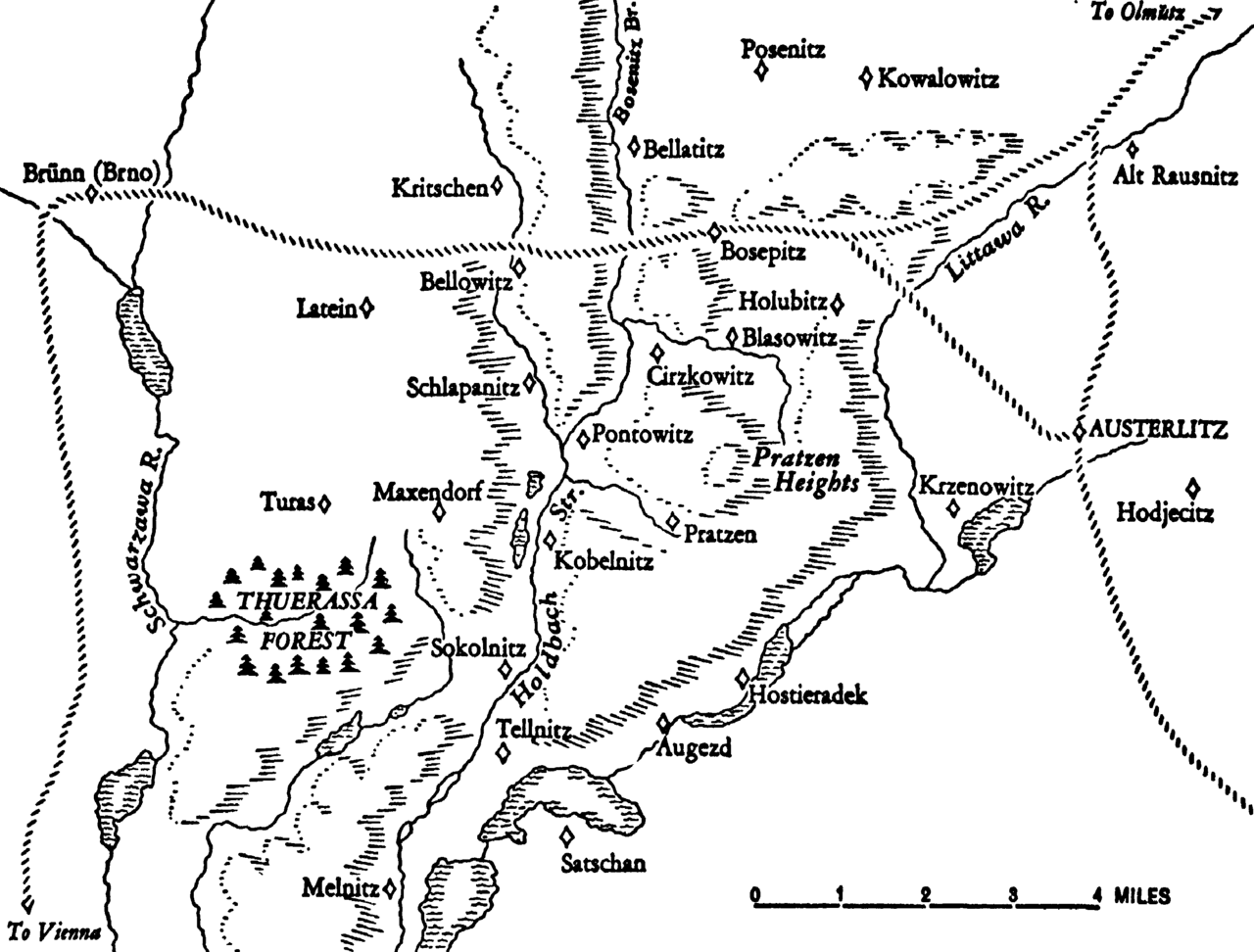
The Battle of Austerlitz, fought on December 2, 1805, near the town of Austerlitz in Moravia (modern-day Slavkov u Brna, Czech Republic), was Napoleon Bonaparte's most celebrated military triumph. In less than nine hours, the French Grande Armée — outnumbered roughly 68,000 to 89,000 — destroyed a combined Russo-Austrian force, killing or capturing nearly 36,000 men and forcing Austria out of the War of the Third Coalition. Historians and military strategists still study Austerlitz as the definitive example of the 'strategy of the central position' and deliberate deception on a grand scale.
What Was the Strategic Context Before Austerlitz?
By the autumn of 1805, Europe was locked in the War of the Third Coalition — Britain, Austria, Russia, Sweden, and Naples ranged against Napoleonic France. Napoleon had originally massed the Grande Armée at Boulogne for a planned invasion of Britain, but British naval supremacy, decisively confirmed at the Battle of Trafalgar on October 21, 1805, made a cross-Channel assault impossible. Napoleon pivoted east with extraordinary speed, marching roughly 200,000 soldiers across France and into Germany. In October 1805, he encircled and captured an entire Austrian army of 30,000 men at Ulm without a major battle — one of the most efficient strategic manoeuvres in history. He then occupied Vienna on November 13, 1805, but this exposed his eastern flank and stretched his supply lines dangerously thin. Napoleon needed a decisive engagement before Prussian neutrality wavered or Russian reinforcements further swelled Allied numbers.
Who Were the Key Commanders at Austerlitz?
Napoleon Bonaparte, at 36 years old and at the absolute peak of his military genius, personally directed every phase of the French operation. His corps commanders — Marshal Jean-de-Dieu Soult, Marshal Jean Lannes, Marshal Nicolas Davout, and the Imperial Guard under Marshal Jean-Baptiste Bessières — executed his intricate plan with disciplined precision. Opposing them was a cumbersome Allied command structure. Tsar Alexander I of Russia, only 28 and hungry for glory, effectively overruled the experienced Austrian commander Feldmarschall Mikhail Kutuzov, who famously argued against attacking. The nominal Allied supreme commander was Austrian General Franz von Weyrother, who drafted the battle plan. This divided leadership — with an impulsive young tsar sidelining a cautious veteran — proved catastrophic for the Coalition.
How Did Napoleon Trick the Allied Army into Attacking?
Napoleon's pre-battle deception was as brilliant as the battle itself. He deliberately weakened his right flank — the area around the Pratzen Heights and the southern approaches — to bait the Allies into concentrating their attack there. He even feigned diplomatic timidity, sending General Anne Jean Marie René Savary to Allied headquarters with a conciliatory letter that gave the impression France was desperate to avoid battle. Napoleon then vacated the strategically vital Pratzen Heights, a broad plateau dominating the centre of the battlefield, knowing the Allies would occupy it and then strip it of troops to reinforce their planned flanking movement. He confided to his marshals: 'If I wanted to stop the enemy from passing a point, I would not put my best troops there; I would put them somewhere else, to fall upon the enemy's flank.' He predicted, almost to the hour, that the Allied attack would come at 9 AM on the southern sector. He was right.
What Happened During the Battle on December 2, 1805?
The battle began at approximately 8 AM with an Allied assault on the French right, commanded by Marshal Davout's III Corps — only about 10,500 men holding the village of Telnitz and the Goldbach stream against nearly 40,000 Allied soldiers. Davout's men fought with desperate tenacity, buying time. At roughly 9 AM, as a thin winter sun burned through the famous 'sun of Austerlitz' fog that had blanketed the Pratzen valley, Napoleon gave the signal. Marshal Soult's IV Corps — some 16,000 men — launched its assault up the Pratzen Heights in two dense columns. Within 20 minutes, French infantry had seized the summit. The Allied centre, stripped of troops for the flanking attack in the south, simply collapsed. Tsar Alexander was reportedly seen weeping on horseback as his centre disintegrated. Napoleon then split the Pratzen plateau force: one half drove south to encircle the Allied flank attack, the other drove north to crush the Allied right under Prince Pyotr Bagration near the village of Blasowitz. By 4 PM, the battle was effectively over. Thousands of retreating Allied soldiers fled across the frozen Satschan ponds; French artillery fire shattered the ice, drowning hundreds — a scene that passed immediately into legend, though modern research suggests the ponds were relatively shallow and actual drowning casualties may have been in the dozens rather than thousands.
What Were the Casualties and Losses at Austerlitz?
| Side | Forces Engaged | Killed & Wounded | Captured | Artillery Lost |
|---|---|---|---|---|
| France (Grande Armée) | ~68,000 | ~9,000 | ~600 | ~0 (net gain) |
| Russia | ~53,000 | ~21,000 | ~8,000 | ~130 guns |
| Austria | ~15,000–16,000 | ~6,000 | ~2,000 | ~45 guns |
| Allied Total | ~68,000–73,000 | ~27,000 | ~10,000+ | ~180 guns |
The numbers tell a devastating story. The Coalition lost approximately 36,000 men killed, wounded, or captured — roughly one in three of all soldiers engaged — along with 180 artillery pieces and 45 regimental standards. French casualties, though significant at around 9,000, represented barely 13% of Napoleon's force. It was, by any measure, a tactical masterpiece: the greatest disparity between effort and result in Napoleonic warfare.
Why Did the Allied Battle Plan Fail So Completely?
Franz von Weyrother's Allied plan was technically detailed but fatally flawed in its assumptions. It presumed the French right was their weakest point and that seizing the southern terrain would unravel the French position. What it failed to account for was Napoleon's complete operational flexibility and his deliberate surrender of the Pratzen Heights. Kutuzov, who reportedly fell asleep during Weyrother's briefing as an act of silent protest, understood the plan was built on false intelligence. The Allied chain of command was further undermined by Tsar Alexander's direct interventions, bypassing Kutuzov's authority on multiple occasions during the battle. Meanwhile, French communication between corps commanders was crisp and rapid, facilitated by Napoleon's central position on the Zuran Hill, from which he observed the entire battlefield through a spyglass and dispatched aides-de-camp with precise orders throughout the morning.
What Were the Political Consequences of the Battle of Austerlitz?
The political aftershocks of Austerlitz were seismic. On December 4, 1805 — just 48 hours after the battle — Austrian Emperor Francis II requested an armistice. The Treaty of Pressburg, signed on December 26, 1805, imposed punishing terms on Austria: cession of Venetia to the Kingdom of Italy, Tyrol to Bavaria, and further territories in southern Germany — losses totalling roughly 3 million subjects and enormous treasury payments. The Holy Roman Empire, a political structure stretching back to Charlemagne in 800 AD, dissolved on August 6, 1806, as Francis II abdicated the imperial crown — a direct consequence of the humiliation at Austerlitz. Napoleon reorganised central Europe to his advantage, creating the Confederation of the Rhine on July 12, 1806, binding 16 German states to France. Russia, though not compelled to sign a formal peace immediately, withdrew its battered forces eastward. British Prime Minister William Pitt the Younger, upon seeing maps of the battle, reportedly said: 'Roll up that map; it will not be wanted these ten years.' He died six weeks later, on January 23, 1806, with Coalition strategy in ruins. Prussia, intimidated by French power, signed the Treaty of Schönbrunn and temporarily accommodated Napoleon — though it would declare war again the following year, leading to further catastrophic defeats at Jena and Auerstedt in October 1806.
What Is the Legacy and Historical Significance of Austerlitz?
Austerlitz occupies a unique position in military history. Carl von Clausewitz, the Prussian military theorist and author of 'On War,' analysed the battle extensively, citing it as proof that superior tactical intelligence and command unity can overcome numerical disadvantage. Napoleon himself considered it his greatest victory and referenced it in his memoirs from Saint Helena. He decreed that soldiers of the Grande Armée should be called 'my children' and promised each veteran that he could one day say: 'I was at Austerlitz.' To honour the fallen, Napoleon financed the construction of the Arc de Triomphe in Paris, commissioned in 1806; the names of 128 battles and 660 commanders are engraved on its façade, with Austerlitz prominently featured. The Austerlitz railway station in Paris (Gare d'Austerlitz), opened in 1840, keeps the name alive in the French capital to this day. In military academies from West Point to Sandhurst, Austerlitz is taught as a model of the 'envelopment from a fixed flank' — a template for achieving decisive results through misdirection and superior concentration of force at the decisive point. The battlefield itself is preserved near Slavkov u Brna; the Cairn of Peace (Mohyla míru), erected in 1912, commemorates the fallen of all nations and draws tens of thousands of visitors annually.
How Is the Battle of Austerlitz Remembered in Culture?
Leo Tolstoy immortalised Austerlitz in his epic novel 'War and Peace' (1869), depicting it through the eyes of the wounded Prince Andrei Bolkonsky, who gazes at an infinite sky and experiences an epiphany about human ambition and mortality. Tolstoy's account remains one of literature's most powerful anti-war passages, counterposing Napoleon's triumph against the suffering of individuals. The battle has also featured in numerous films, documentaries, and video games, including Abel Gance's silent epic 'Austerlitz' (1960) and multiple entries in the Total War and Napoleon strategy game series. Its anniversary, December 2, is occasionally marked by historical re-enactment societies across Europe, with large-scale commemorations held at the battlefield in Slavkov u Brna drawing thousands of participants.