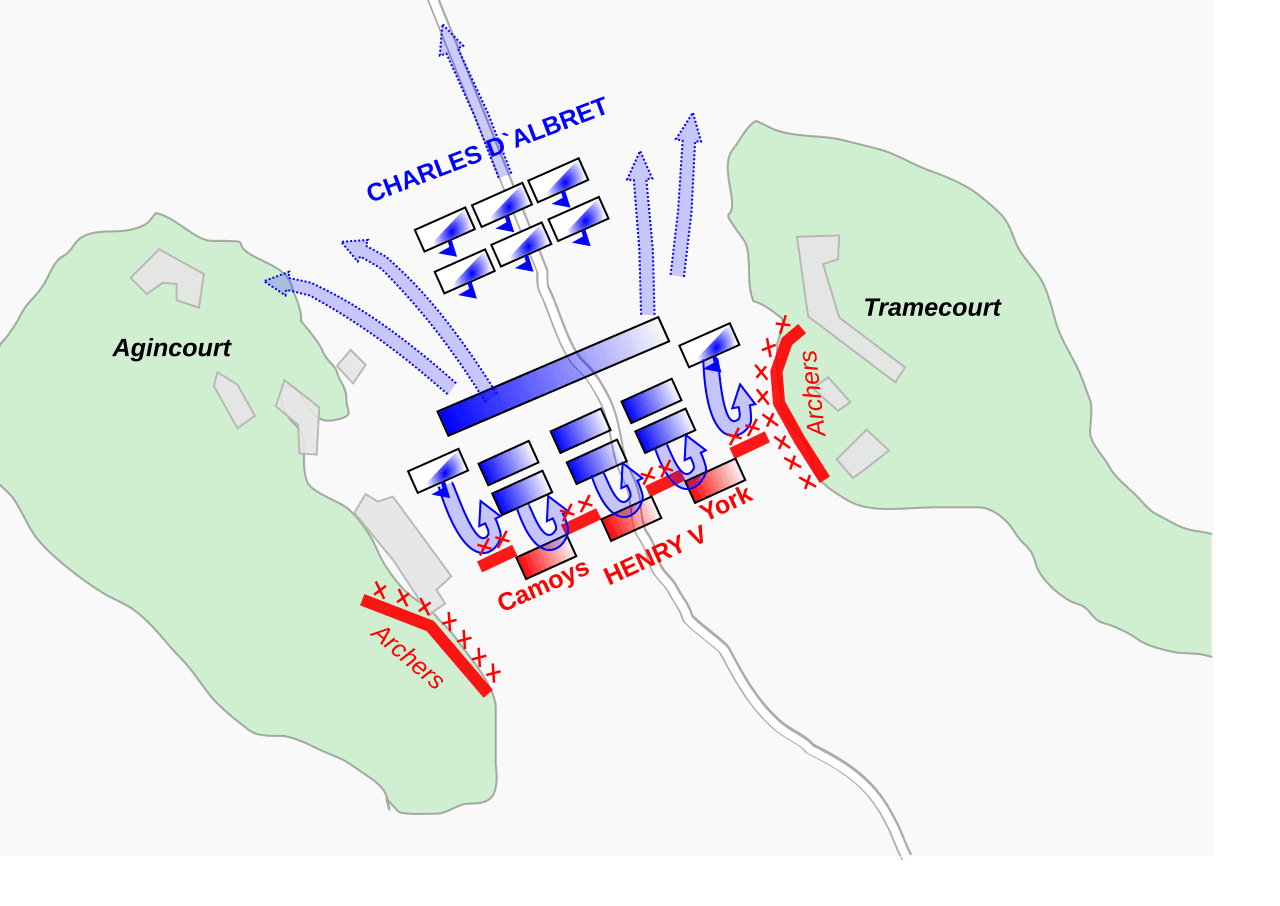
The Battle of Agincourt, fought on October 25, 1415, was one of the most stunning military upsets in medieval history. A battle-weary English army of roughly 6,000–9,000 men, led by King Henry V, annihilated a French force estimated at 12,000–36,000 troops on a muddy field in northern France, killing thousands of French knights and capturing scores of nobles. The victory secured Henry V's place as England's greatest warrior-king and dramatically shifted the balance of power in the Hundred Years' War.
What Was the Background to the Battle of Agincourt?
The Battle of Agincourt did not occur in isolation — it was the climactic clash of a bold English invasion of France during the Hundred Years' War (1337–1453), a prolonged dynastic conflict over the French crown. Henry V, who had ascended the English throne in 1413 at just 25 years old, revived England's territorial claims in France under the 1360 Treaty of Brétigny and pressed his personal claim to the French throne as a descendant of Edward III. In August 1415, Henry landed an army of approximately 12,000 men at Harfleur on the Normandy coast. The siege of Harfleur lasted six brutal weeks, finally ending on September 22, 1415. By then, dysentery and other diseases had ravaged Henry's force, reducing it to an estimated 6,000–9,000 soldiers — roughly 1,500 men-at-arms and 5,000–7,000 longbowmen. Rather than withdraw entirely, Henry made a bold gambit: a 270-mile march northeast toward Calais, England's fortified port, before winter. It was a move designed as much to assert dominance and provoke battle as to reach safety. The French, meanwhile, had mobilised an enormous army and were determined to intercept and destroy the English before they could escape.
Who Were the Commanders at Agincourt?
Henry V commanded the English force in person, and his direct leadership on the battlefield proved critical to morale and decision-making. Born on September 16, 1386, Henry had already demonstrated military competence at the Battle of Shrewsbury in 1403, where he was struck in the face by an arrow at just 16 years old and refused to leave the field. By 1415, he was a hardened commander with a reputation for personal courage and iron discipline. Key English subordinates included the Duke of York, Edward of Norwich, who commanded the right wing and died in the battle, and Lord Camoys, who led the left flank. The French army was led by Constable Charles d'Albret and Marshal Jean II le Meingre, known as 'Boucicaut.' France's King Charles VI was absent due to his recurring mental illness, and the French command structure suffered from the absence of centralised authority. Several powerful French dukes — including the Duke of Burgundy — refused to participate due to ongoing political rivalries within France. Nevertheless, the assembled French nobility represented the flower of French chivalry: dukes, counts, and knights who outclassed their English opponents in wealth, armour, and sheer numbers.
What Were the Terrain and Conditions at Agincourt?
The battlefield lay near the village of Agincourt (modern-day Azincourt) in the Pas-de-Calais region of northern France. The site was a freshly ploughed agricultural field flanked on both sides by dense woodland — the forests of Tramecourt to the east and Agincourt to the west. This narrow corridor, approximately 900–1,000 metres wide, was a terrain nightmare for the French and a tactical gift for the English. Heavy rains in the days preceding October 25, 1415, had turned the ploughed earth into thick, clinging mud. French knights in full plate armour — some weighing over 50 kilograms — found movement agonising. The trampling of thousands of men and horses churned the mud further as the battle commenced. English longbowmen, who wore lighter equipment and could move more freely, were far less disadvantaged by these conditions. The woods on either flank also prevented the French from using their numerical advantage to outflank or encircle the English line, forcing an attritional frontal assault — exactly the kind of engagement the English had prepared for.
How Did the Battle of Agincourt Unfold on October 25, 1415?
The two armies faced each other for several hours on the morning of October 25, the feast day of Saints Crispin and Crispian, without either side advancing. Henry V could not wait indefinitely — his men were hungry, exhausted, and demoralised after weeks of marching. He made a decisive move: ordering the entire English line to advance to within approximately 300 metres (roughly 250–300 yards) of the French — inside optimal longbow range. English archers hammered large wooden stakes into the ground in front of their positions to deter cavalry charges, a technique likely adapted from Portuguese practice against the Moors. The advance provoked the French into action. The French cavalry on the flanks charged first, but the combination of the mud, the stakes, and a devastating storm of English arrows — longbowmen could loose 10–12 arrows per minute — shattered the charge before it reached the English line. Horses panicked, wheeled back, and crashed into the French infantry advancing on foot behind them, creating chaos in the French ranks. The densely packed French men-at-arms, struggling through the mud in heavy armour, fell in enormous numbers under arrow fire. When they finally reached the English line, they were exhausted, disordered, and fighting men who were fresher and more agile. Hand-to-hand combat was fierce but brief. English archers — many of whom set aside their bows and attacked with hatchets, mallets, and swords — surged into the flanks of the French formation, collapsing it entirely. Within two to three hours, the main French assault had been obliterated. A second French force threatened to re-engage, and in the confusion Henry V made the controversial decision to order the killing of the French prisoners already taken, fearing they would re-arm and attack. The second French force ultimately retreated without pressing an assault, making the executions a subject of lasting historical and ethical debate.
What Role Did the English Longbow Play in the Victory?
The English longbow was the decisive weapon at Agincourt and had defined English military doctrine since the battles of Crécy (1346) and Poitiers (1356). Made from yew wood and standing approximately 1.8 metres tall, the longbow had a draw weight of 100–180 pounds and could fire a bodkin-tipped arrow capable of penetrating plate armour at close range. A trained English or Welsh archer could maintain a rate of fire of 10–12 arrows per minute, and Henry's force included an estimated 5,000–7,000 bowmen. During the initial charge alone, English archers may have loosed tens of thousands of arrows within minutes. Modern estimates suggest the English fired as many as 1,000 arrows per second at the peak of the engagement. The psychological and physical effect on tightly packed French formations advancing through mud was catastrophic. Arrows that failed to penetrate armour injured horses, pierced visors, and struck gaps at joints, while the sheer density of fire created a near-impenetrable wall of missiles. Skeletal remains found at the Agincourt site, studied in the early 21st century, show evidence of massive trauma consistent with arrow wounds, bladed weapons, and trampling — a grim testament to the lethality of the longbow's dominance.
What Were the Casualties at the Battle of Agincourt?
| Side | Estimated Force Size | Killed | Captured | Notable Deaths |
|---|---|---|---|---|
| England | 6,000–9,000 | ~400–600 | Minimal | Duke of York (Edward of Norwich) |
| France | 12,000–36,000 | ~6,000–10,000+ | ~1,500–2,200 nobles | Constable d'Albret, Dukes of Alençon, Bar, Brabant |
The casualty disparity at Agincourt remains staggering even by medieval standards. Contemporary chroniclers and modern historians broadly agree that English losses were remarkably light — probably between 400 and 600 dead, including the Duke of York and a small number of other men-at-arms. French losses were catastrophic. Conservative estimates put French dead at around 6,000, including three dukes (Alençon, Bar, and Brabant), at least eight counts, and Constable Charles d'Albret himself. Higher medieval chronicler estimates reach 10,000 or more. Approximately 1,500–2,200 high-ranking French nobles and knights were captured for ransom — a significant haul that also triggered Henry's controversial prisoner massacre order when a second French force appeared to threaten. Among those captured were Charles, Duke of Orléans, who remained a prisoner in England for 25 years, and Marshal Boucicaut. The social and military impact on France's nobility was devastating — in a single afternoon, an entire generation of French leadership was eliminated or neutralised.
Why Was Henry V's Prisoner Massacre Order So Controversial?
During the battle, after the main French assault had been defeated, a fresh French force appeared on the field and a group of French troops attacked the English baggage train in the rear. Fearing that thousands of armed French prisoners — who outnumbered their English guards — might re-arm and attack from within, Henry V ordered that most prisoners be killed immediately. Only those of the highest ransom value were spared. English knights, bound by the chivalric code and the financial incentive of ransoming nobles, refused to carry out the order, and Henry reportedly assigned archers and soldiers to do it. The killing was swift and brutal, conducted largely by sword or fire. Medieval chroniclers and later historians have debated this act extensively. Henry's defenders argue it was a pragmatic military necessity in a moment of genuine panic and danger. Critics, including some of Henry's contemporaries, viewed it as a fundamental violation of the laws of chivalric warfare, which ordinarily guaranteed captured knights safe treatment in exchange for ransom. The philosopher and diplomat Christine de Pizan had written about such obligations barely a decade earlier. Modern historians remain divided, though most acknowledge the genuine tactical fear Henry faced in that moment, even as they question whether the threat was as severe as perceived.
What Were the Consequences of the Battle of Agincourt?
Agincourt's consequences were profound and far-reaching. Henry V returned to England in November 1415 to a hero's welcome in London, his reputation as a warrior-king cemented beyond question. The victory reinvigorated English ambitions in France and led directly to a renewed and far larger English campaign beginning in 1417, during which Henry systematically conquered Normandy. By 1419, Rouen — Normandy's capital — had fallen. The political consequences were equally dramatic in France: the destruction of French nobility at Agincourt deepened the factional conflict between the Armagnacs and Burgundians, which ultimately led the Duke of Burgundy to ally with England. This alliance produced the Treaty of Troyes in May 1420, by which Charles VI of France disinherited his own son (the future Charles VII) and recognised Henry V as heir to the French throne and regent of France. Henry married Charles VI's daughter, Catherine of Valois, and seemed poised to unite the two crowns. However, Henry V died of dysentery on August 31, 1422, at just 35 years old, before he could be crowned King of France. His infant son Henry VI inherited both thrones but lacked his father's ability, and France was eventually reunified under Charles VII with the help of Joan of Arc. The Hundred Years' War finally ended in 1453 with England retaining only Calais on the Continent.
How Has the Battle of Agincourt Been Remembered in Culture and History?
No battle of the medieval era has been more enduringly mythologised than Agincourt. William Shakespeare immortalised it in his 1599 play Henry V, placing the famous 'St. Crispin's Day Speech' on Henry's lips: 'We few, we happy few, we band of brothers.' The speech — though invented — captured a cultural truth about the battle's underdog narrative that has resonated for over four centuries. Laurence Olivier's 1944 film adaptation of Henry V was deliberately produced as wartime propaganda, with Churchill's government funding it to boost British morale during World War II. Kenneth Branagh's 1989 version offered a grimmer, more ambivalent portrait. In academic history, the battle was the subject of John Keegan's landmark 1976 study 'The Face of Battle,' which used Agincourt as a case study to explore what battle actually feels like for ordinary soldiers — a revolutionary approach that transformed the discipline of military history. Archaeological investigations around Azincourt continue to yield new evidence, including a mass grave site discovered in 2012 that has helped historians refine casualty and burial estimates. The Azincourt museum, opened in 2001, draws thousands of visitors annually. In October 2015, France and the United Kingdom held joint commemorations to mark the 600th anniversary — a remarkable act of reconciliation between former adversaries.