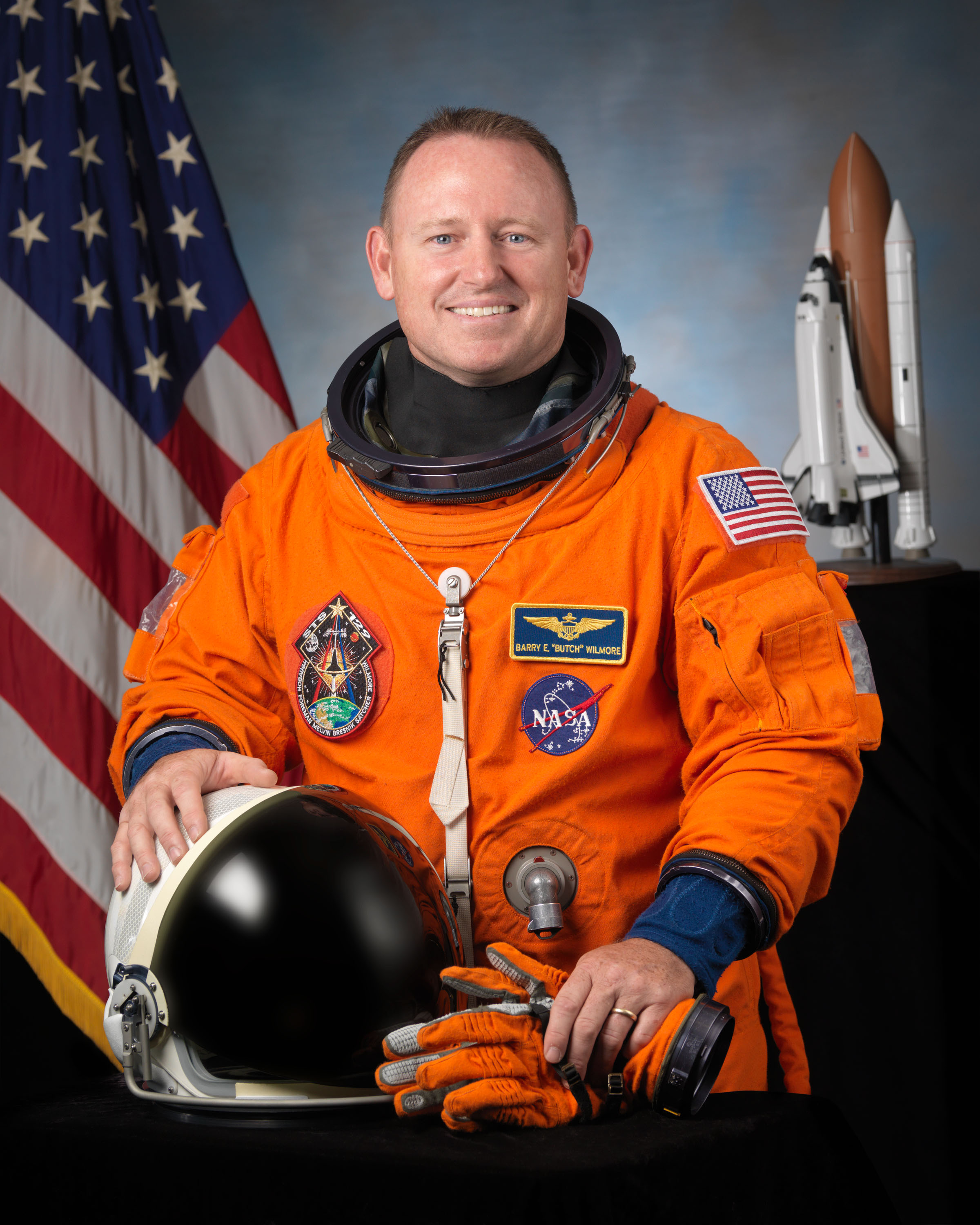
Barry Wilmore is a NASA astronaut and retired U.S. Navy captain who became internationally known when a planned 8-day mission to the International Space Station in June 2024 stretched into a 9-month ordeal. Wilmore and fellow astronaut Sunita Williams flew to the ISS aboard Boeing's CST-100 Starliner on June 5, 2024, but technical faults with the spacecraft's thrusters and helium leaks forced NASA to leave them aboard the station until SpaceX's Crew Dragon could return them safely in March 2025. Their extended stay became the longest unplanned crewed mission in American spaceflight history.
Who Is Barry Wilmore? Background and Career
Born on December 29, 1962, in Mount Juliet, Tennessee, Wilmore earned a Bachelor of Science in Electrical Engineering and a Master of Science in Electrical Engineering from Tennessee Technological University, followed by a Master of Science in Aviation Systems from the University of Tennessee. He logged over 8,000 flight hours as a U.S. Navy test and combat pilot, flying more than 30 different aircraft and completing 663 carrier landings. NASA selected him as an astronaut in 2000. Before the Starliner mission, Wilmore had flown two previous spaceflights: a 2009 Space Shuttle mission aboard STS-129 and a six-month stint on the ISS as commander of Expedition 42, which concluded in March 2015. He is known among colleagues for his calm under pressure and deep Christian faith, which he has spoken about publicly during his extended stay.
What Went Wrong With Boeing Starliner in 2024?
Starliner's Crew Flight Test (CFT) — Boeing's long-delayed crewed certification mission — launched from Cape Canaveral on June 5, 2024. During the approach to the ISS, engineers detected five helium leaks in the service module and found that five of the 28 reaction control system (RCS) thrusters had failed. Four thrusters were eventually recovered, but NASA and Boeing spent weeks running ground tests and simulations to determine whether Starliner was safe enough to bring Wilmore and Williams home. By August 2024, NASA Administrator Bill Nelson announced the agency was not confident in Starliner's reliability and would leave the spacecraft to return uncrewed. Starliner undocked on September 6, 2024, and landed autonomously in New Mexico — leaving Wilmore and Williams without their ride home. The decision highlighted years of development problems that had already cost Boeing over $1.5 billion in cost overruns on the Starliner program.

How Did Wilmore and Williams Finally Return to Earth?
After Starliner's departure, Wilmore and Williams were formally integrated into the ISS crew rotation, joining Expedition 71 and later Expedition 72. NASA arranged their return aboard SpaceX's Crew Dragon Endurance as part of the Crew-9 mission. Crew-9 had launched on September 28, 2024, with only two seats filled — commander Nick Hague and Roscosmos cosmonaut Aleksandr Gorbunov — leaving two berths open specifically for Wilmore and Williams. After months of scientific work aboard the station, including experiments in fluid physics, plant biology, and cardiovascular research, Wilmore and Williams undocked on March 18, 2025, and splashed down off the coast of Florida on March 19, 2025, after 286 days in space. Both astronauts required standard post-flight rehabilitation for muscle atrophy and bone density loss consistent with long-duration spaceflight.
| Mission | Launch Date | Return Date | Duration | Spacecraft |
|---|---|---|---|---|
| STS-129 | Nov 16, 2009 | Nov 27, 2009 | 10 days | Space Shuttle Atlantis |
| Expedition 41/42 | Sep 25, 2014 | Mar 11, 2015 | 167 days | Soyuz TMA-14M |
| Starliner CFT / Crew-9 | Jun 5, 2024 | Mar 19, 2025 | 286 days | Starliner (up) / Crew Dragon (down) |
