
He was twenty years old when he inherited a kingdom, and thirty-two when he died — yet in the brief, blazing arc between those two points, Alexander III of Macedon conquered an empire stretching from Greece to the borders of modern India, founded over twenty cities, and fused Eastern and Western cultures in ways that would echo through millennia. No figure in ancient history inspires more awe, debate, or fascination than the man history calls Alexander the Great.
A Prince Forged by Genius and Ambition
Born in Pella, the capital of the Macedonian kingdom, in 356 BC, Alexander was the son of King Philip II and his queen, Olympias of Epirus. His parentage alone set an extraordinary stage. Philip was one of antiquity's great military reformers, who transformed Macedonia from a peripheral kingdom into the dominant power of the Greek world. Olympias was fierce, politically astute, and deeply devoted to mystery cults — she reportedly told her son he was descended from Achilles and Heracles, a belief Alexander would carry throughout his life.
At the age of thirteen, Alexander received a tutor whose influence would prove as formative as his father's battlefield lessons: Aristotle of Stagira, arguably the greatest philosopher of the ancient world. For three years, Aristotle instilled in the young prince a passion for philosophy, medicine, science, and Homer's Iliad — a text Alexander reportedly slept beside, along with a dagger, throughout his campaigns. This fusion of martial ferocity and intellectual curiosity defined Alexander's character entirely.

The Macedonian War Machine
When Philip was assassinated in 336 BC — in circumstances still debated by historians — Alexander moved with ruthless speed to secure his throne, suppressing rebellions in Greece and eliminating potential rivals. He was king of Macedon, Hegemon of the League of Corinth, and commander of a supremely disciplined army by the time he crossed into Asia in 334 BC.
The Macedonian army Alexander commanded was the most effective fighting force of its era. Philip's innovation of the sarissa — an eighteen-foot pike wielded in tight phalanx formations — combined with Alexander's genius deployment of the Companion cavalry created a battlefield system of devastating flexibility. The phalanx would pin an enemy front while Alexander personally led his cavalry in a hammer blow against the flanks or command center, a tactic he executed with lethal precision time and again.
The Persian Campaigns: An Empire Undone
The Persian Empire, ruled by Darius III, was the largest state the ancient world had produced — a realm encompassing modern Turkey, Egypt, Iraq, Iran, and beyond. Alexander's campaign against it produced three decisive engagements. At the Granicus River in 334 BC, he shattered a Persian satrapal army and opened Anatolia. At Issus in 333 BC, he defeated Darius personally, capturing the Persian king's family and sending a psychological shockwave through the empire. At Gaugamela in 331 BC — perhaps the most brilliant battle in ancient history — Alexander faced a Persian army that may have numbered over 200,000 men and routed it entirely, sending Darius fleeing and sealing the fate of the Achaemenid Empire.
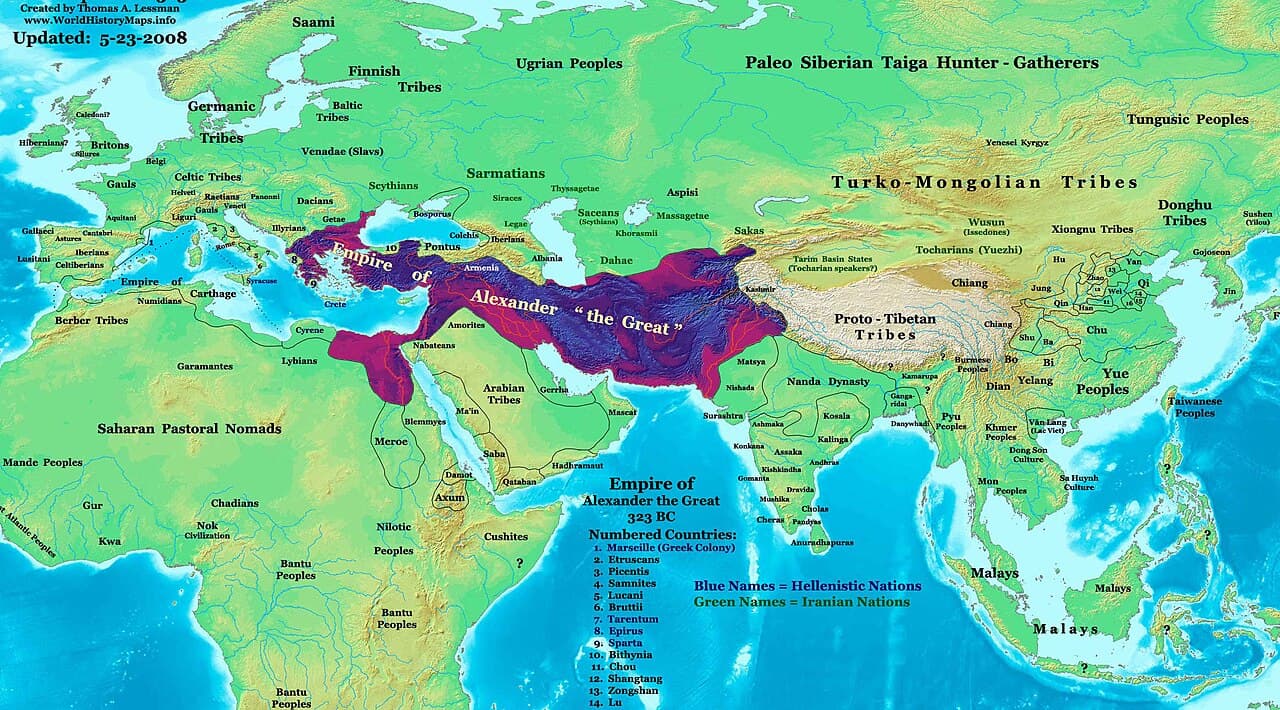
Between these battles, Alexander demonstrated a political sophistication that matched his military genius. He presented himself not as a foreign conqueror but as a liberator and legitimate successor to Persian kingship. He spared the family of Darius and treated them with honor. He incorporated Persian nobles into his administration and, controversially among his Macedonian generals, adopted elements of Persian court dress and ceremony — a policy of cultural fusion he called proskynesis that caused deep friction among his closest companions.
Egypt, Central Asia, and the Edge of the World
Egypt welcomed Alexander as a liberator from Persian rule in 332 BC. The priests of Amun at the Siwa Oasis oracle reportedly confirmed him as the son of Zeus-Ammon, reinforcing his sense of divine destiny. He founded Alexandria on the Mediterranean coast — a city that would become the intellectual capital of the ancient world, home to the great Library and the famous Lighthouse. More than twenty cities bearing his name were planted across his conquests, seeds of Greek culture in foreign soil.
After the fall of Persepolis — which was burned, an act Alexander later reportedly regretted — the campaign turned toward the wild east. In Bactria and Sogdia (modern Afghanistan and Central Asia), Alexander faced his most grueling fighting: a years-long guerrilla war in brutal terrain. It was here, in 327 BC, that he married Roxana, daughter of a Bactrian noble, in what was both a political alliance and, by all accounts, a genuine love match. Pushing into the Indian subcontinent, he defeated King Porus at the Battle of the Hydaspes in 326 BC in a masterpiece of river-crossing tactics — but his exhausted, homesick army finally refused to march further east at the Hyphasis River. For the first and only time, Alexander turned back.
Death of a Legend
Alexander returned to Babylon, which he intended to make the capital of his vast empire. He was planning further campaigns — possibly against Arabia — when he fell gravely ill after a prolonged banquet in June 323 BC. After ten days of fever, Alexander the Great died in the palace of Nebuchadnezzar II. He was thirty-two years old. When asked on his deathbed to whom he left his empire, he reportedly whispered 'to the strongest' — or perhaps 'to Craterus.' The ambiguity was fatal. His generals, the Diadochi, tore the empire apart in decades of savage warfare.
The cause of his death remains one of history's great mysteries. Theories range from typhoid fever complicated by heavy drinking, to poisoning by political rivals, to West Nile virus. A 2019 study in the journal Ancient History Bulletin even proposed that Alexander may have suffered from Guillain-Barré syndrome and was potentially buried alive — citing ancient accounts that his body showed no signs of decay for six days after his death.
A Legacy Cast in Bronze and Ideas
Alexander's physical empire fragmented within a generation. But the cultural legacy he unleashed — the Hellenistic Age — transformed the ancient world. Greek language, art, philosophy, and science spread across the Middle East and Central Asia, blending with local traditions to produce extraordinary syntheses: Greco-Buddhist art in Gandhara, the great scholarship of Ptolemaic Alexandria, the spread of philosophical schools from Athens to Babylon. The conquests created trade networks and cultural corridors that would ultimately carry not just Greek ideas but, centuries later, Christianity and Islam to vast new audiences.
Roman generals revered him — Julius Caesar wept at his statue in Spain, despairing that he had achieved so little at an age when Alexander had conquered the world. Napoleon studied his campaigns obsessively. Today, military academies still teach the Battle of Gaugamela. In the regions he conquered, from Egypt to Pakistan, Alexander appears in local legend and folklore as a quasi-mythic figure. He is Dhul-Qarnayn in Islamic tradition, Sikander in South Asian legend — the two-horned one who reached the ends of the earth.
Key Battles and Conquests at a Glance
| Battle / Event | Year | Significance |
|---|---|---|
| Battle of Granicus | 334 BC | First victory in Asia; opened Anatolia to conquest |
| Battle of Issus | 333 BC | Darius III defeated; Persian royal family captured |
| Siege of Tyre | 332 BC | Seven-month siege; secured the Mediterranean coast |
| Conquest of Egypt & founding of Alexandria | 332–331 BC | Welcomed as liberator; founded his greatest city |
| Battle of Gaugamela | 331 BC | Decisive defeat of Persian Empire; Darius fled and was later killed |
| Battle of the Hydaspes | 326 BC | Last great battle; victory over King Porus in India |
| Death in Babylon | 323 BC | End of unified empire; beginning of the Hellenistic Age |