1. Genghis Khan

Genghis Khan, also known as Chinggis Khan, was the founder and first khan of the Mongol Empire. After spending most of his life uniting the Mongol tribes, he launched a series of military campaigns, conquering large parts of China and Central Asia.
Read the full Genghis Khan article2. Mongol Empire

The Mongol Empire was the largest contiguous empire in history. Originating in present-day Mongolia in East Asia, the medieval empire at its height stretched from the Sea of Japan to Eastern Europe, extending northward into Siberia and east and southward into the Indian subcontinent, mounting invasions of Southeast Asia, and conquering the Iranian Plateau; and reaching westward as far as the Levant and the Carpathian Mountains.
Read the full Mongol Empire article3. Mongol conquests
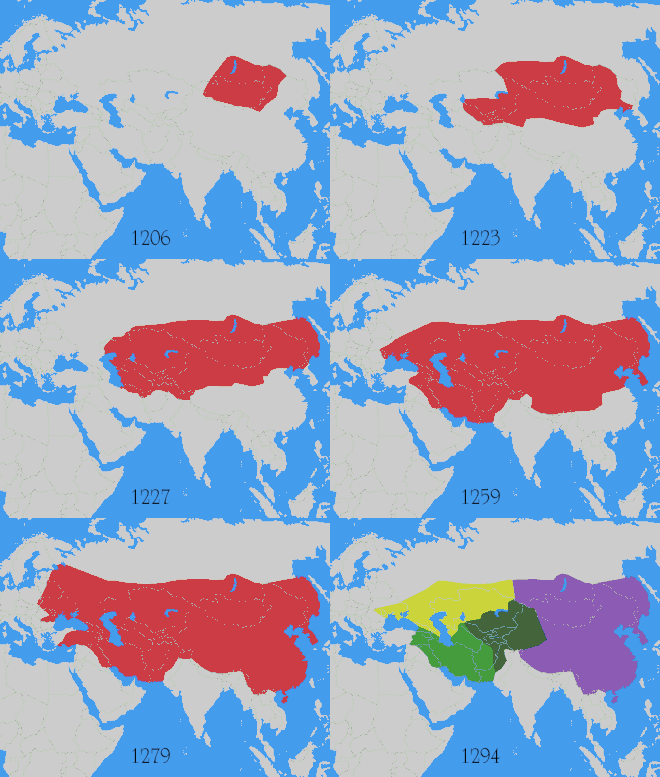
The Mongol conquests took place during the 13th and 14th centuries, creating the largest contiguous empire in history, the Mongol Empire (1206–1368), which by 1260 covered a significant portion of Eurasia. At its height, it stretched from the Pacific to Central Europe. As the Mongol Empire began to fragment from 1260, conflict between the Mongols and Eastern European polities continued for centuries. Mongols continued to rule China into the 14th century under the Yuan dynasty, while Mongol rule in Persia persisted into the 15th century under the Timurid Empire. In the Indian subcontinent, the later Mughal Empire survived into the 19th century.
Read the full Mongol conquests article4. Kublai Khan

Kublai Khan, also known by his temple name as the Emperor Shizu of Yuan and his regnal name Setsen Khan, was the founder and first emperor of the Mongol-led Yuan dynasty of China. He proclaimed the dynastic name "Great Yuan" in 1271, and ruled Yuan China until his death in 1294.
Read the full Kublai Khan article5. Golden Horde

The Golden Horde, or Ulus of Jochi, self-designated as Ulug Ulus, was originally a Mongol and later Turkicized khanate established in the 13th century, originating from the northwestern part of the Mongol Empire. After the division of the empire in 1259, it became a functionally independent khanate. It is also known as the Kipchak Khanate, and replaced the earlier, less organized Cuman–Kipchak confederation.
Read the full Golden Horde article6. Yuan dynasty

The Yuan dynasty, officially the Great Yuan, was a Mongol-led imperial dynasty of China and a successor state to the Mongol Empire after its division. It was established by Kublai, the fifth khagan-emperor of the Mongol Empire from the Borjigin clan, and lasted from 1271 to 1368 AD. In Chinese history, the Yuan dynasty followed the Song dynasty and preceded the Ming dynasty.
Read the full Yuan dynasty article