
The World Wide Web (also known as WWW, W3, or simply the Web) is a global interconnected information system that enables content sharing over the Internet. It facilitates access to documents and other web resources according to specific rules of the Hypertext Transfer Protocol (HTTP).
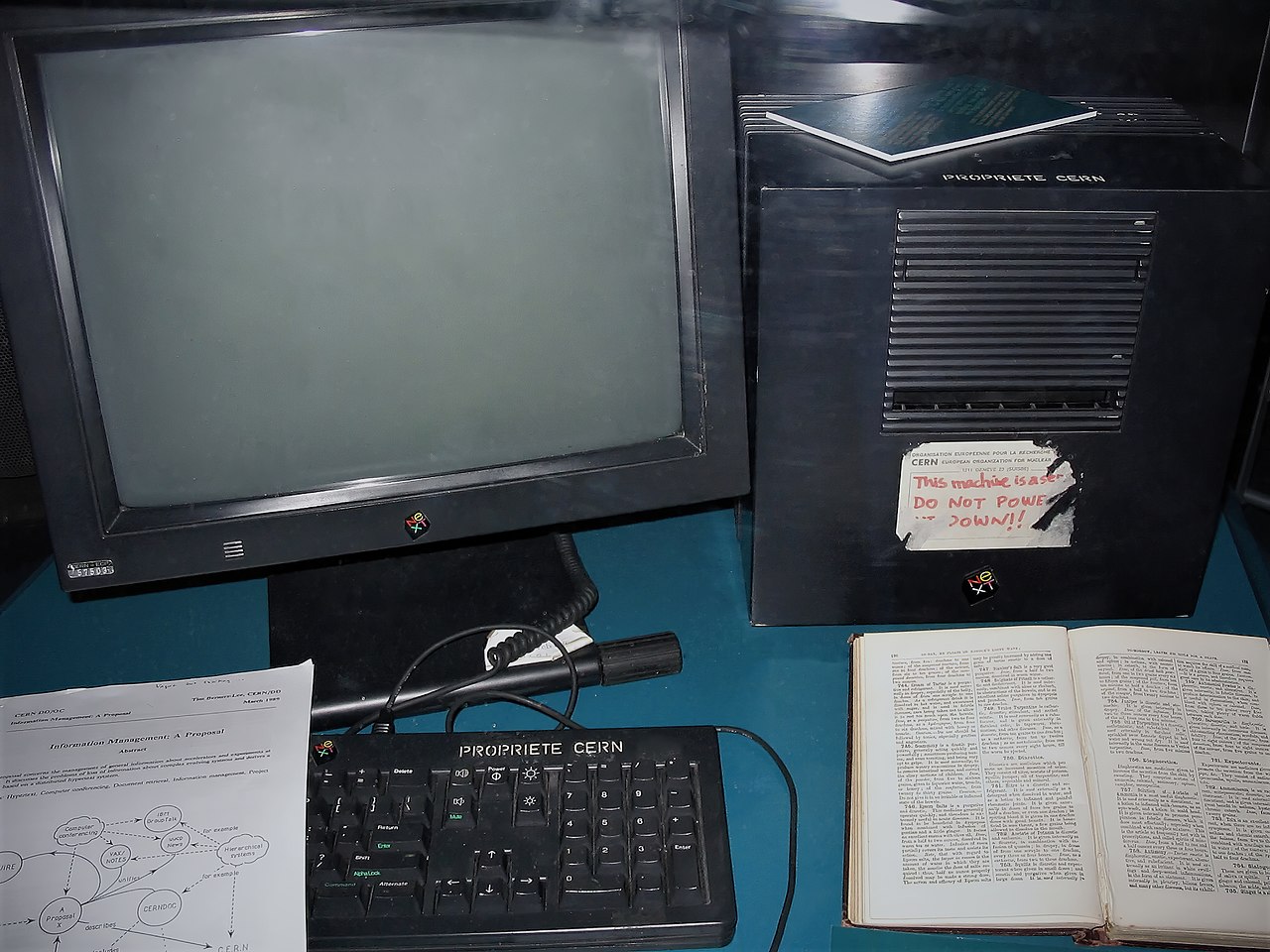
The Web was invented by English computer scientist Tim Berners-Lee while at CERN in 1989 and opened to the public in 1993. It was conceived as a "universal linked information system". Documents and other media content are made available to the network through web servers and can be accessed by programs such as web browsers. Servers and resources on the World Wide Web are identified and located through a character string called a uniform resource locator (URL).
The original and still very common document type is a web page formatted in Hypertext Markup Language (HTML). This markup language supports plain text, images, embedded video and audio contents, and scripts (short programs) that implement complex user interaction. The HTML language also supports hyperlinks (embedded URLs), which provide immediate access to other web resources. Web navigation, or web surfing, is the common practice of following such hyperlinks across multiple websites. Web applications are web pages that function as application software. The information on the Web is transferred across the Internet using HTTP. Multiple web resources with a common theme and usually a common domain name make up a website. A single web server may provide multiple websites, while some websites, especially the most popular ones, may be provided by multiple servers. Website content is provided by a myriad of companies, organisations, government agencies, and individual users; and comprises an enormous amount of educational, entertainment, commercial, and government information.

The World Wide Web has become the world's dominant information systems platform. It is the primary tool that billions of people worldwide use to interact with the Internet.
History
The Web was invented by English computer scientist Tim Berners-Lee while working at CERN. He was motivated by the problem of storing, updating, and finding documents and data files in that large and constantly changing organisation, as well as distributing them to collaborators outside CERN. In his design, Berners-Lee dismissed the common tree structure approach, used for instance in the existing CERNDOC documentation system and in the Unix filesystem, as well as approaches that relied on tagging files with keywords, as in the VAX/NOTES system. Instead, he adopted concepts he had put into practice with his private ENQUIRE system (1980), which was built at CERN. When he became aware of Ted Nelson's hypertext model (1965), in which documents can be linked in unconstrained ways through hyperlinks associated with "hot spots" embedded in the text, it helped to confirm the validity of his concept.
The model was later popularised by Apple's HyperCard system. Unlike Hypercard, Berners-Lee's new system from the outset was meant to support links between multiple databases on independent computers, and to allow simultaneous access by many users from any computer on the Internet. He also specified that the system should eventually handle other media besides text, such as graphics, speech, and video. Links could refer to mutable data files, or even fire up programs on their server computer. He also conceived "gateways" that would allow access through the new system to documents organised in other ways (such as traditional computer file systems or the Usenet). Moreover, he insisted that the system should be decentralised, without any central control or coordination over the creation of links.

Berners-Lee submitted a proposal to CERN in March 1989, without giving the system a name. He got a working system implemented by the end of 1990, including a browser called WorldWideWeb (which became the name of the project and of the network) and an HTTP server running at CERN. As part of that development, he defined the first version of the HTTP protocol, the basic URL syntax, and implicitly made HTML the primary document format. The technology was released outside CERN to other research institutions starting in January 1991, and then to the whole Internet on 23 August 1991. The Web was a success at CERN and began to spread to other scientific and academic institutions. Within the next two years, there were 50 websites created.
CERN made the Web protocol and code available royalty-free on 30 April 1993, enabling its widespread use. After the NCSA released the Mosaic web browser later that year, the Web's popularity grew rapidly as thousands of websites sprang up in less than a year. Mosaic was a graphical browser that could display inline images and submit forms that were processed by the HTTPd server. Marc Andreessen and Jim Clark founded Netscape the following year and released the Navigator browser, which introduced Java and JavaScript to the Web. It quickly became the dominant browser. Netscape became a public company in 1995, which triggered a frenzy for the Web and started the dot-com bubble. Microsoft responded by developing its own browser, Internet Explorer, starting the browser wars. By bundling it with Windows, it became the dominant browser for 14 years.
Berners-Lee founded the World Wide Web Consortium (W3C) which created XML in 1996 and recommended replacing HTML with stricter XHTML. In the meantime, developers began exploiting an IE feature called XMLHttpRequest to make Ajax applications and launched the Web 2.0 revolution. Mozilla, Opera, and Apple rejected XHTML and created the WHATWG which developed HTML5. In 2009, the W3C conceded and abandoned XHTML. In 2019, it ceded control of the HTML specification to the WHATWG.

The World Wide Web has been central to the development of the Information Age and is the primary tool billions of people use to interact on the Internet.
Competition with Gopher
Gopher was run by the University of Minnesota and the alternative to the World Wide Web.
In February 1993, the University of Minnesota announced that it would charge licensing fees for the use of its implementation of the Gopher server. Users became concerned that fees might also be charged for independent implementations. Gopher expansion stagnated, to the advantage of the World Wide Web, which released the WWW into the public domain in April 1993, which CERN maintained. In September 2000, the University of Minnesota re-licensed its Gopher software under the GNU General Public License.

Gopher client functionality was quickly duplicated by the early Mosaic web browser, which subsumed its protocol.
Gopher has a more rigid structure than the free-form HyperText Markup Language (HTML) of the Web. Every Gopher document has a defined format and type, and the typical user navigates through a single server-defined menu system to get to a particular document. This can be quite different from the way a user finds documents on the Web.
Failure to follow the open systems model and bad publicity in comparison to the World Wide Web.
Nomenclature
Tim Berners-Lee states that World Wide Web is officially spelled as three separate words, each capitalised, with no intervening hyphens. Use of the www prefix has been declining, especially when web applications sought to brand their domain names and make them easily pronounceable. As the mobile web grew in popularity, services like Gmail.com, Outlook.com, Myspace.com, Facebook.com and Twitter.com are most often mentioned without adding "www." (or, indeed, ".com") to the domain.
In English, www is usually read as double-u double-u double-u. Some users pronounce it dub-dub-dub, particularly in New Zealand. Stephen Fry, in his "Podgrams" series of podcasts, pronounces it wuh wuh wuh. The English writer Douglas Adams once quipped in The Independent on Sunday (1999): "The World Wide Web is the only thing I know of whose shortened form takes three times longer to say than what it's short for".
Function
The terms Internet and World Wide Web are often used without much distinction. However, the two terms do not mean the same thing. The Internet is a global system of computer networks interconnected through telecommunications and optical networking. In contrast, the World Wide Web is a global collection of documents and other resources, linked by hyperlinks and URIs. Web resources are accessed using HTTP or HTTPS, which are application-level Internet protocols that use the Internet transport protocols.
Viewing a web page on the World Wide Web normally begins either by typing the URL of the page into a web browser or by following a hyperlink to that page or resource. The web browser then initiates a series of background communication messages to fetch and display the requested page. In the 1990s, using a browser to view web pages—and to move from one web page to another through hyperlinks—came to be known as 'browsing,' 'web surfing' (after channel surfing), or 'navigating the Web'. Early studies of this new behaviour investigated user patterns in using web browsers. One study, for example, found five user patterns: exploratory surfing, window surfing, evolved surfing, bounded navigation, and targeted navigation.
The following example demonstrates the functioning of a web browser when accessing a page at the URL http://example.org/home.html. The browser resolves the server name of the URL (example.org) into an Internet Protocol address using the globally distributed Domain Name System (DNS). This lookup returns an IP address such as 203.0.113.4 or 2001:db8:2e::7334. The browser then requests the resource by sending an HTTP request across the Internet to the computer at that address. It requests service from a specific TCP port number that is well known for the HTTP service, so that the receiving host can distinguish an HTTP request from other network protocols it may be servicing. HTTP normally uses port number 80 and, for HTTPS, it normally uses port number 443. The content of the HTTP request can be as simple as two lines of text:
The computer receiving the HTTP request delivers it to the web server software listening for requests on port 80. If the web server can fulfil the request, it sends an HTTP response back to the browser indicating success:
Followed by the content of the requested page. Hypertext Markup Language (HTML) for a basic web page might look like this:
The web browser parses the HTML and interprets the markup (<title>, <p> for paragraph, and such) that surrounds the words to format the text on the screen. Many web pages use HTML to reference the URLs of other resources such as images, other embedded media, scripts that affect page behaviour, and Cascading Style Sheets that affect page layout. The browser makes additional HTTP requests to the web server for these other Internet media types. As it receives its content from the web server, the browser progressively renders the page onto the screen as specified by its HTML and these additional resources.
HTML
Hypertext Markup Language (HTML) is the standard markup language for creating web pages and web applications. With Cascading Style Sheets (CSS) and JavaScript, it forms a triad of cornerstone technologies for the World Wide Web.
Web browsers receive HTML documents from a web server or from local storage and render the documents into multimedia web pages. HTML describes the structure of a web page semantically and originally included cues for the appearance of the document.
HTML elements are the building blocks of HTML pages. With HTML constructs, images and other objects such as interactive forms may be embedded into the rendered page. HTML provides a means to create structured documents by denoting structural semantics for text such as headings, paragraphs, lists, links, quotes, and other items. HTML elements are delineated by tags, written using angle brackets. Tags such as <img /> and <input /> directly introduce content into the page. Other tags, such as <p>, surround and provide information about document text and may include other tags as sub-elements. Browsers do not display the HTML tags, but use them to interpret the content of the page.
HTML can embed programs written in a scripting language such as JavaScript, which affects the behaviour and content of web pages. Inclusion of CSS defines the look and layout of content. The World Wide Web Consortium (W3C), maintainer of the CSS standard, has encouraged the use of CSS over explicit presentational HTML since 1997.
Linking
Most web pages contain hyperlinks to other related pages and perhaps to downloadable files, source documents, definitions, and other web resources. In the underlying HTML, a hyperlink is coded like this:
<a href="http://example.org/home.html">Example.org Homepage</a>.
Such a collection of useful, related resources interconnected via hypertext links is dubbed a web of information. Publication on the Internet created what Tim Berners-Lee first called the WorldWideWeb (in its original CamelCase, which was subsequently discarded) in November 12, 1990.
The hyperlink structure of the web is described by the webgraph: the nodes of the web graph correspond to the web pages (or URLs), the directed edges between them to the hyperlinks. Over time, many web resources pointed to by hyperlinks disappear, relocate, or are replaced with different content. This makes hyperlinks obsolete, a phenomenon referred to in some circles as link rot, and the hyperlinks affected by it are often called "dead" links. The ephemeral nature of the Web has prompted many efforts to archive websites. The Internet Archive, active since 1996, is the best known of such efforts.
www prefix
Many hostnames used for the World Wide Web begin with www because of the long-standing practice of naming Internet hosts according to the services they provide. The hostname of a web server is often www, in the same way that it may be ftp for an FTP server, and news or nntp for a Usenet news server. These hostnames appear as Domain Name System (DNS) or subdomain names, as in www.example.com. The use of www is not required by any technical or policy standard and many websites do not use it; the first web server was nxoc01.cern.ch. According to Paolo Palazzi, who worked at CERN along with Tim Berners-Lee, the popular use of www as subdomain was accidental; the World Wide Web project page was intended to be published at www.cern.ch while info.cern.ch was intended to be the CERN home page; however the DNS records were never switched, and the practice of prepending www to an institution's website domain name was subsequently copied.
Many established websites still use the prefix, or they employ other subdomain names such as www2, secure or en for special purposes. Many such web servers are set up so that both the main domain name (e.g., example.com) and the www subdomain (e.g., www.example.com) refer to the same site; others require one form or the other, or they may map to different websites. The use of a subdomain name is useful for load balancing incoming web traffic by creating a CNAME record that points to a cluster of web servers. Since, currently, only a subdomain can be used in a CNAME, the same result cannot be achieved by using the bare domain root.
When a user submits an incomplete domain name to a web browser in its address bar input field, some web browsers automatically try adding the prefix "www" to the beginning of it and possibly ".com", ".org" and ".net" at the end, depending on what might be missing. For example, entering "microsoft" may be transformed to http://www.microsoft.com/ and "openoffice" to http://www.openoffice.org. This feature started appearing in early versions of Firefox, when it still had the working title 'Firebird' in early 2003, from an earlier practice in browsers such as Lynx. It is reported that Microsoft was granted a US patent for the same idea in 2008, but only for mobile devices.
Scheme specifiers
The scheme specifiers http:// and https:// at the start of a web URI refer to Hypertext Transfer Protocol or HTTP Secure, respectively. They specify the communication protocol to use for the request and response. The HTTP protocol is fundamental to the operation of the World Wide Web, and the added encryption layer in HTTPS is essential when browsers send or retrieve confidential data, such as passwords or banking information. Web browsers usually automatically prepend http:// to user-entered URIs, if omitted.
Pages
A web page (also written as webpage) is a document that is suitable for the World Wide Web and web browsers. A web browser displays a web page on a monitor or mobile device.
The term web page usually refers to what is visible, but may also refer to the contents of the computer file itself, which is usually a text file containing hypertext written in HTML or a comparable markup language. Typical web pages provide hypertext for browsing to other web pages via hyperlinks, often referred to as links. Web browsers will frequently have to access multiple web resource elements, such as reading style sheets, scripts, and images, while presenting each web page.
On a network, a web browser can retrieve a web page from a remote web server. The web server may restrict access to a private network, such as a corporate intranet. The web browser uses the Hypertext Transfer Protocol (HTTP) to make such requests to the web server.
A static web page is delivered exactly as stored, as web content in the web server's file system. In contrast, a dynamic web page is generated by a web application, usually driven by server-side software. Dynamic web pages are used when each user may require completely different information, for example, bank websites, web email, etc.
Static page
A static web page (sometimes called a flat page/stationary page) is a web page that is delivered to the user exactly as stored, in contrast to dynamic web pages which are generated by a web application.
Consequently, a static web page displays the same information for all users, from all contexts, subject to modern capabilities of a web server to negotiate content-type or language of the document where such versions are available and the server is configured to do so.
Dynamic pages
A server-side dynamic web page is a web page whose construction is controlled by an application server processing server-side scripts. In server-side scripting, parameters determine how the assembly of every new web page proceeds, including the setting up of more client-side processing.
A client-side dynamic web page processes the web page using JavaScript running in the browser. JavaScript programs can interact with the document via Document Object Model, or DOM, to query page state and alter it. The same client-side techniques can then dynamically update or change the DOM in the same way.
A dynamic web page is then reloaded by the user or by a computer program to change some variable content. The updated information could come from the server, or from changes made to that page's DOM. This may or may not truncate the browsing history or create a saved version to go back to, but a dynamic web page update using Ajax technologies will neither create a page to go back to nor truncate the web browsing history forward of the displayed page. Using Ajax technologies, the end user gets one dynamic page managed as a single page in the web browser while the actual web content rendered on that page can vary. The Ajax engine sits only on the browser requesting parts of its DOM, the DOM, for its client, from an application server.
Dynamic HTML, or DHTML, is the umbrella term for technologies and methods used to create web pages that are not static web pages, though it has fallen out of common use since the popularisation of AJAX, a term which is now itself rarely used. Client-side scripting, server-side scripting, or a combination of these make for the dynamic web experience in a browser.
JavaScript is a scripting language that was initially developed in 1995 by Brendan Eich, then of Netscape, for use within web pages. The standardised version is ECMAScript. To make web pages more interactive, some web applications also use JavaScript techniques such as Ajax (asynchronous JavaScript and XML). Client-side script is delivered with the page that can make additional HTTP requests to the server, either in response to user actions such as mouse movements or clicks, or based on elapsed time. The server's responses are used to modify the current page rather than creating a new page with each response, so the server needs only to provide limited, incremental information. Multiple Ajax requests can be handled at the same time, and users can interact with the page while data is retrieved. Web pages may also regularly poll the server to check whether new information is available.
Website
A website is a collection of related web resources including web pages, multimedia content, typically identified with a common domain name, and published on at least one web server. Notable examples are wikipedia.org, google.com, and amazon.com.
A website may be accessible via a public Internet Protocol (IP) network, such as the Internet, or a private local area network (LAN), by referencing a uniform resource locator (URL) that identifies the site.