
William Penn (24 October [O.S. 14 October] 1644 – 10 August [O.S. 30 July] 1718) was an English writer, theologian, religious thinker, and influential Quaker who founded the Province of Pennsylvania. An advocate of democracy and religious freedom, Penn was known for his amicable relations and successful treaties with the Lenape native peoples who had resided in present-day Pennsylvania before European colonisation there.
In 1681, King Charles II granted an area of land corresponding to the present-day U.S. states of Pennsylvania and Delaware to Penn to offset debts he owed Penn's father, the admiral and politician Sir William Penn. The following year, Penn left England and sailed up Delaware Bay and the Delaware River, where he founded Philadelphia on the river's western bank. Penn's Quaker government was not viewed favorably by the Dutch, Swedish and English settlers in what is now Delaware, and the land was also claimed by the Calverts, proprietors of the neighbouring Province of Maryland. In 1704, the three southernmost counties of the province of Pennsylvania were granted permission to form a new, semi-autonomous Delaware Colony.
As one of the earliest supporters of colonial unification, Penn wrote and urged the union of all the British colonies into what would later become the United States. The democratic principles that he included in the West Jersey Concessions and outlined in the Pennsylvania Frame of Government inspired delegates to the 1787 Constitutional Convention in Philadelphia when they came to write the Constitution of the United States.

A man of deep religious conviction, Penn authored numerous works, exhorting believers to adhere to the spirit of Primitive Christianity. Penn was imprisoned several times in the Tower of London due to his faith. His book No Cross, No Crown, published in 1669 while he was in jail, has become a classic of Christian theological literature.
Early life
Penn was born on 24 October 1644 at Tower Hill, London, the son of English naval officer Sir William Penn, and Dutchwoman Margaret Jasper, who was widow of a Dutch sea captain and the daughter of a rich merchant from Rotterdam. Through the Pletjes-Jasper family, Penn is also said to have been a cousin of the Op den Graeff family, who were important Mennonites in Krefeld and Quakers in Pennsylvania. Admiral Penn served in the Commonwealth Navy during the Wars of the Three Kingdoms and was rewarded by Oliver Cromwell with estates in Ireland. The lands given to Penn had been confiscated from Irish Confederates who had participated in the Irish Rebellion of 1641. Admiral Penn took part in the restoration of King Charles II and was eventually knighted and served in the Royal Navy. At the time of his son's birth, then-Captain Penn was twenty-three and an ambitious naval officer in charge of blockading ports held by Confederate forces.
Penn grew up during the rule of Oliver Cromwell, who succeeded in leading a Puritan rebellion against King Charles I; the king was beheaded when Penn was four years old. Penn's father was often at sea. Young William caught smallpox, and lost his hair from the disease; he wore wigs for much of his life. Penn's smallpox also prompted his parents to move from the suburbs to an estate in Essex. The country life made a lasting impression on young Penn, and kindled in him a love of horticulture. Their neighbour was the diarist Samuel Pepys, who was friendly at first but later secretly hostile to the Admiral, perhaps embittered in part by his failed seductions of both Penn's mother and his sister Peggy.

After a failed mission to the Caribbean, Admiral Penn and his family were exiled to his lands in Ireland when Penn was about 15 years old. During this time, Penn met Thomas Loe, a Quaker missionary who was maligned by both Catholics and Protestants. Loe was admitted to the Penn household, and during his discourses on the Inward Light, young Penn recalled later that "the Lord visited me and gave me divine Impressions of Himself."
A year later, Cromwell was dead, the Royalists were resurging, and the Penn family returned to England. The middle class aligned itself with the Royalists and Admiral Penn was sent on a secret mission to bring back exiled Prince Charles. For his role in restoring the monarchy, Admiral Penn was knighted and gained a powerful position as Lord Commissioner of the Admiralty.
Education
Penn was first educated at Chigwell School, then by private tutors in Ireland, and later at Christ Church at the University of Oxford in Oxford. At the time, there were no state schools and nearly all educational institutions were affiliated with the Anglican Church. Children from poorer families had to have a wealthy sponsor to get an education. Penn's education leaned heavily on the classical authors and "no novelties or conceited modern writers" were allowed, including Shakespeare.
Running was Penn's favorite sport, and he often ran more than three miles (5 km) from his home to the school, which was cast in an Anglican model and was strict, humorless, and somber. The school's teachers had to be pillars of virtue and provide sterling examples to their pupils. Penn later opposed Anglicanism on religious grounds, but he absorbed many Puritan behaviors, and was known later for his own serious demeanor, strict behavior, and lack of humor.
In 1660, Penn arrived at the University of Oxford, where he was enrolled as a gentleman scholar with an assigned servant. The student body was a volatile mix of Cavaliers, sober Puritans, and non-conforming Quakers. The new British government's discouragement of religious dissent gave the Cavaliers license to harass the minority groups. Because of his father's high position and social status, young Penn was firmly a Cavalier but his sympathies lay with the persecuted Quakers. To avoid conflict, Penn withdrew from the fray and became a reclusive scholar.
During this time, Penn developed his individuality and philosophy of life. He found that he was not sympathetic with either his father's martial view of the world or his mother's society-oriented sensibilities. "I had no relations that inclined to so solitary and spiritual way; I was a child alone. A child was given to musing, occasionally feeling the divine presence," he later said.

Penn returned home as a guest of honour at the King's lavish restoration ceremony alongside his father, who received a highly unusual royal salute for his services to The Crown. Penn's father had great hopes for his son's career under the favor of the King.
Back at Oxford, Penn considered a medical career and took some dissecting classes. Rational thought began to spread into science, politics, and economics, which he took a liking to. When theologian John Owen was fired from his deanery, Penn and other open-minded students rallied to his side and attended seminars at the dean's house, where intellectual discussions covered the gamut of new thought. Penn learned the valuable skills of forming ideas into theory, discussing theory through reasoned debate, and testing the theories in the real world.
At this time he also faced his first moral dilemma. After Owen was fired, he was again censured and students were threatened with punishment for associating with him. However, Penn stood by the dean, thereby gaining a fine and reprimand from the university. The Admiral, despairing of the charges, pulled young Penn away from Oxford, hoping to distract him from the heretical influences of the university. The attempt had no effect and father and son struggled to understand each other.

Back at school, the administration imposed stricter religious requirements including daily chapel attendance and required dress. Penn rebelled against enforced worship and was expelled. His father, in a rage, attacked young Penn with a cane and forced him from their home. Penn's mother made peace in the family, which allowed her son to return home but she quickly concluded that both her social standing and her husband's career were being threatened by their son's behavior. So at age 18, young Penn was sent to Paris to get him out of view, improve his manners, and expose him to another culture.
In Paris, at the court of young Louis XIV, Penn found French manners far more refined than the coarse manners of his countrymen, but he did not like the extravagant display of wealth and privilege he saw in the French. Though impressed by Notre Dame and the Catholic ritual, he felt uncomfortable with it. Instead, he sought out spiritual direction from French Protestant theologian Moise Amyraut, who invited Penn to stay with him in Saumur for a year. The undogmatic Christian humanist talked of a tolerant, adapting view of religion which appealed to Penn, who later stated, "I never had any other religion in my life than what I felt." By adapting his mentor's belief in free will, Penn felt unburdened of Puritanical guilt and rigid beliefs and was inspired to search out his own religious path.
Upon returning to England after two years abroad, he presented to his parents a mature, sophisticated, well mannered, modish gentleman, though Samuel Pepys noted young Penn's "vanity of the French". Penn had developed a taste for fine clothes, and for the rest of his life would pay somewhat more attention to his dress than most Quakers. The Admiral had great hopes that his son then had the practical sense and the ambition necessary to succeed as an aristocrat. He had young Penn enroll in law school but soon his studies were interrupted.

With war with the Dutch imminent, young Penn decided to shadow his father at work and join him at sea. Penn functioned as an emissary between his father and the King, then returned to his law studies. Worrying about his father in battle he wrote, "I never knew what a father was till I had wisdom enough to prize him... I pray God... that you come home secure." The Admiral returned triumphantly, but London was in the grip of the Great Plague of 1665. Young Penn reflected on the suffering and the deaths, and the way humans reacted to the epidemic. He wrote that the scourge "gave me a deep sense of the vanity of this World, of the Irreligiousness of the Religions in it." Further he observed how Quakers on errands of mercy were arrested by the police and demonized by other religions, even accused of causing the plague.
With his father laid low by gout, young Penn was sent to Ireland in 1666 to manage the family landholdings. While there, he became a soldier and took part in suppressing a local Irish rebellion. Swelling with pride, he had his portrait painted wearing a suit of armor, his most authentic likeness. His first experience of warfare gave him the sudden idea of pursuing a military career, but the fever of battle soon wore off after his father discouraged him, "I can say nothing but advise to sobriety...I wish your youthful desires mayn't outrun your discretion."
While Penn was abroad, the Great Fire of 1666 consumed central London. As with the plague, the Penn family was spared. But after returning to the city, Penn was depressed by the mood of the city and his ailing father, so he went back to the family estate in Ireland to contemplate his future. The reign of King Charles had further tightened restrictions against all religious sects other than the Anglican Church, making the penalty for unauthorized worship imprisonment or deportation. The "Five Mile Act" prohibited dissenting teachers and preachers to come within that distance of any borough. The Quakers were especially targeted and their meetings were deemed undesirable.
Career
Religious conversion
Despite the dangers, Penn began to attend Quaker meetings near Cork. A chance re-meeting with Thomas Loe confirmed Penn's rising attraction to Quakerism. Soon Penn was arrested for attending Quaker meetings. Rather than state that he was not a Quaker and thereby avoid any charges, he publicly declared himself a member and finally joined the Quakers at the age of 22. In pleading his case, Penn stated that since the Quakers, unlike the Puritans, had no political agenda, they should not be subject to laws that restricted political action by minority religions and other groups.
Released from jail because of his family's rank rather than his argument, Penn was immediately recalled to London by his father. The Admiral was severely distressed by his son's actions and took the conversion as a personal affront. His father's hopes that Penn's charisma and intelligence would win him favor at the court were crushed. Though enraged, the Admiral tried his best to reason with his son but to no avail. His father not only feared for his own position but that his son seemed bent on a dangerous confrontation with the Crown. In the end, young Penn was more determined than ever, and the Admiral felt he had no option but to order his son out of the house and to withhold his inheritance.
As Penn became homeless, he began to live with Quaker families. Quakers were relatively strict Christians in the 17th century. They refused to bow or take off their hats to social superiors, believing all men were equal under God, a belief antithetical to an absolute monarchy that believed the monarch was divinely appointed by God. As a result, Quakers were treated as heretics because of their principles and their failure to pay tithes. They also refused to swear oaths of loyalty to the King believing that this was following the command of Jesus not to swear.
The basic ceremony of Quakerism was silent worship in a meeting house, conducted in a group. There was no ritual and no professional clergy, and many Quakers disavowed the concept of original sin. God's communication came to each individual directly, and if so moved, the individual shared his revelations, thoughts, or opinions with the group. Penn found all these tenets to sit well with his conscience and his heart.
Penn became a close friend of George Fox, the founder of the Quakers, whose movement started in the 1650s during the tumult of the Cromwellian revolution. The times sprouted many new sects besides Quakers, including Seekers, Ranters, Antinomians, Seventh Day Baptists, Soul sleepers, Adamites, Diggers, Levellers, Behmenists, Muggletonians, and others, as the Puritans were more tolerant than the monarchy had been.
Following Oliver Cromwell's death, however, the Crown was re-established and the King responded with harassment and persecution of all religions and sects other than Anglicanism. Fox risked his life, wandering from town to town, and he attracted followers who likewise believed that the "God who made the world did not dwell in temples made with hands." By abolishing the church's authority over the congregation, Fox not only extended the Protestant Reformation more radically, but he helped extend the most important principle of modern political history – the rights of the individual – upon which modern democracies were later founded.
Penn travelled frequently with Fox, through Europe and England. He also wrote a comprehensive, detailed explanation of Quakerism along with a testimony to the character of George Fox, in his introduction to the autobiographical Journal of George Fox. In effect, Penn became the first theologian, theorist, and legal defender of Quakerism, providing its written doctrine and helping to establish its public standing.
Ireland (1669–1670)
In 1669, Penn travelled to Ireland to deal with his father's estates. While there, he attended many meetings and stayed with leading Quaker families. He became a great friend of William Morris, a leading Quaker figure in Cork, and often stayed with Morris at Castle Salem near Rosscarbery.
Germany (1671–1677)
Between 1671 and 1677, Penn visited Germany on behalf of the Quaker faith, resulting in a German settlement in the Province of Pennsylvania that was symbolic in two ways: It was a German-speaking congregation, and it included religious dissenters. During the colonial era, Pennsylvania was the heartland for various branches of Anabaptists, like the Ephrata Cloister and the Brethren, and groups that later became the Old Order Amish and the Old Order Mennonites.
Pennsylvania quickly emerged as the home for many Lutheran refugees from Catholic provinces, such as Salzburg, and for German Catholics, who were facing discrimination in their home country.
In Philadelphia, Francis Daniel Pastorius negotiated the purchase of 15,000 acres (61 km2) from his friend William Penn, the proprietor of the province of Pennsylvania, and laid out the settlement of what is the present-day Germantown section of Philadelphia. In 1764, the German Society of Pennsylvania was established, which still functions to this day from its headquarters in Philadelphia.
Persecutions and imprisonments
In 1668, Penn published the first of many pamphlets, Truth Exalted: To Princes, Priests, and People. He was a critic of all religious groups, except Quakers, which he saw as the only true Christian group at that time in England. He branded the Catholic Church "the Whore of Babylon", defied the Church of England, and called the Puritans "hypocrites and revelers in God". He lambasted all "false prophets, tithe mongers, and opposers of perfection". Pepys thought it a "ridiculous nonsensical book" that he was "ashamed to read".
In 1668, after writing a follow-up tract, The Sandy Foundation Shaken, Penn was imprisoned in the Tower of London. The Bishop of London ordered that Penn be held indefinitely until he publicly recanted his written statements. The official charge was publication without a license, but the real crime was blasphemy, as signed in a warrant by King Charles II. Placed in solitary confinement in an unheated cell and threatened with a life sentence, Penn was accused of denying the Trinity, though this was a misinterpretation Penn himself refuted in the essay Innocency with her open face, presented by way of Apology for the book entitled The Sandy Foundation Shaken, where he sought to prove the Godhead of Christ.
Penn said the rumor had been "maliciously insinuated" by detractors who wanted to create a bad reputation to Quakers.
Penn later said that what he really denied were the Catholic interpretations of this theological topic, and the use of unbiblical concepts to explain it. Penn expressly confessed he believed in the Holy Three and the divinity of Christ.
In 1668, in a letter to the anti-Quaker minister Jonathan Clapham, Penn wrote: "Thou must not, reader, from my querying thus, conclude we do deny (as he hath falsely charged us) those glorious Three, which bear record in heaven, the Father, Word, and Spirit; neither the infinity, eternity and divinity of Jesus Christ; for that we know he is the mighty God."
Given writing materials in the hope that he would put on paper his retraction, Penn wrote another inflammatory treatise, No Cross, No Crown. In it, Penn exhorted believers to adhere to the spirit of Primitive Christianity. This work was remarkable for its historical analysis and citation of 68 authors whose quotations and commentary he had committed to memory and was able to summon without any reference material at hand. Penn petitioned for an audience with the King, which was denied but which led to negotiations on his behalf by one of the royal chaplains. Penn declared, "My prison shall be my grave before I will budge a jot: for I owe my conscience to no mortal man." He was released after eight months of imprisonment.
Penn demonstrated no remorse for his aggressive stance and vowed to keep fighting against the wrongs of the Church and the King. For its part, the Crown continued to confiscate Quaker property and jailed thousands of Quakers. From then on, Penn's religious views effectively exiled him from English society; he was expelled from Christ Church, a college at the University of Oxford, for being a Quaker, and was arrested several times. In 1670, he and William Mead were arrested. Penn was accused of preaching before a gathering in the street, which Penn deliberately provoked to test the validity of the 1664 Conventicle Act, just renewed in 1670, which denied the right of assembly to "more than five persons in addition to members of the family, for any religious purpose not according to the rules of the Church of England".
Penn was assisted by his solicitor, Thomas Rudyard, an eminent London Quaker lawyer, and pleaded for his right to see a copy of the charges laid against him and the laws he had supposedly broken, but the Recorder of London, Sir John Howel, on the bench as chief judge, refused, although this was a right guaranteed by law. Furthermore, the Recorder directed the jury to come to a verdict without hearing the defense.
Despite heavy pressure from Howel to convict Penn, the jury returned a verdict of "not guilty". When invited by the Recorder to reconsider their verdict and to select a new foreman, they refused and were sent to a cell over several nights to mull over their decision. The Lord Mayor of London, Sir Samuel Starling, also on the bench, then told the jury, "You shall go together and bring in another verdict, or you shall starve", and not only had Penn sent to jail in Newgate Prison (on a charge of contempt of court for refusing to remove his hat), but the full jury followed him, and they were additionally fined the equivalent of a year's wages each. The members of the jury, fighting their case from prison in what became known as Bushel's Case, managed to win the right for all English juries to be free from the control of judges. This case was one of the more important trials that shaped the concept of jury nullification and was a victory for the use of the writ of habeas corpus as a means of freeing those unlawfully detained.
With his father dying, Penn wanted to see him one more time and patch up their differences. But he urged his father not to pay his fine and free him, "I entreat thee not to purchase my liberty." But the Admiral refused to let the opportunity pass and he paid the fine, releasing his son.
His father had gained respect for his son's integrity and courage and told him, "Let nothing in this world tempt you to wrong your conscience." The Admiral also knew that after his death young Penn would become more vulnerable in his pursuit of justice. In an act which not only secured his son's protection but also set the conditions for the founding of Pennsylvania, the Admiral wrote to the Duke of York, the heir to the throne.
The Duke and the King, in return for the Admiral's lifetime of service to the Crown, promised to protect young Penn and make him a royal counsellor.
Penn inherited a large fortune, but found himself in jail again for six months. In April 1672, after being released, he married Gulielma Springett following a four-year engagement filled with frequent separations. Penn remained close to home but continued writing his tracts, espousing religious tolerance and railing against discriminatory laws. A minor split developed in the Quaker community between those who favored Penn's analytical formulations and those who preferred Fox's simple precepts. But the persecution of Quakers had accelerated and the differences were overridden; Penn again resumed missionary work in Holland and Germany.
Founding of Pennsylvania
Seeing conditions deteriorating, Penn appealed directly to the King and the Duke, proposing a mass emigration of English Quakers. Some Quakers had already moved to North America, but the New England Puritans, especially, were as hostile towards Quakers as Anglicans in England were, and some of the Quakers had been banished to the Caribbean.
In 1677, a group of prominent Quakers that included Penn purchased the colonial province of West Jersey, comprising the western half of present-day New Jersey. The same year, 200 settlers from Chorleywood and Rickmansworth in Hertfordshire, and other towns in nearby Buckinghamshire arrived, and founded the town of Burlington. Fox made a journey to America to verify the potential of further expansion of the early Quaker settlements. In 1682, East Jersey was also purchased by Quakers.
With the Province of New Jersey in place, Penn pressed his case to extend the Quaker region. Whether from personal sympathy or political expediency, to Penn's surprise, the King granted an extraordinarily generous charter which made Penn the world's largest private non-royal landowner, with over 45,000 square miles (120,000 km2). Penn became the sole proprietor of a huge tract of land west of New Jersey and north of the Province of Maryland belonging to Lord Baltimore, and gained sovereign rule of the territory with all rights and privileges with the exception of the power to declare war. The land of Pennsylvania had belonged to the Duke of York, but he retained the Province of New York and the area around present-day New Castle, Delaware, and the eastern portion of the Delmarva Peninsula. In return, one-fifth of all gold and silver mined in the province, which had virtually none, was to be remitted to the King, and the Crown was freed of a debt to the Admiral of £16,000, equal to roughly £2,952,623 in 2025.
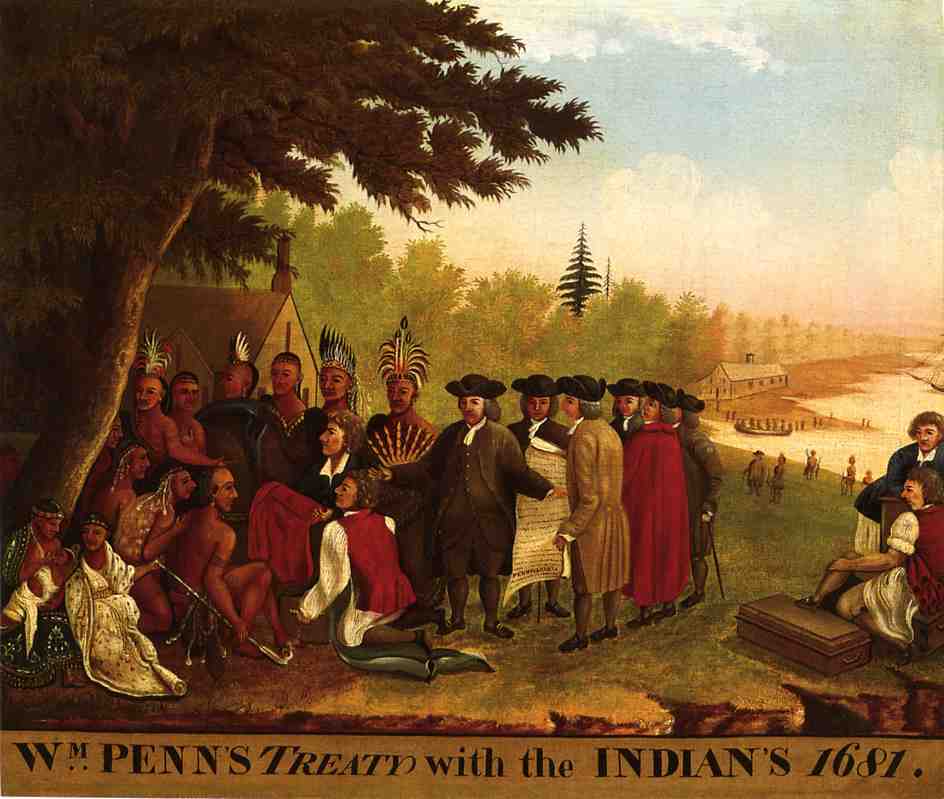
Penn first called the area "New Wales", then "Sylvania", which is Latin for "forests" or "woods", which King Charles II changed to "Pennsylvania" in honour of the elder Penn. On 4 March 1681, the King signed the charter and the following day Penn jubilantly wrote, "It is a clear and just thing, and my God who has given it to me through many difficulties, will, I believe, bless and make it the seed of a nation." Penn then travelled to America and while there, he negotiated Pennsylvania's first land-purchase survey with the tribe of the Lenape people. Penn purchased the first tract of land under a white oak tree at Graystones in 1682. Penn drafted a charter of liberties for the settlement creating a political utopia guaranteeing free and fair trial by jury, freedom of religion, freedom from unjust imprisonment and free elections.
Having proved himself an influential scholar and theoretician, Penn now had to demonstrate the practical skills of a real estate promoter, city planner, and governor for his "Holy Experiment", the province of Pennsylvania.
In addition to his religious goals, Penn had hoped that Pennsylvania would be a profitable venture for himself and his family, with the caveat that he would not exploit either the natives or the immigrants, "I would not abuse His love, nor act unworthy of His providence, and so defile what came to me clean." To that end, Penn's land purchase from the Lenape included the latter party's retained right to traverse the sold lands for purposes of hunting, fishing, and gathering.
Though thoroughly oppressed, getting Quakers to leave England and make the dangerous journey to the New World was his first commercial challenge. Some Quaker families had already arrived in Maryland and New Jersey but the numbers were small. To attract settlers in large numbers, he wrote a glowing prospectus, considered honest and well-researched for the time, promising religious freedom as well as material advantage, which he marketed throughout Europe in various languages. Within six months, he parceled out 300,000 acres (1,200 km2) to over 250 prospective settlers, mostly rich London Quakers. Eventually he attracted other persecuted minorities including Huguenots, Mennonites, Amish, Catholics, Lutherans, and Jews from England, France, Holland, Germany, Sweden, Finland, Ireland, and Wales.