
Westminster School is a public school in Westminster, London, England, in the precincts of Westminster Abbey. It descends from a charity school founded by Westminster Benedictines before the Norman Conquest, as documented by the Croyland Chronicle and a charter of King Offa. Continuous existence is clear from the early 14th century. Westminster was one of nine schools examined by the 1861 Clarendon Commission and reformed by the Public Schools Act 1868. The school motto, Dat Deus Incrementum, quotes 1 Corinthians 3:6: "I planted the seed... but God made it grow." The school owns playing fields and tennis courts in the centre of the 13-acre (5-hectare) Vincent Square, along which Westminster Under School is also situated.
Its academic results place it among the top schools nationally; about half its students go to Oxbridge, giving it the highest national Oxbridge acceptance rate.
In the 2023 A-levels, the school saw 82.3% of its candidates score A* or A. The school is included in The Schools Index of the world's 150 best private schools and among top 30 senior schools in the UK. Among its graduates are three Nobel laureates: Edgar Adrian (Nobel Prize for Physiology in 1932), Sir Andrew Huxley (likewise in 1963) and Sir Richard Stone (Nobel Prize in Economics in 1984). During the mid-17th century, the liberal philosopher of the Enlightenment, John Locke, attended the school, and seven UK prime ministers also then attended, all belonging to the Whig or Liberal factions of British politics: Henry Pelham and his brother Thomas Pelham-Holmes, Charles Watson-Wentworth, James Waldegrave, Augustus Fitzroy, William Cavendish-Bentinck, and John Russell.

From September 2026 boys and girls may join the Under School at four, seven and 11 and the Senior School at 13 if they pass their examinations. Currently girls join the Sixth Form at 16 but may join at 13 from 2028 with the school becoming fully co-educational from 2030. About a quarter of the 750 pupils board. Weekly boarders may go home after Saturday morning school.
History
Medieval Origins
The earliest records of a school at Westminster date back to the 1340s and are held in Westminster Abbey's Muniment Room. Parts of the buildings now used by the school date back to the tenth-century Anglo-Saxon abbey at Westminster.
Henry VIII
In 1540, Henry VIII ordered the dissolution of the monasteries in England, including that of the powerful Abbots of Westminster, but personally ensured the School's survival by his royal charter. The Royal College of St. Peter carried on with forty "King's Scholars" financed from the royal purse. By this point Westminster School had certainly become a public school (i.e. a school available to members of the paying public, rather than the private tuition arranged by the nobility). During Mary I's reign the Abbey was reinstated as a Roman Catholic monastery, but the school continued.

Refoundation Under Elizabeth I
Elizabeth I refounded the school in 1560, with new statutes to select 40 King's Scholars from boys who had attended the school for a year. Queen Elizabeth frequently visited her scholars, although she never signed the statutes or endowed her scholarships; 1560 is now generally taken as the date that the school was "founded". Elizabeth I appointed William Camden as Head Master, and he is the only layman known to have held the position until 1937.
Seventeenth century
It was Richard Busby, himself an Old Westminster, who established the reputation of the school for several hundred years, as much by his classical learning as for his ruthless discipline by the birch, immortalised in Pope's Dunciad. Busby prayed publicly up School for the safety of the Crown, on the very day of Charles I's execution, and then locked the boys inside to prevent their going to watch the spectacle a few hundred yards away. Regardless of politics, he thrashed Royalist and Puritan boys alike without fear or favour. Busby also took part in Oliver Cromwell's funeral procession in 1658, when a Westminster schoolboy, Robert Uvedale, succeeded in snatching the "Majesty Scutcheon" (white satin banner) draped on the coffin, which is now held in the library (it was given to the school by his family three hundred years later). Busby remained in office throughout the Civil War and the Commonwealth, when the school was governed by Parliamentary Commissioners, and well into the Restoration.
In 1679, a group of scholars killed a bailiff, ostensibly in defence of Abbey's traditional right of sanctuary after the man had arrested a person connected to the college. Busby obtained a royal pardon for his scholars from Charles II and added the cost to the school bills.

Distinguished alumni in this period include John Locke and William Godophin.
19th Century
Until the 19th century, the curriculum was predominantly made up of Latin and Greek, and all taught up School. Westminster boys were uncontrolled outside school hours and notoriously unruly about town, but the proximity of the school to the Palace of Westminster meant that politicians were well aware of boys' exploits. After the Public Schools Act 1868, in response to the Clarendon Commission on the financial and other malpractices at nine pre-eminent public schools, the school began to approach its modern form. It was legally separated from the Abbey, although the organisations remain close. The Dean of Westminster was ex officio the Chair of the Governing Body until 2020 and remains a Governor. There followed a scandalous public and parliamentary dispute lasting a further 25 years, to settle the transfer of the properties from the Canons of the Abbey to the school. School statutes have been made by Order in Council of Queen Elizabeth II. The Dean of Christ Church, Oxford, and the Master of Trinity College, Cambridge, were also ex officio members of the school's Governing Body until 2020.
Unusually among public schools, Westminster did not adopt most of the broader changes associated with the Victorian ethos of Thomas Arnold, such as the emphasis on team over individual spirit, and the school retained much of its distinctive character.
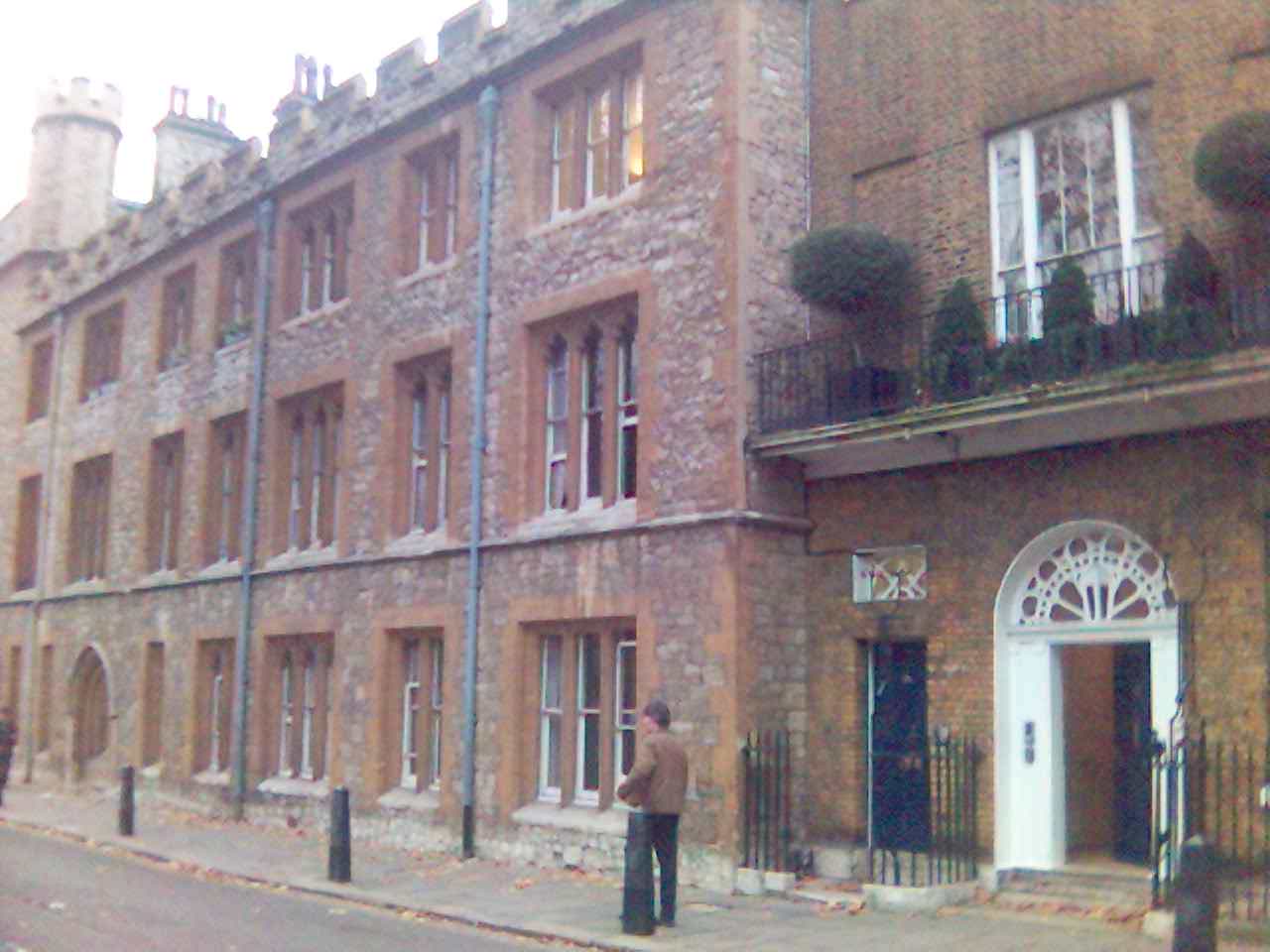
20th Century
Despite many pressures, including evacuation and the destruction of the school roof during the Blitz, the school refused to move out of the city, unlike other schools such as Charterhouse and St. Paul's, and remains in its central London location.
Westminster Under School was formed in 1943 in the evacuated school buildings in Westminster, as a distinct preparatory school for day pupils between the ages of eight to 13 (now seven to 13). Only the separation is new: for example, in the 18th century, Edward Gibbon attended Westminster from the age of 11 and Jeremy Bentham from the age of eight. The Under School has since moved to Vincent Square, overlooking the school's playing fields. Its current Master is Kate Jefferson.
In 1967, the first female pupil was admitted to the school. Girls became full members in 1973. In 1981, a single-sex boarding house, Purcell's, was created for girls. In 1997 the school expanded further with the creation of a new day house, Milne's, at 5a, Dean's Yard.

21st Century
In 2005 the school was one of 50 leading independent schools found guilty of running a cartel, exposed by The Times, which had allowed them to collaborate in uncompetitive fees for thousands of customers. Jean Scott, the head of the Independent Schools Council, said that independent schools had always been exempt from anti-cartel rules applied to business, were following a long-established procedure in sharing the information with each other, and that they were unaware of the change to the law (on which they had not been consulted). She wrote to John Vickers, the OFT director-general, saying, "They are not a group of businessmen meeting behind closed doors to fix the price of their products to the disadvantage of the consumer. They are schools that have quite openly continued to follow a long-established practice because they were unaware that the law had changed.". However, each school agreed to pay a nominal penalty of £10,000 and ex-gratia payments totalling £3 million into a trust designed to benefit pupils who attended the schools during the period in respect of which fee information was shared.
In 2007, the school responded to an invitation to become the sponsor of Pimlico School, which was due to be rebuilt as an academy, but decided not to do so after Westminster City Council developed its plans. In 2013 the school collaborated with the Harris Federation to set up a selective, mixed sixth-form academy, with entrance priority being given to those from disadvantaged backgrounds. Harris Westminster Sixth Form opened nearby in 2014; pupils of the academy share some lessons and facilities of the school.
In 2010 the school and the abbey celebrated the 450th anniversary of the granting of their royal charter and Elizabeth I's refoundation of the school in 1560. Queen Elizabeth II with the Duke of Edinburgh unveiled a controversial statue in Little Dean's Yard of the Queen's namesake Elizabeth I, the nominal foundress of the School, by Old Westminster sculptor Matthew Spender. The head of the statue came off in May 2016 after a Sixth Former (a pupil in Year 12) tried to climb onto the statue. The head has since been reattached.

In 2011, the school agreed to buy a 999-year lease of Lawrence Hall, London from The Royal Horticultural Society. This listed Art-Deco building adjacent to the school's playing fields at Vincent Square has been converted into a Sports Centre. It provides for climbing, martial arts, fencing, rowing, table tennis, badminton, netball, indoor football and indoor cricket. In 2012 the school took possession of St Edward's House, which was the last Anglican monastery in London. The building, on the corner of Great College Street and Tufton Street, now houses Purcell's, a Boarding House for girls and a Day House for boys, as well as a small Chapel and Refectory. Westminster Under School has also been enlarged by a building in Douglas Street, which provides an Art Studio, IT Suite and Dining Hall and has recently modernised a new school building in Chapter Street.
In May 2013, the school was criticized for staging an auction involving the selling of internships to fund bursaries, resulting in adverse press coverage.
In 2014/2015 Westminster was reported to be the 13th most expensive HMC day school and tenth most expensive HMC boarding school in the UK It achieved the highest percentage of students accepted by Oxbridge colleges over the period 2002–2006, and was ranked as best boys' school in the country in terms of GCSE results in 2017. In 2019, 84% of pupils scored A*-A for their A-Levels examination, while 80% scored A*-A for their GCSEs.
In December 2017, the school announced plans to open six schools in China, working with the Hong Kong educational group HKMETG; the first opened in Chengdu in 2020. Revenue generated by the deal will be used to support bursary funds at the existing school, and follows similar moves by Harrow School, Malvern School, Wellington College and Dulwich College. The school was criticized in the media and by its pupils for its decision to teach the Chinese national curriculum as opposed to an international curriculum normally taught by international schools. Steve Tsang, director of the China Institute at SOAS London, was quoted in the Financial Times as saying, "I think they have no idea what they're dealing with.... If you set up a school in China, they will have a party secretary superintending the whole school and the party secretary will be responsible for political education." The school responded that it would exercise "soft power" over the teaching and would also teach an international curriculum for students aged 16–18. The issue was re-opened when The Times published an article quoting Professor Edward Vickers of Kyushu University, who accused the school (and King's College School, with similar plans) of "helping Chinese teach propaganda". These plans were cancelled in November 2021 in response to "recent changes in Chinese education policy".
In 2028 The school plans to introduce girls into Year 9. It will be co-educational in all year groups by 2030.
Architecture
Westminster School, in the middle of the UNESCO World Heritage Site of Westminster Abbey, St. Margaret's, and the Palace of Westminster, has several buildings notable for qualities, age and history. The school stands mainly in the precincts of the medieval monastery of Westminster Abbey, its main buildings surrounding its private square Little Dean's Yard (known as Yard), off Dean's Yard, where Church House, the headquarters of the Church of England, is situated, along with some of the houses, the common room, the humanities building Weston's, and College Hall.
Sutcliff's
Just outside the abbey precincts in Great College Street is Sutcliff's (named after the tuck shop on the site of the building in the 19th century), where Geography, Art, Theology, Philosophy and Classics (Latin and Ancient Greek) are taught. The Robert Hooke Science Centre is further away, just off Smith Square. As part of an expansion programme funded by donations and a legacy from A. A. Milne, the school has acquired the nearby Millicent Fawcett Hall for Drama and Theatre Studies lessons and performances; the Manoukian Centre for Music Lessons (timetabled and private) and recitals; and the Weston Building at 3 Dean's Yard. It often uses St John's, Smith Square as a venue for major musical concerts.
College Garden
College Garden, to the East of Little Dean's Yard, is believed to be the oldest garden in England, under continuous cultivation for about a millennium. Just beyond rises the Victoria Tower of the Houses of Parliament; the King's Scholars have special rights of access to the House of Commons. To the North, the Dark Cloister leads straight to the Abbey, which serves as the School Chapel.
Playing Fields and Boathouse
The playing fields are half a mile away at Vincent Square, which Dean Vincent created for the school by hiring a horse and plough to carve 10 acres (4 hectares) out of the open Tothill Fields. The boathouse is now some way from the school at Putney, where it is also used for the Oxford and Cambridge boat race; but the school's First Eight still returns annually to exercise its traditional right to land at Black Rod Steps of the Palace of Westminster.
Cloisters
The Great Cloisters, St Faith's Chapel, The Chapter House, The Parlour, 1 and 2 The Cloisters, and the dormitory with the Chapel of St Dunstan are listed Grade I as a group on the National Heritage List for England.
Dormitory at Little Dean's Yard
The dormitory at Little Dean's Yard and the staircase and doorway in Little Dean's Yard to the Busby Library are separately listed Grade I.
College Hall
College Hall, the 14th-century abbot's state dining hall, is one of the oldest and finest examples of a medieval refectory and still in daily use for that purpose in term-time; outside of term it reverts to the dean as the abbot's successor. Queen Elizabeth Woodville took sanctuary here in 1483 with five daughters and her son Richard of Shrewsbury, Duke of York, but failed to save him from his fate as one of the Princes in the Tower. In the 1560s, Elizabeth I several times came to see her scholars act their Latin plays on a stage in front of the attractive Elizabethan gallery, which may have been first erected especially for the purpose.
College
College, now shared between the three Houses of College, Dryden's and Wren's, is a dressed stone building overlooking College Garden, the former monastery's Infirmary garden, which is still the property of the Collegiate Church of Westminster Abbey. College dates from 1729 and was designed by the Earl of Burlington, based on earlier designs by Sir Christopher Wren (himself an Old Westminster).
School
School, known as "Up School", originally built in the 1090s as the monks' dormitory, is the school's main hall, used for Latin Prayers (a weekly assembly with prayers in the Westminster dialect of Latin), exams, and large concerts, plays and the like. From 1599 it was used to teach all the pupils, the Upper and Lower Schools being separated by a curtain hung from a 16th-century pig iron bar, which remains the largest piece of pig iron in the world. The panelling "up School" is painted with the coats of arms of many former pupils. The original shell-shaped apse at the north end of the school gave its name to the 'Shell' forms taught there and the corresponding classes at many other public schools. The current shell displays a Latin epigram on the rebuilding of School, with the acrostic Semper Eadem, Elizabeth I's motto. The classroom door to the right of the Shell was recovered from the notorious Star Chamber at its demolition, but was destroyed during the Blitz. The building lies directly on top of the Westminster Abbey museum in the Norman Undercroft, and ends at the start of the Pyx Chamber. Both School and College had their roofs destroyed by incendiary bombs in the Blitz of 1941. They were re-opened by George VI in 1950.
Gateway
The school gateway was also designed by the Earl of Burlington. It is engraved with the names of many pupils, who used to hire a stonemason for the purpose.
Ashburnham
Ashburnham House, not to be confused with the similarly named house, houses the library and the Mathematics Department, and until 2005 accommodated the Economics, English and History of Art departments as well. Ashburnham House may have been built by Inigo Jones or his pupil John Webb around the time of the Restoration, as a London seat for the family, who became the Earls of Ashburnham. It incorporates remains of the mediaeval Prior's House. Its garden is the site of the monks' refectory and some of the earliest sittings of the House of Commons.
In 1731 when Ashburnham housed the King's and Cottonian libraries, which form the basis of the British Library, there was a disastrous fire, and many of the books and manuscripts still show the marks. After the Public Schools Act 1868 there was a scandalous parliamentary and legal battle between the Dean and Chapter of Westminster Abbey and the School until the School eventually obtained Ashburnham House under the Act for £4,000. The dispute was reported in The Times and it was suggested by Thomas Wise, Secretary of The Society for the Protection of Ancient Buildings that the property was "in danger of being pulled down or of being virtually destroyed by being converted into a boarding-house in connexion with Westminster School", adding that the "house is admirably suited for a residence for the Dean or one of the Canons, and is totally unfitted for a school or a boarding house." The school responded: "The Chapter themselves have in past years greatly altered and disfigured Ashburnham-house. It had originally two wings; one was destroyed and never restored. About 1848 the roof was taken off, a story added, and a dome in the ceiling of the drawing-room demolished, the external elevation being ruined. The house now has no beauty externally, and hardly any features of interest internally, except the staircase, which in any case would be preserved". On 28 November William Morris also became involved in the campaign, writing a letter to the editor of The Daily News. In the event, the school demolished the adjacent Turle's House and renovated sections of the east wing, but left the staircase and drawing room untouched.
During the Second World War, the library was used for military purposes and as an American soldiers' club, the Churchill Club.
Customs
The Greaze
The Greaze has been held "up School" (in the School Hall) on Shrove Tuesday since at least 1753. The head cook ceremoniously tosses a horsehair-reinforced pancake over a high bar, which was used from the 16th century to curtain off the Under School from the Great School. Members of the school fight for the pancake for one minute, watched over by the Dean of Westminster, the Head Master, and the upper year groups of the school and distinguished or even occasionally royal visitors. The pupil who gets the largest weight is awarded a gold sovereign (promptly redeemed for use next year), and the Dean begs for a half-holiday for the whole school. Weighing scales are on hand in the event of a dispute. A cook who failed to get the pancake over the bar after three attempts would formerly have been "booked" or pelted with Latin primers, but that tradition has long lapsed.
Coronation
The privilege of being the first commoners to acclaim each new sovereign at their coronation in Westminster Abbey is reserved for the King's (or Queen's) Scholars. Their shouts of "Vivat Rex/Regina" ("Long live the king/queen!") are incorporated into the coronation anthem "I was glad" by Hubert Parry. The tradition dates back to the coronation of King James II.