
Wells Fargo & Company is an American multinational financial services company. The company operates in 35 countries and serves more than 70 million customers worldwide. It is a systemically important financial institution according to the Financial Stability Board, and is considered one of the "Big Four Banks" in the United States, alongside JPMorgan Chase, Bank of America, and Citigroup.
The company's primary subsidiary is Wells Fargo Bank, N.A., a national bank that designates its Sioux Falls, South Dakota, site as its main office (and therefore is treated by most U.S. federal courts as a citizen of South Dakota). It is the fourth-largest bank in the United States by total assets and is also one of the largest as ranked by bank deposits and market capitalization. It has 8,050 branches and 13,000 automated teller machines and 2,000 stand-alone mortgage branches. It is the second-largest retail mortgage originator in the United States, originating one out of every four home loans, and services $1.8 trillion in home mortgages, one of the largest servicing portfolios in the U.S. It is one of the most valuable bank brands. Wells Fargo is ranked 47th on the Fortune 500 list of the largest companies in the U.S.
In addition to banking, the company provides equipment financing via subsidiaries including Wells Fargo Rail and provides investment management and stockbrokerage services. A key part of Wells Fargo's business strategy is cross-selling, the practice of encouraging existing customers to buy additional banking services. This led to the Wells Fargo cross-selling scandal.

The company has been the subject of several investigations by regulators. In February 2018, Wells Fargo account fraud scandal erupted when the Federal Reserve barred the bank from growing its nearly $2 trillion asset base any further, until the company resolved its internal issues to its satisfaction. In September 2021, Wells Fargo incurred further fines from the U.S. DOJ, charging fraudulent behavior by the bank against foreign-exchange currency trading customers. Bloomberg Businessweek reported in March 2022 that Wells Fargo was the only major lender in 2020 to reject more home refinancing applications from Black applicants than it approved.
Wells Fargo has international offices in London, Dublin, Paris, Milan, Dubai, Singapore, Tokyo, Shanghai, Beijing, and Toronto, among others. Back-offices are in India and the Philippines with more than 20,000 staff.
Wells Fargo operates under Charter No. 1, the first national bank charter issued in the United States. This charter was issued to First National Bank of Philadelphia on June 20, 1863, by the Office of the Comptroller of the Currency. Wells Fargo, in its present form, is a result of a merger between the original Wells Fargo & Company and Minneapolis-based Norwest Corporation in 1998. The merged company took the better-known Wells Fargo name and moved to Wells Fargo's hub in San Francisco. At the same time, Norwest's banking subsidiary merged with Wells Fargo's Sioux Falls-based banking subsidiary. Wells Fargo became a coast-to-coast bank with the 2008 acquisition of Charlotte-based Wachovia.
History
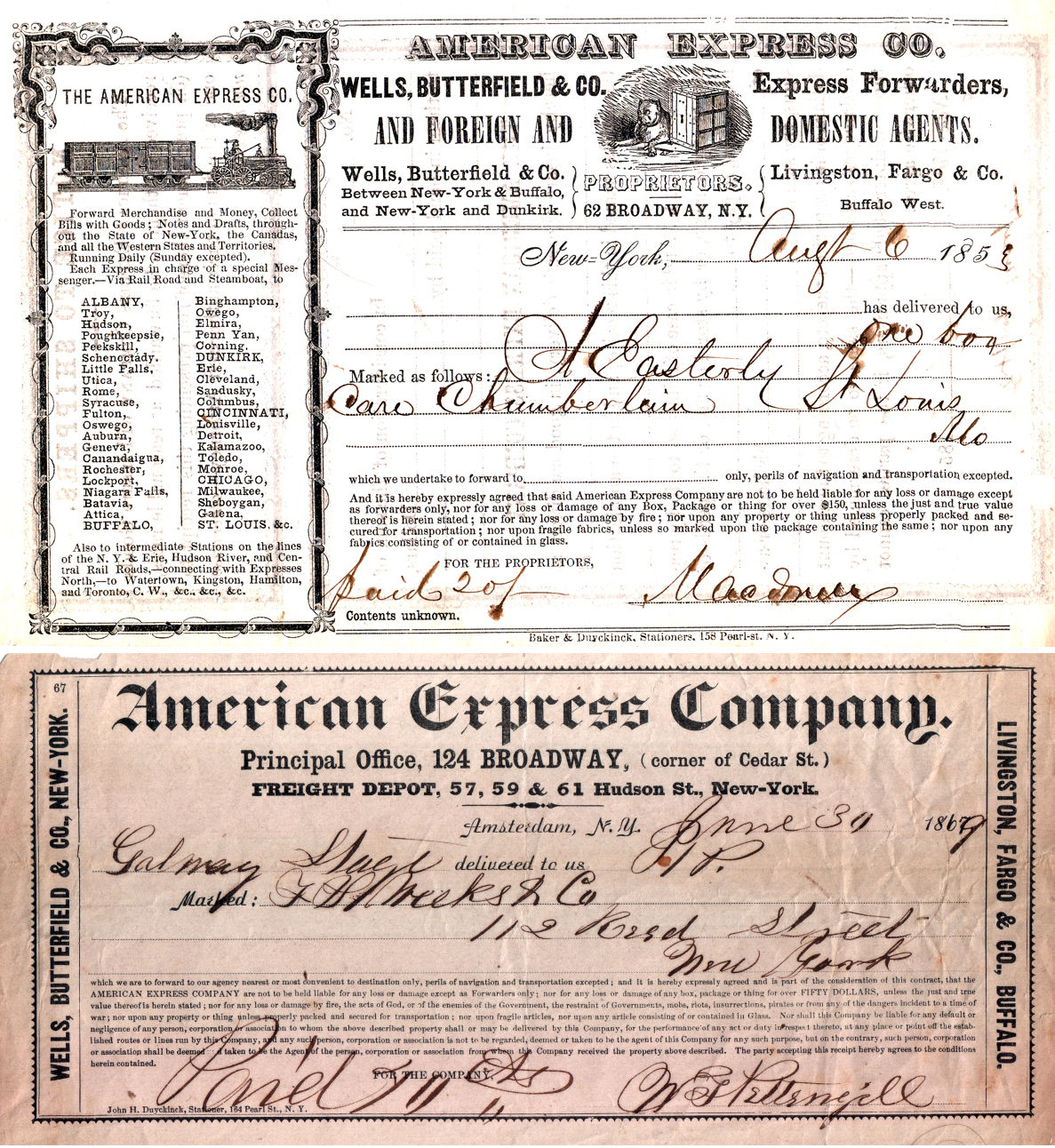
Henry Wells and William G. Fargo, who founded American Express along with John Butterfield, formed Wells Fargo & Company in 1852 to provide "express" and banking services to California, which was growing rapidly due to the California gold rush. Its earliest and most significant tasks included transporting gold from the Philadelphia Mint and "express" mail delivery that was faster and less expensive than U.S. Mail. American Express was not interested in serving California.
By the end of the California gold rush, Wells Fargo was a dominant express and banking organization in the West, making large shipments of gold and delivering mail and supplies. It was also the primary lender of Butterfield Overland Mail Company, which ran a 2,757-mile route through the Southwest to San Francisco and was nicknamed the "Butterfield Line" after the name of the company's president, John Butterfield. In 1860, Congress failed to pass the annual Post Office appropriation bill, leaving the Post Office unable to pay Overland Mail Company. This caused Overland to default on its debts to Wells Fargo, allowing Wells Fargo to take control of the mail route. Wells Fargo then operated the western portion of the Pony Express.
Six years later, the "Grand Consolidation" united Wells Fargo, Holladay, and Overland Mail stage lines under the Wells Fargo name.

In 1872, Lloyd Tevis, a friend of the Central Pacific "Big Four" and holder of rights to operate an express service over the Transcontinental Railroad, became president of the company after acquiring a large stake, a position he held until 1892.
In 1905, Wells Fargo separated its banking and express operations, and Wells Fargo's bank merged with the Nevada National Bank to form the Wells Fargo Nevada National Bank.
During the First World War, the United States government nationalized Wells Fargo's express business into a federal agency known as the US Railway Express Agency (REA). After the war, the REA was privatized and continued service until 1975.

In 1923, Wells Fargo Nevada merged with the Union Trust Company to form the Wells Fargo Bank & Union Trust Company.
In 1954, Wells Fargo & Union Trust shortened its name to Wells Fargo Bank. Four years later, it merged with American Trust Company to form the Wells Fargo Bank American Trust Company. It changed its name back to Wells Fargo Bank in 1962.
In 1968, Wells Fargo was converted to a federal banking charter and became Wells Fargo Bank, N.A. In that same year, Wells Fargo merged with Henry Trione's Sonoma Mortgage in a $10.8 million stock transfer, making Trione the largest shareholder in Wells Fargo until Warren Buffett and Walter Annenberg surpassed him.

One year later, Wells Fargo & Company holding company was formed, with Wells Fargo Bank as its main subsidiary.
In September 1983, a Wells Fargo armored truck depot in West Hartford, Connecticut, was the victim of the White Eagle robbery. The robbery was organized by Los Macheteros (a guerrilla group seeking Puerto Rican independence from the United States) and involved an insider armored truck guard. It was the largest US bank theft to date with $7.1 million stolen.
Throughout the 1980s and '90s, Wells Fargo completed a series of acquisitions. In 1986, it acquired Crocker National Bank from Midland Bank. Then, in 1987 it acquired the personal trust business of Bank of America. In 1988, it acquired Barclays Bank of California from Barclays plc. In 1991, Wells Fargo spent $491 million to acquire 130 branches in California from Great American Bank. In 1996, Wells Fargo acquired First Interstate Bancorp for $11.6 billion. Integration went poorly as many executives left.

Wells Fargo became the first major US financial services firm to offer internet banking, in May 1995.
After its string of acquisitions, in 1998, Wells Fargo Bank was acquired by Norwest Corporation of Minneapolis, with the combined company assuming the Wells Fargo name.
It then began on another set of acquisitions, starting in 2000, when Wells Fargo Bank acquired National Bank of Alaska and First Security Corporation. In late 2001, it acquired H.D. Vest Financial Services for $128 million, but sold it in 2015 for $580 million. The 2008 financial crisis resulted in many bank takeovers. In 2007, Wells Fargo acquired Greater Bay Bancorp, which had $7.4 billion in assets, in a $1.5 billion transaction. It also acquired Placer Sierra Bank and CIT Group's construction unit that same year. In 2008, Wells Fargo acquired United Bancorporation of Wyoming and Century Bancshares of Texas.
On October 3, 2008, after Wachovia turned down an inferior offer from Citigroup, Wachovia agreed to be bought by Wells Fargo for about $14.8 billion in stock. The next day, a New York state judge issued a temporary injunction blocking the transaction from going forward while the competing offer from Citigroup was sorted out. Citigroup alleged that it had an exclusivity agreement with Wachovia that barred Wachovia from negotiating with other potential buyers. The injunction was overturned late in the evening on October 5, 2008, by the New York state appeals court. Citigroup and Wells Fargo then entered into negotiations brokered by the FDIC to reach an amicable solution to the impasse. The negotiations failed. Citigroup was unwilling to take on more risk than the $42 billion that would have been the cap under the previous FDIC-backed deal (with the FDIC incurring all losses over $42 billion). Citigroup did not block the merger, but sought damages of $60 billion for breach of an alleged exclusivity agreement with Wachovia.
On October 28, 2008, Wells Fargo received $25 billion of funds via the Emergency Economic Stabilization Act in the form of a preferred stock purchase by the United States Department of the Treasury. As a result of requirements of the government stress tests, the company raised $8.6 billion in capital in May 2009. On December 23, 2009, Wells Fargo redeemed $25 billion of preferred stock issued to the United States Department of the Treasury. As part of the redemption of the preferred stock, Wells Fargo also paid accrued dividends of $131.9 million, bringing the total dividends paid to $1.441 billion since the preferred stock was issued in October 2008.
In April 2009, Wells Fargo acquired North Coast Surety Insurance Services.
In 2010, hedge fund administrator Citco purchased the trust company operation of Wells Fargo in the Cayman Islands.
In 2011, the company hired 25 investment bankers from Citadel LLC.
In April 2012, Wells Fargo acquired Merlin Securities. In December 2012, it was rebranded as Wells Fargo Prime Services. In December of that year, Wells Fargo acquired a 35% stake in The Rock Creek Group LP. The stake was increased to 65% in 2014 but sold back to management in July 2018.
In 2015, Wells Fargo Rail acquired GE Capital Rail Services and merged in with First Union Rail. In late 2015, Wells Fargo acquired three GE units focused on business loans equipment financing.
In March 2017, Wells Fargo announced a plan to offer smartphone-based transactions with mobile wallets including Wells Fargo Wallet, Android Pay and Samsung Pay.
In June 2018, Wells Fargo sold all 52 of its physical bank branch locations in Indiana, Michigan, and Ohio to Flagstar Bank.
In September 2018, Wells Fargo announced it would cut 26,450 jobs by 2020 to reduce costs by $4 billion.
In March 2019, CEO Tim Sloan resigned amidst the Wells Fargo account fraud scandal and former general counsel C. Allen Parker became interim CEO.
In July 2019, Principal Financial Group acquired the company's Institutional Retirement & Trust business.
On September 27, 2019, Charles Scharf was announced as the firm's new CEO.
In 2020, the company sold its student loan portfolio.
In May 2021, the company sold its Canadian Direct Equipment Finance business to Toronto-Dominion Bank.
In 2021, the company sold its asset management division, Wells Fargo Asset Management (WFAM) to private equity firms GTCR and Reverence Capital Partners for $2.1 billion. WFAM had $603 billion in assets under management as of December 31, 2020, of which 33% was invested in money market funds. WFAM was rebranded as Allspring Global Investments.
In December 2023, Wells Fargo became the first major U.S. bank with a unionized branch, when employees at an Albuquerque, New Mexico branched voted to join the Communications Workers of America's Wells Fargo Workers United (WFWU). As of 2026, less than 30 of the bank's 4,000 branches have unionized, about 0.1% of the bank’s workforce.
On September 23, 2024, Wells Fargo launched a $1.6 billion delayed-draw term loan to support Tempur Sealy International's acquisition of Mattress Firm Group.
In December 2024, Wells Fargo announced that it would be selling its decades-long San Francisco headquarters building to downsize its footprint in San Francisco by moving to another building nearby. The move was interpreted by bankers as a sign of the financial industry drifting away from San Francisco and California.
In June 2025, Wells Fargo hired a senior banker from Citigroup to lead its activism defense practice, as corporations find it difficult to build out business units to help clients facing pressure from activist investors.
In July 2025, Wells Fargo announced that it sought to end its partnership with Bilt Rewards ahead of schedule, a venture that initially began in 2022. Wells Fargo was losing as much as $10 million per month according to The Wall Street Journal. The partnership was initially set to end in 2029.
Environmental record
In 2022, Wells Fargo announced a goal of reducing absolute emissions by companies it lends to in the oil and gas sector by 26% by 2030 from 2019 levels. Some critics say these goals conflict with the bank being the largest lender to fossil fuel companies in the U.S. and one of the largest globally. The company has committed to net zero financed emissions by 2050; however, major environmental groups are skeptical that this goal will be achieved. The company has stated that it will not finance any hydrocarbon exploration projects in the Arctic. The company has also provided financing to renewable energy projects.
In December 2024, Wells Fargo withdrew itself from its membership of Net- Zero Banking Alliance.
Financing of Dakota Access Pipeline
Wells Fargo is a lender on the Dakota Access Pipeline, a 1,172-mile-long (1,886 km) underground oil pipeline transport system in North Dakota. The pipeline has been controversial regarding its potential impact on the environment.
In February 2017, the city councils of Seattle, Washington and Davis, California voted to move $3 billion of deposits from the bank due to its financing of the Dakota Access Pipeline as well as the Wells Fargo account fraud scandal.
Lawsuits, fines, and controversies
Regulatory issues
The company has been the subject of several investigations by regulators. Many of these issues have resulted in reputational damage. On February 2, 2018, the Wells Fargo account fraud scandal resulted in the Federal Reserve barring Wells Fargo from growing its nearly $2 trillion asset base any further until the company fixed its internal problems to the satisfaction of the Federal Reserve. In June 2025, the Federal Reserve lifted the punitive asset cap, allowing the bank to pursue growth and provide more financing to corporate clients. Scharf called the decision "a pivotal milestone in our journey to transform Wells Fargo."
In September 2021, Wells Fargo incurred further fines from the United States Justice Department charging fraudulent behavior by the bank against foreign-exchange currency trading customers. Bloomberg L.P. reported in March 2022 that Wells Fargo was the only major lender in 2020 to reject more home refinance applications from Black applicants than it approved.
In December 2022, the U.S. levied a $3.7 billion loan-management fine upon Wells Fargo. In March 2023, Wells Fargo blamed a technical glitch for misstating the balances of customers' accounts, in many cases incorrectly deeming the customers as having a negative bank balance. Subsequently, in 2023, prison sentencing took place for employee-directed money laundering and funneling cash illegally to Mexico through the creation of fictitious accounts.
1981 MAPS Wells Fargo embezzlement scandal
In 1981, it was discovered that a Wells Fargo assistant operations officer, Lloyd Benjamin "Ben" Lewis, had perpetrated one of the largest embezzlements in history through its Beverly Drive branch. During 1978–1981, Lewis had successfully written phony debit and credit receipts to benefit boxing promoters Harold J. Smith (né Ross Eugene Fields) and Sam "Sammie" Marshall, chairman and president, respectively, of Muhammad Ali Professional Sports, Inc. (MAPS), of which Lewis was also listed as a director; Marshall, too, was a former employee of the same Wells Fargo branch as Lewis. In excess of $300,000 was paid to Lewis, who pled guilty to embezzlement and conspiracy charges in 1981, and testified against his co-conspirators for a reduced five-year sentence. (Boxer Muhammad Ali had received a fee for the use of his name, and had no other involvement with the organization.)
Higher costs charged to African-American and Hispanic borrowers
Illinois Attorney General Lisa Madigan filed suit against Wells Fargo on July 31, 2009, alleging that the bank steered African Americans and Hispanics into high-cost subprime loans. A Wells Fargo spokesman responded that "The policies, systems, and controls we have in place – including in Illinois – ensure race is not a factor..." An affidavit filed in the case stated that loan officers had referred to black mortgage-seekers as "mud people," and the subprime loans as "ghetto loans." According to Beth Jacobson, a loan officer at Wells Fargo interviewed for a report in The New York Times, "We just went right after them. Wells Fargo mortgage had an emerging-markets unit that specifically targeted black churches because it figured church leaders had a lot of influence and could convince congregants to take out subprime loans." The report presented data from the city of Baltimore, where more than half the properties subject to foreclosure on a Wells Fargo loan from 2005 to 2008 now stand vacant, and 71 percent of those are in predominantly black neighborhoods. Wells Fargo agreed to pay $125 million to subprime borrowers and $50 million in direct down payment assistance in certain areas, for a total of $175 million.
Failure to monitor suspected money laundering
In a March 2010 agreement with US federal prosecutors, Wells Fargo acknowledged that between 2004 and 2007 Wachovia had failed to monitor and report suspected money laundering by narcotics traffickers, including the cash used to buy four planes that shipped a total of 22 tons of cocaine into Mexico.