
The Weather Underground was an American Marxist militant organization active from 1969 until 1977. Originally known as the Weathermen, or simply Weatherman, the group was organized as a faction of the national leadership of Students for a Democratic Society (SDS). Officially known as the Weather Underground Organization (WUO) beginning in 1970, the group's express political goal was to create a revolutionary party to overthrow the United States government, which the WUO viewed as imperialist.
The Federal Bureau of Investigation (FBI) regarded the WUO as a domestic terrorist group, with revolutionary positions characterized by Black Power and opposition to the Vietnam War. The WUO took part in such actions as the jailbreak of Timothy Leary in 1970. The "Days of Rage", the WUO's first riot in October 1969 in Chicago, was timed to coincide with the trial of the Chicago Seven. In 1970 the group issued a "Declaration of a State of War" against the U.S. government under the name "Weather Underground Organization".
In the 1970s, the WUO conducted a bombing campaign targeting government buildings and banks. Some attacks were preceded by evacuation warnings, along with threats identifying the particular matter that the attack was intended to protest. Three members of the WUO were killed in an accidental explosion in New York City's Greenwich Village, but none were killed in any of the bombings. The WUO communiqué issued in connection with its bombing of the United States Capitol on March 1, 1971, indicated that it was "in protest of the U.S. invasion of Laos". The WUO asserted that its May 19, 1972, bombing of the Pentagon was "in retaliation for the U.S. bombing raid in Hanoi". On September 28, 1973, an ITT Corporation building in New York was bombed in retaliation for the company's involvement in the 1973 Chilean coup d'état. The WUO announced that its January 29, 1975, bombing of the U.S. State Department was "in response" to recent escalation in Vietnam.

The WUO began to disintegrate after the U.S. reached a peace accord with Vietnam in 1973, and was defunct by 1977. Some members of the group joined the May 19th Communist Organization and continued their activities until that group disbanded in 1985.
The Weather Underground took its name from Bob Dylan's lyric "You don't need a weatherman to know which way the wind blows", from the song "Subterranean Homesick Blues" (1965). That Dylan line was also the title of a position paper distributed at an SDS convention in Chicago on June 18, 1969. This founding document called for a "White fighting force" to be allied with the "Black Liberation Movement" and other radical movements to achieve "the destruction of U.S. imperialism and form a classless communist world".
Background and formation
The Weather Underground emerged from campus-based opposition to United States involvement in the Vietnam War as well as from the civil rights movement of the 1960s, particularly from the emergence of the Students for a Democratic Society (SDS), one of the leading organizations in the New Left.
One of the factors that contributed to the radicalization of SDS members was the Economic Research and Action Project, which the group undertook in urban neighborhoods in the Northeastern United States between 1963 and 1968. This project was aimed at creating an interracial movement of impoverished Americans that would mobilize for full and fair employment or guaranteed annual income and political rights. The group's goal was to create a more democratic society "which guarantees political freedom, economic and physical security, abundant education, and incentives for wide cultural variety". While the initial phase of the SDS involved campus organizing, phase two involved community organizing. These experiences led some SDS members to conclude that deep social change would not happen through community organizing and electoral politics, and that more radical and disruptive tactics were needed.
In the late 1960s, United States military action in Southeast Asia escalated, especially in the Vietnam War. In the U.S., anti-war sentiment was particularly pronounced during the 1968 presidential election. Around this time, the SDS began to fragment and collapse following a split between the group's leadership in the "National Office", the Progressive Labor Party (PLP) and their respective supporters. During the factional struggle, National Office leaders such as Bernardine Dohrn and Mike Klonsky began announcing their emerging perspectives, and Klonsky published a manifesto titled "Toward a Revolutionary Youth Movement" (RYM).
RYM promoted the philosophy that young workers possessed the potential to be a revolutionary force which could overthrow capitalism, if not by themselves then by transmitting radical ideas to the working class. Klonsky's document reflected the philosophy of the National Office and was eventually adopted as the SDS's official doctrine. During the summer of 1969, however, the National Office itself began to split. One group, led by Klonsky, became known as RYM II; the other group, RYM I, was led by Dohrn and endorsed more aggressive tactics such as direct action, as some members felt that years of nonviolent resistance had done little or nothing to stop the war. The Weathermen strongly sympathized with the radical Black Panther Party; the police killing of Panther Fred Hampton prompted the Weathermen to issue a declaration of war upon the U.S. government.
We petitioned, we demonstrated, we sat in. I was willing to get hit over the head, I did; I was willing to go to prison, I did. To me, it was a question of what had to be done to stop the much greater violence that was going on.
SDS Convention, June 1969
At an SDS convention in Chicago on June 18, 1969, the National Office attempted to persuade unaffiliated delegates not to endorse a takeover by the PLP, who had packed the convention with their supporters. The PLP was a Stalinist group that had turned to the SDS to recruit new members after meeting with little success in organizing industrial workers, their preferred base. SDS members of that time were nearly all anti-communist but refused to be drawn into actions that could be perceived as red-baiting, which they viewed as mostly irrelevant and out of date. The PLP soon began to organize a Worker Student Alliance. By the late 1960s the group would profoundly affect SDS, particularly at national gatherings of the membership, forming a well-groomed, disciplined faction which followed the PLP line. At the beginning of the June 1969 convention, two position papers were passed out by the National Office leadership, one a revised statement of Klonsky's manifesto, the other called "You Don't Need a Weatherman to Know Which Way the Wind Blows".
The latter document outlined the position of the group that would become the Weather Underground. It had been signed by Dohrn, Karen Ashley, Bill Ayers, John Jacobs, Jeff Jones, Gerry Long, Howie Machtinger, Jim Mellen, Terry Robbins, Mark Rudd and Steve Tappis. The document called for creating a clandestine revolutionary party:
The most important task for us toward making the revolution, and the work our collectives should engage in, is the creation of a mass revolutionary movement, without which a clandestine revolutionary party will be impossible. A revolutionary mass movement is different from the traditional revisionist mass base of "sympathizers". Rather it is akin to the Red Guard in China, based on the full participation and involvement of masses of people in the practice of making revolution; a movement with a full willingness to participate in the violent and illegal struggle.
At the June 1969 convention, the Weathermen faction planned for October 8–11 as a "National Action" built around Jacobs' slogan, "bring the war home". The National Action grew out of a resolution drafted by Jacobs and introduced at the October 1968 SDS National Council meeting in Boulder, Colorado. The resolution, titled "The Elections Don't Mean Shit—Vote Where the Power Is—Our Power Is In The Street" and adopted by the council, was prompted by the perceived success of the protests at the 1968 Democratic National Convention and reflected Jacobs' strong advocacy of direct action.
As part of the "National Action Staff", Jacobs was an integral part of the planning for what quickly came to be called "Four Days of Rage". For Jacobs, the goal of the "Days of Rage" was clear:
Weatherman would shove the war down their dumb, fascist throats and show them, while we were at it, how much better we were than them, both tactically and strategically, as a people. In an all-out civil war over Vietnam and other fascist U.S. imperialism, we were going to bring the war home. 'Turn the imperialists' war into a civil war', in Lenin's words. And we were going to kick ass.
In July 1969, thirty members of Weathermen leadership traveled to Cuba and met with North Vietnamese representatives to gain from their revolutionary experience. The North Vietnamese requested armed political action in order to stop the U.S. government's war in Vietnam. Subsequently, the group accepted funding, training, recommendations on tactics and slogans from Cuba, and perhaps explosives as well.
SDS Convention, December 1969
After the Days of Rage, the Weathermen held the last of its National Council meetings from December 26–31, 1969, in Flint, Michigan. The meeting, dubbed the "War Council" by the 300 people who attended, adopted Jacobs' call for violent revolution. Dohrn opened the conference by telling the delegates they needed to stop being afraid and begin the "armed struggle". Over the next five days, the participants met in informal groups to discuss what "going underground" meant, how best to organize collectives and justifications for violence. In the evening, the groups reconvened for a mass "wargasm"—practicing karate, engaging in physical exercise, singing songs and listening to speeches.
The War Council ended with a major speech by Jacobs, who condemned the "pacifism" of white middle-class American youth, a belief which he claimed they held because they were insulated from the violence which afflicted blacks and the poor. He declared that youth were moving away from passivity and apathy and toward a new high-energy culture of "depersonalization" brought about by drugs, sex and armed revolution. "We're against everything that's 'good and decent' in honky America," Jacobs said in his most commonly quoted statement. "We will burn and loot and destroy. We are the incubation of your mother's nightmare."
Two major decisions came out of the War Council. The first was to go underground and to begin a violent, armed struggle against the state without attempting to organize or mobilize a broad swath of the public. The Weathermen hoped to create underground collectives in major cities throughout the country. Ultimately, the group eventually created only three significant, active collectives; one in California, one in the Midwest and one in New York City. The New York City collective was led by Jacobs and Terry Robbins, and included Ted Gold, Kathy Boudin, Cathy Wilkerson (Robbins's girlfriend) and Diana Oughton. Jacobs was one of Robbins' biggest supporters and pushed the Weathermen's national leadership to allow Robbins be as violent as he wanted to be. The Weathermen leadership agreed, as did the New York City collective. The collective's first target was Judge John Murtagh, who was overseeing the trial of the "Panther 21".
The second major decision was the dissolution of the SDS. After the group's fragmentation in the summer of 1969, the Weathermen's adherents explicitly claimed themselves to be the true leadership of the organization and retained control of the National Office. Thereafter, any leaflet, label or logo bearing the name "Students for a Democratic Society" (SDS) was in fact the views and politics of the Weathermen, not of the slate elected by the PLP. The Weathermen contained the vast majority of former SDS National Committee members, including Dohrn, Mark Rudd, David Gilbert and Vernon T. Grizzard. The group, while small, was able to commandeer the mantle of SDS and all of its membership lists, but with the Weathermen in charge there was little or no support from local branches or members of the old organization, and local chapters soon disbanded. At the War Council, the Weathermen had decided to close the SDS National Office, ending an organization which at its peak included 100,000 members just a few years earlier.
Ideology
The thesis of Weatherman theory, as expounded in its founding document, "You Don't Need a Weatherman to Know Which Way the Wind Blows", was that "the main struggle going on in the world today is between U.S. imperialism and the national liberation struggles against it", based on Vladimir Lenin's theory of imperialism, first expounded in Imperialism, the Highest Stage of Capitalism (1916). In Weatherman theory "oppressed peoples" are the creators of the wealth of empire, and "the goal of revolutionary struggle must be the control and use of this wealth in the interest of the oppressed peoples of the world" in the service of establishing "world communism".
Vietnam and other third world countries, as well as third world people within the United States, were to play a vanguard role. They "set the terms for class struggle in America ...". The role of the "Revolutionary Youth Movement" was to build a centralized organization of revolutionaries, a "Marxist–Leninist Party" supported by a mass revolutionary movement to support international liberation movements and "open another battlefield of the revolution."
The theoretical basis of the Revolutionary Youth Movement was an insight that most of the American population, including both students and the supposed "middle class", comprised, due to their relationship to the instruments of production, the working class, thus the organizational basis of the SDS, which had begun in the elite colleges and had been extended to public institutions as the organization grew could be extended to youth as a whole including students, those serving in the military, and the unemployed. Students could be viewed as workers gaining skills prior to employment. This contrasted to the Progressive Labor view which viewed students and workers as being in separate categories which could ally, but should not jointly organize.
FBI analysis of the travel history of the founders and initial followers of the organization emphasized contacts with foreign governments, particularly the Cuban and North Vietnamese and their influence on the ideology of the organization. Participation in the Venceremos Brigade, a program which involved U.S. students volunteering to work in the sugar harvest in Cuba, is highlighted as a common factor in the background of the founders of the Weather Underground, with China a secondary influence. This experience was cited by both Kathy Boudin and Bernardine Dohrn as a major influence on their political development.
Terry Robbins took the organization's name from the lyrics of the Bob Dylan song "Subterranean Homesick Blues", which featured the lyrics "You don't need a weatherman to know which way the wind blows." The lyrics had been quoted at the bottom of an influential essay in the SDS newspaper, New Left Notes. By using this title the Weathermen meant, partially, to appeal to the segment of U.S. youth inspired to action for social justice by Dylan's songs.
The Weatherman group had long held that militancy was becoming more important than nonviolent forms of anti-war action, and that campus-based demonstrations needed to be punctuated with more dramatic actions which had the potential to interfere with the U.S. military and internal security apparatus. The belief was that these types of urban guerrilla actions would act as a catalyst for the coming revolution. Many international events indeed seemed to support the Weathermen's overall assertion that worldwide revolution was imminent, such as the tumultuous Cultural Revolution in China; the 1968 student revolts in France, Mexico City and elsewhere; the Prague Spring; the Northern Ireland Civil Rights Association; the emergence of the Tupamaros organization in Uruguay; the emergence of the Guinea-Bissauan Revolution and similar Marxist-led independence movements throughout Africa; and within the U.S., the prominence of the Black Panther Party, together with a series of "ghetto rebellions" throughout poor black neighborhoods across the country.
We felt that doing nothing in a period of repressive violence is itself a form of violence. That's really the part that I think is the hardest for people to understand. If you sit in your house, live your white life and go to your white job, and allow the country that you live in to murder people and to commit genocide, and you sit there and you don't do anything about it, that's violence.
The Weathermen were outspoken critics of the concepts that later came to be known as "white privilege" (described as white-skin privilege) and identity politics. As the civil disorder in poor black neighborhoods intensified in the early 1970s, Dohrn said, "White youth must choose sides now. They must either fight on the side of the oppressed or be on the side of the oppressor."
Anti-imperialism, anti-racism, and white privilege
Weather maintained that their stance differed from the rest of the movements at the time in the sense that they predicated their critiques on the notion that they were engaged in "an anti-imperialist, anti-racist struggle". Weather put the international proletariat at the center of their political theory. Weather warned that other political theories, including those addressing class interests or youth interests, were "bound to lead in a racist and chauvinist direction". Weather denounced other political theories of the time as "objectively racist" if they did not side with the international proletariat; such political theories, they argued, needed to be "smashed".
Members of Weather further contended that efforts at "organizing whites against their own perceived oppression" were "attempts by whites to carve out even more privilege than they already derive from the imperialist nexus". Weather's political theory sought to make every struggle an anti-imperialist, anti-racist struggle; out of this premise came their interrogation of critical concepts that would later be known as "white privilege". As historian Dan Berger writes, Weather raised the question "what does it mean to be a white person opposing racism and imperialism?"
At one point, the Weathermen adopted the belief that all white babies were "tainted with the original sin of "skin privilege", declaring "all white babies are pigs" with one Weatherwoman telling feminist poet Robin Morgan "You have no right to that pig male baby" after she saw Morgan breastfeeding her son and told Morgan to put the baby in the garbage. Charles Manson was an obsession within the group and Dohrn claimed he truly understood the iniquity of white America, with the Manson family being praised for the murder of Sharon Tate; Dohrn's cell subsequently made its salute a four-fingered gesture that represented the "fork" used to stab Tate.
Practice
Shortly after its formation as an independent group, Weatherman created a central committee, the Weather Bureau, which assigned its cadres to a series of collectives in major cities. These cities included New York, Boston, Seattle, Philadelphia, Cincinnati, Buffalo, and Chicago, the home of the SDS's head office. The collectives set up under the Weather Bureau drew their design from Che Guevara's foco theory, which focused on the building of small, semi-autonomous cells guided by a central leadership.
To try to turn their members into hardened revolutionaries and to promote solidarity and cohesion, members of collectives engaged in intensive criticism sessions which attempted to reconcile their prior and current activities to Weathermen doctrine. These "criticism self-criticism" sessions (also called "CSC" or "Weatherfries") were the most distressing part of life in the collective. Derived from Maoist techniques, it was intended to root out racist, individualist and chauvinist tendencies within group members. At its most intense, members would be berated for a dozen or more hours non-stop about their flaws. It was intended to make group members believe that they were, deep down, white supremacists by subjecting them to constant criticism to break them down. The sessions were used to ridicule and bully those who didn't agree with the party line and force them into acceptance. However, the sessions were also almost entirely successful at purging potential informants from the Weathermen's ranks, making them crucial to the Weathermen's survival as an underground organization. The Weathermen were also determined to destroy "bourgeois individualism" amongst members that would potentially interfere with their commitment to both the Weathermen and the goal of revolution. Personal property was either renounced or given to the collective, with income being used to purchase the needs of the group and members enduring spartan living conditions. Conventional comforts were forbidden, and the leadership was exalted, giving them immense power over their subordinates (in some collectives the leadership could even dictate personal decisions such as where one went). Martial arts were practiced and occasional direct actions were engaged in. Critical of monogamy, they launched a "smash monogamy" campaign, in which couples (whose affection was deemed unacceptably possessive, counterrevolutionary or even selfish) were to be split apart; collectives underwent forced rotation of sex partners (including allegations that some male leaders rotated women between collectives in order to sleep with them) and in some cases engaged in sexual orgies. This formation continued during 1969 and 1970 until the group went underground and a more relaxed lifestyle was adopted as the group blended into the counterculture.
Life in the collectives could be particularly hard for women, who made up about half the members. Their political awakening had included a growing awareness of sexism, yet they often found that men took the lead in political activities and discussion, with women often engaging in domestic work, as well as finding themselves confined to second-tier leadership roles. Certain feminist political beliefs had to be disavowed or muted and the women had to prove, regardless of prior activist credentials, that they were as capable as men in engaging in political action as part of "women's cadres", which were felt to be driven by coerced machismo and failed to promote genuine solidarity amongst the women. While the Weathermen's sexual politics did allow women to assert desire and explore relationships with each other, it also made them vulnerable to sexual exploitation.
Recruitment
Weather used various means by which to recruit new members and set into motion a nationwide revolt against the government. Weather members aimed to mobilize people into action against the established leaders of the nation and the patterns of injustice which existed in America and abroad due to America's presence overseas. They also aimed to convince people to resist reliance upon their given privilege and to rebel and take arms if necessary. According to Weatherman, if people tolerated the unjust actions of the state, they became complicit in those actions. In the manifesto compiled by Ayers, Dohrn, Jones, and Celia Sojourn, entitled "Prairie Fire: The Politics of Revolutionary Anti-Imperialism," Weatherman explained that their intention was to encourage the people and provoke leaps in confidence and consciousness in an attempt to stir the imagination, organize the masses, and join in the people's day-to-day struggles in every way possible.
In the year 1960, over a third of America's population was under 18 years of age. The number of young citizens set the stage for a widespread revolt against perceived structures of racism, sexism, and classism, the violence of the Vietnam War and America's interventions abroad. At college campuses throughout the country, anger against "the Establishment's" practices prompted both peaceful and violent protest.
The members of Weatherman targeted high school and college students, assuming they would be willing to rebel against the authoritative figures who had oppressed them, including cops, principals, and bosses. Weather aimed to develop roots within the class struggle, targeting white working-class youths. The younger members of the working class became the focus of the organizing effort because they felt the oppression strongly in regard to the military draft, low-wage jobs, and schooling.
Schools became a common place of recruitment for the movement. In direct actions, dubbed Jailbreaks, Weather members invaded educational institutions as a means by which to recruit high school and college students. The motivation of these jailbreaks was the organization's belief that school was where the youth were oppressed by the system and where they learned to tolerate society's faults instead of rise against them. According to "Prairie Fire", young people are channeled, coerced, misled, miseducated, misused in the school setting. It is in schools that the youth of the nation become alienated from the authentic processes of learning about the world.
Factions of the Weatherman organization began recruiting members by applying their own strategies. Women's groups such as The Motor City Nine and Cell 16 took the lead in various recruitment efforts. Roxanne Dunbar-Ortiz, a member of the radical women's liberation group Cell 16 spoke about her personal recruitment agenda saying that she wanted their group to go out in every corner of the country and tell women the truth, recruit the local people, poor and working-class people, in order to build a new society.
Berger explains the controversy surrounding recruitment strategies saying, "As an organizing strategy it was less than successful: white working class youths were more alienated than organized by Weather's spectacles, and even some of those interested in the group were turned off by its early hi-jinks."
Armed propaganda
In 2006, Dan Berger (writer, activist, and longtime anti-racism organizer) states that following their initial set of bombings, which resulted in the Greenwich Village townhouse explosion, the organization adopted a new paradigm of direct action set forth in the communiqué New Morning, Changing Weather, which abjured attacks on people. The shift in the organization's outlook was in good part due to the 1970 death of Weatherman Terry Robbins, Diana Oughton and Ted Gold, all graduate students, in the Greenwich Village townhouse explosion.
According to Dan Berger a relatively sophisticated program of armed propaganda was adopted. This consisted of a series of bombings of government and corporate targets in retaliation for specific imperialist and oppressive acts. Small, well-constructed time bombs were used, generally in vents in restrooms, which exploded at times the spaces were empty. Timely warnings were made, and communiqués issued explaining the reason for the actions.
Major activities
Haymarket Police Memorial bombing
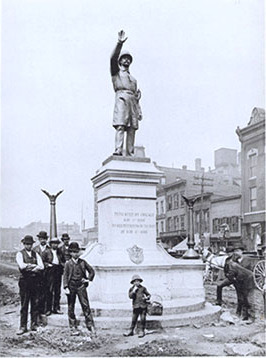
Shortly before the Days of Rage demonstrations on October 6, 1969, the Weatherman planted a bomb which blew up a statue in Chicago commemorating the deaths of police officers during the 1886 Haymarket Riot. The blast broke nearly 100 windows and scattered pieces of the statue onto the Kennedy Expressway below. The city rebuilt the statue and unveiled it on May 4, 1970, but the Weathermen blew it up as well on October 6, 1970. The city rebuilt the statue once again, and Mayor Richard J. Daley posted a 24-hour police guard to protect it, but the Weathermen destroyed the third one, as well. The city compromised and rebuilt the monument once more, but this time they located it at Chicago Police Headquarters.
"Days of Rage"
One of the first acts of the Weathermen after splitting from SDS was to announce they would hold the "Days of Rage" that autumn. This was advertised to "Bring the war home!" Hoping to cause sufficient chaos to "wake" the American public out of what they saw as complacency toward the role of the U.S. in the Vietnam War, the Weathermen meant it to be the largest protest of the decade. They had been told by their regional cadre to expect thousands to attend; however, when they arrived, they found only a few hundred people.
According to Ayers in 2003, "The Days of Rage was an attempt to break from the norms of kind of acceptable theatre of 'here are the anti-war people: containable, marginal, predictable, and here's the little path they're going to march down, and here's where they can make their little statement.' We wanted to say, "No, what we're going to do is whatever we had to do to stop the violence in Vietnam.'" The protests did not meet Ayers' stated expectations.
Though the October 8, 1969, rally in Chicago had failed to draw as many as the Weathermen had anticipated, the two or three hundred who did attend shocked police by rioting through the affluent Gold Coast neighborhood. They smashed the windows of a bank and those of many cars. The crowd ran four blocks before encountering police barricades. They charged the police but broke into small groups; more than 1,000 police counter attacked. Many protesters were wearing motorcycle or football helmets, but the police were well trained and armed. Large amounts of tear gas were used, and at least twice police ran squad cars into the mob. The rioting lasted about half an hour, during which 28 policemen were injured. Six Weathermen were shot by the police and an unknown number injured; 68 rioters were arrested.
For the next two days, the Weathermen held no rallies or protests. Supporters of the RYM II movement, led by Klonsky and Noel Ignatin, held peaceful rallies in front of the federal courthouse, an International Harvester factory, and Cook County Hospital. The largest event of the Days of Rage took place on Friday, October 9, when RYM II led an interracial march of 2,000 people through a Spanish-speaking part of Chicago.
On October 10, the Weathermen attempted to regroup and resume their demonstrations. About 300 protesters marched through The Loop, Chicago's main business district, watched by a double line of heavily armed police. The protesters suddenly broke through the police lines and rampaged through the Loop, smashing the windows of cars and stores. The police were prepared, and quickly isolated the rioters. Within 15 minutes, more than half the crowd had been arrested.