
Walter Philip Reuther ( ROOTH-er; September 1, 1907 – May 9, 1970) was an American leader of organized labor and civil rights activist who built the United Automobile Workers (UAW) into one of the most progressive labor unions in American history. He considered labor movements not as narrow special interest groups but as instruments to advance social justice and human rights in democratic societies. He leveraged the UAW's resources and influence to advocate for workers' rights, civil rights, women's rights, universal health care, public education, affordable housing, environmental stewardship, profit-sharing for employees, and nuclear nonproliferation around the world. He believed in Swedish-style social democracy and societal change through nonviolent civil disobedience. He cofounded the AFL-CIO in 1955 with George Meany. He survived two attempted assassinations, including one at home where he was struck by a 12-gauge shotgun blast fired through his kitchen window. He was the fourth and longest serving president of the UAW, serving from 1946 until his death in 1970.
As the leader of five million autoworkers, including retirees and their families, Reuther was influential inside the Democratic Party. Following the Bay of Pigs in 1961, President John F. Kennedy sent Reuther to Cuba to negotiate a prisoner exchange with Fidel Castro. He was instrumental in spearheading the creation of the Peace Corps and in marshaling support for the Civil Rights Act of 1964, the Voting Rights Act of 1965, Medicare and Medicaid, and the Fair Housing Act. He met weekly in 1964 and 1965 with President Lyndon B. Johnson at the White House to discuss policies and legislation for the Great Society and War on Poverty. The Republican Party was wary of Reuther, leading presidential candidate Richard Nixon to say about John F. Kennedy during the 1960 election, "I can think of nothing so detrimental to this nation than for any President to owe his election to, and therefore be a captive of, a political boss like Walter Reuther." Conservative politician Barry Goldwater declared that Reuther "was more dangerous to our country than Sputnik or anything Soviet Russia might do."
A powerful ally of Martin Luther King Jr. and the civil rights movement, Reuther marched with King in Detroit, Selma, Birmingham, Montgomery, and Jackson. When King and others including children were jailed in Birmingham, Alabama, and King authored his famous Letter from Birmingham Jail, Reuther arranged $160,000 for the protestors' release. He also helped organize and finance the March on Washington on August 28, 1963, delivering remarks from the steps of the Lincoln Memorial shortly before King gave his historic "I Have a Dream" speech on the National Mall. An early supporter of Cesar Chavez and the United Farm Workers, he asked Robert F. Kennedy to visit and support Chavez. He served on the board of directors for the National Association for the Advancement of Colored People (NAACP) and was one of the founders of Americans for Democratic Action. A lifelong environmentalist, Reuther played a critical role in funding and organizing the first Earth Day on April 22, 1970 and he died weeks later in a plane accident at age 62. According to Denis Hayes, the principal national organizer of the first Earth Day, "Without the UAW, the first Earth Day would have likely flopped!"

Reuther was recognized by Time Magazine as one of the 100 most influential people of the 20th century. He was posthumously awarded the Presidential Medal of Freedom in 1995 by President Bill Clinton, who remarked at the ceremony, "Walter Reuther was an American visionary so far ahead of his times that although he died a quarter of a century ago, our Nation has yet to catch up to his dreams."
Early life, education, and beliefs
Reuther was born on September 1, 1907, in Wheeling, West Virginia, to Valentine and Anna (née Stocker) Reuther, who were German-Americans. His father Valentine was a horse-drawn beer wagon driver and Socialist union organizer who at age 11 had emigrated from Germany. Walter was one of five children, who were, from the oldest to the youngest, Ted, Walter, Roy, Victor, Christine. Valentine would facilitate debates every Sunday for his sons, training them to think on their feet about social issues of the day such as yellow journalism, child labor, women's suffrage, and civil rights. Reuther later recalled, "At my father's knee we learned the philosophy of trade unionism. We got the struggles, the hopes and the aspirations of working people every day." As a child, he and Victor accompanied their father on a visit to a jail to meet Eugene V. Debs, who was being incarcerated for his pacifism during World War I.
The Reuthers were frugal and learned not to waste. To save money, Walter's mother Anna would make underwear for her sons out of used flour sacks. When Valentine was partially blinded by an exploding bottle, Walter began doing odd jobs to bring in family income at the age of nine. He later dropped out of high school during his junior year and worked in a local factory to help support the family. He learned firsthand about inadequate worker safety when a 400-pound die that he and three other men were lifting fell and severed his big toe.
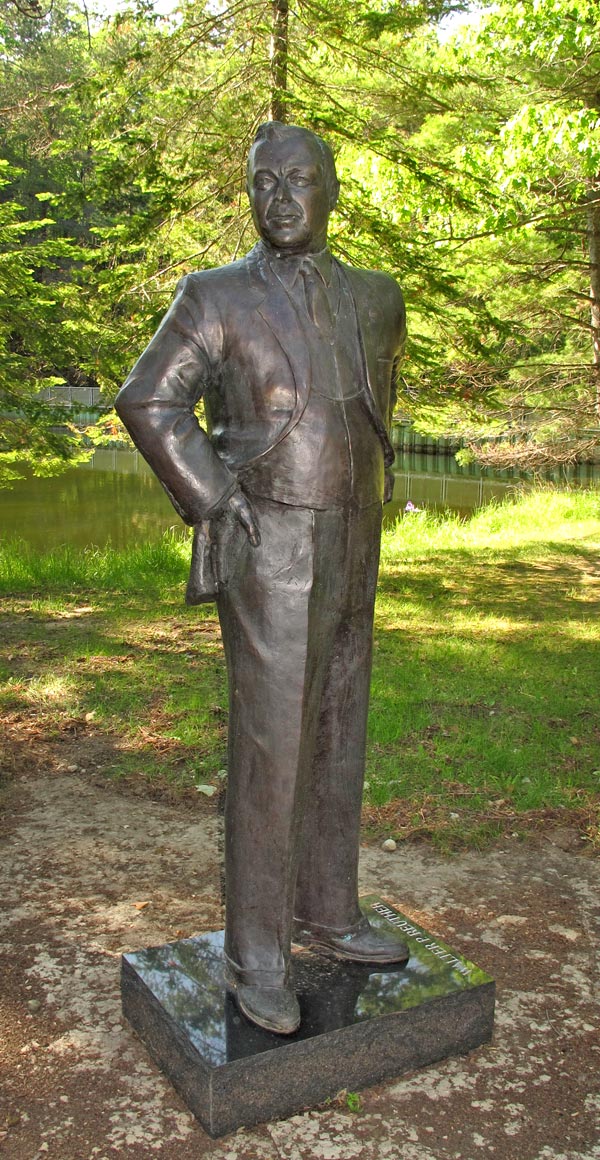
From an early age, the Reuther boys received lessons on racism. One day they saw local boys throwing rocks at black people being transported north through their hometown in open railway cars. Their father gave them a stern warning to never treat another human being like that. The Reuther boys never forgot that lesson, spending the rest of their lives fighting for racial and economic equality for all people.
Left home for Detroit
In 1927, at the age of 19, Reuther left Wheeling for Detroit and argued himself into an expert tool and die maker job at Ford Motor Company that required 25 years experience. The foreman was baffled that at his young age he could read blueprints and dies, becoming one of the highest paid mechanics in the factory. He finished high school while working at Ford and enrolled at Detroit City College, which is today known as Wayne State University. In 1932, he was fired for organizing a rally for Norman Thomas who was running for President of the United States as the nominee for the Socialist Party of America. His official Ford employment record states that he quit voluntarily, but Reuther himself maintained that he was fired for his increasingly visible socialist activities. Walter and Victor decided it was time for the European trip they had discussed from childhood.
World tour
When Henry Ford retired the Model T in 1927, he sold the production mechanisms to the Soviet Union, and American workers who knew how to operate the equipment were needed. Walter and Victor were promised work teaching Soviet workers how to run the machines and assembly line. With that employment assurance, the brothers embarked on a three-year adventure, first bicycling through Europe, then working in the auto plant in Gorky, in the Soviet Union, where the unheated factories were often 30–40 degrees Fahrenheit below zero. He frequently wrote letters to the Moscow Daily News criticizing the many inefficiencies associated with how the communists operated the plants.

After almost two years in the Soviet Union, the brothers travelled through Turkey, Iran, British India, and China. After crossing the East China Sea, they finished their Far East tour by bicycling throughout Japan. Finally, after being gone from home for almost three years, they found work for passage on the steamship SS President Harding to San Francisco and hurried back to Detroit where their brother Roy was already deeply involved with organizing autoworkers. Walter later stated the world tour taught him that "all people long for the same basic human goals of a job with some degree of security, greater opportunity for their children, and of course, freedom. We felt we could make a contribution by helping American workers build strong and democratic labor unions. That's why we went into the labor movement."
Political affiliation
Before joining the Democratic Party, Reuther was a member of the Socialist Party of America. Although Reuther always denied it, some, including J. Edgar Hoover, have suspected that at one time he was a member of the Communist Party. On this subject, Reuther said in 1938, "I am not and never have been a member of the Communist Party nor a supporter of its policies nor subject to its control or influence in any way." Nevertheless, people have suspected that he may have paid dues to the Communist Party for some months in 1935–36, and one source listed him as attending a Communist Party planning meeting as late as February 1939. Reuther did cooperate with the Communists in the mid-1930s; this was the period of the Popular Front, and the Communist Party agreed with him on internal issues of the UAW; but his associations were with anti-Stalinist Socialists. Reuther remained active in the Socialist Party and in 1937 failed in his attempt to be elected to the Detroit City Council when the AFL and blacks opposed his CIO ticket. (Historian Martin Glaberman found proof of Reuther's less-than-one-year CPUSA membership in the papers of UAW activist Nat Ganley.) However, impressed by the efforts by President Franklin D. Roosevelt to tackle inequality, he eventually joined the Democratic Party.
United Automobile Workers (UAW)
First victory against automobile companies
Upon returning from Europe to Detroit, Reuther hitchhiked to South Bend, Indiana, to attend the second annual convention as a delegate of the fledgling UAW. Upon his return he became president of newly formed Local 174 on Detroit's west side and with brother Victor, led the first successful strike against the automotive giants at Kelsey Hayes, which supplied brake drums and wheels to Ford Motor Company. The main complaint was the speed-up of the assembly line was intolerable. Workers were losing limbs and even their own lives trying in vain to keep up with the ever-increasing speed of the assembly line. It was December 1936 when the workers pulled a surprise strike and sat down in the plant refusing to leave until management negotiated with their representative, Walter Reuther.

When management tried to enter the plant to remove the machinery, thousands of sympathizers swarmed the sidewalks and blocked the doorways. Ford needed those brake drums and wheels badly and after 10 days of striking the sides settled. The first major UAW victory to unionize the auto factories was won. Upon Reuther's insistence, women won equal pay for equal work: 75 cents an hour. The speed-up of the assembly line was slowed down and the company could not fire a worker for joining the union. UAW Local 174's membership expanded from 200 before the strike to 35,000 within the next year.
General Motors
In 1936, General Motors (GM) was the largest corporation in the world and held many plants in Flint, Michigan, about 60 miles north of Detroit. Reuther's brother, Roy, was already in Flint drawing up strategy plans and organizing workers to shut down the automaker until it would recognize the rights of the workers to unionize. The strike began on New Year's Eve, December 31, 1936, when the workers sat down in the plants and refused to leave. General Motors retaliated by turning off the heat in the plant.
In solidarity with the Flint strikers, Reuther led a strike at Detroit's Fleetwood Plant, where bodies were made for GM's luxury vehicle, the Cadillac. Support strikes were also called in Oakland, California; Pontiac, Michigan; and St. Louis, Missouri. Autoworkers around the nation engaged in action in support of the Flint sit-down strikers.

Back in Flint, the police tried to force the workers out of the plant in what became known as the "Battle of Bulls Run." Over a hundred policemen attacked the pickets with tear gas and bullets, sending thirteen workers to the hospital with gunshot wounds. Victor manned the sound car and encouraged the workers to fight back, which they did by sling-shotting door hinges from the factory roof and turning fire hoses on the police in the 16-degree Fahrenheit winter night. Victor and Genora Johnson, a leader of the Women's Brigade, took turns in the sound car exhorting the workers to stand their ground.
Michigan Governor Frank Murphy called in 2,000 members of the National Guard, not to force the workers out of the plants, but to keep the peace. After a brilliant move, the workers were able to gain control of the only plant in the country that made Chevrolet engines. Finally, 44 days later, General Motors was forced to recognize the workers' right to unionize and signed its first collective bargaining agreement with the fledgling UAW.
The Flint sit-down strike has become known as the Lexington and Valley Forge of American industrial unionism. Roy recalled, "When the boys came out of the plants, I never saw a night like that and perhaps will never see it again. I liken it to a country experiencing independence, families reunited for the first time since the strike began, kids hanging onto daddy with tears of joy and happiness. It was a sea of humanity in which fears were no longer on the minds of the workers."

In 1950, Reuther negotiated and signed with Charlie Wilson, chief executive officer of General Motors, the Treaty of Detroit, an historic five-year labor contract that, in exchange for a commitment not to strike, gave rank-and-file workers better wages, health care, and pensions. At the time, Fortune Magazine wrote that the Treaty of Detroit “made the worker to an amazing degree a middle class member of a middle class society.”
Chrysler
Chrysler was next on the list of the young UAW. In March 1937, 60,000 Chrysler workers went on strike. When police started roughing up pickets and strikers, over 150,000 citizens gathered at Detroit's downtown Cadillac Square where Reuther and others led them in protest. After a four-week strike, Chrysler followed General Motors’ lead and negotiated its first collective bargaining agreement with the UAW.
Ford Motor Company
Henry Ford had stated that he would never allow his workers to unionize. His main enforcer was Harry Bennett, who led a 3,000-man Security Department for Ford Motor Company, whose mandate was to intimidate, beat, and fire any worker who showed signs of favoring unionization. In 1932, when workers marched out of the giant Ford River Rouge Complex in protest of the speed-up of the assembly lines, they were attacked by Bennett's armed men; five workers were shot dead and hundreds suffered injuries.
Barely a month after the Chrysler signing, Reuther got permission from the City of Dearborn to pass out handbills titled, "Unionism, not Fordism" on public property at Gate Four of the giant Ford River Rouge Complex. As he and three other UAW leaders climbed the stairs to the bridge, they were attacked by Bennett's "enforcers" who severely beat them.
Reuther was instantly surrounded by at least a dozen men, knocked to the ground, kicked and punched in the head and body, picked up four feet parallel to the ground then slammed to the concrete repeatedly, then thrown and kicked down three flights of stairs. The pummeling continued as four or five men beat him in and out of parked cars, until a streetcar arrived with union women to pass out leaflets and the thugs turned their attention to viciously attack them.
Press photographers were attacked as well and their cameras confiscated but one camera was inconspicuously thrown into a convertible and the next day, the "Battle of the Overpass," was national news.
The beatings taken by the union organizers in the long run hurt Henry Ford more, as national sentiment turned against him. Time magazine published the photographs with descriptions of how the union men and women were mercilessly beaten by Henry Ford's paid thugs. Ford retaliated against Time, Life, and Fortune magazines by withdrawing all advertising.
It took four more years, but finally, in 1941, Henry Ford signed his first agreement with the UAW. Shortly after, Henry Ford told Walter Reuther: "It was one of the most sensible things Harry Bennett ever did when he got the UAW into this plant." Reuther inquired, "What do you mean?" Ford replied, "Well, you've been fighting General Motors and the Wall Street crowd. Now you're in here and we've given you a union shop and more than you got out of them. That puts you on our side, doesn't it? We can fight General Motors and Wall Street together, eh?"
In the 1950s, Reuther and Henry Ford II, CEO of Ford, toured a state-of-the-art engine plant in Cleveland. As they walked about the plant, Ford gestured to the cutting-edge, automated machines, saying, "Walter, how are you going to get these robots to pay union dues?" Without missing a beat, Reuther famously replied: "Henry, how are you going to get them to buy your cars?"
"500 Planes a Day"
In 1940, in the midst of World War II, the United States was producing fighter planes to help the allies in their war against Hitler's aggression. The production was slow, inadequate, and threatening the security of the Allies. The US planned to construct new manufacturing plants specifically to produce more planes. That plan would have taken two years to begin production. The Allies did not have that time to spare. In response, Reuther proposed "to transform the entire unused capacity of the auto industry into one huge plane production unit capable of turning out 500 Planes a Day." After getting the support of workers, he publicly announced the "Reuther Plan: 500 Planes a Day," shortly before Christmas, 1940. He said, during a national radio address on December 28, 1940:
In London they are huddled in the subways praying for aid from America. In America we are huddled over blueprints praying that Hitler will be obliging enough to postpone an "all out" attack on England for another two years until new plants finally begin to turn out engines and aircraft. We believe that without disturbing present aircraft plant production schedules we can supplement them by turning out 500 planes a day of a single standard fighting model by the use of idle automotive capacity. . . . England's battles, it used to be said, were won on the playing fields of Eton. America's can be won on the assembly lines of Detroit. Give England planes and there will be no need to give her men.
A week after receiving the plan, on December 30, 1940, President Roosevelt wrote William S. Knudsen, chairman of the War Production Board, "It is well worthwhile to give a good deal of attention to this (Reuther) program." Three days later on January 2, 1941, Reuther met with President Roosevelt at the White House to discuss the possibility of implementing his plan for 500 Planes a Day.
General Motors, Ford, and Chrysler all opposed the Reuther Plan. According to Reuther, management felt production was their exclusive domain, and wanted the government to build new plane and tank factories that could be sold to them at giveaway prices after the war. General Motors chairman Alfred P. Sloan argued that the idea was impractical, saying that "only about 10 to 15% of the machinery and equipment in an automobile factory can be utilized for the production of special defense material."
After the attack on Pearl Harbor on December 7, 1941, many of Reuther's proposals were implemented. Detroit's automobile plants produced planes and tanks in mass volume and became known as the center of the Arsenal of Democracy, which gave the Allies a decisive advantage to win the war. By 1943, Chrysler President, K. T. Keller, reported that his company had converted 89% of its machine tools to wartime production, leading Washington Post publisher, Phil Graham, to state that meant Reuther was 89% right. At the war's end, Fortune magazine wrote: "Reuther was right on track. Compared with many industrialists that sat back and hugged profits and the aimless agencies of Washington, the red-headed labor leader exhibited atomic spirit of action. He never let up." In 1953, President Eisenhower wrote in a letter to Reuther, "When I last addressed a CIO Convention, I came to thank you for your magnificent performance in World War II in supplying the planes and tanks and ships and arms. You did your job, and you did it well."
Elected UAW president
After the war ended in 1945, Reuther proved he would be a different type of labor leader when he led a strike challenging GM to increase workers wages by 30% without increasing the price of their new cars. Worker pay had been restricted during World War II and Reuther sought to get them a raise but not at the cost of increased inflation. Historically, when workers won a pay increase, the company would pass on the expense to their consumers. GM refused the pay increase and after a 113 day strike, the sides settled on an eighteen and a half cent hourly raise. Reuther's bold collective bargaining leadership in this strike catapulted him into the union's top position.On March 27, 1946, Reuther won the election and became the president of the UAW in a very close race, defeating incumbent UAW president R. J. Thomas by a mere 124 votes, out of almost 9,000 cast. The new UAW president pledged his vision of "a labor movement whose philosophy is to fight for the welfare of the public at large." One of his first acts as president was to fight to integrate the American Bowling League, which had previously excluded black bowlers. He was a new kind of leader who viewed the labor movement as "an instrument for social change."
Salary
Although presidents of much smaller unions were making 3 or 4 times his salary, Reuther purposely kept his salary low to stay in touch, and show solidarity, with UAW members he represented. He never made an annual salary of more than $31,000. Author David Halberstam writes: "His life was not about material things. The constant success of the union was reward enough."
Expelling Communists from organized labor
The following 18 months after Reuther's election win, bitter battles erupted inside the UAW as Communist-backers of R. J. Thomas had a two-thirds majority on the UAW's Executive Board. One observer noted, "The Commies threw everything but their hammer and sickle at Walter." In November 1947, at the next UAW national convention, this time Reuther won the election overwhelmingly, severely weakening the Communist's hold on the union's leadership. Life magazine reported that Reuther's victory was "the biggest setback of all time for the Communists in the American Labor Movement."
President of Congress of Industrial Organizations (CIO)
Reuther became president of the CIO in 1952 until its merger with the AFL in 1955, and continued as head of the UAW until his death in 1970. As president of the CIO, Reuther sought to remove officers from Communist-dominated unions within the CIO, leading Hubert Humphrey to write, "Communist infiltration of the CIO was a direct threat to the survival of all of our country's democratic institutions. The CIO's victory over the Communist party was a significant victory for our nation." In response, Trud, a Soviet newspaper, called Reuther a "traitor and strikebreaker" and a favorite of the U.S. Chamber of Commerce. The Republican Party called Reuther "the most dangerous man in America and a Communist." Despite removing Communists from the labor movement, J. Edgar Hoover, Director of the Federal Bureau of Investigation, never stopped suspecting Reuther to be a Communist for working in Russia and having early associations with Communists.
In 1959, at the request of the Department of State, Reuther met with Soviet Premier Nikita Khrushchev, who was visiting the U.S. They discussed, among other things, capitalism versus communism, organized labor, and US-Russia relations. The meeting happened in San Francisco and was front-page international news.
Collective bargaining
As president of the UAW, Reuther negotiated contracts that included unprecedented standard-of-living increases for automobile workers. Such increases include annual raises based on productivity advances, cost-of-living increases, supplementary unemployment benefits, early-retirement options, and health and welfare benefits.
He employed a strategy called "pattern bargaining" against the Big Three automobile manufacturers, General Motors, Ford Motor Company, and Chrysler. He would first target a company that seemed most likely to accept his bargaining objective. If that target company refused to offer concessions, Reuther would threaten a strike to halt production at its plants only while allowing production operations at its competitors' plants to go uninterrupted. As a result, the target company would accept Reuther's demands to prevent its competitors from absorbing its sales and market share. Once he secured the initial agreement, he would use it as a pattern against the other automobile companies, threatening to strike if they too did not match the same terms to which the initial target company agreed. Reuther employed pattern bargaining to leverage competition among automobile manufacturers, maximize the influence of labor, and reduce the frequency of costly strikes.
Ideas, activism, and political stances
Peace Corps
In 1950, Reuther proposed, in an article titled, "A Proposal for a Total Peace Offensive", that the United States establish a voluntary agency for young Americans to be sent around the world to fulfill humanitarian and development objectives. Subsequently, throughout the 1950s, Reuther gave speeches to the following effect:I have been saying for a long time that I believe the more young Americans who are trained to join with other young people in the world to be sent abroad with slide rule, textbook, and medical kit to help people help themselves with the tools of peace, the fewer young people will need to be sent with guns and weapons of war.In August 1960, following the 1960 Democratic National Convention, Walter Reuther visited John F. Kennedy at the Kennedy compound in Hyannisport to discuss Kennedy's platform and staffing of a future administration. It was there that Reuther got Kennedy to commit to creating the executive agency that would become the Peace Corps. Under Reuther's leadership, the United Auto Workers had earlier that summer put together a policy platform that included a "youth peace corps" to be sent to developing nations. Subsequently, at the urging of Reuther, John F. Kennedy announced the idea for such an organization on October 14, 1960, at a late-night campaign speech at the University of Michigan.
Civil rights activism
Reuther was a strong supporter of the Civil Rights Movement. He marched with Martin Luther King, Jr. in Selma, Birmingham, Montgomery, and Jackson and when King and others were jailed in Birmingham, Alabama, and King authored his famous Letter from Birmingham Jail, Reuther arranged $160,000 for the protestors' release. He also helped organize and finance the March on Washington on August 28, 1963, delivering remarks from the steps of the Lincoln Memorial shortly before King gave his historic "I Have a Dream" speech. He served on the board of directors for the National Association for the Advancement of Colored People (NAACP). Under his leadership, the UAW donated $75,000 in 1954 to help underwrite the NAACP's efforts—led by Thurgood Marshall—before the Supreme Court in the landmark case of Brown v. Board of Education. According to King, Reuther sent letters to all of his local unions in 1957, requesting members to attend and provide financial support to the Prayer Pilgrimage for Freedom in Washington, D.C.
On the 25th anniversary of the UAW, King wrote a letter to Reuther, congratulating him on his successes and observing:More than anyone else in America, you stand out as the shining symbol of democratic trade unionism. Through trials, efforts and your unswerving devotion to humanitarian causes, you have made life more meaningful for millions of working people. Through moments of difficulty and strong obstacles, you have stood firm for what you believe, knowing that in the long run 'Truth crushed to earth will rise again.' As I have heard you say, the true measure of a man is where he stands in moments of challenge and controversy, when the only consolation he gains is the quiet whisper of an inner voice saying there are things so eternally true and significant that they are worth dying for, if necessary. You have demonstrated over the years that you can stand up in moments of challenge and controversy. One day all of America will be proud of your achievements, and will record your work as one of the glowing epics of our heritage.