
Volkswagen AG (German pronunciation: [ˈfɔlksˌvaːɡŋ̍] ), commonly abbreviated to VW, is a German automobile manufacturer based in Wolfsburg, Lower Saxony, Germany. Established in 1937 by the German Labour Front, it was revived after World War II by British Army officer Ivan Hirst and, over the 81 years since, grew into the global brand it is today. As of 2025, the company had a market capitalization of approximately US$58.9 billion. The company is well known for the Beetle and serves as the flagship brand of its eponymous conglomerate, the Volkswagen Group, which was the world's largest automotive manufacturer by global sales in 2016 and 2017.
The name Volkswagen derives from the German words Volk and Wagen, meaning "people's car", or more directly "folk's wain (wagon)".
History
1932–1938: People's Car project
Volkswagen was established in 1937 by the Nazi Party's German Labour Front (Deutsche Arbeitsfront) as part of the Strength Through Joy (Kraft durch Freude, abbreviated to KdF) program in Berlin. In the early 1930s, cars were a luxury; most Germans could afford nothing more elaborate than a motorcycle, and only one out of 50 Germans owned a car. Seeking a potential new market, some car makers began independent "people's car" projects – the Mercedes 170H, BMW 3/15, Adler AutoBahn, Steyr 55 and Hanomag 1.3 L (79 in3), among others.

The growing trend was not nascent; Béla Barényi, a pioneering automotive engineer, is credited as already having conceived the basic design during the mid-1920s. Josef Ganz developed the Standard Superior (going as far as to advertise it as the "German Volkswagen"). In Germany, Hanomag mass-produced the 2/10 PS Kommissbrot, a small, cheap rear-engined car, from 1925 to 1928. Also, in Czechoslovakia, the Hans Ledwinka-designed Tatra T77, a very popular car amongst the German elite, was becoming smaller and more affordable at each revision. Ferdinand Porsche, a well-known designer for high-end vehicles and race cars, had been trying for years to get a manufacturer interested in a small car suitable for a family. He built a car known as the Volksauto from the ground up in 1933, using many popular ideas and several of his own, putting together a car with an air-cooled rear engine, torsion bar suspension, and a "beetle" shape, the front bonnet rounded for better aerodynamics (necessary as it had a small engine).
In 1934, with many of the aforementioned projects still in development or early stages of production, Adolf Hitler became involved, ordering the production of a basic vehicle capable of transporting two adults and three children at 100 km/h (62 mph). He wanted a car every German family would be able to afford. The "People's Car" would be available through a savings plan at 990 ℛ︁ℳ︁, equivalent to €4,688 in 2021 – about the price of a small motorcycle (the average income being around 32 ℛ︁ℳ︁ a week, equivalent to €152 in 2021).
It soon became apparent that private industry could not turn out a car for only 990 ℛ︁ℳ︁. Thus, Hitler chose to sponsor an all-new, state-owned factory using Ferdinand Porsche's design (with some of Hitler's design suggestions, including an air-cooled engine so nothing could freeze). The intention was that German families could buy the car through a savings scheme ("Fünf Mark die Woche musst du sparen, willst du im eigenen Wagen fahren", transl. "Five marks a week you must set aside, if in your own car you wish to ride"), which around 336,000 people eventually paid into. However, the project was not commercially viable, and only government support was able to keep it afloat. Due to the outbreak of World War II in 1939, none of the participants in the savings scheme ever received a car. In 1950, a lawsuit was issued that, after 12 years of trial, ultimately provided a credit of 12% off the list price of a new VW base model or roughly 20% of the value originally paid into the saving scheme.

Prototypes of the car called the KdF-Wagen (from the German term Kraft durch Freude, meaning Strength Through Joy) first appeared in 1938. The first cars had been produced in Stuttgart. The car already had its distinctive round shape and air-cooled, flat-four, rear-mounted engine. The VW car was just one of many KdF programs, which included tours and outings. The prefix Volks ("people's") was not just applied to cars, but also to other products in Germany, such as the Volksempfänger radio receiver. On 28 May 1937, Gesellschaft zur Vorbereitung des Deutschen Volkswagens mbH ("Company for the Preparation of the German Volkswagen Ltd"), or Gezuvor for short, was established in Berlin by the German Labour Front (Deutsche Arbeitsfront), the national labour organization of the Nazi Party. More than a year later, on 16 September 1938, it was renamed Volkswagenwerk GmbH.
Erwin Komenda, the longstanding Auto Union chief designer, part of Ferdinand Porsche's hand-picked team, developed the car body of the prototype, which was recognisably the Beetle known today. It was one of the first cars designed with the aid of a wind tunnel – a method used for German aircraft design since the early 1920s. The car designs were put through rigorous tests and achieved a record-breaking 1.6 million kilometres (1 million miles) of testing before being deemed finished.
The construction of the new factory started in May 1938 in the new town of Stadt des KdF-Wagens (now known as Wolfsburg), which had been purpose-built for the factory workers. This factory had only produced a handful of cars by the time war started in 1939. None were actually delivered to any holder of the completed saving stamp books, though one Type 1 Cabriolet was presented to Hitler on 20 April 1944, his 55th birthday.

1939–1944: Wartime production and Nazi concentration camp labour
World War II shifted the company's priorities to military vehicles – the Type 82 Kübelwagen ('bucket car') utility vehicle (VW's most common wartime model), and the amphibious Schwimmwagen – manufactured for German forces. One of the first foreigners to drive a Volkswagen was Ernie Pyle, an American war correspondent who had the use of a captured Volkswagen for a few days after the Allied victory in Tunisia in May 1943. As was common with much of the production in Nazi Germany during the war, slave labour was utilised in the Volkswagen plant, such as from the Arbeitsdorf concentration camp. The company would admit in 1998 that it used 15,000 slaves during the war effort. German historians estimated that 80% of Volkswagen's wartime workforce was slave labour. Many of the slaves were reported to have been supplied from the concentration camps upon request from plant managers. A lawsuit was filed in 1998 by survivors for restitution for the forced labour. Volkswagen would set up a voluntary restitution fund.
1945–1948: British military intervention
In April 1945, KdF-Stadt and its heavily bombed factory were captured by the U.S. Army and subsequently handed over to the British, within whose occupation zone the town and factory fell. The factory was placed under the control of British Army officer Major Ivan Hirst, REME, a civilian Military Governor with the occupying forces. One initial plan was to use it for military vehicle maintenance, and possibly dismantle and ship it to Britain. The equipment could have been salvaged as war reparations since the factory had been used for military production (though not of KdF-Wagens) and had been, in Hirst's words, a "political animal" rather than a commercial enterprise, technically making it liable for destruction under the terms of the Potsdam Agreement. Allied dismantling policy changed in late 1946 to mid-1947, though heavy industry continued to be dismantled until 1951.
One of the factory's wartime KdF-Wagen cars had been taken to the factory for repairs and abandoned there. Hirst had it repainted green and demonstrated it to British Army headquarters. In September 1945, the British Army, short of light transport, was persuaded to place a vital order for 20,000 cars. However, production facilities had been massively disrupted; there was a refugee crisis at and around the factory, and some parts (such as carburettors) were unavailable. Hirst and his German assistant Heinrich Nordhoff (who went on to run the Volkswagen factory after military involvement ended in 1949) helped to stabilise the acute social situation while simultaneously re-establishing production. Hirst, for example, used his engineering experience to arrange the manufacture of carburettors, the original producers being effectively "lost" in the Soviet zone. The first few hundred cars went to personnel from the occupying forces, and to the postal service. Some British service personnel were allowed to take their Beetles back to the UK when they were demobilised.

The post-war industrial plans for Germany set out rules that governed which industries Germany was allowed to retain. These rules set German car production at a maximum of 10% of 1936 car production. By 1946, the Volkswagen factory produced 1,000 cars a month, even though it was still in disrepair. Due to roof and window damage, production had to stop when it rained, and the company had to barter new vehicles for steel for production.
The car and its town changed their World War II-era names to "Volkswagen" and "Wolfsburg", respectively, and production increased. It was still unclear what was to become of the factory. It was offered to representatives from the American, Australian, British and French motor industries, who all rejected it. After an inspection of the plant, Sir William Rootes, head of the British Rootes Group, told Hirst that the project would fail within two years, and that the car "...is quite unattractive to the average motorcar buyer, is too ugly and too noisy. If you think you're going to build cars in this place, you're a bloody fool, young man." The official report said: "To build the car commercially would be a completely uneconomic enterprise."
American Ford representatives were equally critical. In March 1948, the British offered the Volkswagen company to Ford free of charge. Henry Ford II, the son of Edsel Ford, traveled to West Germany for discussions. Heinz Nordhoff was also present, as well as Ernest Breech, Ford's chairman of the board. Henry Ford II looked to Breech for his opinion, and Breech said, "Mr. Ford, I don't think what we're being offered here is worth a damn!" Ford passed on the offer, leaving Volkswagen to rebuild itself under Nordhoff's leadership.
1948–1961: Icon of post-war West Germany
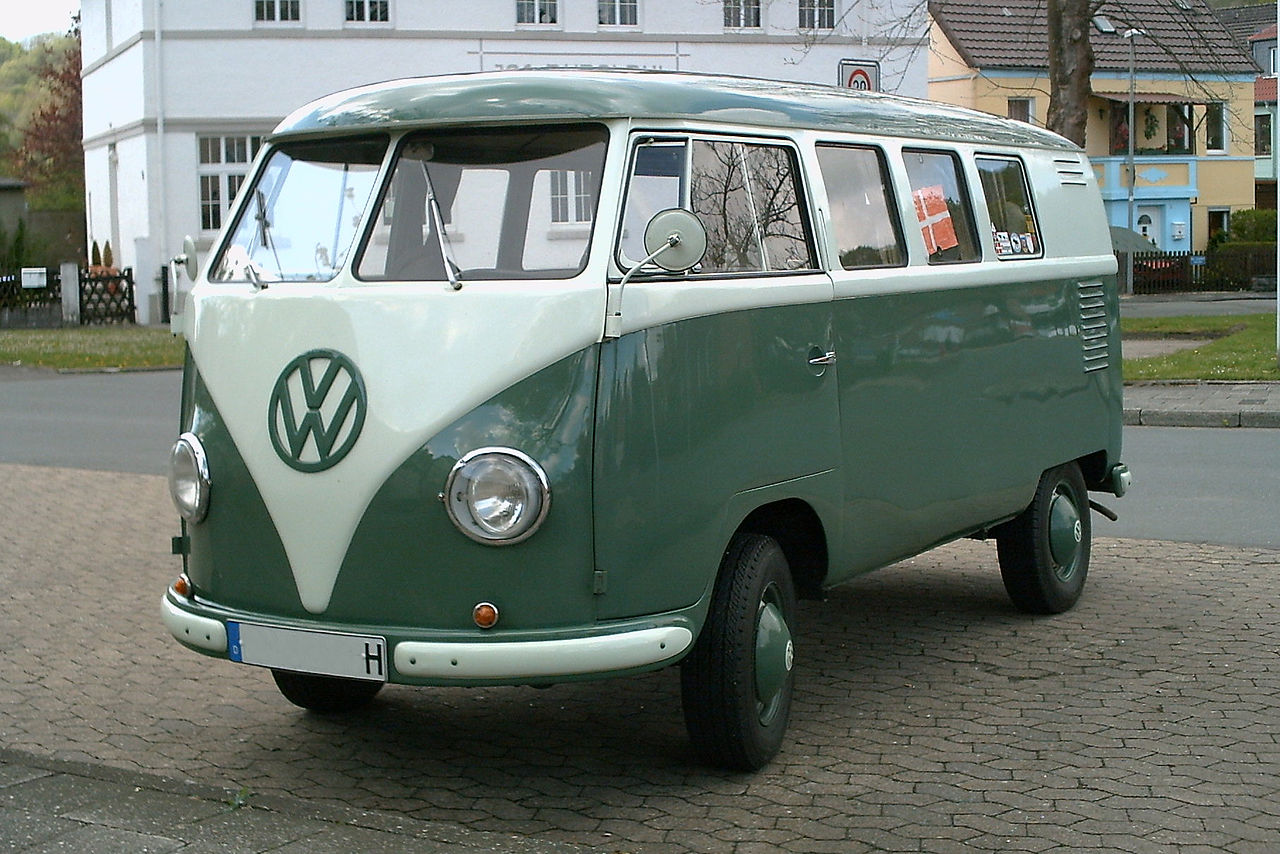
From 1948 onwards, Volkswagen became an important element, symbolically and economically, of West German regeneration. Heinrich Nordhoff, a former senior manager at Opel who had overseen civilian and military vehicle production in the 1930s and 1940s, was recruited to run the factory in 1948. In 1949, Major Hirst left the company, which had been reformed as a trust controlled by the West German government and the government of the state of Lower Saxony. Apart from the introduction of the Volkswagen Type 2 commercial vehicle (van, pick-up, and camper) and the Karmann Ghia sports car, Nordhoff pursued a "one-model" policy of focusing on the Type 1 "Beetle" sedan until shortly before his death in 1968.
Volkswagens were first exhibited and sold in the United States in 1949, but sold only two units in the region that first year. On entry to the US market, the VW was briefly sold as a Victory Wagon. In April 1955, Volkswagen of America was formed to standardise sales and service in the US. Production of the Type 1 Volkswagen Beetle increased dramatically over the years, the total reaching one million in 1955.
The UK's first official Volkswagen importer, Colborne Garages of Ripley, Surrey, started business with importing parts for the models brought home by soldiers returning from Germany.

Canadian Motors, Limited brought in Canada's first shipment of Volkswagens on 10 July 1952 (shipping order 143075). The order consisted of 12 vehicles:
Volkswagens were seen in Canada for the first time at the Canadian National Exhibition in August 1952, and were accepted enthusiastically (at least one Type 2 bus from this order still exists, and is currently in France undergoing restoration). The first shipment for Volkswagen Canada reached Toronto in early December 1952 (at least one Type 1 from this first shipment still exists, and was driven on a nationwide tour for Volkswagen Canada's 60th year of business festivities in 2012).
By 1955, sales warranted the building of the Volkswagen plant on a 13-hectare (32-acre) site on Scarborough's Golden Mile. To this, a 5,600-square-metre (60,000 sq ft) building with administration, showrooms, service, repairs and parts was built in 1957, with storage for $4,000,000 of parts.
In 1959, VW started production at a plant near São Paulo in Brazil. Volkswagen do Brasil was accused of spying on workers during the time of the military dictatorship in the 1970s and informing police on oppositional activities. In 1976, mass arrests occurred and some VW employees were tortured. In 1979, Brazilian VW workers travelled to Wolfsburg to inform the CEO in person. In 2015, activists and former VW employees in Brazil spoke out in public and accused the company of being silent about the persecution of its workers. In 2016, VW commissioned an expert review of the situation due end of 2017.
On 22 August 1960, Volkswagenwerk GmbH was renamed Volkswagenwerk AG. Sales soared throughout the 1960s, peaking at the end of the decade thanks in part to the famous advertising campaigns by New York advertising agency Doyle Dane Bernbach. Led by art director Helmut Krone and copywriters Julian Koenig and Bob Levinson, Volkswagen advertisements became as popular as the car, using crisp layouts and witty copy to lure younger, sophisticated consumers with whom the car became associated. Even though it was almost universally known as the Beetle (or the Bug), it was never officially labelled as such by the manufacturer, instead referred to as the Type 1.
Although the car was becoming outdated during the 1960s and early 1970s, American exports, innovative advertising, and a growing reputation for reliability helped production figures surpass the levels of the previous record holder, the Ford Model T. On 17 February 1972, the 15,007,034th Beetle was sold. Volkswagen could now claim the world production record for the most-produced, single make of car in history. By 1973, total production was over 16 million.
To commemorate its passing the Ford Model T's record sales mark and its victories in the Baja 1000 Mexican races from 1967 to 1971, Volkswagen produced its first limited edition Beetle, marketed as the "Baja Champion SE" in the United States and as the "Marathon" Superbeetle in the rest of the world. It featured unique "Marathon Blau" metallic blue paint, steel-pressed 10-spoke 38-centimetre (15 in) magnesium-alloy wheels, a commemorative metal plate mounted on the glovebox, and a certificate of authenticity presented to the original purchaser. Dealer-installed options for this limited edition Superbeetle included the following: white stripes running the length of the rocker-panel, a special shifter knob, bumper overriders, tapered exhaust tips, fake walnut inserts in the dashboard (behind the steering wheel and the glovebox cover), as well as Bosch fog lights mounted on the front bumper.
1961–1973: Beetle to Golf
The 1961 Type 1 Beetle had a 27 kW (36 hp) 1,200 cc (73 cu in) four cylinder air-cooled flat-four opposed OHV engine made of aluminum alloy block and heads. By 1966, the Type 1 came with a 1,300 cc (79 cu in) engine. By 1967, the Type 1 had a 1,500 cc (92 cu in) engine, and 1,600 cc (98 cu in) in 1970. The air-cooled engine lost favour in the United States market with the advent of unleaded petrol and smog controls. These air-cooled engines were commonly tuned to be fuel-rich in order to control engine over-heating, and this led to excessive carbon monoxide emissions. VW production equipment was eventually moved to Mexico where vehicle emissions were not regulated. Beetles were popular on the US West Coast, where the limited-capacity cabin heating was less inconvenient. Beetles were popularised on the US West Coast as beach buggies and dune buggies.
VW expanded its product line in 1961 with the introduction of four Type 3 models (Karmann Ghia, Notchback, Fastback, and Variant) based on the new Type 3 mechanical underpinnings. The name 'Squareback' was used in the United States for the Variant.
In 1969, the larger Type 4 (411 and 412) models were introduced. These differed substantially from previous vehicles, with the notable introduction of monocoque/unibody construction, the option of a fully automatic transmission, electronic fuel injection, and a sturdier powerplant.
Volkswagen acquired Auto Union in 1964 and NSU Motorenwerke AG (NSU) in 1969. The former company owned the historic Audi brand, which had disappeared after World War II. VW ultimately merged Auto Union and NSU to create the modern Audi company, and would go on to develop it as its luxury vehicle marque. The purchase of Auto Union and NSU was a pivotal point in Volkswagen's history, as both companies yielded the technological expertise that proved necessary for VW to survive when demand for its air-cooled models declined.
Volkswagen added a "Super Beetle" (the Type 131) to its lineup in 1971. The Type 131 differed from the standard Beetle in its use of a MacPherson strut front suspension instead of the usual torsion bars. The Super Beetle featured a new hooded, padded dash and curved windshield (from 1973 model year on up). Rack and pinion steering replaced recirculating ball steering gears in the model year 1975 and up. The front of the car was stretched 51 millimetres (2 in) to allow the spare tire to lie flat, and the combination of these two features increased the usable front luggage space.
In 1973, Volkswagen introduced the military-themed Type 181, known as the "Trekker" in Europe and the "Thing" in America, recalling the wartime Type 82. The military version was produced for the NATO-era German Army during the Cold War years of 1970 to 1979. The US Thing version only sold for two years, 1973 and 1974.
By late 1972, Volkswagen had decided to cancel the nearly finished typ 266, a project for a mid-engined car to replace the Beetle, and to focus on front-wheel-drive, water-cooled cars. Rudolf Leiding, recently made head of Volkswagen, cited noise, heat, and servicing problems with the mid-engine layout, as well as the difficulty of making it a station wagon.
Volkswagen was in serious trouble by 1973. The Type 3 and Type 4 models had sold in much smaller numbers than the Beetle and the NSU-based K70 also failed to sell. Beetle sales had started to decline rapidly in European and North American markets. The company knew that Beetle production had to end, but faced a conundrum of how to replace it. VW's ownership of Audi and Auto Union proved beneficial. Its expertise in front-wheel drive, and water-cooled engines would help Volkswagen produce a credible Beetle successor. Audi influences paved the way for this new generation of Volkswagens: the Passat, Scirocco, Golf, and Polo.
First in the series was the Volkswagen Passat (known as the Dasher in the US), introduced in 1973, a fastback version of the Audi 80, using many identical body and mechanical parts. Estate/wagon versions were available in many markets. In Europe, the estate/wagon version dominated market share for many years.
The Scirocco followed in 1974, designed by Giorgetto Giugiaro. Based on the platform of the not yet released Golf, it was built at Karmann due to capacity constraints at Volkswagen.
The pivotal model emerged as the Volkswagen Golf in 1974, marketed in the United States and Canada as the Rabbit for the first generation (1975–1985) and fifth generation (2006–2009). Its angular styling was again designed by Giorgetto Giugiaro. Its design followed trends for small family cars set by the 1959 Mini – the Golf had a transversely mounted, water-cooled engine in the front, driving the front wheels, and had a hatchback, a format that has dominated the market segment ever since. Beetle production at Wolfsburg ended upon the Golf's introduction. It continued in smaller numbers at other German factories (Hanover and Emden) until 1978, but mainstream production shifted to Brazil and Mexico.
In 1975, the Volkswagen Polo followed. It was a re-badged Audi 50, which was soon discontinued in 1978. The Polo became the base of the Volkswagen Derby, which was introduced in 1977. The Derby was, for all intents and purposes, a three-box design of the Polo. After a second model generation, the Derby was discontinued in 1985, although the body style lived on in the form of the Polo classic/Polo saloon until 1991.
The Passat, Scirocco, Golf, and Polo shared many character-defining features, as well as parts and engines. They built the basis for Volkswagen's turn-around.
1974–1990: Product line expansion
While Volkswagen's range of cars soon became similar to that of other large European car makers, the Golf has been the mainstay of the Volkswagen line-up since its introduction, as well as the mechanical basis for several other cars from the company. There have been eight generations of the Golf, the first generation of which (sold as the Rabbit in the United States and Canada and as the Caribe in Latin America) was produced from the summer of 1974 until the autumn of 1983. Its chassis also spawned the Scirocco sport coupe, the Jetta saloon/sedan, the Golf Cabriolet convertible, and the Caddy pick-up. North American production of the Rabbit commenced at the Volkswagen Westmoreland Assembly Plant near New Stanton, Pennsylvania in 1978. It would be produced in the United States as the Rabbit until the spring of 1984. The second-generation Golf hatchback ran from 1983 until the autumn of 1991, and a North American version produced at Westmoreland Assembly went on sale at the start of the 1985 model year. The production numbers of the first-generation Golf have continued to grow annually in South Africa as the Citi Golf, with only minor modifications to the interior, engine, and chassis, using tooling relocated from the New Stanton plant when that site began to build the second-generation model. The second-generation Jetta sedan was produced from early 1984 to 1992.
In the 1980s, Volkswagen's sales in the United States and Canada fell dramatically, despite the success of models like the Golf elsewhere. Sales in the US were 293,595 in 1980, but were down to 177,709 by 1984. The introduction of the second-generation Golf, GTI, and Jetta models helped Volkswagen briefly in North America. Motor Trend magazine named the GTI its Car of the Year for 1985, and Volkswagen rose to eighth place in the J.D. Power buyer satisfaction ratings in 1985, up from 22nd place a year earlier. VW's American sales broke 200,000 in 1985 and 1986 before resuming the downward trend from earlier in the decade. Chairman Carl Hahn decided to expand the company elsewhere (mostly in developing countries), and the New Stanton factory closed on 14 July 1988. Meanwhile, four years after signing a cooperation agreement with the Spanish car maker SEAT in 1982, Hahn expanded the company by purchasing a majority share of SEAT up to 75% by the end of 1986, which VW bought outright in 1990. On 4 July 1985, Volkswagenwerk AG was renamed Volkswagen AG.
In 1975, Volkswagen entered the supermini market with the Polo, a stylish, spacious three-door hatchback designed by Bertone. It was a strong seller in West Germany and most of the rest of Western Europe, being one of the first foreign small cars to prove popular in Britain. It had started out in 1974 as the Audi 50, which was only available in certain markets and was less popular. The Polo entered a market sector already being dominated by the Fiat 127 and Renault 5, and which before long would also include the Austin Metro and Ford Fiesta.
In 1981, the second-generation Polo launched as a hatchback (resembling a small estate car). The range was expanded in 1983, with the introduction of a Coupe (similar to a conventional hatchback), and the Classic (a two-door saloon). The Polo's practicality, despite the lack of a five-door version, helped ensure even stronger sales than its predecessor. It continued to sell well after a facelift in 1990, finally being replaced by a new version in 1994. Also arriving in 1981 were the second generation of the larger Passat and a second generation of the Scirocco coupe.
In 1983, the Golf Mk2 was launched. At the beginning of 1988, the third generation Passat was the next major car launch. Volkswagen did not produce a hatchback version of this Passat, despite the rising popularity of the hatchback body style throughout Europe. Just after launching the B3 Passat, Volkswagen launched the Corrado, analogous to the Scirocco, although the Scirocco remained in production until 1992; a third generation of Scirocco was in production between 2008 and 2017.
1991–1999
In 1991, Volkswagen launched the third-generation Golf, which won European Car of the Year for 1992. The Golf Mk3 and Jetta Mk3 arrived in North America in 1993. The sedan version of the Golf was badged as the Vento in Europe, but retained the Jetta name in the US. The Scirocco and the later Corrado were both Golf-based coupés.
In 1994, Volkswagen unveiled the J Mays-designed Concept One, a "retro"-themed concept car with a resemblance to the original Beetle, based on the platform of the Polo. Due to a positive response to the concept, a production version was developed as the New Beetle, based on the Golf's larger platform.
In 1995, the Sharan was launched in Europe, the result of a joint venture with Ford, which also resulted in the Ford Galaxy and SEAT Alhambra.
The company's evolution of its model range continued with the Golf Mk4, introduced at the end of 1997 (North America in 1999). Its chassis spawned a host of other cars within the Volkswagen group: the Volkswagen Bora (the sedan known as the Jetta in the United States), SEAT Toledo, SEAT León, Audi A3, Audi TT, and Škoda Octavia. Other main models during the decade include the Polo, a smaller car than the Golf, and the larger Passat for the segment above the Golf.
In 1998, the company launched the new Lupo city car. In 1999, it announced the first "3-litre" car, a lightweight version of the Lupo that could travel 100 km (62 mi) with only 3 L (0.79 US gal), or 78 mpg‑US, of diesel – making it the world's most fuel efficient car at the time.
2000–2016: Further expansion
Volkswagen began introducing an array of new models after Bernd Pischetsrieder became Volkswagen Group CEO (responsible for all VW brands) in 2002. The sixth-generation Volkswagen Golf launched in 2008, and came runner-up to the Opel/Vauxhall Insignia in the 2009 European Car of the Year. It has spawned several cousins: VW Jetta, VW Scirocco, SEAT León, SEAT Toledo, Škoda Octavia and Audi A3 hatchback ranges, as well as a new mini-MPV, the SEAT Altea. The GTI, a "hot hatch" performance version of the Golf, has a 2.0 L Turbocharged Fuel Stratified Injection (FSI) direct injection engine. VW began marketing the Golf under the Rabbit name once again in the US and Canada in 2006.
The sixth-generation Passat and the fifth-generation Jetta both debuted in 2005, and Volkswagen announced plans to expand its lineup further by bringing back the Scirocco by 2008. Other models in Wolfgang Bernhard's (Volkswagen brand CEO) "product offensive" include the Tiguan mid-sized SUV in 2008 and a Passat Coupé. In November 2006, Bernd Pischetsrieder announced his resignation as Volkswagen Group CEO, and was replaced by Audi worldwide CEO Martin Winterkorn at the beginning of 2007.
Volkswagen maintained North American sales of 224,195 in 2005. The momentum continued for fiscal year 2006, as Volkswagen's North American sales for the year were 235,140 vehicles, a 4.9 per cent increase over 2005, despite a slump in domestic North American manufacturer's sales. In conjunction with the introduction of new models, the production location of Volkswagen vehicles also underwent a great change. The 2007 Eos, a hardtop convertible, is produced in a new facility in Portugal. All Golfs/Rabbits and GTIs as of 2006 are manufactured in Wolfsburg, Germany, rather than Puebla, Mexico, where Golfs and GTIs for the North American market were produced from 1989 to 1998, and the Brazilian factory in Curitiba, where Golfs and GTIs were produced from 1999 to 2006 (the Jetta has been primarily manufactured in Mexico since 1989). Volkswagen is also in the process of reconfiguring an automotive assembly plant in Belgium. The new models and investments in manufacturing improvements were immediately noticed by automotive critics. Favourable reviews for Volkswagen's newest cars include the GTI being named by Consumer Reports as the top sporty car under $25,000, one of Car and Driver magazine's "10 Best" for 2007, Automobile Magazine's 2007 Car of the Year, as well as a 2008 Motor Trend comparison ranking the mid-size Passat first in its class.