
Vandenberg Space Force Base (IATA: VBG, ICAO: KVBG, FAA LID: VBG), previously Vandenberg Air Force Base, is a United States Space Force Base in Santa Barbara County, California. Established in 1941, Vandenberg Space Force Base is a space launch base, launching spacecraft from the Western Range, and also performs missile testing. The United States Space Force's Space Launch Delta 30 serves as the host delta for the base, equivalent to an Air Force air base wing. In addition to its military space launch mission, Vandenberg Space Force Base also hosts space launches for civil and commercial space entities, such as NASA and SpaceX.
History
United States Army
Camp Cooke (1941–1953)
In 1941, just before the United States entered World War II, the United States Army embarked on an initiative to acquire lands in the United States to be used to train infantry and armored forces. These areas needed to be of a varied nature to ensure relevant training. In March 1941, the Army identified approximately 86,000 acres (35,000 ha) of open ranch lands along the Central Coast of California between Lompoc and Santa Maria. With its flat plateau, surrounding hills, numerous canyons, and relative remoteness from populated areas, the Army was convinced this portion of the Gaviota Coast was an ideal training location. The government purchased most of the land, however, some smaller parcels were obtained either by lease, license, or as easements. The land was previously part of six ranchos: Casmalia, Guadalupe, Mission de la Purisima, Rancho Lompoc and Rancho Todos Santos y San Antonio, and Jesús María.
Construction of the Army camp began in September 1941. Although unfinished, the camp was activated on the 5th of October and was named Camp Cooke in honor of Phillip St. George Cooke, a cavalry officer with a distinguished career spanning the Mexican War, Indian Wars, the Civil War.

Troop training didn't wait for construction to finish. The 5th Armored Division was the first to arrive in February and March 1942. Throughout the war, Camp Cooke served as a training ground for numerous armored and infantry divisions before their deployment overseas. Additionally, anti-aircraft artillery, combat engineer, ordnance, and hospital units trained at Cooke. In total, over 400 groups passed through the camp.
As the war progressed, Camp Cooke was used to house German and Italian prisoners of war. Following the Geneva Convention, the groups were kept separate and assigned various jobs within the camp, including construction, clerical work, food service, and laundry. To address wartime labor shortages, German prisoners also participated in agricultural work in nearby communities.
After the war's conclusion in 1946, Camp Cooke became home to a maximum-security military prison, while most of the land was largely leased for agriculture and grazing. From 1950 to 1953, Camp Cooke served again as a training ground for units heading to the Korean War. In 1953, the camp was inactivated, and the military prison became a federal prison for civilians, now known as the United States Penitentiary, Lompoc.

The final remaining buildings from Camp Cooke were demolished in 2010.
Known United States Army Units at Camp Cooke

40th Infantry Division
44th Infantry Division
United States Air Force
Cooke Air Force Base
As the 1950s ushered in the age of missiles, and the United States urgently needed a training ground that could also serve as an initial combat ready missile base. In 1956, after examining over 200 potential locations, a committee selected Camp Cooke. Similar to its appeal in 1941 for the Army, Camp Cooke's vast size, remoteness, moderate climate, and coastal location made it ideal. Missiles could be launched westward over the Pacific Ocean without flying over populated areas, and satellites could be placed into polar orbit towards the South Pole without traversing any landmass until reaching Antarctica.

Following the committee's recommendation, on 16 November 1956, the Secretary of Defense directed the Army to transfer 64,000 acres (26,000 ha) to the United States Air Force. This land was initially called North Camp Cooke, but when the official transfer happened on 21 June 1957 it was named Cooke Air Force Base.
The first airmen of the 6591st Support Squadron arrived on 15 February, before the official transfer, and found the base in rough shape. World War II-era buildings were dilapidated, and roads needed extensive repair. Over the next two years, launch and control facilities emerged, old structures were renovated, and new housing was built. The initial mission of the base was to train personnel on the PGM-17 Thor, SM-65 Atlas, and HGM-25A Titan I missiles, while also serving as an emergency operational facility for the Atlas.
The 1957 launch of Sputnik by the Soviet Union intensified the urgency of the U.S. missile program. In November, the Department of Defense authorized ballistic missile launches from Cooke AFB. Management responsibility shifted from the Air Research and Development Command (ARDC) to the Strategic Air Command (SAC) in January 1958. SAC assumed responsibility for training missile launch crews and achieving initial operational capability. ARDC retained oversight of site activation, research, and development testing. This began a close working relationship between the two commands that would last 35 years.

In February 1958, the PGM-19 Jupiter program was transferred from the Army to the Air Force. SAC established squadrons for both the Jupiter and Atlas missiles at Cooke. Construction also began on the Operational System Test Facility for the Titan I. The first Thor missile arrived later that year.
The southern 19,800 acres (8,000 ha) of Cooke AFB was transferred to the Navy in May 1958 for their Pacific Missile Range. However, in 1963, a restructuring returned major sections of this range, including Point Arguello, to the Air Force. This move gave the Air Force full responsibility for missile range safety at Vandenberg and much of the Pacific Ocean. The Air Force renamed the area the Western Range.
Vandenberg Air Force Base
The facility was renamed Vandenberg Air Force Base on 4 October 1958 in honor of General Hoyt Vandenberg, the Air Force's second Chief of Staff.
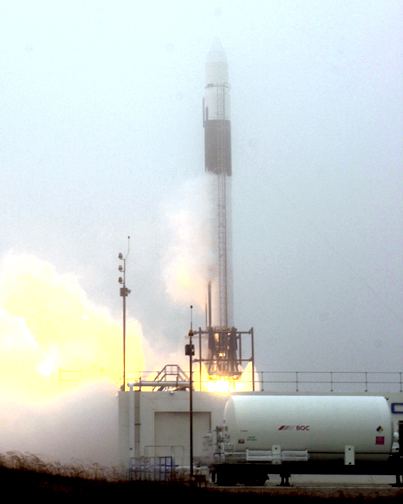
The final acquisition of 15,000 acres (6,100 ha) of land for the base occurred in 1966 to accommodate the construction of Space Launch Complex 6 for the Manned Orbiting Laboratory program. With the annexation, the base reached its final size, 99,099 acres (40,104 ha).
Ballistic missile testing
PGM-17 Thor
The transition from U.S. Army camp to missile base solidified on 15 December 1958 when Vandenberg AFB successfully launched its first missile, a PGM-17 Thor IRBM (Intermediate Range Ballistic Missile). The launch from Vandenberg inaugurated the intermediate-range ballistic missile portion of the Pacific Missile Range and was fired by a crew from the 1st Missile Division. The first successful launch of a Thor IRBM by a Royal Air Force crew took place at Vandenberg AFB on 16 April 1959. The launch was part of integrated weapon system training. In October 1959, the first combat training launch of a Thor IRBM by a Royal Air Force crew was successful.
On 22 April 1960, the fourth and final British-based Thor IRBM squadron was turned over to the Royal Air Force by the Strategic Air Command, thus completing the deployment of this weapon system in the United Kingdom. The next month, the first missile to be removed from an operational unit and sent to Vandenberg AFB for confidence firing arrived from a Thor IRBM squadron (No. 98 Squadron RAF) in the United Kingdom. Confidence firing was the predecessor of SAC's operational test program.
SM-65 Atlas
On 16 October 1958, the first Atlas ICBM launcher (576A-1) constructed at Vandenberg AFB, California, was accepted from the contractor by the 1st Missile Division. The first intercontinental ballistic missile, the SM-65D Atlas ICBM, was delivered and was accepted by SAC's 576th Strategic Missile Squadron on 18 February 1959. The first Atlas-D flew on 9 September 1959, and following the successful launch, General Thomas S. Power, CINCSAC, declared the Atlas ICBM to be operational. The following month, equipped with a nuclear warhead, the Atlas at Vandenberg became the first ICBM to be placed on alert in the United States. It was an SM-69D Atlas ICBM (AFSN 58-2190) on launcher 576A-1. In April 1960, the first attempted launch of a Series D Atlas ICBM from a coffin-type launcher (576B-2) was successful. This launcher was the prototype of the ones to be used at the first operational Atlas squadron, the 564th Strategic Missile Squadron, Francis E. Warren Air Force Base, Wyoming. Following this successful launch, Major General David Wade, Commander of the 1st Missile Division, declared the coffin-type launcher to be operational.
In July 1959, construction began on the first Series E Atlas ICBM coffin-type launcher (Atlas operational system test facility #1). On 28 February 1962, the first successful launch of the SM-65E Atlas took place. Construction began on the first SM-65F Atlas ICBM "silo-lift" launcher (Atlas operational system test facility #2) in November 1962. The first Atlas F arrived in June 1961 and the first operationally configured Series F Atlas was successfully launched on 1 August 1962.
During its testing phase, Vandenberg would operate two Atlas-D launch complexes; two Atlas-E, and three Atlas-F silos. The Atlas-Ds were taken off alert at the 576th Strategic Missile Squadron (Complex 576B) in May 1964 as part of the phaseout of the Atlas from active ICBM service. The last Atlas F test launch was on 18 January 1965, and the 576th Strategic Missile Squadron was inactivated on 2 April 1966. The 576th SMS carried out 53 Atlas-D, 7 Atlas-E and 7 Atlas-F test launches between 1959 and 1965.
The Atlas would remain in use as a launch vehicle for satellites from Vandenberg as a space booster configured with an RM-81 Agena upper-stage rocket and the Atlas-Agena would launch many different types of satellites into orbit until its phaseout in the late 1980s.
HGM-25A Titan I
The HGM-25A Titan I was the United States' first multistage ICBM. When designed and manufactured, the Titan I provided an additional nuclear deterrent to complement the U.S. Air Force's SM-65 Atlas missile. It was the first in a series of Titan rockets, and was an important step in building the Air Force's strategic nuclear forces.
In July 1958, construction began on the Titan I ICBM Operational System Test Facility (OSTF). This was the prototype of the hardened Titan I launch control facility at its operational sites. It consisted of one silo-lift launcher, blockhouse, and associated equipment. Designated "OSTF-8", the facility was destroyed on 3 December 1960 when the launcher elevator failed while lowering a fully fueled missile back into the silo. There were no injuries. This was the first silo accident at Vandenberg.
The first "silo-lift" launch of the Titan I was successful in September 1961, and the first SAC launch of the ICBM was successful in January 1962. As a result, the Titan I ICBM launch complex (395-A1/A2/A3) at Vandenberg was turned over to the Strategic Air Command 395th Strategic Missile Squadron to perform test launches of the missile.
However, the operational lifetime of the Titan I was short, as Secretary of Defense McNamara announced in November 1964 that all remaining first-generation ICBMs (Series E and F Atlas and Titan I) would be phased out (Project Added Effort) by the end of June 1965.
On 5 March 1965, the last test launch of a Titan I ICBM conducted by the Strategic Air Command at Vandenberg was successful. The 395th SMS performed 19 test launches between 1963 and 1965 before moving on to exclusively Titan II testing. During the 1980s, some Titan I second stages were used as targets for early Strategic Defense Initiative (SDI) testing.
LGM-25C Titan II
The LGM-25C Titan II ICBM was a second-generation ICBM with storable propellants, all inertial guidance, and in-silo launch capability. Construction of the first Titan II site began in 1962, and eventually Vandenberg operated four Titan II launch complexes.
Most of the testing of the missile was done at Cape Kennedy Air Force Station, Florida by the 6555th Aerospace Test Group, and the first successful underground silo launch of a Titan II ICBM took place at Vandenberg by the 395th SMS in April 1963. The first fully operational test took place in March 1965.
On 25 March 1966, the 200th SAC missile launched from Vandenberg AFB, California was a Titan II. The operational testing of the Titan II continued until 1985. Like its predecessor the Atlas ICBM, the Titan II GLV a derivative of that missile was used to launch Project Gemini spacecraft and the Titan 23G was used as a space booster to launch satellites. The final launch of a Titan II was made in 2003 when the last Titan IIG was expended.
LGM-30 Minuteman
The advent of solid-propellant gave the three-stage LGM-30 Minuteman ICBM a major advantage over earlier liquid propellant ICBMs. In February 1961, the construction began on Minuteman ICBM test launch facilities at Vandenberg. Silos 394A-1 through A-7 were the first constructed for use by the SAC 394th Strategic Missile Squadron.
LGM-30A Minuteman IA flight tests began in September 1962. The first Minuteman IB test took place in May 1963. On 24 February 1966, the first attempted salvo (simultaneous) launch of two model "A" Minuteman I ICBMs from Vandenberg silos LF-04 (394A-3) and LF-06 (394-A5) was successful. This launch demonstrated the multiple countdown and launch techniques that would be used at operational bases under actual combat conditions. Minuteman I testing continued until 1968.
LGM-30F Minuteman II testing began in August 1965 with the first launch conducted by Air Force Systems Command, was successful. The missile flew 5,000 mi (8,000 km) down the Pacific Missile Range and its reentry vehicle impacted in the target area.
On 22 October 1970, the first attempted OT GT70F (Salvo) operational test launch (simultaneous) launch of two Minuteman II ICBMs was successful from LF-25 and LF-26. The last Minuteman II phase I operational test was performed in April 1972.
The first LGM-30G Minuteman III phase II operational test was launched on 5 December 1972 from the LF-02 silo. The ICBM flew 800 mi (1,300 km) downrange before impacting in the Pacific Ocean. This was the beginning of Minuteman III launches which continue to this day from Vandenberg.
In July 1974, the initial training of Minuteman missile combat crews, formerly performed by Air Training Command (ATC) instructors at Vandenberg AFB, California, was incorporated into the 4315th Combat Crew Training Squadron's Operational Readiness Training (ORT) program at Vandenberg. As a result of this action, the entire Minuteman missile combat training, from beginning (initial training) to end (upgrade training) became the responsibility of Strategic Air Command.
SAC launched two Minuteman III ICBMs from Vandenberg AFB during exercise Global Shield, a comprehensive exercise of SAC's nuclear forces on 10 July 1979 from LF 08 and LF 09. One of these Global Shield missions, Glory Trip 40 GM, was the last Minuteman III phase I operational test flight. The missiles were launched 12 seconds apart by a SAC task force from the 90th Strategic Missile Wing, Francis E. Warren Air Force Base, Wyoming.
Glory Trip 77GM, a Minuteman III Operational Test in September 1980, became the longest Minuteman flight test when its payload impacted a broad ocean area target over 5,600 nmi (10,400 km) downrange.
LGM-118 Peacekeeper
The last ICBM tested from Vandenberg was the LGM-118 Peacekeeper (MX) ICBM beginning in June 1983. In addition to having a longer range than earlier ICBMs, the Peacekeeper could deliver up to 10 reentry vehicles to separate targets. It was intended as a replacement for the LGM-30 Minuteman, but it suffered from a long development time, and was retired in 2005 before the Minuteman because of arms reduction treaties.
The first Peacekeeper ICBM was launched by Air Force Systems Command from an above ground canister-type launch facility from Launch Complex TP-01 on 17 June 1983. This was the first "cold launch" of a missile at Vandenberg AFB, the missile reaching 600 mi (970 km) downrange. Two more test launches were conducted in 1983 from Launch Complex TP-01.
The first Peacekeeper with a Mark-21 test reentry vehicle was flight-tested from TP-01 on 15 June 1984. The Mark-21 resembled the reentry vehicle intended for the Peacekeeper weapon system. Two more test launches were conducted in 1984, the missile from TP-01. Air Force Systems Command conducted the final Peacekeeper launch from the above-ground TP-01 launch pad on 30 June 1985.
The first silo launch from LF-05 took place on 24 August 1985 from LF-08. LF-02 began to be used in 1986 for additional launches. On 23 August 1986 the first launch of a completely operational hardware configured missile and launch facility, and also the first Peacekeeper launch by a SAC combat crew under the control of Air Force Systems Command took place from silo LF-02.
A new Peacekeeper Missile Procedures Trainer was dedicated in March 1987. The US$17 million facility featured a state-of-the-art computer based simulator which would be used to train and evaluate missile crew members. The first LGM-118 Peacekeepers were deployed to Francis E. Warren Air Force Base in Wyoming that year. LGM-118 Peacekeeper test launches continued from Vandenberg with a third silo, LF-05 becoming operational in March 1990. The final launch of a LGM-118 Peacekeeper 33PA took place on 21 July 2004 before the missile was retired from service.