
The Union Jack or Union Flag is the national flag of the United Kingdom. While no law has been enacted making the Union Flag the national flag of the United Kingdom, it has become so through precedent.
The flag overlays three crosses, each representing a constituent country of the United Kingdom. England is represented by the red cross of Saint George edged in white, Scotland is represented by the white saltire of Saint Andrew on a blue field, and Northern Ireland is represented by the red saltire of Saint Patrick edged in white. The remaining constituent country, Wales, is not represented in the flag because the earlier flag of Great Britain was designed while Wales was part of the Kingdom of England.
The origins of the flag date to the earlier flag of Great Britain which was established in 1606 by a proclamation of King James VI and I of Scotland and England. The present design was established by an order in council following the Act of Union 1800, which joined the Kingdom of Great Britain and the Kingdom of Ireland to create the United Kingdom of Great Britain and Ireland. It was unchanged following the secession of the Irish Free State in 1922.

The flags of British Overseas Territories, as well as certain sovereign states and regions (particularly in the Commonwealth) that were previously British possessions, incorporate the Union Jack into their own flag designs or have official flags that are derived from the Union Jack. Many of these flags are blue or red ensigns with the Union Jack in the canton and defaced with the distinguishing arms of the territory. The governors of British Overseas Territories and the Australian states also have personal standards that incorporate the Union Jack in their design. The flag continues to have official status in Canada, by parliamentary resolution, where it is also known as the Royal Union Flag.
Terminology
The terms Union Jack and Union Flag are both used historically for describing the national flag of the United Kingdom.
Initially, the flag was termed the "British flag" or "flag of Britain", and the term "Union" first appeared in 1625. The etymology of jack in the context of flagstaffs reaches back to Middle German. The suffix -kin was used in Middle Dutch and Middle German as a diminutive. Examples occur in both Chaucer and Langland though the form is unknown in Old English. John is a common male forename (going back to the Bible), appearing in Dutch as Jan. Both languages use it as a generic form for a man in general. The two were combined in the Middle Dutch Janke, whence Middle French Jakke and Middle English Jack. Jack came to be used to identify all manner of particularly small objects or small versions of larger ones. The Oxford English Dictionary has definition III.21 "Something insignificant, or smaller than the normal size" and gives examples from 1530 to 2014 of this usage. Further examples in the compounds section at 2b illustrate this. The original maritime flag use of jack was "A ship's flag of a smaller size than the ensign, used at sea as a signal, or as an identifying device". The jack was flown in the bows or from the head of the spritsail mast to indicate the vessel's nationality: "You are alsoe for this present service to keepe in yor Jack at yor Boultspritt end and yor Pendant and yor Ordinance" The Union Flag when instantiated as a small jack became known as the "Union Jack" and this later term transferred to more general usage of the Union Flag.

Also later a short flagpole was placed in the bows of a ship to fly the jack, this became known as the jackstaff.
According to the Flag Institute, a membership-run vexillological charity, "the national flag of the United Kingdom, the Crown Dependencies and Overseas Territories is the Union Flag, which may also be called the Union Jack." The institute has also stated: it is often stated that the Union Flag should only be described as the Union Jack when flown in the bows of a warship, but this is a relatively recent idea. From early in its life the Admiralty itself frequently referred to the flag as the Union Jack, whatever its use, and in 1902 an Admiralty circular announced that Their Lordships had decided that either name could be used officially. In 1908, a government minister stated, in response to a parliamentary question, that "the Union Jack should be regarded as the National flag". Notwithstanding Their Lordships' circular of 1902, by 1913 the Admiralty described the "Union Flag" and added in a footnote that "A Jack is a Flag to be flown only on the 'Jack' Staff".
However, the authoritative A Complete Guide to Heraldry published in 1909 by Arthur Charles Fox-Davies uses the term "Union Jack".

The term "Union Flag" is used in King Charles I's 1634 proclamation:
... none of Our Subjects, of any of Our Nations and Kingdoms shall from henceforth presume to carry the Union Flag in the Main top, or other part of any of their Ships (that is) St Georges cross and St Andrew's Cross joined together upon pain of Our high displeasure, but that the same Union Flag be still reserved as an ornament proper for Our own Ships and Ships in our immediate Service and Pay, and none other. and in King George III's proclamation of 1 January 1801 concerning the arms and flag of the United Kingdom of Great Britain and Ireland:
And that the Union Flag shall be Azure, the Crosses Saltires of St. Andrew and St. Patrick Quarterly per Saltire, counterchanged Argent and Gules; the latter fimbriated of the Second, surmounted by the Cross of St. George of the Third, fimbriated as the Saltire : ...

When the first flag representing Britain was introduced on the proclamation of King James I in 1606, it became known simply as the "British flag" or the "flag of Britain". The royal proclamation gave no distinctive name to the new flag. At the funeral of King James in 1625 the flag was called the "Banner of the Union of the two Crosses of England and Scotland". The word jack was in use before 1600 to describe the maritime bow flag. By 1627 a small Union Jack was commonly flown in this position. One theory goes that for some years it would have been called simply the "Jack", or "Jack flag", or the "King's Jack", but by 1674, while formally referred to as "His Majesty's Jack", it was commonly called the "Union Jack", and this was officially acknowledged.
A proclamation issued by King George III at the time of the Union of 1801 concerned flags at sea and repeatedly referred to "Ensigns, Flags, Jacks, and Pendants" and forbade merchant vessels from wearing "Our Jack, commonly called the Union Jack" nor any pendants or colours used by the King's ships. Reinforcing the distinction the King's proclamation of the same day concerning the arms and flag of the United Kingdom (not colours at sea) called the new flag "the Union Flag".
The size and power of the Royal Navy internationally at the time could also explain why the flag was named the "Union Jack"; considering the navy was so widely utilised and renowned by the United Kingdom and colonies, it is possible that the term jack occurred because of its regular use on all British ships using the jackstaff (a flag pole attached to the bow of a ship). The name may alternatively come from the "jack-et" of the English or Scottish soldiers, or from the name of James I who originated the first union in 1603. Even if the term Union Jack does derive from the jack flag, after three centuries, it is now sanctioned by use and has appeared in official use, confirmed as the national flag by Parliament and remains the popular term.

Winston Churchill, British Prime Minister from 1940 to 1945, referred to the flag of the United Kingdom as the Union Jack. In March 1899, Churchill wrote to his mother from India about her plans to produce a new trans-Atlantic magazine, to be called The Anglo-Saxon Review. The drawing at the end of this letter was deliberately facetious, teasing her for going down-market, and in the accompanying letter he wrote, "Your title 'The Anglo Saxon' with its motto 'Blood is thicker than water' only needs the Union Jack & the Star Spangled Banner crossed on the cover to be suited to one of Harmsworth's cheap Imperialist productions."
More recently, Reed's Nautical Almanac (1990 edition) unambiguously stated: "The Union Flag, frequently but incorrectly referred to as the Union Jack, ..." and later: "8. The Jack – A small flag worn on a jackstaff on the stem of Naval Vessels. The Royal Navy wears the Union Flag ... This is the only occasion when it correct to describe the flag as the Union Jack". However, this assertion does not appear in any Reed's Nautical Almanac since 1993. In the 2016 Reed's Nautical Almanac, the only entry where this might appear, section 5.21, covering Flag Etiquette, does not include this statement. Within the Almanac, neither the Union Flag nor the Union Jack are included pictorially or mentioned by name.
For comparison with another anglophone country with a large navy, jack of the United States specifically refers to the flag flown from the jackstaff of a warship, auxiliary or other U.S. governmental entity.
The Butcher's Apron is a pejorative term for the flag, common amongst Irish republicans, citing the blood-streaked appearance of the flag and referring to atrocities committed in Ireland and other countries under British colonial rule. In 2006, Sandra White, a Member of the Scottish Parliament, caused a furore when the term was used in a press release under her name. It was later blamed on the actions of a researcher, who resigned yet claimed that the comment had been approved by White. The Irish folk band the Wolfe Tones has a song entitled "The Butcher's Apron" which makes reference to the term.
In the Chinese language, the flag has the nickname Rice-Character Flag (米字旗; Mandarin Pinyin: mǐzìqí, Cantonese Jyutping: mai5zi6kei4) because the pattern looks similar to the Chinese character for "rice" (米).
Design
The current flag's design has been in use since 1801. Its original blazon, as decreed by George III of the United Kingdom on 1 January 1801, reads:
the Union flag shall be azure, the crosses-saltires of St. Andrew and St. Patrick quartered per saltire counter changed argent and gules; the latter fimbriated of the second [viz., argent]; surmounted by the cross of St. George of the third [viz., gules], fimbriated as the saltire [viz., argent].
Specification
The Union Jack is normally twice as long as it is tall, a ratio of 1:2. In the United Kingdom, land flags are normally a ratio of 3:5; the Union Jack can also be made in this shape, but is 1:2 for most purposes. In 2008, MP Andrew Rosindell proposed a Ten Minute Rule bill to standardise the design of the flag at 3:5, but the bill did not proceed past the first reading.
The three-component crosses that make up the Union Jack are sized as follows:
The red St George's Cross width is 1⁄5 of the flag's height with a 1⁄15 flag height fimbriation
The white diagonal St Andrew's Cross width is 1⁄5 of the flag's height, visible on either side of the St Patrick's Cross in diagonals of 1⁄10 and 1⁄30 of the flag's height, respectively.
The red diagonal St Patrick's Cross width is 1⁄15 of the flag's height. It is offset by 1⁄30 of the flag's height in an anti-clockwise direction. According to the official blazon of 1801, the white diagonal St Andrew's Cross is in fact counterchanged with the red diagonal of St Patrick's Cross. In this interpretation, the width of both saltires is 1⁄15 of the flag's height, with fimbriations of 1⁄30 of the flag's height on either side of the red saltire.
The crosses and fimbriations retain their thickness relative to the flag's height whether they are shown with a ratio of 3:5 or 1:2. Height here is the distance from top to bottom which in vexillology is termed width or breadth.
Ratios
The Admiralty in 1864 settled all official flags at proportions of 1:2, but the relative widths of the crosses remained unspecified, with the above conventions becoming standardised in the 20th century. In the 19th century, the Union Flag was defined by the same blazon but could vary in its geometrical proportions.
Although the most common ratio is 1:2, other ratios exist. The Royal Navy's flag code book, BR20 Flags of All Nations, states that both 1:2 and 3:5 versions are official. In the 3:5 version, the innermost points of the lower left and upper right diagonals of the St Patrick's Cross are cut off or truncated. The Garter King of Arms also suggests a ratio of 3:5 as the suitable proportion for a Union Flag flown on land. The war flag used by the British Army has the proportions 3:5.
The King's Harbour Master's flag, similar to the Pilot Jack, is a 1:2 flag that contains a white-bordered Union Flag that is longer than 1:2. The jacks of ships flying variants of the Blue Ensign are square and have a square Union Flag in the canton. The King's Colours of Army regiments are 36 by 43 inches (910 mm × 1,090 mm); on them, the bars of the cross and saltire are of equal width, as are their respective narrow fimbriations.
Colours
Although the proclamation of 1801 did not specify colours beyond azure, argent and gules (blue, silver/white and red, respectively), the Garter King of Arms, under the authority of the Earl Marshal, has approved the below shades as an accurate representation:
Flying
The flag does not have reflection symmetry due to the slight pinwheeling of the St Patrick's and St Andrew's crosses, technically the counterchange of saltires. Thus, there is a correct side up. It is one of two national flags with two-fold rotational symmetry, symmetry group C2, the other being the flag of Trinidad and Tobago. The original specification of the Union Flag in the royal proclamation of 1 January 1801 did not contain a drawn pattern or express which way the saltires should lie; they were simply "counterchanged" and the red saltire fimbriated. Nevertheless, a convention was soon established which accords most closely with the description. The flag was deliberately designed with the Irish saltire slightly depressed at the hoist end to reflect the earlier union with Scotland, giving as it were seniority to the Saint Andrew's cross.
When statically displayed, the hoist is on the observer's left. To fly the flag correctly, the white of St Andrew is above the red of St Patrick in the upper hoist canton (the quarter at the top nearest to the flag-pole). This is expressed by the phrases wide white top and broadside up. An upside-down flag must be turned over to be flown correctly; rotating it 180 degrees will still result in an upside-down flag.
The first drawn pattern for the flag was in a parallel proclamation on 1 January 1801, concerning civil naval ensigns, which drawing shows the red ensign (also to be used as a red jack by privateers). As it appears in the London Gazette, the broad stripe is where expected for three of the four quarters, but the upper left quarter shows the broad stripe below.
It is often stated that a flag upside down is a form of distress signal or even a deliberate insult. In the case of the Union Flag, the difference is subtle and is easily missed by the uninformed. It is often displayed upside down inadvertently—even on commercially-made hand waving flags.
History
In 1603, James VI of Scotland inherited the Kingdom of England (and the newly created client state, the Kingdom of Ireland) as James I, thereby uniting the crowns in a personal union. With Wales annexed into the Kingdom of England under the Laws in Wales Acts 1535 and 1542, James now ruled over all of the island of Great Britain, which he frequently described as a unified kingdom (though the parliaments of the Kingdom of England and the Kingdom of Scotland did not actually unify until the Kingdom of Great Britain was formed in 1707). In the wake of the 1603 personal union, several designs for a new flag were drawn up, juxtaposing the Saint George's Cross and the St Andrew's Saltire, but none were acceptable to James:
Various other designs for a common flag were drawn up following the union of the two Crowns in 1603, but were rarely, if ever, used. One version showed St George's Cross with St Andrew's Cross in the canton, and another version placed the two crosses side by side.
A painted wooden ceiling boss from Linlithgow Palace, dated to about 1617, depicts the Scottish royal unicorn holding a flag where a blue Saltire surmounts the red cross of St. George.
1606–1801
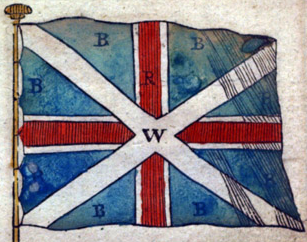
On 12 April 1606, a new flag to represent the regal union between England and Scotland was specified in a royal decree, according to which the flag of England (a red cross on a white background, known as St George's Cross), and the flag of Scotland (a white saltire on a blue background, known as the saltire or St Andrew's Cross), would be joined together, forming the flag of Great Britain and first union flag:
By the King: Whereas, some differences hath arisen between Our subjects of South and North Britaine travelling by Seas, about the bearing of their Flagges: For the avoiding of all contentions hereafter. We have, with the advice of our Council, ordered: That from henceforth all our Subjects of this Isle and Kingdome of Great Britaine, and all our members thereof, shall beare in their main-toppe the Red Crosse, commonly called St George's Crosse, and the White Crosse, commonly called St Andrew's Crosse, joyned together according to the forme made by our heralds, and sent by Us to our Admerall to be published to our Subjects: and in their fore-toppe our Subjects of South Britaine shall weare the Red Crosse onely as they were wont, and our Subjects of North Britaine in their fore-toppe the White Crosse onely as they were accustomed.
This royal flag was, at first, to be used only at sea on civil and military ships of both England and Scotland, whereas land forces continued to use their respective national banners. Flying the national flag at the mainmast had signified the Admiral of the Narrow Seas (the English Channel) and confusion arose. In 1634, King Charles I restricted its use to Royal Navy ships. After the Acts of Union 1707, the flag gained a regularised status as "the ensign armorial of the Kingdom of Great Britain", the newly created state. It was then adopted by land forces as well, although the blue field used on land-based versions more closely resembled that of the blue of the flag of Scotland.
Various shades of blue have been used in the saltire over the years. The ground of the current Union Flag is a deep "navy" blue (Pantone 280), which can be traced to the colour used for the Blue Ensign of the Royal Navy's historic "Blue Squadron". (Dark shades of colour were used on maritime flags on the basis of durability.) In 2003 a committee of the Scottish Parliament recommended that the flag of Scotland use a lighter "royal" blue (Pantone 300) (the Office of the Lord Lyon does not detail specific shades of colour for use in heraldry).
A thin white stripe, or fimbriation, separates the red cross from the blue field, in accordance with heraldry's rule of tincture where colours (such as red and blue) must be separated from each other by metals (such as white, i.e. argent or silver). The blazon for the old Union Flag, to be compared with the current flag, is azure, the cross saltire of St Andrew argent surmounted by the Cross of St George gules, fimbriated of the second.
The Kingdom of Ireland, which had existed as a personal union with England since 1541, was unrepresented in the original versions of the Union Jack. However, the flag of the Protectorate from 1658 to 1660 was inescutcheoned with the arms of Ireland. These were removed at the Restoration, because Charles II found them offensive.
The original flag appears in the canton of the Commissioners' Ensign of the Northern Lighthouse Board. This is the only contemporary official representation of the pre-1801 Union Jack in the United Kingdom and can be seen flying from their George Street headquarters in Edinburgh.
It is this version of the Union Jack that formed the canton of the Continental Union Flag, the "de facto" first national flag of the United States from July 1776 to June 1777.
Lord Howe's action, or the Glorious First of June, painted in 1795, shows a Union flying from HMS Queen Charlotte on the "Glorious First of June" 1794. The actual flag, preserved in the National Maritime Museum, is a cruder approximation of the proper specifications; this was common in 18th and early 19th century flags.
The flag is also flown beside Customs House in Loftus Street, Sydney, to mark the raising of the Union Jack by Captain Phillip at Sydney Cove, the site of the first British settlement in New South Wales and Australia in 1788. On the plaque it is referred to as the "Jack of Queen Anne".
The flag of the British Army is the Union Jack, however in 1938 a "British Army Non-Ceremonial Flag" was devised, featuring a crowned golden lion, statant guardant, surmounting the royal crown, overlying two crossed swords on a red background, (the word "Army" in gold letters sometimes appears below this motif). This is not the equivalent of the ensigns of the other armed services but is used at recruiting and military or sporting events, when the army needs to be identified but the reverence and ceremony due to the regimental flags and the Union Jack would be considered inappropriate.
Scottish Union Flag
In objecting to the design of the Union Flag adopted in 1606, whereby the cross of Saint George surmounted that of Saint Andrew, a number of owners and masters of merchant vessels in the Kingdom of Scotland raised the issue with John Erskine, 19th Earl of Mar, and were encouraged by him to send a letter of complaint to James VI, via the Privy Council of Scotland, which stated: