
The Tsar Bomba (code name: Ivan or Vanya, internal designation "AN602") is the most powerful nuclear weapon or weapon of any kind ever constructed and tested. A project of the Soviet Union, it was a thermonuclear aerial bomb, tested on 30 October 1961 at the Novaya Zemlya site in the country's far north. The bomb yielded the equivalent of 50 megatons of TNT.
The Soviet physicist Andrei Sakharov oversaw the project at Arzamas-16, while the main work of design was by Sakharov, Viktor Adamsky, Yuri Babayev, Yuri Smirnov, and Yuri Trutnev. The project was ordered by First Secretary of the Communist Party Nikita Khrushchev in July 1961 as part of the Soviet resumption of nuclear testing after the Test Ban Moratorium, with the detonation timed to coincide with the 22nd Congress of the Communist Party of the Soviet Union (CPSU).
Tested on 30 October 1961, the test verified new design principles for high-yield thermonuclear charges, allowing nuclear explosives "of practically unlimited power". The bomb was dropped by parachute from a Tu-95V aircraft, and detonated autonomously 4,000 metres (13,000 ft) above the cape Sukhoy Nos of Severny Island, Novaya Zemlya, 15 kilometres (8 nautical miles) from Mityushikha Bay, north of Matochkin Strait. Blast data and footage was recorded by a Soviet Tu-16. Both aircraft received radiation flash damage.
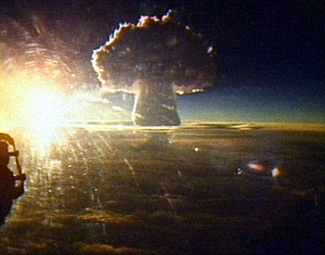
The bhangmeter results and other data suggested the bomb yielded around 58 Mt (243 PJ), which was the accepted yield in technical literature until 1991, when Soviet scientists revealed that their instruments indicated a yield of 50 Mt (209 PJ). As they had the instrumental data and access to the test site, their yield figure has been accepted as more accurate. In theory, the bomb would have had a yield over 100 Mt (418 PJ) if it had included the natural uranium tamper which featured in the design but was replaced with lead in the test to reduce radioactive fallout. As only one bomb was built to completion, that capability has never been demonstrated. The design was too large and heavy to be deployed operationally, although it influenced the initial development of the Proton rocket. The next four most powerful nuclear weapons tests ever to have taken place were carried out by the Soviet Union the following year.
The United States government's reaction emphasized the lack of military usefulness, and signalled readiness to sign the Partial Nuclear Test Ban Treaty, eventually realized in 1963. It also prompted the disclosure of the US B41 nuclear bomb's 25 Mt (105 PJ) yield. In the Western world, the reaction focused on the incorrectly assumed record level of fission product fallout from a typical fissionable tamper design, similar to the US Castle Bravo test disaster. In fact, the Tsar Bomba derived only 3% of its yield from fission, or 1.5 Mt.
Background
In the late 1950s Cold War, the US nuclear weapons arsenal greatly exceeded that of the USSR in quantity of weapons, total explosive yield of weapons, and their ability to deliver the weapon. In the early part of the decade, the Strategic Air Command had begun deploying nuclear-capable bombers, as well as actual weapons, to airbases hosted by US allies within striking distance of the Soviet Union, as well as deploying them on aircraft carriers and on medium-range ballistic missiles in the United Kingdom. The USSR had a credible ability to threaten American allies in Western Europe and Asia via a limited bomber and short-range missile force, had tested a multi-stage thermonuclear weapon in 1955, and had begun testing a prototype rocket for an intercontinental ballistic missile in 1957. Its leadership was well aware that the USSR's deployed nuclear forces in 1960 could not reliably and credibly threaten targets in the continental United States, and that in the event of war, the Soviet Union would struggle to reply in kind. This in turn threatened to weaken Soviet leverage in hot-spots like Berlin, which had been the subject of Soviet and American tension since the end of World War II.

Given the Soviet Union's strategic disadvantage concerning America's nuclear weapons possessions, foreign policy and propaganda considerations during the leaderships of Georgy Malenkov and Nikita Khrushchev made a response to the perceived US nuclear blackmail imperative for both international and domestic reasons. The creation of the Tsar Bomba represented part of a larger effort to maintain the concept of nuclear deterrence, and to impress (and terrify) both domestic and international audiences with the strength of the Soviet nuclear weapons program, even though the weapon itself was arguably impractical.
Name
The name Tsar Bomba is a recent invention dating to the 1990s. Contemporarily, the bomb was referred to by Western Bloc press as the "50-megaton bomb" or "100-megaton bomb".
Tsar Bomba was a modification of an earlier project, RN202, which used a ballistic case of the same size but a very different internal mechanism. Many published books, even some authored by those involved in product development of 602, contain inaccuracies that are replicated elsewhere, including wrongly identifying Tsar Bomba as RDS-202 or RN202.

The bomb was officially known as "product 602" (изделие 602) or "AN602", and codenamed "Ivan". The usage of different names can be a source of confusion. The Tsar Bomba, being a modification of (the) RN202, is sometimes mistakenly labelled as RDS-37, RDS-202 or PH202 (product 202).
Unofficially, the bomb would later become known as "Tsar Bomba" and "Kuzka's mother" (Кузькина мать, Kuz'kina mat'). The name Tsar Bomba (loosely translated as Emperor of Bombs) comes from an allusion to two other Russian historical artifacts, the Tsar Cannon and the Tsar Bell, both of which were created as showpieces but whose large size made them impractical for use. The name "Tsar Bomba" does not seem to have been used for the weapon prior to the 1990s. The name "Kuzka's Mother" was inspired by the statement of Khrushchev to then US Vice President Richard Nixon: "We have funds at our disposal that will have dire consequences for you. We will show you Kuzka's mother!"
The Central Intelligence Agency (CIA) designated the test as "JOE 111" using their "JOE" counting scheme, which had begun with RDS-1 in 1949.

Development
The development of a very large bomb began in 1956 and was carried out in two stages. At the first stage, from 1956 to 1958, it was "product 202", which was developed in the recently created NII-1011. The modern name of NII-1011 is the "Russian Federal Nuclear Center or the All-Russian Scientific Research Institute of Technical Physics" (RFNC-VNIITF). According to the official history of the institute, the order on the creation of a research institute in the system of the Ministry of Medium Machine Building was signed on 5 April 1955; work at the NII-1011 began a little later.
At the second stage of development, from 1960 to a successful test in 1961, the bomb was called "item 602" and was developed at KB-11 (VNIIEF), V. B. Adamsky was developing, and the physical scheme was developed by Andrei Sakharov, Yu. N. Babaev, Yu. N. Smirnov, and Yu. A. Trutnev.
Product 202
After the successful test of the RDS-37, KB-11 employees (Sakharov, Zeldovich, and Dovidenko) performed a preliminary calculation and, on 2 February 1956, they handed over to N. I. Pavlov, a note with the parameters for charges of 150 Mt (628 PJ) and the possibility of increasing the power to 1 gigaton of TNT (4.2 EJ).

After the creation in 1955 of the second nuclear center – NII-1011, in 1956, by a resolution of the Council of Ministers of the Soviet Union, the center was assigned the task of developing an ultra-high-power charge, which was called "Project 202".
On 12 March 1956, a draft Joint Resolution of the Central Committee of the Communist Party of the Soviet Union (CPSU Central Committee) and the Council of Ministers of the Soviet Union on the preparation and testing of the 202 product was adopted. The project planned to develop a version of the RDS-37 with a capacity of 30 Mt (126 PJ).
RDS-202 was designed with a maximum calculated power release of 50 Mt (209 PJ), with a diameter of 2.1 m (6 ft 11 in), a length of 8 m (26 ft), weighing 26 tonnes (29 short tons) with a parachute system and structurally coordinated with the Tu-95-202 carrier aircraft specially converted for its use. On 6 June 1956, the NII-1011 report described the RDS-202 thermonuclear device with a design power of up to 38 Mt (159 PJ) with the required task of 20–30 Mt (84–126 PJ). In reality, this device was developed with an estimated power of 15 Mt (63 PJ), after testing the products "40GN", "245" and "205" its tests were deemed inappropriate and canceled.
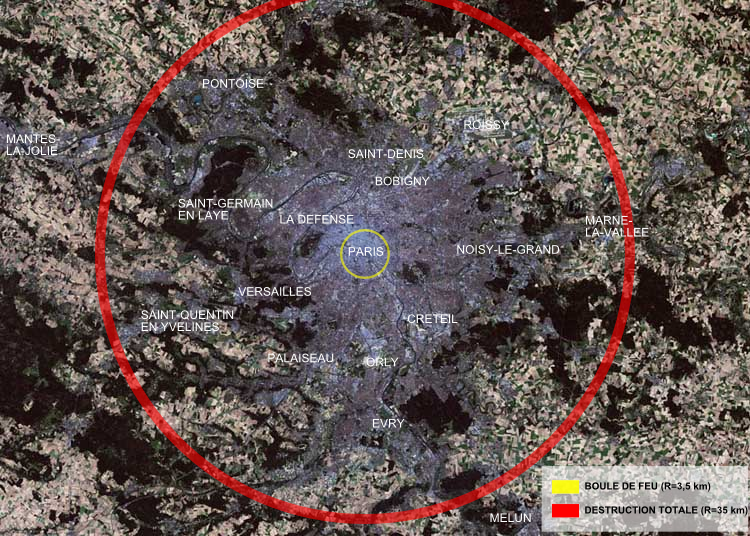
The Tsar Bomba differs from its parent design – the RN202 – in several places. The Tsar Bomba was a three-stage bomb with a Trutnev-Babaev second- and third-stage design, with a yield of 50 Mt. This is equivalent to about 1,570 times the combined energy of the bombs that destroyed Hiroshima and Nagasaki, 10 times the combined energy of all the conventional explosives used in World War II, one quarter of the estimated yield of the 1883 eruption of Krakatoa, and 10% of the combined yield of all other nuclear tests to date.
A three-stage hydrogen bomb uses a fission bomb primary to compress a thermonuclear secondary, as in most hydrogen bombs, and then uses energy from the resulting explosion to compress a much larger additional thermonuclear stage. There is evidence that the Tsar Bomba had several third stages rather than a single very large one.
RDS-202 was assembled on the principle of radiation implosion, which was previously tested during the creation of RDS-37. Since it used a much heavier secondary module than in the RDS-37, two primary modules (charges), located on opposite sides of the secondary module, were used to compress it. This physical charging scheme was later used in the design of the AN-602, but the AN-602 thermonuclear charge itself (secondary module) was new. The RDS-202 thermonuclear charge was manufactured in 1956, and was planned for testing in 1957, but was not tested and put into storage. Two years after the manufacture of the RDS-202, in July 1958, it was decided to remove it from storage, dismantle and use automation units and charge parts for experimental work. The CPSU Central Committee and the Council of Ministers of the USSR adopted a draft Joint Resolution on 12 March 1956, on the preparation and testing of izdeliye 202, which read:
Adopt a draft resolution of the CPSU Central Committee and the USSR Council of Ministers on the preparation and testing of izdeliye 202.
Paragraphs required for inclusion in the draft resolution:
(a) The Ministry of Medium Engineering (Comrade Avraami Zavenyagin) and the Ministry of Defense of the USSR (Comrade Georgy Zhukov) at the end of the preparatory work for the test of izdeliye 202 to report to the CPSU Central Committee on the situation;
(b) The Ministry of Medium Engineering (Comrade Zavenyagin) to solve the issue of introducing a special stage of protection into the design of izdeliye 202 to ensure disarming of the product in the event of a failure of the parachute system, as well as their proposals reported to the CPSU Central Committee.
Comrades Boris Vannikov and Kurchatov are assigned to edit the final version of this resolution.
Product 602
In 1960, KB-11 began developing a thermonuclear device with a design capacity of one hundred megatons of TNT (418 petajoules). In February 1961, the leaders of KB-11 sent a letter to the Central Committee of the CPSU with the subject line "Some questions of the development of nuclear weapons and methods of their use", which, among other things, raised the question of the expediency of developing such a 100 Mt device. On 10 July 1961, a discussion took place in the Central Committee of the CPSU, at which First Secretary Nikita Khrushchev supported the development and testing of this super-powerful bomb.
To speed up the work on Tsar Bomba, it was based on the 202 Project, but was a new project, developed by a different group. For KB-11, six casings for the Project 202 bomb already manufactured at NII-1011 and a set of equipment developed for the 202 Project testing were used.
Tsar Bomba had a "three-stage" design: the first stage is the necessary fission trigger. The second stage was two relatively small thermonuclear charges with a calculated contribution to the explosion of 1.5 Mt (6 PJ), which were used for radiation implosion of the third stage, the main thermonuclear module located between them, and starting a thermonuclear reaction in it, contributing 50 Mt of explosion energy. As a result of the thermonuclear reaction, huge numbers of high-energy fast neutrons were formed in the main thermonuclear module, which, in turn, initiated the fast fission nuclear reaction in the nuclei of the surrounding uranium-238, which would have added another 50 Mt of energy to the explosion, so that the estimated energy release of Tsar Bomba was around 100 Mt.
The test of such a complete three-stage 100 Mt bomb was rejected due to the extremely high level of radioactive contamination that would be caused by the fission reaction of large quantities of uranium-238. During the test, the bomb was used in a two-stage version. A. D. Sakharov suggested using the non-fissionable lead instead of the uranium-238 in the secondary's tamper, which reduced the bomb's energy to 50 Mt, and, in addition to reducing the amount of radioactive fission products, avoided the fireball's contact with the Earth's surface, thus eliminating radioactive contamination of the soil and the distribution of large amounts of fallout into the atmosphere. In the United States nuclear complex this use of lead tampers became common after the Castle Bravo testing disaster, and was known as the "materials substitution method".
Many technical innovations were applied in the design of Tsar Bomba. The thermonuclear charge was made according to the "bifilar" scheme – the radiation implosion of the main thermonuclear stage was carried out from two opposite sides. These secondary charges produced X-ray compression of the main thermonuclear charge. For this, the second stage was separated into two fusion charges which were placed in the front and rear parts of the bomb, for which a synchronous detonation was required with a difference in initiation of no more than 100 nanoseconds. To ensure synchronous detonation of charges with the required accuracy, the sequencing unit of the detonation electronics was modified at KB-25 (now "Federal State Unitary Enterprise "NL Dukhov All-Russian Scientific Research Institute of Automation")(VNIIA).
Development of the carrier aircraft
The initial three-stage design of Tsar Bomba was capable of yielding approximately 100 Mt (approximately 3,000 times the power of the Hiroshima (15 kt) and Nagasaki (21 kt) bombs, combined); however, it was thought that this would have resulted in too much nuclear fallout, and the aircraft delivering the bomb would not have had enough time to escape the explosion. To limit the amount of fallout, uranium-238 in the tamper was replaced with lead. This eliminated fast fission reactions from the tamper by the fusion-stage neutrons, so that approximately 97% of the total yield resulted from thermonuclear fusion alone. As such, it was one of the "cleanest" nuclear bombs ever created, as most of the radioactive intensity of nuclear fallout is caused by the creation of fission products. There was a strong incentive for this modification, since most of the fallout from a test of the bomb would probably have descended on populated Soviet territory.
The first studies on "Topic 242" began immediately after Igor Kurchatov talked with Andrei Tupolev in late 1954. Tupolev appointed his deputy for weapon systems, Aleksandr Nadashkevich, as the head of the topic. Subsequent analysis indicated that to carry such a heavy, concentrated load, the Tu-95 bomber carrying the Tsar Bomba needed to have its engines, bomb bay, suspension and release mechanisms extensively redesigned. The Tsar Bomba's dimensional and weight drawings were passed in the first half of 1955, together with its placement layout drawing. The Tsar Bomba's weight accounted for 15% of the weight of its Tu-95 carrier as expected. The carrier, aside from having its fuel tanks and bomb bay doors removed, had its BD-206 bomb-holder replaced by a new, heavier beam-type BD7-95-242 (or BD-242) holder attached directly to the longitudinal weight-bearing beams. The problem of how to release the bomb was also solved; the bomb-holder would release all three of its locks in a synchronous fashion via electro-automatic mechanisms as required by safety protocols.
A Joint Resolution of the CPSU Central Committee and the Council of Ministers (Nr. 357-28ss) was issued on 17 March 1956, which mandated that OKB-156 begin conversion of a Tu-95 bomber into a high-yield nuclear bomb carrier. These works were carried out in the Gromov Flight Research Institute from May to September 1956. The converted bomber, designated the Tu-95V, was accepted for duty and was handed over for flight tests, which including a release of a mock-up "superbomb", were conducted under the command of Colonel S. M. Kulikov until 1959, and passed without major issues.
Despite the creation of the Tu-95V bomb-carrier aircraft, the test of the Tsar Bomba was postponed for political reasons: namely, Khrushchev's visit to the United States and a pause in the Cold War. The Tu-95V during this period was flown to Uzyn, in today's Ukraine, and was used as a training aircraft; therefore, it was no longer listed as a combat aircraft. With the beginning of a new round of the Cold War in 1961, the test was resumed. The Tu-95V had all connectors in its automatic release mechanism replaced, the bomb bay doors removed and the aircraft itself covered with a special, reflective white paint.
In late 1961, the aircraft was modified for testing Tsar Bomba at the Kuibyshev aircraft plant.
Test
Nikita Khrushchev, the first secretary of the Communist Party, announced the upcoming tests of a 50-Mt bomb in his opening report at the 22nd Congress of the Communist Party of the Soviet Union on 17 October 1961. Before the official announcement, in a casual conversation, he told an American politician about the bomb, and this information was published on 8 September 1961, in The New York Times. The Tsar Bomba was tested on 30 October 1961.
The Tupolev Tu-95V aircraft No. 5800302 carrying the bomb took off from the Olenya airfield, and flew to State Test Site No. 6 of the USSR Ministry of Defense on Novaya Zemlya with a crew of nine:
Test pilot – Major Andrei Yegorovich Durnovtsev
Lead navigator of tests – Major Ivan Nikiforovich Kleshch
Second pilot – Captain Mikhail Konstantinovich Kondratenko
Navigator-operator of the radar – Lieutenant Anatoly Sergeevich Bobikov
Radar operator – Captain Alexander Filippovich Prokopenko
Flight engineer – Captain Grigory Mikhailovich Yevtushenko
Radio operator – Lieutenant Mikhail Petrovich Mashkin
Gunner / radio operator – Captain Vyacheslav Mikhailovich Snetkov
Gunner / radio operator – Corporal Vasily Yakovlevich Bolotov
The test was also attended by the Tupolev Tu-16 laboratory aircraft, no. 3709, equipped for monitoring the tests, and its crew:
Leading test pilot – Lieutenant Colonel Vladimir Fyodorovich Martynenko
Second pilot – Senior Lieutenant Vladimir Ivanovich Mukhanov
Leading navigator – Major Semyon Artemievich Grigoryuk
Navigator-operator of the radar – Major Vasily Timofeevich Muzlanov
Gunner / radio operator – Senior Sergeant Mikhail Emelyanovich Shumilov