
Tsakhiagiin Elbegdorj (Mongolian: Цахиагийн Элбэгдорж; born 8 March 1963), known internationally as Elbegdorj Tsakhia, is a Mongolian politician and journalist who served as the president of Mongolia from 2009 to 2017. He previously served as prime minister in 1998 and again from 2004 to 2006.
Elbegdorj was one of the key leaders of the 1990 Mongolian democratic revolution that ended 70 years of communist rule in Mongolia, and co-drafted the country's 1992 constitution that guaranteed democracy and a free market economy. Elbegdorj has been labeled by his supporters as a "freedom fighter" and the "Golden Sparrow of Democracy", alluding to a bird that comes with spring sunshine after a long, harsh winter.
Currently, Elbegdorj is a member of The Elders – established by Nelson Mandela in 2007 – that works for peace, justice, human rights and a sustainable planet. Moreover, he is a member of Club de Madrid which commits to advancing democracy worldwide. In addition, Elbegdorj is a commissioner of International Commission Against Death Penalty.

Furthermore, he is a vice chairman of International Democracy Union -an international alliance of centre right political parties. Elbegdorj is a patron of World Sustainable Development Forum. He is the Bernard and Susan Liautaud visiting fellow at Stanford University's Freeman Spogli Institute for International Studies. Elbegdorj is a president of World Mongol Federation - an international federation of Mongols around the world.
His tenure has focused on fighting corruption, environmental protection, women's rights, judicial reform, civic engagement, economic liberalization and privatization, property rights, and the abolition of the death penalty.
Elbegdorj is the founder of the Ardchilal (English: Democracy) newspaper – the country's first independent newspaper – and helped to establish the first independent television station in Mongolia.

Early life and education
Elbegdorj was born into a nomadic herding family in Zereg sum, Khovd province, on 8 March 1963. He was the youngest of eight sons. Elbegdorj spent most of his early childhood herding livestock through the high mountains of Zereg sum. His father, Mongolyn Tsakhia, was a veteran of Mongolia's border conflict with the Empire of Japan that resulted in the 1939 Battle of Khalkhyn Gol. Elbegdorj finished the sum's eight-year school (Primary & middle school) in 1979. Afterwards, his family moved to Erdenet city, and he finished Erdenet's No. 1 ten-year school (High school) in 1981.
Army and studies in the USSR
In 1981–82, Elbegdorj worked in copper ore mining and processing plant Erdenet Concern (currently Erdenet Mining Corporation) as a machinist. In 1982, he was drafted into military service. For submitting poems to the army newspaper Ulaan Od (Red Star), which impressed army authorities, and heading a Revolutionary Youth Unit in the army, he was awarded with the possibility to study military journalism and Marxism–Leninism at the USSR's Military Political Institute (present day - Hetman Petro Sahaidachnyi National Ground Forces Academy) under the umbrella of Lviv Polytechnic National University in Lviv, Ukraine from 1983 on. He graduated from the academy in 1988 with a bachelor's degree in journalism and then began working for the newspaper Ulaan Od.
Harvard Kennedy School
After his first term as prime minister, he spent a year at the University of Colorado Boulder's Economic Institute. Then Elbegdorj studied with a full scholarship at Harvard University and graduated from Harvard's John F. Kennedy School of Government with a Master of Public Administration (MPA) in 2002.
Early political activism
During his studies in the USSR, Elbegdorj learned about Glasnost, the concepts such as freedom of speech and economic liberties. After returning to Mongolia, he met other like-minded people and tried to present those ideas to a wider audience, despite attempts of repression from the Politburo-authority of the government, and threats by his employer to lose his job. At the end of a speech at the Young Artists' Second National Congress on 28 November 1989, Elbegdorj said that Mongolia needed democracy and appealed to youth to collaborate to create democracy in Mongolia. He told the audience "We consider that Perestroika is a timely and brave step. Youth's contribution to this revolutionary matter is not by supportive talks but by certain work. Our contribution is our objectives to be fulfilled. Our objectives are: ... following democracy and transparency and contributing to glasnost, ... and supporting fair progressive power ... These are the objectives of an initiatives' group-an organization that shall work. After the congress I hope we will gather and discuss with you about it in this (newly forming group). The organization shall be based on public, voluntary and democratic principles."
The chairman of the congress stopped Elbegdorj's speech and warned him not to say such things. It was 1989 and Mongolia had been a communist country for 68 years. At that time, it was alleged that every other person was an unofficial communist party spy who would report people who expressed opinions other than socialism and communism. During the break of the congress, two young individuals met Elbegdorj and the three agreed to found a democratic movement and to secretly spread the news to other young people. Later the three met and united with ten other individuals, colloquially known now as the First Thirteen of Democracy. On his return from Congress, his boss at the newspaper Ulaan Od warned Elbegdorj that he would be fired if he participated further in any activities out of work or engaged in any conduct inconsistent with communist and socialist ideology. Despite the warning, Elbegdorj and his friends met secretly with other young people in the circle auditorium of the National University of Mongolia and discussed democracy, free market economic policy, and other prohibited subjects of the time, and began to draft a plan to organize a democratic movement. They met many times and brought new friends and new supporters to join them secretly. One night they placed ads for their open demonstration in the streets.
On the morning of 10 December 1989, the first open pro-democracy demonstration met in front of the Youth Cultural Center in Ulaanbaatar. There, Elbegdorj announced the creation of the Mongolian Democratic Union. The Mongolian Democratic Union founders publicly petitioned the government for a real implementation of perestroika, including allowing a multi-party system, and the total implementation of the Universal Declaration of Human Rights in all party and government affairs. In subsequent months activists led by Elbegdorj and others continued to organize demonstrations, rallies, protests and hunger strikes, as well as teachers' and workers' strikes. Activists had growing support from Mongolians, both in the capital and the countryside, and the union's activities led to other calls for democracy all over the country.

After numerous demonstrations, the Politburo of the Mongolian People's Revolutionary Party (MPRP) – the authority of the government – eventually gave way to the pressure and entered negotiations with the leaders of the democratic movement. Jambyn Batmönkh, chairman of Politburo of MPRP's Central Committee decided to dissolve the Politburo and to resign on 9 March 1990. This paved the way for the first multi-party elections in Mongolia. Elbegdorj announced this news to the hunger strikers and to people who'd gathered on Sükhbaatar Square at 10 PM on that day after the negotiations between leaders of MPRP and Mongolian Democratic Union. As a result, Mongolia became the first Asian country to successfully transition from communist rule to democracy. Elbegdorj worked as the leader of the Mongolian Democratic Union from 1989 to 1997.
In a documentary film about the President (titled: "Man of the People") released in the year of the 25th-anniversary celebrations of the Mongolian democratic changes, President Elbegdorj tells the story of the historical political change and reinventing democracy.
Journalism career
Elbegdorj worked as a correspondent at Ulaan Od-newspaper of the Mongolian Armed Forces and as a chief of an army literature unit between 1988 and 1990. While in these positions, Elbegdorj wrote articles disclosing all the good and bad in the army units and suggested improvements for the army prior to democratic movement's beginning.
Elbegdorj founded Mongolia's first independent newspaper Ardchilal (Democracy) and worked as its first editor-in-chief in 1990. The newspaper played a major role in completing the country's democratic revolution. He co-introduced freedom of the press in the country by co-initiating the Law on Press Freedom and playing a key role in passing the law in 1998.
Elbegdorj also helped to create Mongolia's first independent TV station Eagle TV in 1994. It was run by the former Mongolian Broadcasting Company, a joint venture of the U.S. Christian missionary organization AMONG Foundation, and the Mongolia Media Corporation.
Political ascent (1990-1998)
Elbegdorj was elected to the State Great Khural four times, in 1990, 1992, 1996 and 2008. As a Member of the People's Congress, Elbegdorj co-drafted and co-adopted Mongolia's new Constitution on 13 January 1992. The new Constitution guaranteed human rights, democracy, freedom of religion, and free speech. An international intellectual once referred Elbegdorj as "Mongolia's Thomas Jefferson". Elbegdorj, as the chairman of the Democratic Party, co-led the Democratic Union Coalition to its historic victory in the 1996 parliamentary elections. He served as the Majority Leader of the State Great Khural in 1996–2000 and as the Deputy Chairman of the State Great Khural in 1996–1998.

Elbegdorj founded and worked as the head of Mongolia's first Entrepreneurs Association in 1991 as well. The association helped to privatize livestock for free to their herders from the socialist collective farms. As a result, the first private property was given to almost half of Mongolia's entire population. He supported the privatization of state-owned properties and assets and land.
While as the chairman of the State Commission on Rehabilitation, Elbegdorj initiated and brought the state to apologize for the victims and families of over 36,000 people who had been persecuted and massacred during the years of Mongolian People's Party's communist rule. He played a key role in the approval of the Rehabilitation Law, which provided rehabilitation and compensation to the survivors and families of political victims, and recovery from the Stalinist purges and prohibited future violation of human rights. In addition, the law established a Memorial Day for Political Victims.
Furthermore, Elbegdorj was a member of the National Counseling Committee of the Democratic Party in 1994–2009; leader and chairman of the Mongolian National Democratic Party (MNDP) in 1996–1999, and April 2006 – September 2008 respectively; and chairman of the Democratic Union Coalition of the MNDP and Mongolian Social Democratic Party in 1996–2000.
First premiership (1998)
In 1998, a clause in the constitution was removed that prohibited members of parliament from taking cabinet responsibility. Thus on 23 April 1998, the Parliament elected (61–6) Elbegdorj as the prime minister. During his first term, Elbegdorj attempted to solve looming economic, structural and political issues through several policy initiatives such as co-initiating Law on Press Freedom and playing a key role to pass the law in 1998. Based on this law, another law was passed that changed all daily state newspapers into public newspapers without direct control and censorship from the government.
Elbegdorj's most significant achievement during his first term as prime minister was to collect tax and create tax income. The biggest taxpayer and only significant income contributor to the government's budget at the time was the copper ore mining and processing Erdenet Mining Corporation(EMC) – a joint stock company owned by the governments of Mongolia and the Russian Federation. EMC hadn't paid due tax, income and royalty to Mongolia's government between 1997 and 1998 which resulted in the financial crumbling of the government. Because of it, previous prime minister Enkhsaikhan stepped down due to pressure from the opposition party, MPRP. After becoming prime minister, Elbegdorj ordered an audit of EMC. The audit result revealed that the state-due income did not enter the state account, instead, it went to dubious accounts of directors at EMC. This embezzlement case was reported in detail in investigative series "Swindle of the Century" on Eagle television. Elbegdorj dismissed the EMC's chairman. As a result, the government began to receive due tax, royalty and income from the EMC.
In addition, at the recommendations of international financial institutions such as the International Monetary Fund and the World Bank – aid granters to Mongolia, and discount interest rate loan giver Asian Development Bank, Elbegdorj made a decision to sell state-owned Reconstruction Bank which became illiquid and was experiencing tremendous loss, the biggest financial burden to the economy since its establishment in 1997. Golomt Bank was the only one that offered to buy Reconstruction Bank.
In response to this and the change of EMC's chairman, the minority group at the Parliament MPRP demanded Elbegdorj to resign and thus resulted Elbegdorj to lose confidence vote at the Parliament. The Parliament had prevented Elbegdorj's government from selling the bank. Elbegdorj's decision to sell the Reconstruction Bank was proven to be correct. The bank bankrupted soon after Elbegdorj's first term as prime minister was over and the bankruptcy led the government to suffer a gigantic amount of financial loss. Moreover, Elbegdorj made a decision to financially assist from a tight budget to complete the construction of Mongolia's first Wrestling Palace which was half built for a long time. He stayed in office until Janlavyn Narantsatsralt replaced him on 9 December 1998.
Post first premiership
Elbegdorj served as the chairman of the Majority Group of the Parliament and the leader of the Democratic Union Coalition and a Member of Parliament respectively from 1996 to 2000.
In 2000–2001, he studied at the University of Colorado Boulder's Economic Institute, and earned a diploma. Then he studied with a full scholarship of Harvard University at Harvard's John F. Kennedy School of Government and graduated with a Master of Public Administration (M.P.A.) in 2002.
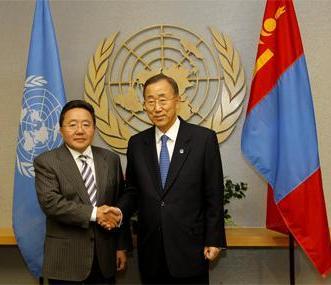
Then he worked as a consultant at the Millennium Development Goal Project, United Nations Headquarters in New York City and as a consultant at Radio Free Asia in Washington, D.C. in 2002–2003. Afterwards, he returned to Mongolia and made series of public speeches touring in Mongolian provinces inspiring the people and the youth sharing his new ideas and perspectives based on his knowledge from Harvard University and the United States in combination with Mongolian way of life in 2003–2004. His lectures played a significant role to make Democratic Party get majority seats in 2004 Mongolian Parliamentary elections.
Second premiership (2004–2006)
On 20 August 2004, Elbegdorj became the prime minister of Mongolia for the second time. This time, he headed a grand coalition government after the vote in the parliamentary elections had been evenly split between the two major political forces – Democratic Coalition and the Mongolian People's Revolutionary Party.
U.S. president George W. Bush highlighted about Elbegdorj as one of the country's democratic leaders to have been serving as the prime minister in his speech in Ulaanbaatar on 21 November 2005. "The world needs more people such as yourself who are willing to admire liberty," President Bush wrote to Elbegdorj immediately after his visit to Mongolia.
During Elbegdorj's term, on 27 January 2005, the government-controlled National State Television and Radio were converted into formally independent public organisations with increasingly smaller control by the government. Also, legal provisions that prohibited demonstrations on Ulaanbaatar's Sükhbaatar Square were abolished on 17 November 2005.
In his second term as prime minister, Elbegdorj proclaimed a fight against corruption and poverty, which he saw as the biggest challenges to Mongolia's economic development. Elbegdorj's government signed the United Nations Convention Against Corruption in April 2005 and ratified it in January 2006. His administration revealed the Customs chairman's corruption case amounting to millions of dollars from which the ex-chairman donated hundreds of thousands of dollars to the MPRP in 2005.
Elbegdorj attempted to support domestic businesses by eliminating excessive regulations, many licensing requirements, and import taxes for key category products. Mongolia was accepted into the European Union's GSP+ system, which allows Mongolian exporters to pay lower customs tariffs when exporting to the European Union during Elbegdorj's term as prime minister.
To promote affordable computers and internet access, Elbegdorj established the Information and Communication Agency under the government. He subsidized and supported technical schools and specialized professions to reduce unemployment. By a decision of his government English replaced Russian as the first foreign language to be taught in public schools. In addition, Elbegdorj initiated the erection of the Genghis Khan memorial complex in front of Mongolia's government house for the 800th Anniversary of the Great Mongol Empire. Besides, Elbegdorj initiated a "Green Wall" environmental project to plant trees in barren areas and desert zones to prevent from massive sandstorms from Mongolia reaching to North America and to reduce air pollution.
In August 2005, Elbegdorj wanted to run in by-elections in Ulaanbaatar's Bayangol district. However, the MPRP threatened to leave the coalition if Elbegdorj ran against MPRP candidate Miyeegombyn Enkhbold, and Elbegdorj withdrew. On 13 January 2006, the MPRP left the coalition anyway, and Elbegdorj was forced to resign. The MPRP proceeded to form a new government with the help of DP defectors and independent MPs, and Miyeegombyn Enkhbold became the new prime minister. The events triggered protests from some civic groups and their followers. Mongolian economy had real GDP growth of 10.4% in 2004, 7.3% in 2005 and 8.6% in 2006 respectively during Elbegdorj's second term as prime minister compared to 7% in 2003 prior to Elbegdorj's government.
Presidential elections
2009 presidential election
At the Democratic Party's convention on 3 April 2009, Elbegdorj defeated Erdeniin Bat-Üül in a contest for the party's nomination for the presidency of Mongolia. Elbegdorj won with 65.3% of the total vote. After Elbegdorj was announced as the candidate, the Civil Will Party and the Mongolian Green Party endorsed Elbegdorj's presidential candidacy.
Elbegdorj won the 2009 Mongolian presidential election on 24 May 2009 with 51.21% of the votes. Defeating incumbent president Enkhbayar, who got 47.41%, Elbegdorj was sworn into office as President of Mongolia on 18 June 2009.
2013 presidential election
The Democratic Party's National Consultative Committee held its convention on 7 May 2013 and decided to re-nominate Elbegdorj as a presidential candidate with 100% votes. And the Congress of Democratic Party, with 7,000 participants in Ulaanbaatar plus participants in all provincial centers connected via live internet video conference voted 100% for Elbegdorj's nomination from the Democratic Party for the 2013 presidential election on 8 May 2013. Civil Will-Green Party and Mongolian National Democratic Party – which have seats at both the parliament and the government cabinet – endorsed Elbegdorj's presidential candidacy. The Republican Party and the Motherland Party expressed their full support for Elbegdorj's candidacy also.
Elbegdorj won the 2013 Mongolian presidential election on 26 June 2013 with 50.23% of total votes while opposition Mongolian People's Party's candidate Badmaanyambuugiin Bat-Erdene received 41.97%, and Natsagiin Udval, candidate of Mongolian People's Revolutionary Party got 6.5% of total votes.
Elbegdorj is also the third Mongolian president to be reelected.
Presidency (2009–2017)
Elbegdorj won the Mongolian presidential elections twice: on 24 May 2009 and 26 June 2013. Elbegdorj was sworn into office on 18 June 2009 for his first term, and on 10 July 2013 for his second term as President of Mongolia. Elbegdorj is Mongolia's first president to never have been a member of the former communist Mongolian People's Revolutionary Party and the first to obtain a Western education.
Inauguration
Elbegdorj was sworn into office for his first term as President of Mongolia in State House in front of the Parliament and guests on 18 June 2009. His inauguration ceremony included his address to the nation and a military parade on Sükhbaatar Square. The United States Senate passed Resolution Number 192 supporting Mongolia's democracy and economic development and noting Elbegdorj's election victory on the day he was sworn in on 18 June 2009.
For his second term as President of Mongolia, Elbegdorj was sworn into office in front of the Chinggis Khaan (also referred as Genghis Khan) monument, Nine White Banners of Mongolia, the Parliament and public on Sükhbaatar Square on 10 July 2013. This is the first time a Mongolian president made an oath in front of public in the country's history. After making an oath, he addressed to the nation, and a military parade followed. Nobel Peace Laureate, co-founder of the Soviet bloc's first independent trade union Solidarity, former Polish president Lech Wałęsa attended Elbegdorj's second inauguration as president.
Democracy and human rights
Presidency of the Community of Democracies
Elbegdorj served as a chair of the Community of Democracies from 2011 to 2013, an intergovernmental coalition of democratic countries of which Mongolia is a participating member. Under his presidency, Mongolia successfully organized the VII Ministerial Conference of the Community of Democracies with democracy icon guest speakers namely chairperson of the National League for Democracy in Burma and Nobel Peace Laureate Aung San Suu Kyi, "Mother of the Revolution" of 2011 Yemeni uprising and Nobel Peace Laureate Tawakkol Karman, Elbegdorj, Thailand's prime minister Yingluck Shinawatra and others, on 27–29 April 2013. The conference had over 1300 participants from more than 100 countries and issued Ulaanbaatar Declaration "Community's Attainments and Global Challenges."