
The Treaty of Versailles was a peace treaty signed on 28 June 1919. As the most important treaty of World War I, it ended the state of war between Germany and most of the Allied Powers. It was signed in the Palace of Versailles, exactly five years after the assassination of Archduke Franz Ferdinand, the proximate cause of the war. The other Central Powers on the German side signed separate treaties. Although the armistice of 11 November 1918 ended the actual fighting, and agreed certain principles and conditions including the payment of reparations, it took six months of Allied negotiations at the Paris Peace Conference to conclude the peace treaty. Germany was not allowed to participate in the negotiations before signing the treaty.
The treaty required Germany to disarm, make territorial concessions, extradite alleged war criminals, agree to Kaiser Wilhelm being put on trial, recognise the independence of states whose territory had previously been part of the German Empire, and pay reparations to the Entente powers. The most critical and controversial provision in the treaty was: "The Allied and Associated Governments affirm and Germany accepts the responsibility of Germany and her allies for causing all the loss and damage to which the Allied and Associated Governments and their nationals have been subjected as a consequence of the war imposed upon them by the aggression of Germany and her allies." The other members of the Central Powers signed treaties containing similar articles. This article, Article 231, became known as the "War Guilt" clause.
Critics including John Maynard Keynes declared the treaty too harsh, styling it as a "Carthaginian peace." He also said the reparations were excessive and counterproductive with others stating that the reparations contributed significantly to the ensuing hyperinflation. On the other hand, prominent Allied figures such as French Marshal Ferdinand Foch criticized the treaty for treating Germany too leniently. This is still the subject of ongoing debate by historians and economists.

The result of these competing and sometimes conflicting goals among the victors was a compromise that left no one satisfied. In particular, Germany was neither pacified nor conciliated, nor was it permanently weakened. The United States never ratified the Versailles Treaty; instead it made a separate peace treaty with Germany, albeit based on the Versailles Treaty. The problems that arose from the treaty would lead to the Locarno Treaties, which improved relations between Germany and the other European powers. The reparation system was reorganized and payments reduced in the Dawes Plan and the Young Plan. Bitter resentment of the treaty powered the rise of the Nazi Party, and eventually the outbreak of a Second World War.
Although it is often referred to as the "Versailles Conference", only the actual signing of the treaty took place at the historic palace. Most of the negotiations were in Paris, with the "Big Four" meetings taking place generally at the French Ministry of Foreign Affairs on the Quai d'Orsay.
Background
First World War
War broke out following the July Crisis in 1914. Austria-Hungary declared war on Serbia, followed quickly by Germany declaring war on Russia on 1 August, and on Belgium and France on 3 August. The German invasion of Belgium on 3 August led to a declaration of war by Britain on Germany on 4 August, creating the conflict that became the First World War. Two alliances faced off, the Central Powers (led by Germany) and the Triple Entente (led by Britain, France and Russia). Other countries entered as fighting raged widely across Europe, as well as the Middle East, Africa and Asia. Having seen the overthrow of the Tsarist regime in the February Revolution and the Kerensky government in the October Revolution, the new Russian Soviet Federative Socialist Republic under Vladimir Lenin in March 1918 signed the Treaty of Brest-Litovsk, amounting to a surrender that was highly favourable to Germany. Sensing victory before the American Expeditionary Forces could be ready, Germany now shifted forces to the Western Front and tried to overwhelm the Allies. It failed. Instead, the Allies won decisively on the battlefield, overwhelmed Germany's Turkish, Austrian, and Bulgarian allies, and forced an armistice in November 1918 that resembled a surrender.

Role of the Fourteen Points
The United States entered the war against the Central Powers in 1917 and President Woodrow Wilson played a significant role in shaping the peace terms. His expressed aim was to detach the war from nationalistic disputes and ambitions. On 8 January 1918, Wilson issued the Fourteen Points. They outlined a policy of free trade, open agreements, and democracy. While the term was not used, self-determination was assumed. It called for a negotiated end to the war, international disarmament, the withdrawal of the Central Powers from occupied territories, the creation of a Polish state, the redrawing of Europe's borders along ethnic lines, and the formation of a League of Nations to guarantee the political independence and territorial integrity of all states.
It called for what it characterised as a just and democratic peace uncompromised by territorial annexation. The Fourteen Points were based on the research of the Inquiry, a team of about 150 advisors led by foreign-policy advisor Edward M. House, into the topics likely to arise in the expected peace conference.
Armistice
During the autumn of 1918, the Central Powers began to collapse. Desertion rates within the German army began to increase, and civilian strikes drastically reduced war production. On the Western Front, the Allied forces launched the Hundred Days Offensive and decisively defeated the German western armies. Sailors of the Imperial German Navy at Kiel mutinied in response to the naval order of 24 October 1918, which prompted uprisings in Germany, which became known as the German Revolution. The German government tried to obtain a peace settlement based on the Fourteen Points, and maintained it was on this basis that they surrendered. Following negotiations, the Allied powers and Germany signed an armistice, which came into effect on 11 November while German forces were still positioned in France and Belgium.

Many aspects of the Versailles treaty that were later criticised were agreed first in the 11 November armistice agreement, whilst the war was still ongoing. These included the German evacuation of German-occupied France, Belgium, Luxembourg, Alsace-Lorraine, and the left bank of the Rhine (all of which were to be administered by the Allies under the armistice agreement), the surrender of a large quantity of war materiel, and the agreed payment of "reparation for damage done".
German forces evacuated occupied France, Belgium, and Luxembourg within the fifteen days required by the armistice agreement. By late 1918, Allied troops had entered Germany and began the occupation of the Rhineland under the agreement, in the process establishing bridgeheads across the Rhine in case of renewed fighting at Cologne, Koblenz, and Mainz. Allied and German forces were additionally to be separated by a 10 km-wide demilitarised zone.
Blockade
Both Germany and Great Britain were dependent on imports of food and raw materials, most of which had to be shipped across the Atlantic Ocean. The Blockade of Germany was a naval operation conducted by the Allied Powers to stop the supply of raw materials and foodstuffs reaching the Central Powers. The German Kaiserliche Marine was mainly restricted to the German Bight and used commerce raiders and unrestricted submarine warfare for a counter-blockade. The German Board of Public Health in December 1918 stated that 763,000 German civilians had died during the Allied blockade, although an academic study in 1928 put the death toll at 424,000 people.
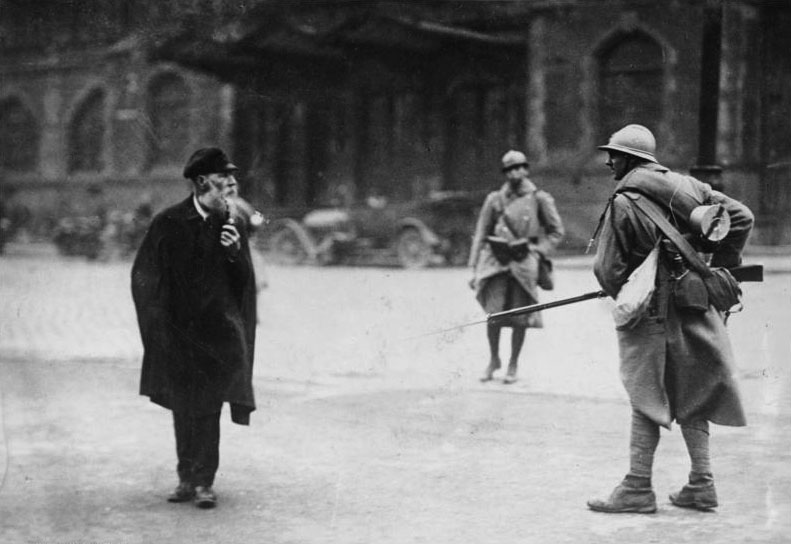
The blockade was maintained for eight months after the Armistice in November 1918, into the following year of 1919. Foodstuffs imports into Germany were controlled by the Allies after the Armistice with Germany until Germany signed the Treaty of Versailles in June 1919. In March 1919, Churchill informed the House of Commons, that the ongoing blockade was a success and "Germany is very near starvation." From January 1919 to March 1919, Germany refused to agree to Allied demands that Germany surrender its merchant ships to Allied ports to transport food supplies. Some Germans considered the armistice to be a temporary cessation of the war and knew, if fighting broke out again, their ships would be seized. Over the winter of 1919, the situation became desperate and Germany finally agreed to surrender its fleet in March. The Allies then allowed for the import of 270,000 tons of foodstuffs.
Both German and non-German observers have argued that these were the most devastating months of the blockade for German civilians, though disagreement persists as to the extent and who is truly at fault. According to Max Rubner 100,000 German civilians died due to the continuation blockade after the armistice. In the UK, Labour Party member and anti-war activist Robert Smillie issued a statement in June 1919 condemning continuation of the blockade, claiming 100,000 German civilians had died as a result.
Negotiations
Talks between the Allies to establish a common negotiating position started on 18 January 1919, in the Salle de l'Horloge (Clock Room) at the French Foreign Ministry on the Quai d'Orsay in Paris.

Initially, 70 delegates from 27 nations participated in the negotiations. Russia was excluded due to their signing of a separate peace (the Treaty of Brest-Litovsk) and early withdrawal from the war. Furthermore, German negotiators were excluded to deny them an opportunity to divide the Allies diplomatically.
Initially, a "Council of Ten" (comprising two delegates each from Britain, France, the United States, Italy, and Japan) met officially to decide the peace terms. This council was replaced by the "Council of Five", formed from each country's foreign ministers, to discuss minor matters. French Prime Minister Georges Clemenceau, Italian Prime Minister Vittorio Emanuele Orlando, British Prime Minister David Lloyd George, and United States President Woodrow Wilson formed the "Big Four" (at one point becoming the "Big Three" following the temporary withdrawal of Orlando). These four men met in 145 closed sessions to make all the major decisions, which were later ratified by the entire assembly. The minor powers attended a weekly "Plenary Conference" that discussed issues in a general forum but made no decisions. These members formed over 50 commissions that made various recommendations, many of which were incorporated into the final text of the treaty.
French aims
France had lost 1.3 million soldiers, including 25% of French men aged 18–30, as well as 400,000 civilians. France had also been more physically damaged than any other nation; the so-called zone rouge (Red Zone), the most industrialized region and the source of most coal and iron ore in the north-east, had been devastated, and in the final days of the war, mines had been flooded and railways, bridges and factories destroyed.
Clemenceau intended to ensure the security of France, by weakening Germany economically, militarily, territorially and by supplanting Germany as the leading producer of steel in Europe.
British economist and Versailles negotiator John Maynard Keynes summarized this position as attempting to "set the clock back and undo what, since 1870, the progress of Germany had accomplished."
Clemenceau told Wilson: "America is far away, protected by the ocean. Not even Napoleon himself could touch England. You are both sheltered; we are not".
The French wanted a frontier on the Rhine, to protect France from a German invasion and compensate for French demographic and economic inferiority.
American and British representatives refused the French claim and after two months of negotiations, the French accepted a British pledge to provide an immediate alliance with France if Germany attacked again, and Wilson agreed to put a similar proposal to the Senate. Clemenceau had told the Chamber of Deputies, in December 1918, that his goal was to maintain an alliance with both countries. Clemenceau accepted the offer, in return for an occupation of the Rhineland for fifteen years and that Germany would also demilitarise the Rhineland.
French negotiators required reparations, to make Germany pay for the destruction induced throughout the war and to decrease German strength. The French also wanted the iron ore and coal of the Saar Valley, by annexation to France.
The French were willing to accept a smaller amount of World War I reparations than the Americans would concede and Clemenceau was willing to discuss German capacity to pay with the German delegation, before the final settlement was drafted. In April and May 1919, the French and Germans held separate talks, on mutually acceptable arrangements on issues like reparation, reconstruction and industrial collaboration. France, along with the British Dominions and Belgium, opposed League of Nations mandates and favored annexation of former German colonies.
The French, who had suffered significantly in the areas occupied by Germany during the war, were in favour of trying German war criminals, including the Kaiser. In the face of American objections that there was no applicable existing law under which the Kaiser could be tried, Clemenceau took the view that the "law of responsibility" overruled all other laws and that putting the Kaiser on trial offered the opportunity to establish this as an international precedent.
British aims
Britain had suffered heavy financial costs but suffered little physical devastation during the war. British public opinion wanted to make Germany pay for the War.
Public opinion favoured a "just peace", which would force Germany to pay reparations and be unable to repeat the aggression of 1914, although those of a "liberal and advanced opinion" shared Wilson's ideal of a peace of reconciliation.
In private Lloyd George opposed revenge and attempted to compromise between Clemenceau's demands and the Fourteen Points, because Europe would eventually have to reconcile with Germany.
Lloyd George wanted terms of reparation that would not cripple the German economy, so that Germany would remain a viable economic power and trading partner. By arguing that British war pensions and widows' allowances should be included in the German reparation sum, Lloyd George ensured that a large amount would go to the British Empire.
Lloyd George also intended to maintain a European balance of power to thwart a French attempt to establish itself as the dominant European power. A revived Germany would be a counterweight to France and a deterrent to Bolshevik Russia. Lloyd George also wanted to neutralize the German navy to keep the Royal Navy as the greatest naval power in the world; dismantle the German colonial empire with several of its territorial possessions ceded to Britain and others being established as League of Nations mandates, a position opposed by the Dominions.
Together with the French, the British favoured putting German war criminals on trial, and included the Kaiser in this. Already in 1916 Herbert Asquith had declared the intention "to bring to justice the criminals, whoever they be and whatever their station", and a resolution of the war cabinet in 1918 reaffirmed this intent. Lloyd George declared that the British people would not accept a treaty that did not include terms on this, though he wished to limit the charges solely to violation of the 1839 treaty guaranteeing Belgian neutrality. The British were also well aware that the Kaiser having sought refuge in the Netherlands meant that any trial was unlikely to take place and therefore any Article demanding it was likely to be a dead letter.
American aims
Before the American entry into the war, Wilson had talked of a "peace without victory". This position fluctuated following the US entry into the war. Wilson spoke of the German aggressors, with whom there could be no compromised peace.
On 8 January 1918, however, Wilson delivered a speech (known as the Fourteen Points) that declared the American peace objectives: the rebuilding of the European economy, self-determination of European and Middle Eastern ethnic groups, the promotion of free trade, the creation of appropriate mandates for former colonies, and above all, the creation of a powerful League of Nations that would ensure the peace. The aim of the latter was to provide a forum to revise the peace treaties as needed, and deal with problems that arose as a result of the peace and the rise of new states.
Wilson brought along top intellectuals as advisors to the American peace delegation, and the overall American position echoed the Fourteen Points. Wilson firmly opposed harsh treatment on Germany. While the British and French wanted to largely annex the German colonial empire, Wilson saw that as a violation of the fundamental principles of justice and human rights of the native populations, and favored them having the right of self-determination via the creation of mandates. The promoted idea called for the major powers to act as disinterested trustees over a region, aiding the native populations until they could govern themselves.
In spite of this position and in order to ensure that Japan did not refuse to join the League of Nations, Wilson favored turning over the former German colony of Shandong, in Eastern China, to the Japanese Empire rather than return the area to the Republic of China's control.
Further confounding the Americans, was US internal partisan politics. In November 1918, the Republican Party won the Senate election by a slim margin. Wilson, a Democrat, refused to include prominent Republicans in the American delegation making his efforts seem partisan, and contributed to a risk of political defeat at home.
On the subject of war crimes, the Americans differed to the British and French in that Wilson's proposal was that any trial of the Kaiser should be solely a political and moral affair, and not one of criminal responsibility, meaning that the death penalty would be precluded. This was based on the American view, particularly those of Robert Lansing, that there was no applicable law under which the Kaiser could be tried. Additionally, the Americans favoured trying other German war criminals before military tribunals rather than an international court, with prosecutions being limited to "violation[s] of the laws and customs of war", and opposed any trials based on violations against what was called "laws of humanity".
Italian aims
Vittorio Emanuele Orlando and his foreign minister Sidney Sonnino, an Anglican of British origins, worked primarily to secure the partition of the Habsburg Empire and their attitude towards Germany was not as hostile. Generally speaking, Sonnino was in line with the British position while Orlando favored a compromise between Clemenceau and Wilson. Within the negotiations for the Treaty of Versailles, Orlando obtained certain results such as the permanent membership of Italy in the security council of the League of Nations and a promised transfer of British Jubaland and French Aozou strip to the Italian colonies of Somalia and Libya respectively. Italian nationalists, however, saw the War as a "mutilated victory" for what they considered to be little territorial gains achieved in the other treaties directly impacting Italy's borders. Orlando was ultimately forced to abandon the conference and resign. Orlando refused to see World War I as a mutilated victory, replying at nationalists calling for a greater expansion that "Italy today is a great state....on par with the great historic and contemporary states. This is, for me, our main and principal expansion." Francesco Saverio Nitti took Orlando's place in signing the treaty of Versailles.
The Italian leadership were divided on whether to try the Kaiser. Sonnino considered that putting the Kaiser on trial could result in him becoming a "patriotic martyr". Orlando, in contrast, stated that "the ex-Kaiser ought to pay like other criminals", but was less sure about whether the Kaiser should be tried as a criminal or merely have a political verdict cast against him. Orlando also considered that "[t]he question of the constitution of the Court presents almost insurmountable difficulties".
Treaty content and signing
In June 1919, the Allies declared that war would resume if the German government did not sign the treaty they had agreed to among themselves. The government headed by Philipp Scheidemann was unable to agree on a common position, and Scheidemann himself resigned rather than agree to sign the treaty. Gustav Bauer, the head of the new government, sent a telegram stating his intention to sign the treaty if certain articles were withdrawn, including Articles 227 to 231 (i.e., the Articles related to the extradition of the Kaiser for trial, the extradition of German war criminals for trial before Allied tribunals, the handing over of documents relevant for war crimes trials, and accepting liability for war reparations). In response, the Allies issued an ultimatum stating that Germany would have to accept the treaty or face an invasion of Allied forces across the Rhine within 24 hours. On 23 June, Bauer capitulated and sent a second telegram with a confirmation that a German delegation would arrive shortly to sign the treaty.
On 28 June 1919, the fifth anniversary of the assassination of Archduke Franz Ferdinand (the immediate impetus for the war), the peace treaty was signed. The treaty had clauses ranging from war crimes, the prohibition on the merging of the Republic of German Austria with Germany without the consent of the League of Nations, freedom of navigation on major European rivers, to the returning of a Quran to the king of Hedjaz.
The treaty itself was signed in the Hall of Mirrors in the Palace of Versailles, which had considerable historical resonance. The Second German Empire had been proclaimed in the Hall of Mirrors in 1871, after the German siege of Paris at the conclusion of the Franco-Prussian War, which deeply humiliated the French. French Prime Minister Georges Clemenceau consciously chose the Hall of Mirrors as the site to sign the Treaty of Versailles, thus dismantling the German Empire in the very room where it had been proclaimed.
Territorial changes
The treaty stripped Germany of 65,000 km2 (25,000 sq mi) of territory and 7 million people. It also required Germany to give up the gains made via the Treaty of Brest-Litovsk and grant independence to the protectorates that had been established.
In Western Europe, Germany was required to recognize Belgian sovereignty over Moresnet and cede control of the Eupen-Malmedy area. Within six months of the transfer, Belgium was required to conduct a plebiscite on whether the citizens of the region wanted to remain under Belgian sovereignty or return to German control, communicate the results to the League of Nations and abide by the League's decision. The Belgian transitional administration, under High Commissioner General Herman Baltia, was responsible for the organisation and control of this process, held between January and June 1920. The plebiscite itself was held without a secret ballot, and organized as a consultation in which all citizens who opposed the annexation had to formally register their protest. Ultimately, only 271 of 33,726 voters signed the protest list, of which 202 were German state servants. After the Belgian government reported this result, the League of Nations confirmed the change of status on 20 September 1920, with the line of the German-Belgian border finally fixed by a League of Nations commission in 1922. To compensate for the destruction of French coal mines, Germany was to cede the output of the Saar coalmines to France and control of the Saar to the League of Nations for 15 years; a plebiscite would then be held to decide sovereignty.
The treaty restored the provinces of Alsace-Lorraine to France by rescinding the treaties of Versailles and Frankfurt of 1871 as they pertained to this issue.
France was able to make the claim that the provinces of Alsace-Lorraine were indeed part of France and not part of Germany by disclosing a letter sent from the Prussian King to the Empress Eugénie that Eugénie provided, in which William I wrote that the territories of Alsace-Lorraine were requested by Germany for the sole purpose of national defense and not to expand the German territory. The sovereignty of Schleswig-Holstein was to be resolved by a plebiscite to be held at a future time (see Schleswig Plebiscites).
In Central Europe Germany was to recognize the independence of Czechoslovakia and cede parts of the province of Upper Silesia to them.