Top Gear is a British motoring-themed magazine television programme. It is a revival of the 1977–2001 show of the same name for the BBC, devised by Jeremy Clarkson and Andy Wilman, which premiered on 20 October 2002. The programme expanded upon its earlier incarnation which focused on reviewing cars to incorporate films featuring motoring-based challenges, races, timed laps of notable cars, and celebrity timed laps on a specially-designed track. The programme drew acclaim for its visual and presentation style, as well as criticism over the controversial nature of some content. The programme aired on BBC Two until it was moved to BBC One in 2020.
The programme's first series in 2002 was presented by Clarkson, Richard Hammond, and Jason Dawe, with an anonymous test driver "The Stig" also featuring. Wilman was the show's executive producer. Following the first series, Dawe was replaced by James May, with the line-up unchanged until the end of the twenty-second series, when the BBC chose to not renew Clarkson's contract in March 2015, following an incident during filming. His dismissal from Top Gear prompted the departure of Hammond, May and Wilman from the programme, who joined Clarkson on a new motoring series for Amazon, The Grand Tour.
Chris Evans and Matt LeBlanc were appointed as new hosts of Top Gear and they were joined by four co-presenters for the twenty-third series. After negative feedback on this series, Evans resigned from the programme, with LeBlanc joined by Chris Harris and Rory Reid as the main hosts. From the twenty-seventh series onwards (2019), the presenting line-up was changed following the departure of LeBlanc and Reid, with Harris joined by Paddy McGuinness and Andrew Flintoff. This series proved more popular with viewers. Production of the thirty-fourth series was halted in March 2023 after Flintoff was seriously injured in an accident during filming; the BBC later announced that Top Gear would not return for the "foreseeable future".

Top Gear has been one of the BBC's most commercially successful programmes since its relaunch. It has become a significant part of British popular culture, with episodes also broadcast in many countries in Europe, North America, Southeast Asia and more, making it the most widely-broadcast factual television programme in the world. Its success has led to merchandising including live tours, special DVD editions, and books, as well as spawning international versions in several countries.
Development
After the BBC cancelled the original format of Top Gear in December 2001, Jeremy Clarkson and producer Andy Wilman met to work out ideas for reviving the programme for television. This led to them eventually meeting the broadcaster to pitch the idea of changing it from a motoring magazine format to one that was studio-based. Amongst the ideas that were pitched included: the involvement of a fixed location for car reviews and other films, alongside locations across Britain and abroad; putting notable cars through a timed lap of a circuit; the involvement of test driver with veteran racing experience, who handles driving some of the cars for the programme; and the participation of celebrity guests who would be invited to take part in an episode, undertake an interview over motoring matters, such as their car history, and take part in a special challenge to do a timed lap in a designated car. Following the pitch, the BBC decided to green-light the new format, in order to create a programme to compete with Channel 5's new motoring show Fifth Gear, to which several original Top Gear presenters including Tiff Needell, Vicki Butler-Henderson and producer Jon Bentley went.
Production began in mid-2002, with the broadcaster securing the right to use Dunsfold Aerodrome, an airport and business park in Waverley, Surrey, as the programme's fixed location – while its runways and taxiways were allocated for reviews and other films, one of the site's large aircraft hangars was transformed into Top Gear's new studio. To match the proposed ideas for the new format, the BBC gained assistance from Lotus to design a race circuit at the aerodrome. The runtime of the programme was extended to one hour. Wilman took on the role of the show's executive producer, while Clarkson became part of the hosting line-up. Because most of those who had worked with Clarkson on the original programme had left the BBC to work on Fifth Gear, the production team arranged for him to be joined by Richard Hammond and Jason Dawe.

A difficulty found during production revolved around the show's test driver – neither Clarkson nor Wilman could find a racing driver with experience at speaking on-camera. They opted to make the driver silent, and later having their identity concealed. When they recruited Perry McCarthy amongst their candidates for the role, his input led to Wilman choosing to nickname the test driver "the Stig".
Presenters
To date, there have been 13 presenters of the show:
History
2002–2005: Beginnings
The first series of the new format of Top Gear premiered on 20 October 2002. In its early state, the programme's segments were based on elements of the previous format, such as interviews and viewers' letters, but also featured some new humorous elements, such as the presenters regularly destroying a caravan during the early series.

After the first series, Dawe was replaced by James May. Having previously been a presenter on Channel 4's motoring programme Driven and the 1999 series of Top Gear, May initially declined to be a part of the new format, until its growing popularity later changed his mind.
At the beginning of the third series, McCarthy was replaced as the Stig by Ben Collins for contractual reasons. The Stig's outfit was changed from a black outfit to a white one.
As the programme progressed, the format slowly began to transform, with a focus towards creating a unique presentation style for the programme, which included the addition of new segments, a more unusual approach to reviewing cars, road trips, and more specialised films involving races – either between cars or between a car and another form of transport – and completing a variety of challenges, mostly with cheap, second-hand cars.

2006–2014: Changes and growing popularity
In early 2006, the BBC made plans to move the programme's film site from Dunsfold to Enstone, Oxfordshire, in preparation for its eighth series. The move was later cancelled, after West Oxfordshire District Council strongly objected to the planned move, on the basis of noise and pollution concerns. As a result, the broadcaster ordered that filming continued at Dunsfold during May of that year, despite having no permit to do so, with the eighth series unveiling a revamped studio set. In addition, the "Star in a Reasonably Priced Car" segment was modified with new rules along with a new car, while Hammond included one of his dogs for the series throughout its studio segments, along with a number of films made for this series and the next.
On 20 September, during production for the ninth series, Hammond was seriously injured while driving a Vampire turbojet drag racing car at up to 314 miles per hour (505 km/h), as part of a planned feature, leading the BBC to postpone the broadcast of Best of Top Gear until a later date, and delaying production on the series until the presenter had recovered. Both the BBC and the Health and Safety Executive carried out inquiries into the accident, with filming later resuming on 5 October. The opening episode of the ninth series, aired on 28 January 2007, included footage of Hammond's crash; while it was not repeated like other episodes in the programme, it attracted higher ratings than the finale of Celebrity Big Brother, providing one of the highest ratings for BBC Two for a decade, alongside the series finale, which attracted around 8 million viewers.
Later that summer, on 25 July, the BBC aired a special edition episode entitled Top Gear: Polar Special. It was one of the first episodes of the programme to be shown in high definition, and the third special to be produced, focusing on a race to the North Magnetic Pole, at its recorded location in 1996, between a "polar modified" Toyota Hilux and a dog sled. Considerable planning and co-ordination for the filming of the episode was conducted by both Top Gear's production team and Toyota, with both Clarkson and May, driving the Hilux, being the first people to reach the recorded location of the North Magnetic Pole by car.

With popularity for the show rising, the waiting list to get a ticket for a recording became extensive – a person seeking a ticket, found that they would be required to wait for 21 years before securing a place. On 17 June 2008, Hammond and May said that the eleventh series would feature a new "host" in the line-up, who was later revealed on the programme as "Top Gear Stunt Man", an individual who made few, occasional appearances on the programme. From the twelfth series, feature-length specials were created for the show, each visiting a different part of the world for a road trip using second-hand cars, with some produced to be aired as a Christmas special. Despite growing popularity, Wilman revealed that future programmes would have less time devoted to big challenges, stating:
"We've looked back at the last two or three runs and noticed that a programme can get swallowed up by one monster film – a bit like one of those Yes albums from the 1970s where side one is just one track – so we're trying to calm down the prog-rock side. We'll inevitably still have big films, because it's the only way you can enjoy the three of them cocking about together, but they'll be shorter overall, and alongside we'll be inserting two- or three-minute punk songs."The success of the programme soon led to a live-version format being created called Top Gear Live; produced by a former producer of the programme, Rowland French, the touring show aimed to attempt to "bring the TV show format to life... featuring breath-taking stunts, amazing special effects and blockbusting driving sequences featuring some of the world's best precision drivers". The Live tour began on 30 October 2008 in Earls Court, London, moving on to Birmingham in November before being performed in at least 15 other countries.
As the 14th series was being broadcast in late 2009, the programme began to attract criticism from some viewers, over its predictability through the over-reliance on stunts and forced humour at the expense of serious content. On 13 December 2009, controller of BBC Two Janice Hadlow appeared on the BBC's Points of View to reject such comments, purely on the evidence of Top Gear's ratings and audience appreciation figures. On 20 December, Wilman admitted that the three presenters were now "playing to their TV cartoon characters a bit too much". His statement included referring to "this incarnation of Top Gear" being close to its end, and that the production team would be working towards keeping its "dignity still intact", while experimenting with new ideas for the programme. Nevertheless, an episode of the long-running US news programme 60 Minutes featuring Clarkson, Hammond, and May, attracted 16 million viewers in October 2010.
2014–2015: Clarkson, Hammond and May's departure
Towards the end of 2014, the BBC became concerned over Clarkson's behaviour on the programme, including its production. Their concerns were raised by two incidents that year. The first involved an un-aired take from the 19th series emerging on national news media, featuring the presenter attempting to choose between two cars using the traditional rhyme "Eeny, meeny, miny, moe" but allegedly failing to censor the original version's use of the word nigger. The second involved an investigation into racism complaints by the regulator Ofcom, in regards to the show's "Burma Special", which led to the programme being found in breach of broadcasting rules. The presenters had been involved in constructing a bridge, when Clarkson, seeing an Asian man crossing it, remarked that the bridge "had a slope on it". As a result, the broadcaster issued a "final warning" against Clarkson. The programme then suffered another incident, when production of its next special in Argentina was dogged by major issues that placed the team at serious risk of harm, as one of the car number plates had read "H982 FKL" in an alleged reference to the Falklands War of 1982. The controversial incident it created was covered by international news media, and the special was later aired as part of the BBC's Christmas schedule for 2014, though with amendments to its ending and the inclusion of an introduction for it.
On 10 March 2015, production of the 22nd series of the programme was abruptly suspended by the BBC. The broadcaster's actions were the result of them suspending Clarkson in order to investigate allegations made against him, over verbal and physical abuse he had committed against one of the show's producers, Oisin Tymon. On 25 March, Clarkson's contract with the BBC was terminated, with Director-General of the BBC Tony Hall announcing that the remaining episodes future were uncertain until the broadcaster could determine how to air them out and complete the 22nd series. Clarkson's forced departure had an impact on the programme, beginning with that year's Top Gear Live – as a result of the BBC's decision, the tour's name was changed to "Clarkson, Hammond and May Live" and announced on 1 April 2015. Wilman resigned from the programme, along with May and Hammond, having stated that they would not continue working on Top Gear without Clarkson. The group agreed to make one final episode for the BBC consisting of the trio's final films, which was aired as a special on 28 June 2015. Clarkson, Hammond, May and Wilman subsequently signed a deal with Amazon to produce a new motoring programme, The Grand Tour, which debuted in 2016.
2016–2019: Revolving door of presenters
Following the departure of Clarkson, and the subsequent departure of May, Hammond and Wilman, the BBC began searching for their replacements. On 16 June 2015, Chris Evans was confirmed as one of the new hosts, On 4 February, it was announced that American actor Matt LeBlanc was to join the show as Evans' co-host. On an edition of his BBC Radio 2 breakfast show, a week later, Evans revealed that both men would also be joined by Eddie Jordan, motoring journalist Chris Harris, German motor racing driver Sabine Schmitz, and motoring journalist Rory Reid.
Filming for the twenty-third series soon began in early 2016. While the show still retained the use of the show's presentation style and its test driver The Stig, the format received a number of changes – a small number of segments were dropped, the studio received a revamp to its layout, the celebrity segment was redesigned to feature a rallycross-styled challenge, while Evans and LeBlanc fronted the show with the other co-presenters appearing "when required". On 27 April 2016, BBC Three announced that a spin-off programme to Top Gear had been commissioned, entitled Extra Gear. Designed to be aired after each episode of the new series was aired, its format focused on providing exclusive new content online – hosted by both Reid and Harris, the spin-off would consist of new footage, interviews, specially recorded films and behind-the-scenes access to the main programme.
A combination of delays with production and conflicts with scheduling led to the premiere date of the 23rd series being pushed back to 29 May 2016. In addition, the new series aired with only six of the ten episodes that it promised to show. The new look of the show received mixed feedback from critics and viewers – although praise was given for the inclusion of LeBlanc, Harris and Reid, the new format was panned for its sluggish pace, the lack of humour in the studio segments, and the length of time spent on the revamped celebrity segment, "Star in a Rally-Cross Car". On 4 July, following the series finale, Evans announced his resignation from Top Gear. The BBC announced on 26 September that, among the remaining five presenters, LeBlanc would be joined by Harris and Reid to become the main hosts for the next series.
To make amends for its dismal performance, Top Gear underwent a more thorough revamp, which included redesigning the show's studio and opening titles. The show's format was refocused on elements developed in early series, a deeper work on chemistry between the presenters, while also revising the celebrity segment – as the arrangement for the 23rd series had proven to be a failure, the segment returned to its original format.
2019–2023: Further reshuffle, Flintoff's accident and hiatus
On 31 May 2018, LeBlanc announced he would be leaving the show after the twenty-sixth series in 2019. Andrew Flintoff and Paddy McGuinness were announced on 22 October 2018 to be replacing LeBlanc and joining Harris for the twenty-seventh series. As a part of the reshuffle Rory Reid was announced to be stepping down as a main host to present Extra Gear and make occasional appearances on the main show; however, Extra Gear was not renewed for any further series and so Reid moved to ITV4 to present Speed Freaks. The new presenting line-up received a positive reception compared to the mixed reviews of the previous few series.
During the broadcast of the twenty-eighth series in early 2020, it was announced that, from the twenty-ninth series, the show would move channels to BBC One following the positive reception of the new presenting lineup. The twenty-ninth series itself, which was broadcast in late 2020, also saw some changes as a result of filming and broadcast during the COVID-19 pandemic, including the show moving out of the studio and onto the runway, in a 'drive-in festival' style, to enable the audience members to remain physically distanced, and the dropping of the Star in a ... Car segment to maintain social distancing. Further changes were made to the thirtieth series, broadcast in early 2021, due to restrictions as a result of the COVID-19 pandemic: studio segments were recorded during a two-night shoot outside Television Centre, London, instead of the previous location at Dunsfold Aerodrome, with no full audience, and all of the films in the series were recorded in the UK. The new outdoor studio at Television Centre was retained for the thirty-first series, which was broadcast later that year.
The revamped show fronted by the new trio helped Top Gear increase viewership to numbers not seen since the departure of Clarkson, Hammond and May. The twenty-seventh series has also been one of the most popular shows for British 16 to 34 year olds.
On 4 August 2021, it was announced that production of the show would transfer to BBC Studios Bristol for the thirty-third series; however, Dunsfold Aerodrome would still be used for filming.
On 13 December 2022, whilst filming at Dunsfold Park Aerodome for the planned 34th series, Flintoff was involved in a second accident and had to be airlifted to hospital. In January 2023 The Mirror reported Flintoff chose to put his TV career on hold to allow himself time to recover from the crash. In March 2023 the BBC announced that series 34 production had been suspended to enable a thorough health and safety investigation into the accident. In November 2023, the BBC announced that Top Gear would not return on TV for the "foreseeable future" following Flintoff's accident, though the statement left open the possibility of the show resuming production in the future.
Format
Each episode of Top Gear focus a series of segments, switching between those filmed within the programme's main studio before a studio audience, and pre-recorded films conducted before the broadcast of an episode – these films primarily cover major segments of the episodes, with studio segments often used as links or breaks between them. The most common forms of segments used in the show's history are "Car Reviews", "Power Laps", "Star in a ... Car", "Cool Wall", "Challenges" and "Races".
Car reviews
A major segment of the programme, happening at least once in most episodes, it focuses on the presenters conducting a road-test of a car, looking at such factors as ride quality, speed, handling, practicality, and reliability. These reviews are conducted either on and around Top Gear's test track, or on the roads of Britain and abroad, and often focus on one car, primarily from well known car manufacturers. On a number of occasions, the review may feature more than one car from the same class, as well as include exotic/foreign models, and feature more than one presenter as a way of providing different opinions on the cars being reviewed and putting forth an argument over the model they believe is worthwhile to own.
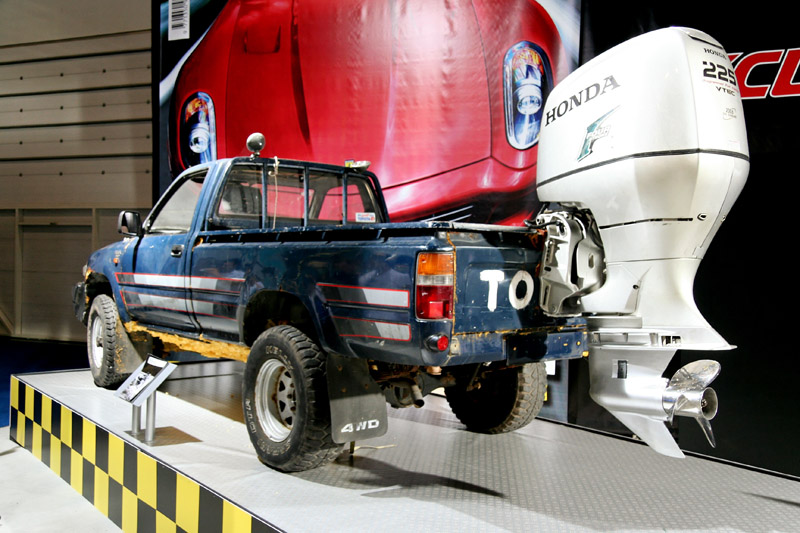
Although the programme operated in a standard manner in the early series to the original format of car reviews in the 1977 show, it soon began to adopt an unusual approach of reviewing cars, by conducting an unusual test(s) to either put a vehicle through its paces in an arranged scenario, or to demonstrate and showcase an exceptional quality that it exhibited. An example of this comes from the "Toyota Hilux Destruction" film, divided between two episodes of the third series – to prove the strength of a Toyota Hilux pick-up truck, presenters Clarkson and May set about subjecting it to various, mainly destructive tests to see if it could survive against them and still run, allowing the use of tools for repair but prohibiting the replacement of any components (with the exception of the windscreen). Other notable uses of this unusual approach have included:
Testing the ride quality of two off-road vehicles by having a passenger receive a tattoo in each vehicle as it is driven off-road, to see how smoothly it can be done in each.
Testing a car's handling, by racing it through a shopping centre against a more powerful, but much larger car.
Assigning the presenter's mothers with the duty of reviewing a small selection of cars.
Testing the comfort of a vehicle by chauffeuring a VIP to an event.
Another unusual approach with car reviews was to conduct them in the form of a challenge. Examples of such "review" challenges have included:
Road-testing cars in the style of "Russian Roulette", in which presenters did not know what they would get to drive and had to review it in the presence of their owners while driving them and their car back to their home.
Comparing the practicality of two new vehicles by operating them as taxi cabs for a night.
Spending 24 hours within a car without stepping out of it any point within the time period.
Taking an off-road vehicle up a mountain in Scotland.
Power laps
This segment focuses on a featured car undergoing a timed lap of the programme's test track, with the car driven by The Stig. Often used after the main review of an episode, it mainly involved the car or cars from the review, though it sometimes featured vehicles that either had been reviewed in a previous episode but couldn't be put on the track due to problems or unfavourable conditions on the track, or were special models (such as racing versions of the car). On occasions when multiple cars did a timed lap, the episode either shows the film of each car one after the other, or alongside each other. After the film is shown, the presenter reveals the time to the studio audience and the viewer – abbreviations next to lap times, such as "W" for "wet", highlight if they were conducted under certain track conditions.
In order to qualify for a place on the Power Lap Board, cars that undergo a Power Lap must fulfil certain requirements:
Roadworthy, and make use of standard road tyres.
Commercially available.
Able to negotiate a speed bump.
As such, vehicles that do not qualify have their times mentioned, but do not get included on the Lapboard. Examples of this include the Renault F1 car (0:59.0) and the Caparo T1 (1:10.6), which were disqualified for failing the speed bump requirement; the Ferrari FXX (1:10.7), which was disqualified for using slick tyres; and the Pagani Zonda R (1:08.5), which was disqualified for not being road legal. In addition, non-production cars are also disallowed from the board, such as the Aston Martin DBR9 Le Mans racer.
"Star in a ... Car"
Another major segment in the programme, featured in the majority of episodes broadcast, the format for this involves a celebrity being invited to take part in a timed lap around Top Gear's test track in a car provided for the segment. They then join the presenters in the studio for an interview, mainly about their car history, their performance in the car and a look back to the highlights from their practice laps. After viewing footage of their timed lap, their time is stated and recorded onto a leaderboard, much in a similar fashion to lap times for Power Laps, including the use of abbreviations to denote track conditions the celebrity faced. In the event that the car being used was put out of action by serious mechanical damage during practice sessions, a back-up car would be provided for the celebrity to use to continue practising, and/or to do their timed lap in. Although only one celebrity is involved in this segment, in a number of episodes, including the majority of the eleventh and twenty-third series, it sometimes featured two celebrities taking part, with footage of each timed lap shown one after the other.