
The Expedition of the Thousand (Italian: Spedizione dei Mille) was an event of the unification of Italy that took place in 1860. A corps of volunteers led by Giuseppe Garibaldi sailed from Quarto al Mare near Genoa and landed in Marsala, Sicily, in order to conquer the Kingdom of the Two Sicilies, ruled by the Spanish House of Bourbon-Two Sicilies. The name of the expedition derives from the initial number of participants, which was around 1,000 people.
The Garibaldians, with the contribution of southern volunteers and reinforcements to the expedition, increased in number, creating the Southern Army. After a campaign of a few months with some victorious battles against the Bourbon army, the Thousand and the newborn southern army managed to conquer the entire Kingdom of the Two Sicilies. The expedition was a success and concluded with a plebiscite that brought Naples and Sicily into the Kingdom of Piedmont-Sardinia, the last territorial conquest before the proclamation of the Kingdom of Italy on 17 March 1861.
The Expedition of the Thousand was the only desired action that was jointly decided by the four "Fathers of the Fatherland": Giuseppe Mazzini, Giuseppe Garibaldi, King Victor Emmanuel II, and Camillo Benso, Count of Cavour, pursuing divergent goals. Mazzini, of republican political belief, wanted to liberate Southern Italy and Rome, while Garibaldi wanted to conquer, in the name of Victor Emmanuel II, the Kingdom of the Two Sicilies and continue towards Rome to complete the Italian unification, while Cavour wanted to prevent the conquest of Rome to avoid a conflict with his French ally, Napoleon III, who protected the Papal States.

The project was an ambitious and risky venture aiming to conquer, with one thousand men, a kingdom with a larger regular army and a more powerful navy. The various groups participated in the expedition for a variety of reasons: for Garibaldi, it was to achieve a united Italy; for the Sicilian bourgeoisie, an independent Sicily as part of the Kingdom of Italy, and for common people, land distribution and the end of oppression. The Expedition was instigated by Francesco Crispi, who utilized his political influence to bolster the Italian unification project.
Background
Political context
Since the fall of the Western Roman Empire, the Italian Peninsula was divided into a multitude of small independent states. The French Revolution and the constitution of the Cisalpine Republic and of the Napoleonic Kingdom of Italy gave birth to a political movement aimed at national reunification. Insurrectional movements aimed at national self-determination were therefore born. Some of them were viewed favorably by the Kingdom of Piedmont-Sardinia which took the lead in the movement for the political unification of the peninsula.
The Expedition took place within the overall process of the unification of Italy, which was largely orchestrated by Cavour, Prime Minister of Piedmont-Sardinia, as his life's work. The Second Italian War of Independence ended on 11 July 1859; the terms of the armistice of Villafranca, wanted by Napoleon III, which recognized Lombardy (with the exclusion of Mantua) to the Kingdom of Piedmont-Sardinia, but left Venice and all of Veneto in Austrian hands, had created discontent among a large part of the Italian patriots.
Already since May 1859 the populations of the Grand Duchy of Tuscany, of the Delegation of Romagna (Bologna, Ferrara, Ravenna and Forlì), of the Duchy of Modena and of the Duchy of Parma had expelled their sovereigns and requested annexation to the Kingdom of Piedmont-Sardinia, while the papal government had regained full possession of Umbria and the Marche, whose populations suffered harsh repression, culminating on 20 June 1859 in the bloody massacres of Perugia by the papal Swiss troops in the service of Pope Pius IX.
Napoleon III and Cavour were mutually indebted because he had withdrawn from the Second Italian War of Independence before the expected conquest of Veneto, and because he had allowed the uprisings to spread to the territories of central-northern Italy, thus going beyond what was agreed with the Plombières Agreement.
The political stalemate was resolved on 24 March 1860, when Cavour signed the cession of the Duchy of Savoy and the County of Nice to France with the Treaty of Turin (1860), obtaining in exchange the consent of the French emperor to the annexation of Tuscany and Emilia-Romagna to the Kingdom of Piedmont-Sardinia. After the annexation of the Grand Duchy of Tuscany, the Duchies of Modena and Parma and the Romagna to the Kingdom of Piedmont-Sardinia in March 1860, Italian patriots set their sights on the Kingdom of the Two Sicilies, which comprised all of southern mainland Italy and Sicily, as the next step toward their dream of unification of all Italian lands.

As regard to the interests of foreign powers, the United Kingdom supported the Kingdom of Piedmont-Sardinia to counter French policy in the Italian peninsula. In fact, the United Kingdom, which together with France dominated North Africa, did not want Napoleon III to extend his influence on the Italian peninsula to have greater control of the Mediterranean Sea. Instead, the other more reactionary European powers such as Spain, the Austrian Empire and Russian Empire took the side of the Kingdom of the Two Sicilies, but maintained a wait-and-see attitude. In such a divided Europe, the Kingdom of the Two Sicilies found itself rather isolated and could only count on its own forces.
The Kingdom of the Two Sicilies was led by a young and inexperienced monarch (Francis II of the Two Sicilies, who succeeded his father Ferdinand II only on 22 May 1859, less than one year before the expedition). In 1836, the Kingdom of the Two Sicilies had worsened relations with the United Kingdom, to which it had owed its survival during the Napoleonic period, with the "sulphur question". Finally, the Kingdom of the Two Sicilies had fallen into a sort of diplomatic isolation as it had in fact refused to participate in the Crimean War alongside France and the United Kingdom, alongside which the Kingdom of Piedmont-Sardinia had instead participated.
When the idea of a conference regarding the reorganization of Italy following recent events circulated in European diplomatic circles in late 1859, Francis II proved indifferent, not taking the opportunity to show an active presence internationally. In 1860, Giuseppe Garibaldi, already the most famous Italian revolutionary leader, was in Genoa planning an expedition against Sicily and Naples, with the covert support of the United Kingdom. Lorenzo del Boca suggested that British support for Garibaldi's expedition was spurred by the necessity to obtain more favourable economic conditions for Sicilian sulfur, which was needed in great quantities for munitions.

Garibaldi, although close to republican and revolutionary circles, had already been in contact with King Victor Emmanuel II for some time to organize the Expedition of the Thousand. Despite his republican ideas, he agreed to collaborate with the House of Savoy until national unity was achieved; the contingencies are such that even the republican Giuseppe Mazzini wrote: "It is no longer a question of republic or monarchy: it is a question of national unity... to be or not to be".
Sicilian independentism
In 1860 the only force opposed to the Bourbons that proved willing to take up arms was Sicilian independentism. The memory of the long revolution of 1848 was still alive on the island, where the repression by the Bourbons was particularly harsh. Subsequently, the Bourbon government's attempts to reach a political solution were unsuccessful. Intolerance, even in urban and rural populations that associated with the Risorgimento was common, as evidenced by their belonging to the ranks of Giuseppe Garibaldi volunteers from Marsala to Messina, up until the Battle of the Volturno.
Many leading cadres of the 1848 revolution (including Rosolino Pilo and Francesco Crispi) fled to Turin. They participated in the Second Italian War of Independence and adopted a decidedly liberal and unitary political position. It is these follower of Giuseppe Mazzini who see, in insurrectional Sicily, in Garibaldi's intervention and in the House of Savoy, the fundamental elements for the success of the unification cause. On 2 March 1860, Giuseppe Mazzini wrote a letter inciting the Sicilians to rebel, declaring: "Garibaldi must come".

At the beginning of March, Rosolino Pilo turned to Garibaldi, first asking him for weapons, then inviting him to intervene directly. Garibaldi considered any revolutionary movement that did not have a good chance of success to be inappropriate. He wanted to lead the revolution if the people asked him to, and in the name of King Victor Emmanuel II. With the help of the local populations and the support of Piedmont, Garibaldi managed to avoid failures similar to those of the previous actions of the Bandiera brothers and Carlo Pisacane.
Despite not receiving Garibaldi's support, Pilo traveled to Sicily on 25 March with the intention of preparing the ground for a future expedition. Accompanied by Giovanni Corrao, also a follower of Mazzini, Pilo arrived in Messina and immediately made contact with representatives of the most important families. In this way he obtained the support of the landowners. In fact, once the expeditionary force had landed, the barons made their gangs (the picciotti) available. Pilo was killed in a clash on 21 May 1860.
Internal situation of the Kingdom of the Two Sicilies
In the first half of the 19th century, several revolts broke out in the Kingdom of the Two Sicilies, all repressed by the Bourbons. There was the insurrection of 1820–24, the Calabrian revolution of 1847, the Sicilian independence revolution of 1848, the Calabrian insurrection of the same year, and the constitutional movement of Naples, also in 1848.
From a military point of view, it is essential for the Two Sicilies to maintain close ties with the Austrian Empire. Twice the Bourbons regained the throne due to the intervention of the Austrian armies. In 1815, the Austrian Frederick Bianchi, Duke of Casalanza, defeated the army of Gioacchino Murat, Napoleon's brother-in-law, during the battle of Tolentino and, in 1821, the Austrian Johann Maria Philipp Frimont defeated Guglielmo Pepe's troops during the battles of Rieti and the battle of Rieti-Antrodoco.
In 1860, however, the situation seemed much more favorable to the Bourbons. From 1821, the army received constant funding from the regime and was reinforced by units made up of foreigners (especially Swiss) who appeared loyal to the ruling house.
The populations of the provinces of the peninsular part are generally close to the Bourbon dynasty, as demonstrated by the success of the Sanfedist movement which overthrew the Parthenopean Republic in 1799 by massacring the Jacobins of the Kingdom of Naples, as well as the anti-French of the period 1806–15.
Gancia revolt
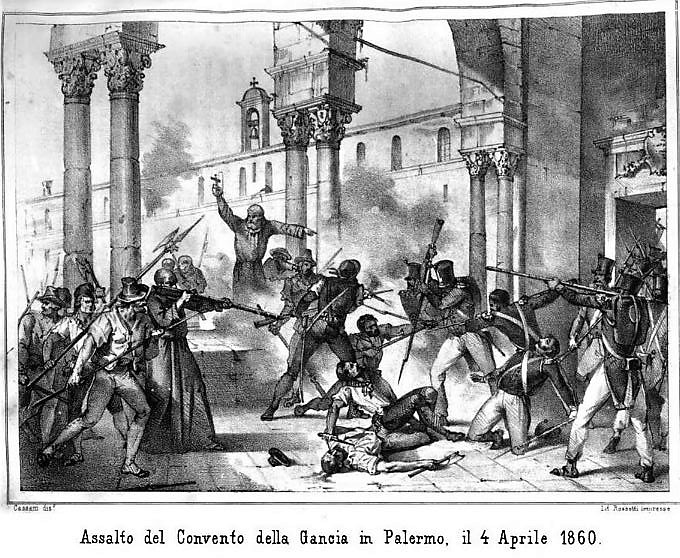
The revolt began on 4 April in Palermo with an episode that was immediately repressed whose protagonists, on the field, were Francesco Riso and, far from the theater of the operation, Francesco Crispi, who coordinated the action of the Genoese rebels. Despite the failure, the action gave rise to a series of demonstrations and insurrections, including Rosolino Pilo's march from Messina to Piana dei Greci from 10 to 20 April. To those, Rosolino Pilo met along the way he announced that they would have to be ready "for Garibaldi's arrival".
The news of the revolt was confirmed on the continent by an encrypted telegram sent by Nicola Fabrizi on 27 April. The content of the message was not at all encouraging and increased Giuseppe Garibaldi's uncertainty to the point that he initially gave up on the idea of an expedition. Francesco Crispi, who had decoded the telegram, claimed to have been wrong and provided a new version, probably falsified, which convinced Garibaldi to undertake the expedition.
Role of Cavour
Cavour considered the expedition risky. He feared that it would damage relations with France, especially because he suspected that Giuseppe Garibaldi was targeting Rome. However, since his prestige was undermined by the transfer of Savoy and Nice, he did not consider himself in a position to express his dissent.
For Cavour Garibaldi represented an "opportunity", because through him it was possible to trigger an internal revolt in the Two Sicilies which would have forced the Kingdom of Piedmont-Sardinia to take measures to guarantee public order. Cavour therefore decided to wait and observe the evolution of events, to grasp any favorable developments in Piedmont; it was only when the chances of success of the expedition were significant that Cavour openly supported the initiative.
With this in mind, on 18 April Cavour sent two warships to Sicily; the Governolo and the Authion. Officially their presence aimed to guarantee the protection of the Piedmontese citizens present on the island but, in reality, they had to accurately evaluate the forces at play. At the same time, Cavour managed, through Giuseppe La Farina (sent after the landing in Sicily to monitor and maintain contact with Garibaldi), to follow all the preparatory phases of the expedition. The definitive agreements between Cavour and King Victor Emmanuel II were concluded during a meeting in Bologna on 2 May. Cavour accepted that the government, with caution, would help Garibaldi in the expedition.
Search for a casus belli
The Kingdom of Piedmont-Sardinia needed a presentable casus belli in order to attack the Kingdom of the Two Sicilies. This was needed for the House of Savoy, which however never gave any declaration of war against the Bourbon kingdom, a necessary condition since this was among the requirements presented to Cavour. In fact, Cavour always presented himself as an instrument for maintaining order among the European powers. The only occurrence that would have satisfied this requirement was an uprising from within. Such an event would have felt the alienation of the people from the dynasty that ruled in Naples and, particularly, the inability of Francis II of the Two Sicilies, to exercise government in his domains.
Sicily, as shown by the history of the past decades, was fertile ground, and the liberal south, especially those returning after an amnesty granted by the young king, who worked in this direction for some time. Meanwhile the organization of the expeditionary force was in full swing. Garibaldi, fresh from the brilliant Lombardy campaign with the Hunters of the Alps, had demonstrated his abilities as a military leader, facing a regular army with a light army made up of volunteers. Also for this expedition he would have resorted to enlisting volunteers willing to fight under his leadership.
The expedition
Departure and journey
In March 1860, exile Rosolino Pilo exhorted Giuseppe Garibaldi to take charge of an expedition to liberate southern Italy from Bourbon rule. Garibaldi was against it at first, but eventually agreed. The expeditionary force was in full preparation and was organizing itself publicly throughout the Italian peninsula. Agostino Bertani, Giovanni Acerbi, Giuseppe Guerzoni and Nino Bixio were active in Genoa, and Giuseppe Missori and Giuseppe Sirtori in Lombardy. By May 1860, Garibaldi had collected 1,089 volunteers for his expedition to Sicily.
A total of 336 volunteers came from the contemporary Italian regions, including Genoa (156 volunteers), Tuscany (78 volunteers), Sicily (45 volunteers), Naples (46 volunteers), with only 11 from Rome and the Papal States. The largest number of volunteers came from Austrian Lombardy and Venetia, with 434 from Lombardy and 194 from Venetia. An additional 33 foreign volunteers joined the expedition. This included 14 ethnic Italians from the Trentino region of Austria, as well as István Türr and three other Hungarians. The volunteers came from middle-class backgrounds, with the vast majority being students and skilled craftsmen.
The 1,089 volunteers were unfavorably armed with obsolete muskets, and wore red shirts and grey trousers as their uniform. Thus they became known as the Redshirts. The Redshirts were very popular and influenced many armies worldwide. For example, during the American Civil War, the Union's Garibaldi Guard and its Confederate counterpart, the Garibaldi Legion, wore red shirts as a part of their uniforms.
During the night of 5 May, a small group of Redshirts led by Nino Bixio "seized" two steamships in Genoa from the Rubattino shipping company (the ships were actually provided by Rubattino following a secret agreement with the Kingdom of Piedmont-Sardinia, which paid the temporary rent of the two ships). The two ships were renamed Il Piemonte and Il Lombardo. That night, the expedition meticulously controlled by the Piedmontese authorities, set sail for Sicily, having embarked from a rock now known as the Scoglio dei Mille, at Quarto al Mare (now Quarto dei Mille), 5.6 km south-east of the Old Port of Genoa. The rock was situated directly in front of Villa Spinola (now Villa Carrara), the home of Candido Augusto Vecchi, his old comrade-in-arms from South American times, where Garibaldi had established his headquarters and lodgings.
According to Frederick Schneid, "Before embarking on the adventure, Garibaldi once again pledged his loyalty to Victor Emmanuel II and proclaimed that his intention was to conquer Sicily for the king. There is every indication that there was far more collusion between Cavour and Garibaldi, if not Victor Emmanuel and Garibaldi. After Garibaldi landed in Sicily, Admiral Persano received orders to support the expedition."
On 7 May, having no ammunition or gunpowder, Garibaldi decided to stop at Talamone, on the Tuscan coast, where he knew a military fort existed. In addition to the ammunition, he recovered three old cannons and a hundred rifles from the Sardinian army garrison stationed at fort. A second stop was made on 9 May, near Porto Santo Stefano (capital of Monte Argentario), for coal supply. Garibaldi officially obtained weapons and coal, as major general of the royal army, a title obtained during the 1859 campaign.
The two steamers, to avoid Bourbon ships, had followed an unusual route, which had taken them almost to the Tunisian coast. On this route near the Tunisian coast, however, it was observed that on the morning of the last day of navigation, at the Il Lombardo's speed of 7 miles per hour and after 40 hours of navigation, the two steamers could not be more than 280 miles from the departure from Argentario promontory and therefore approximately at the height of the Aegadian Islands or to the west of them, at least 70 miles from Cape Bon, without considering delays and stops. The Thousand, intending to turn towards Sciacca, after having excluded Menfi, between Selinunte and Sciacca, due to shallow water and disembarkation difficulties, then headed for Marsala, as they were informed by the crews of an English sailing ship and a Sicilian fishing vessel owned by master Strazzeri that the city's port was not protected by Bourbon vessels. The absence of Bourbons convinced Garibaldi to head towards Marsala, where the Thousand steamers arrived in the early hours of the afternoon of 11 May 1860.
The army of the Kingdom of the Two Sicilies, which the Expedition of the Thousand and the insurgents had to face, was numerically considerable. In 1860 the active army was made up of four army corps, one of the guards and three of the line, for a total of around 90,000 soldiers in active service and over 50,000 in the reserve, therefore overall the total of the Two Sicilies forces at full mobilization could have had 143,586 personnel, while according to other sources, the maximum number that could be mobilized with the reserves totaled 130,000.
Landing in Sicily
Garibaldi's landing in Marsala on 11 May 1860, on the westernmost point of Sicily, was favored by various circumstances, in particular by the presence of two Royal Navy ships under Admiral Rodney Mundy in the port of Marsala, the gunboat HMS Argus and sloop-of-war HMS Intrepid. Due to their presence in the harbour, the Bourbon ships were deterred from interfering. The Lombardo was attacked and sunk only after the disembarkation had been completed, while the Piemonte was captured.
Furthermore, the Bourbon commanders, ignoring the recommendations of the secret services of the Kingdom of the Two Sicilies, just one day before the landing, had the column of General Letizia and Major d'Ambrosio repatriated to Palermo to face the insurrectionary threat in the Sicilian capital. The landing had been preceded by the arrival of Francesco Crispi and others, who had the task of gaining the support of the locals for the volunteers.
According to the historian George Macaulay Trevelyan in his book Garibaldi and the Thousand, Argus and Intrepid did nothing to help Garibaldi, nor could they have because their boilers were turned off and they were moored offshore, with their captains Marryat and Winnington-Ingram on the ground together with portions of their crews.
The Royal Navy's neutrality was confirmed during the following battle of Palermo, when Garibaldi, his troops almost out of gunpowder, unsuccessfully requested more from the captains of British warships moored off the coast of the city. They were joined, as early as 12 May, by 200 Sicilian volunteers commanded by the Sant'Anna brothers. Their forces increased due to the subsequent landings of Sardinian troops in civilian clothes and the liberation of prisoners taken from the Bourbon prisons.
Calatafimi and Palermo
On 12 May Garibaldi left Marsala and advanced quickly and easily towards the interior of Sicily. In the following days, a thousand Sicilian volunteers joined the expedition, including Franciscan priests. The volunteers are grouped within a new military structure, the Hunters of Etna, directed by Giuseppe La Masa. On 14 May 1860 in Salemi, after an enthusiastic welcome which reassured him of the participation of the population, Garibaldi declared to ensure the dictatorship of Sicily in the name of King Victor Emmanuel II, which would then come later.
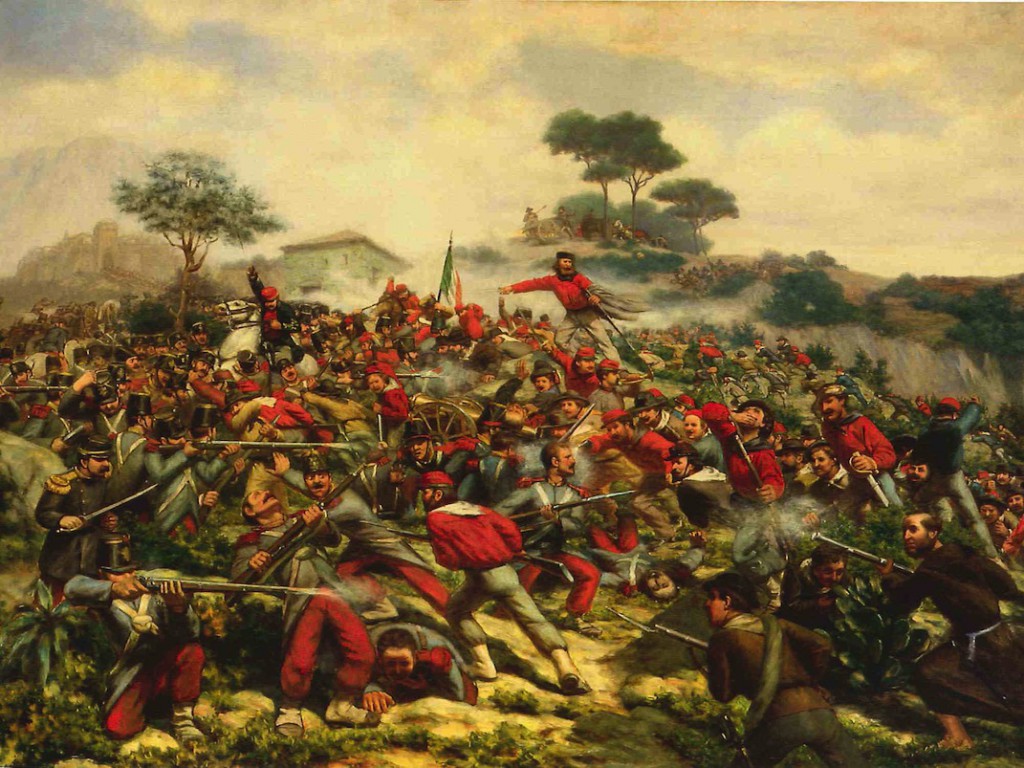
The Thousand, flanked by 500 Sicilian insurgents, had their first clash on 15 May 1860 in the battle of Calatafimi against around 3,000 royal troops led by General Francesco Landi. The news of the victory of the Thousand spread rapidly in the area, fomenting revolt among the Sicilian population. In Alcamo, on the way to Palermo, the Two Sicilies troops were attacked by Sicilians who shot from houses and balconies, and in retaliation, the soldiers set many houses on fire. In Partinico the population rebelled against the attempted forced requisition of goods and food by the retreating soldiers with a bloody popular revolt. The battle boosted the morale of the Thousand and, at the same time, depressed the Bourbons, who were poorly led by their often corrupt higher officers, and started to feel abandoned. Garibaldi promised land to every male who volunteered to fight against the Bourbons, and the ranks of the Thousand enlarged to 1,200 with local men.
After the battle of Calatafimi Giuseppe Garibaldi headed for Palermo passing through Alcamo and Partinico. Along the journey, the Thousand were joined by 3,200 Sicilians, bringing the number of fighters under Garibaldi's orders to 4,000 men. From there, Garibaldi and the Sicilian volunteers arrived in Palermo on 27 May and prepared to enter the city, through the Admiral's Bridge and the Porto Termini manned by the Bourbon military. After a hard battle, the royal troops abandoned the field and retreated to Palermo. A Garibaldian column crossed the Porta Termini and entered the city, while another column entered Palermo, crossing the Porta Sant'Antonino with less difficulty.
Aided by the Palermo insurrection, between 28 May and 30 May, the Garibaldians and the insurgents, often fighting street by street, conquered the whole city, despite the indiscriminate bombardment carried out by the Bourbon ships and by the positions present on the floor in front of the Palazzo dei Normanni and the Castello a Mare. On 29 May there was a decisive counterattack by the royal troops which, however, was contained. Thus began the Siege of Palermo. On 30 May the Bourbons, barricaded in the fortresses along the walls, asked for an armistice (organized by the British Admiral Rodney Mundy), which was granted and which lasted from 30 May to 3 June. On 6 June the Bourbon troops defending the Sicilian capital capitulated in exchange for permission to leave the city, asking for the honor of arms, which Garibaldi granted as they were also Italian. The garrison evacuated on 7 July, after King Francis II authorized the Bourbon withdrawal.
Support of national and international opinion
On 21 June 1860 Giuseppe Garibaldi definitively occupied Palermo. The news went around the world and public opinion took up the cause of the expedition. In the United Kingdom, workers from Glasgow and Liverpool offered days of work to support the expedition. The French daily newspaper Le Siècle launched an appeal for fundraising and the enlistment of volunteers. Having left Marseille on 9 May, Alexandre Dumas and Giustiniano Lebano arrived in Palermo on 30 May from his personal yacht to supply Garibaldi with weapons. Dumas, a friend of Garibaldi, also organized the propaganda of the expedition through the newspapers.
George Sand and Victor Hugo, then in exile, supported Garibaldi's action. The same went for Karl Marx and Friedrich Engels. These, in the New-York Tribune, considered the conquest of Palermo "one of the most surprising military feats of our century". Funds and volunteers arrived from all over Europe, the United States, Uruguay and Chile. Giacomo Medici and Enrico Cosenz were joined by 33 Englishmen, as well as the socialist Paul de Flotte who was the only foreign Garibaldian to obtain, posthumously, the Medal of the Thousand.
It is essentially the respect for the figure of Garibaldi that caused this outburst of generosity, while the reactionary governments, Austrian Empire, Russian Empire, Kingdom of Prussia and Spain, protest against the Sardinian government, the alleged beneficiary of the events.
Formation of the dictatorial government
On 7 July, Giuseppe Garibaldi proclaimed himself Dictator of Sicily "in the name of Victor Emmanuel, King of Italy". Garibaldi then ordered Giacomo Medici to advance upon Messina, Enrico Cosenz to advance upon Catania, and Nino Bixio to advance upon Syracuse, gathering more Sicilian volunteer irregulars. King Francis II strengthened his Bourbon garrisons at Messina and Syracuse.