
The Shadow is a fictional character created by American magazine publishers Street & Smith and writer Walter B. Gibson. Originally created to be a mysterious radio-show narrator and developed into a distinct literary character in 1931 by Gibson, the Shadow has been adapted into other media, including American comic books, comic strips, serials, video games, and at least five feature films. The radio drama included episodes voiced by Orson Welles.
The Shadow debuted on July 31, 1930, as the mysterious narrator of the radio program Detective Story Hour, created to boost sales of Street & Smith's monthly pulp Detective Story Magazine. When listeners of the program began asking at newsstands for copies of "that Shadow detective magazine", Street & Smith launched a magazine based on the character, and hired Gibson to create a concept to fit the name and voice and to write a story featuring him. The first issue of the pulp series The Shadow magazine went on sale April 1, 1931.
On September 26, 1937, The Shadow, a new radio drama based on the character as created by Gibson for the pulp magazine, premiered with the story "The Death House Rescue", in which the Shadow was characterized as having "the hypnotic power to cloud men's minds so they cannot see him". In the magazine stories, the Shadow did not become literally invisible.
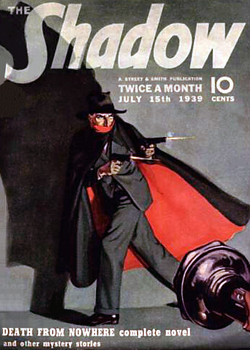
The introductory line from the radio adaptation of The Shadow – "Who knows what evil lurks in the hearts of men? The Shadow knows!" – spoken by actor Frank Readick, has earned a place in the American idiom.
Publication history
Origin of the character's name
To boost the sales of its Detective Story Magazine, Street & Smith Publications hired David Chrisman, of the Ruthrauff & Ryan advertising agency, and writer-director William Sweets to adapt the magazine's stories into a radio series. Chrisman and Sweets thought the upcoming series should be narrated by a mysterious storyteller with a sinister voice and began searching for a suitable name. One of their scriptwriters, Harry Engman Charlot, suggested various possibilities, such as "The Inspector" or "The Sleuth". Charlot then proposed the ideal name for the phantom announcer: "The Shadow".
Thus, beginning on July 31, 1930, "The Shadow" was the name given to the mysterious narrator of the Detective Story Hour radio program. The narrator was initially voiced by James LaCurto, who was replaced after four months by prolific character actor Frank Readick Jr. The episodes were drawn from the Detective Story Magazine issued by Street & Smith, the nation's oldest and largest publisher of pulp magazines at the time. Although the latter company had hoped the radio broadcasts would boost the declining sales of Detective Story Magazine, the result was quite different. Listeners found the sinister announcer much more compelling than the unrelated stories. They soon began asking newsdealers for copies of "that Shadow detective magazine", even though it did not exist.

Creation as a distinctive literary character
Recognizing the demand and responding promptly, circulation manager Henry William Ralston of Street & Smith commissioned Walter B. Gibson to begin writing stories about "The Shadow". Using the pen name of Maxwell Grant and claiming the stories were "from The Shadow's private annals" as told to him, Gibson wrote 282 out of 325 tales over the next 20 years: a novel-length story twice a month (1st and 15th). The first story produced was The Living Shadow published April 1, 1931.
Gibson's characterization of The Shadow laid the foundations for the archetype of the superhero, including stylized imagery and title, sidekicks, supervillains, and a secret identity. Clad in black, The Shadow operated mainly after dark as a vigilante in the name of justice, terrifying criminals into vulnerability. Gibson himself claimed the literary inspirations upon which he had drawn were Bram Stoker's Dracula and Edward Bulwer-Lytton's "The House and the Brain". Another possible inspiration for The Shadow is the French character Judex; the first episode of the original Judex film serial was released in the United States as The Mysterious Shadow, and Judex's costume is similar to The Shadow's. French comics historian Xavier Fournier notes other similarities with another silent serial, The Shielding Shadow, whose protagonist had a power of invisibility, and considers The Shadow to be a mix between the two characters. In the 1940s, some Shadow comic strips were translated in France as adventures of Judex.
Because of the great effort involved in writing two full-length novels every month, several guest writers were hired to write occasional installments in order to lighten Gibson's workload. Those guest writers included Lester Dent, who also wrote the Doc Savage stories, and Theodore Tinsley. In the late 1940s, mystery novelist Bruce Elliott (also a magician) temporarily replaced Gibson as the primary author of the pulp series (he wrote #'s 306 through 320). Richard Wormser, a reader for Street & Smith, wrote two Shadow stories. For a complete list of Street and Smith's Shadow novels (and a list of the reprint editions), see the List of The Shadow stories article.
A new beginning at Belmont Books
The Shadow Magazine ceased publication with the Summer 1949 issue, but Walter B. Gibson wrote three new "official" stories between 1963 and 1980. The first began a new series of nine Shadow mass market paperback novels from Belmont Books. In this series, The Shadow is given psychic powers, including the radio character's ability "to cloud men's minds", so that he effectively became invisible. Return of The Shadow was published under his own name. The remaining eight novels in this series, The Shadow Strikes, Shadow Beware, Cry Shadow, The Shadow's Revenge, Mark of The Shadow, Shadow Go Mad, Night of The Shadow, and The Shadow, Destination: Moon, were written by Dennis Lynds, not Gibson, under the Maxwell Grant pseudonym.
The other two Gibson works were the novelettes "The Riddle of the Rangoon Ruby", published June 1, 1979 in The Shadow Scrapbook. and "Blackmail Bay", published February 1, 1980 in The Duende History of The Shadow Magazine.
Literary sequels and reboots
The Shadow returned in 2015 in the authorized novel The Sinister Shadow, an entry in the Wild Adventures of Doc Savage series from Altus Press. The novel, written by Will Murray, used unpublished material originally written in 1932 by Doc Savage originator Lester Dent and published under the pen name Kenneth Robeson. Set in 1933, the story details the conflict between the two pulp magazine icons during a crime wave caused by a murderous kidnapping-extortion ring led by the mysterious criminal mastermind known as the Funeral Director.

A sequel, Empire of Doom, was published in 2016 and takes place seven years later in 1940. The Shadow's old enemy, Shiwan Khan, attacks his hated adversary. Doc Savage joins forces with The Shadow to vanquish Khan in a Doc Savage novel written by Murray, from a concept by Dent.
In 2020, James Patterson Entertainment and Condé Nast Entertainment announced a new series written by James Patterson and Brian Sitts. The arrangement also includes potential screen adaptations of these novels. The first novel, The Shadow, released in 2021, serves as a sequel-update with some science-fiction elements, bringing Lamont Cranston from 1937 into 2087 to battle Shiwan Khan in a futuristic New York. The second Patterson-Sitts Shadow novel, Circle of Death, was published in 2023.
Character development
The character and look of The Shadow gradually evolved over his lengthy fictional existence:

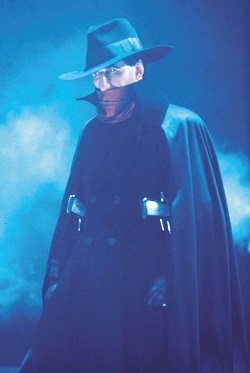
As depicted in the pulps, The Shadow wore a wide-brimmed black hat and a black, crimson-lined cloak with an upturned collar over a standard black business suit. In the 1940s comic books, the later comic book series, and the 1994 film starring Alec Baldwin, he wore either the black hat or a wide-brimmed, black fedora and a crimson scarf just below his nose and across his mouth and chin. Both the cloak and scarf covered either a black double-breasted trench coat or a regular black suit. As seen in some of the later comics series, The Shadow also would wear his hat and scarf with either a black Inverness coat or Inverness cape.
In the radio drama that debuted in 1937, The Shadow does not wear a costume because he is invisible when he operates as a vigilante, a feature born out of necessity. Time constraints of 1930s radio made it difficult to explain to listeners where The Shadow was hiding and how he remained concealed from criminals until he was ready to strike, so the character was given invisibility, meaning the criminals (like the radio audience) only knew him by his haunting voice. The actors used their normal voice when the hero was in his civilian identity of Lamont Cranston and effects were added when he became invisible and acted as The Shadow, his voice now having a sinister and seemingly omnipresent quality. To explain this power, radio episodes regularly said that while a young man, The Shadow traveled around the world and then through the Orient, where he learned how to read thoughts and became a master of hypnotism, granting him "the mysterious power to cloud men's minds, so they could not see him". In the episode "The Temple Bells of Neban" (1937), The Shadow said he developed these abilities in India specifically, under the guidance of a "Yogi priest" who was "Keeper of the Temple of Cobras" in Delhi. He does not wear a mask or any disguise while invisible, and so in episodes such as "The Temple Bells of Neban" he is cautious when he meets an enemy who could potentially disrupt his hypnotic abilities, exposing his true face and instantly making him a visible target for attack.
Background
In the print adventures, The Shadow is Kent Allard, although his real name is not revealed until The Shadow Unmasks (1937). Early stories explain he was once a famed aviator who fought for the French during World War I, known by the alias the "Black Eagle" according to one character in The Shadow's Shadow (1933). Later stories revised this alias as the "Dark Eagle", beginning with The Shadow Unmasks. After the war's conclusion, Allard finds a new challenge in waging war on criminals. Allard falsifies his death by crash landing his plane in Guatemala, encountering the indigenous "Xinca tribe" as a result, who see him as a supernatural being and provide him with two loyal aides. Allard returns to the United States and takes residence in New York City, adopting numerous identities to acquire valuable information and conceal his true nature, and recruiting a variety of agents to aid his war on crime, only a few of whom are aware of his other identities.

As the vigilante called The Shadow, Allard hunts down and often violently confronts criminals, armed with M1911 pistols and sometimes using magician tricks to convince his prey that he is supernatural. One such trick is “The Devil's Whisper”, a chemical compound on the thumb and forefinger, causing a flash of bright flame and sharp explosion when he snaps his fingers. The Shadow is also known for wearing a girasol ring with a purple stone (sometimes depicted as a red stone in cover artwork), given to Allard by the Czar of Russia (The Romanoff Jewels, 1932) during World War I. The ring is later said to be one of two rings made with gemstones taken from the eyes of an idol made by the Xinca tribe (The Shadow Unmasks, 1937).
The Shadow's best known alter ego is Lamont Cranston, a "wealthy young man-about-town". In the pulps, Cranston is a separate character, a rich playboy who travels the world while The Shadow uses his identity and resources in New York (The Shadow Laughs, 1931). The Shadow's disguise as Cranston works well because the two men resemble each other (Dictator of Crime, 1941). In their first meeting, The Shadow threatens Cranston, saying that unless the playboy agrees to allow the aviator to use his identity when he is abroad, then Allard will simply take over the man's identity entirely, having already made arrangements to begin the process, including switching signatures on various documents. Although alarmed at first, the real Lamont Cranston agrees, deciding that sharing his resources and identity is better than losing both entirely. The two men sometimes meet afterward in order to impersonate each other (Crime over Miami, 1940). As Cranston, The Shadow often attends the Cobalt Club, an exclusive restaurant and lounge catering to the wealthy, and associates with New York City Police Commissioner Ralph Weston.
The Shadow's other disguises include: businessman Henry Arnaud, who like Cranston is a real person whose identity Allard simply assumes at times, as revealed in Arnaud's first appearance The Black Master (March 1, 1932); elderly Isaac Twambley, who first appears in No Time for Murder (December 1944); and Fritz, an old, seemingly slow-witted, uncommunicative janitor who works at police headquarters, listening in on conversations and examining recovered evidence, first appearing in The Living Shadow (April 1931).
In Teeth of the Dragon and later stories including The Golden Pagoda, The Shadow is known in Chinatown as Ying Ko, often fighting the criminal Tong.
In the 2015 Altus Press novel The Sinister Shadow by Will Murray, The Shadow masquerades as celebrated criminologist George Clarendon of Chicago, a past member of the Cobalt Club and long-time friend of Commissioner Weston.
For the first half of The Shadow's tenure in the pulps, his past and true identity (outside of his Cranston disguise) are ambiguous. In The Living Shadow, a thug claiming to have seen the Shadow's face recalls seeing "a piece of white that looked like a bandage". In The Black Master and The Shadow's Shadow, the villains of both stories see The Shadow's true face and remark the vigilante is a man of many faces with no face of his own. It was not until the August 1937 issue, The Shadow Unmasks, that The Shadow's real name was revealed.
In the radio drama series that premiered in 1937, the Allard secret identity and backstory were dropped for simplicity's sake. The radio incarnation of The Shadow is really and only Lamont Cranston with no other regular cover identities, though he does adopt disguises and short-term aliases during some adventures. The radio version of Cranston travels the world to "learn the old mysteries that modern science has not yet rediscovered" ("Death House Rescue" in 1937). Along with learning skills and knowledge in Europe, Africa, and Asia, he spends time training with a Yogi priest, "Keeper of the Temple of Cobras", in Delhi and learns how to read thoughts and hypnotize people enough to "cloud" their minds, making himself invisible to them (as revealed in the episode "The Temple Bells of Neban" in 1937). He explicitly states in several episodes that his talents are not magic but based on science. Returning to New York, he decides he can best aid the police and his city by operating outside the law as an invisible vigilante. He is somewhat less ruthless and more compassionate than the pulp incarnation, and without the vast network of agents and operatives. Only cab driver/chauffeur Shrevvy makes regular appearances on the radio series, but the character is different from his print counterpart. Commissioner Weston and a few other supporting characters from the print stories also are adapted to radio.
Supporting characters
The Shadow has a network of agents who assist him in his war on crime. These include:
Harry Vincent - A man who tries to commit suicide in the first Shadow story. The Shadow saves and recruits him, after which Vincent is a regular recurring character in the pulp stories and one of the most trusted agents.
Moses "Moe" Shrevnitz, a.k.a. "Shrevvy" - A cab driver who doubles as his chauffeur. The radio version of Shrevvy is dimwitted and does not knowingly work for The Shadow, aiding Lamont Cranston on many occasions. Peter Boyle performed the role in the 1994 film.
Margo Lane - A socialite created for the radio drama and introduced in the debut episode "The Death House Rescue" as The Shadow's companion who loves him. Margo aids the Shadow in nearly every radio episode and was later introduced into the pulps as one of his agents. Penelope Ann Miller performed the role in the 1994 film, in which Margo had the power of telepathy, allowing her to pierce The Shadow's hypnotic mental-clouding abilities.
Clyde Burke - A newspaper reporter who also is initially paid to collect news clippings for The Shadow.
Burbank - A radio operator who maintains contact between The Shadow and his agents. He was portrayed by Andre Gregory in the 1994 film.
Clifford "Cliff" Marsland - He first appeared in the ninth novel Mobsmen on the Spot. A man with a checkered past known to The Shadow, he changed his name to Clifford Marsland. Having spent years in Sing Sing maximum security prison for a crime he did not commit, he is wrongly believed by the underworld to have murdered one or more people. He infiltrates gangs using his crooked reputation (the Green Hornet is often described as having a modus operandi similar to that of Marsland).
Dr. Rupert Sayre - The Shadow's personal physician.
Jericho Druke - A large, immensely strong black man.
Slade Farrow - He works with The Shadow to rehabilitate criminals.
Miles Crofton - He sometimes pilots The Shadow's autogyro.
Claude Fellows - The only agent of The Shadow ever shown to be killed in Gangdom's Doom (1931).
Rutledge Mann - A stockbroker who collects information, taking over for Claude Fellows after the latter's death. First appeared in Double Z (June 1, 1932). After his business failed and he acquired heavy debt, he was ready to commit suicide before The Shadow, knowing about his situation, recruited him.
Hawkeye - A reformed underworld snoop who trails gangsters and other criminals.
Myra Reldon - A female operative who uses the alias of Ming Dwan when in Chinatown.
Dr. Roy Tam - The Shadow's contact man in New York's Chinatown. Sab Shimono portrayed him in the 1994 film, in which he provided valuable scientific information to Lamont Cranston, believing the latter to be an agent of The Shadow.
Though initially wanted by the police, The Shadow also works with and through them, notably gleaning information from his many chats (as Cranston) at the Cobalt Club with NYPD Commissioner Ralph Weston and later Commissioner Wainwright Barth, who is also Cranston's uncle (portrayed by Jonathan Winters in the 1994 film). Weston believes Cranston is merely a rich playboy who dabbles in detective work out of curiosity. Another police contact is Detective (later Inspector) Joseph Cardona, a key character in many Shadow novels.
In contrast to the pulps, The Shadow radio drama limited the cast of major characters to The Shadow, Commissioner Weston, and Margo Lane, the last of whom was created for the radio series. Along with giving The Shadow a love interest, Margo was created because it was believed that including Harry Vincent as a regular would mean an overabundance of male characters (considering the criminals in the stories were usually male, too) and could possibly make it difficult for the audience to distinguish between the voices of so many male actors. The radio script for "The Death House Rescue" (reprinted in The Shadow Scrapbook) features Harry Vincent, but he did not appear in the actual radio broadcast or any episode of the radio drama series. Clyde Burke made occasional appearances, but not as an agent of The Shadow. Lieutenant Cardona was a minor character in several episodes. Moe Shrevnitz (identified only as "Shrevvy") made several appearances as a simple-minded acquaintance of Cranston and Lane who sometimes acted as their chauffeur, unaware Cranston was actually The Shadow.
Enemies
The Shadow also faces a wide variety of enemies, ranging from kingpins and mad scientists to international spies.
Among his recurring foes are:
Shiwan Khan – A would-be conqueror who is the last living descendant of Genghis Khan. Seen in The Golden Master, Shiwan Khan Returns, The Invincible Shiwan Khan and Masters of Death. In the 1994 film, he was portrayed by actor John Lone.
Dr. Rodil Moquino – A doctor and self-proclaimed Voodoo Master who uses hypnosis to make people do his bidding. Seen in The Voodoo Master, The City of Doom and Voodoo Trail.
Wasp – Basil Gannaford is a criminal mastermind with a bulbous head on a tall frail body whose grasp contained an electric sting and spoke in a buzzing voice. Seen in The Wasp and The Wasp Returns.
Benedict Stark – The self-described Prince of Evil. Seen in The Prince of Evil, The Murder Genius, The Man Who Died Twice and The Devil's Paymaster, all written by Theodore Tinsley
The only recurring criminal organization he fought was the Hand (The Hand, Murder for Sale, Chicago Crime, Crime Rides the Sea and Realm of Doom), where he defeated one Finger of the organization in each book.
In addition, the villain King Kauger from the Shadow story Wizard of Crime is the unseen mastermind behind the events of Intimidation, Inc., and the organization known as The Silent Seven was referenced in the previous title The Death Tower.