
The Odyssey (; Ancient Greek: Ὀδύσσεια, romanized: Odýsseia [odýsseːa]) is one of two major epics of ancient Greek literature attributed to Homer. It is one of the oldest surviving works of literature and remains popular with modern audiences. Like the Iliad, the Odyssey is divided into 24 books. It follows the heroic king of Ithaca, Odysseus, also known by the Latin variant Ulysses, and his homecoming journey after the ten-year-long Trojan War. His journey from Troy to Ithaca lasts an additional ten years, during which time he encounters many perils and all of his crewmates are killed. In Odysseus's long absence, he is presumed dead, leaving his wife Penelope and son Telemachus to contend with a group of unruly suitors competing for Penelope's hand in marriage.
The Odyssey was first composed in Homeric Greek around the 8th or 7th century BC; by the mid-6th century BC, it had become part of the Greek literary canon. In antiquity, Homer's authorship was taken as true, but contemporary scholarship predominantly assumes that the Iliad and the Odyssey were composed independently, as part of long oral traditions. Given widespread illiteracy, the poem was performed for an audience by an aoidos or rhapsode.
Key themes in the epic include the ideas of nostos (νόστος; 'return', homecoming), wandering, xenia (ξενία; 'guest-friendship'), testing, and omens. Scholars discuss the narrative prominence of certain groups within the poem, such as women and slaves, who have larger roles than in other works of ancient literature. This focus is especially remarkable when contrasted with the Iliad, which centers upon the exploits of soldiers and kings during the Trojan War.

The Odyssey is regarded as one of the most significant works of the Western canon. The first English translation of the Odyssey was in the 16th century. Adaptations and re-imaginings continue to be produced across a wide variety of media. In 2018, when BBC Culture polled experts around the world to find literature's most enduring narrative, the Odyssey topped the list.
Background
Dating
Many suggestions have been made for dating the composition of the Iliad and the Odyssey, but there is no consensus. Robert Lamberton says that the epics "[straddled] the beginnings of widespread literacy" from the middle of the 5th-century BC, but the poems' language can be dated to long before this period. The Greeks began adopting a modified version of the Phoenician alphabet to create their own writing system during the eighth century BC; if the Homeric poems were among the earliest products of that literacy, they would have been composed towards the late period of that century.
According to Rudolf Pfeiffer, they were probably written down, but there is no evidence for their publishing or physical dissemination for consumption by a literate audience. Dating is further complicated by the fact that the Homeric poems, or sections of them, were performed by rhapsodes for hundreds of years.

Composition and authorship
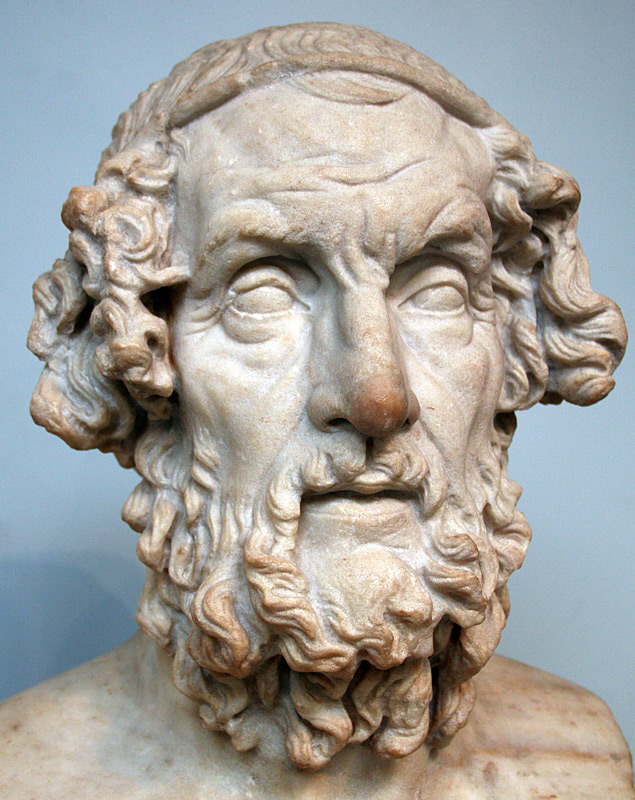
Scholars agree that the Homeric epics developed as part of an oral tradition over hundreds of years. In the early twentieth century, Milman Parry and Albert Lord demonstrated that they prominently contained the characteristics of oral poetry, which would allow even an illiterate poet to improvise large poems, composing them through speech. Scholars do not agree on how the poems emerged from this tradition, and it is not clear whether oral tradition can claim full credit for their composition. In the nineteenth century, a series of related questions about the epics' authorship became known as the Homeric Question. Sources from antiquity created mythic narratives to explain Homer. Debate still persists today over many of the Homeric questions; for example, concerning the compositional relationship between the Iliad, the Odyssey, and the largely lost poems of the Epic Cycle; about whether Homer lived and, if he did, when; and whether the poems reflect any geographical, historical or cultural reality. While Homer is today attributed as the author of the Iliad and the Odyssey, other texts have historically been attributed to him—for example, the Homeric Hymns.
Textual reconstructions indicate the poems have taken many forms. As feedback is an important component of live performance, the content of the poem may have varied from telling to telling. This context is important for understanding and interpreting the epics; John Miles Foley writes that performance is a crucial part of their meaning. The performance of epic poetry is a subject of both poems, with the Odyssey actually depicting professional singers like Phemius and Demodocus. Applying these in-narrative performances to modern understanding of the epics' performance might indicate that they were performed at the houses of distinguished families as part of banquets or dinners in the 2nd and early 1st millennia BC, and that observers may have directed or participated in them. They were probably recited—as in, not performed with music.
Like the Iliad, the Odyssey is divided into twenty-four parts. Early scholars suggested these correspond to the 24 letters of the Greek alphabet, but this is widely considered ahistorical. The division was probably made long after the poem's composition but is now generally accepted as part of the poem's modern structure. There are many theories as to how they arose. Some suggest they were an authentic part of the oral tradition or invented by Alexandrian scholars. Pseudo-Plutarch attributed the divisions to Aristarchus of Samothrace, but there is some evidence against this. Some scholars connect the epics' segmentation to the tradition of performance, for example as a creation of rhapsodes.

Both epics presuppose some knowledge of their audiences—for example, concerning the Trojan War. This strongly indicates that the epics were engaging with a pre-existing mythological tradition. While the Trojan War is an important element for both, the Odyssey does not directly reference any events from the Iliad's depiction of the war, and they are generally considered to have formed independently from one another. Arguments exist for either epic having been composed first; it is not clear.
Influences
Scholars note strong influences from Near Eastern mythology and literature in the Odyssey. Martin West notes substantial parallels between the Epic of Gilgamesh and the Odyssey. Both Odysseus and Gilgamesh are known for traveling to the ends of the earth and on their journeys go to the land of the dead. On his voyage to the underworld, Odysseus follows instructions given to him by Circe, who is located at the edges of the world and associated with solar imagery. Like Odysseus, Gilgamesh gets directions on reaching the land of the dead from a divine helper: the goddess Siduri, who, like Circe, dwells by the sea at the ends of the earth, whose home is also associated with the sun. Gilgamesh reaches Siduri's house by passing through a tunnel underneath Mount Mashu, the high mountain from which the sun comes into the sky. West argues that the similarity of Odysseus's and Gilgamesh's journeys to the edges of the earth are the result of the influence of the Gilgamesh epic upon the Odyssey. Classical folklorist Graham Anderson notes other patterns—the heroes of the Odyssey and Gilgamesh meet women who can transform people into animals; are involved in the death of divine cattle; unhappily enjoy the presence of a "voluptuous lady in an other-worldly paradise" following a voyage through the underworld.
Scholars have explored whether figures originate within the poem or belong to a tradition outside of it. Adrienne Mayor says that the Austrian paleontologist Othenio Abel made unfounded claims about the fifth-century BC philosopher Empedocles connecting the cyclops to prehistoric elephant skulls. Whether the epic poem created, popularised, or simply retold the tale of Polyphemus is a long-standing dispute, but Anderson says there is some amount of scholarly consensus that the story existed separately from the epic. William Bedell Stanford notes there are some indications that Odysseus existed independently of Homer, although it is inconclusive.
Geography
Scholars are divided on whether any of the places visited by Odysseus are real. The events in the main sequence of the Odyssey (excluding Odysseus's embedded narrative of his wanderings) have been said to take place across the Peloponnese and the Ionian Islands. Many have attempted to map Odysseus's journey, but largely agree that the landscapes—especially those described in books 9 to 11—include too many mythical elements to be truly mappable. For instance, there are challenges ascertaining whether Odysseus's homeland of Ithaca is the same island that is now called Ithakē (modern Greek: Ιθάκη); the same is true of the route described by Odysseus to the Phaeacians and their island of Scheria. British classicist Peter Jones writes that the poem was likely updated many times by oral story-tellers across several centuries before it was written down, making it "virtually impossible" to say "in what sense [the poem] reflects a historical society or accurate geographical knowledge". Modern scholars tend to explore Odysseus's journey metaphorically rather than literally.
Synopsis
Ten years after the Achaeans (Greeks) won the Trojan War, Odysseus, king of Ithaca, has yet to return home from Troy. In his absence, 108 boorish suitors court his wife Penelope. Penelope tells them she will remarry when she is done weaving a shroud for Odysseus's aged father Laertes; however, she secretly unweaves it every night.
The goddess Athena, disguised first as Mentes then as Mentor, tells Odysseus's son Telemachus to seek news of his father. The two leave Ithaca and visit Nestor, who tells them that Agamemnon, the commander of the Greek army at Troy, was murdered soon after the war. Telemachus travels to Sparta to meet Agamemnon's brother Menelaus, who in turn describes his encounter with the shape-shifting god known as the Old Man of the Sea. Menelaus says he learned from the Old Man of the Sea that Odysseus is alive, but held captive by the nymph Calypso.

Athena petitions Zeus to rescue Odysseus, and Zeus sends Hermes to negotiate his release. As Odysseus leaves Calypso's island, Poseidon destroys his raft with a storm. The sea nymph Ino protects Odysseus as he swims to Scherie, home of the Phaeacians, and Athena leads the Phaeacian princess Nausicaä to recover him. In the court of Nausicaä's parents Arete and Alcinous, Odysseus excels at athletic games and is overcome with emotion when the bard Demodocus sings about the Trojan War. Odysseus reveals his identity and recounts his adventures following the war.
On leaving Troy, Odysseus's men unsuccessfully raided the Cicones. Afterward, on an island of lotus-eaters, they found intoxicating fruit which made them forget about reaching home. On another island, they were captured by the cyclops Polyphemus. Odysseus, deceptively calling himself "Nobody" (Greek: Οὔτις), escaped by intoxicating the cyclops and blinding him. However, he boastfully revealed his true identity while escaping, and Polyphemus asked his father Poseidon to take revenge.
Odysseus's crew nearly arrived in Ithaca, but were blown off course after opening a bag of winds they received from Aeolus. Afterwards, all but one of their ships were destroyed by giant cannibals called Laestrygonians. On the island of Aeaea, the goddess Circe turned Odysseus's men into pigs. Hermes helped Odysseus resist Circe's magic using the herb moly, and Odysseus forced her to restore the crew's human forms. Odysseus and Circe then became lovers for a year until he left to continue home. Next, Odysseus traveled to the edge of Oceanus, where the living can speak with the dead. The spirit of the prophet Tiresias told Odysseus he would return home, but must eventually undertake another journey. Odysseus also met the spirits of his mother Anticleia and former comrades Agamemnon and Achilles.

Odysseus's crew then sailed past the Sirens, whose enticing song lured sailors to their deaths. His crewmen plugged their ears with beeswax to avoid hearing them, while Odysseus tied himself to the ship's mast. Next, they navigated the narrow passage between the whirlpool Charybdis and the multi-headed monster Scylla. Finally, on the island of Thrinacia, Odysseus's men killed and ate sacred cattle belonging to the sun god Helios. Helios asked Zeus to punish them, which he did by destroying their last ship. Odysseus, the sole survivor, washed ashore on the island Ogygia. There he met Calypso, who took him captive as her lover until Hermes eventually intervened.
After hearing Odysseus's story, the Phaeacians take him to Ithaca, where Athena disguises him as an elderly beggar. Without knowing his identity, the swineherd Eumaeus offers him lodging and food. Telemachus returns home from Sparta, evading an ambush from the suitors. Odysseus reveals himself to his son and the two return home, where Odysseus's elderly dog Argos, long neglected, recognizes him through his disguise; the old dog had been faithfully awaiting his master and upon finally seeing his return, dies peacefully. The suitors mock and mistreat Odysseus in his own home. He and Telemachus hide the suitors' weapons in preparation for revenge. Odysseus also reencounters Penelope and her servant Eurycleia, who recognizes him from a scar on his leg.
Penelope announces she is ready to remarry, and that she will choose whoever wins an archery contest with Odysseus's bow. After each suitor fails to even string the bow, Odysseus strings it and shoots an arrow through a series of axe heads. Having won the contest, he kills the suitors; Telemachus also hangs a group of female slaves who had sex with them. Odysseus reveals his identity to Penelope, who tests him by asking to move their bed. He correctly states that the bed, which he carved from the trunk of an olive tree, is immovable, and the two lovingly reunite.
The next day, after Odysseus reveals himself to his father Laertes, the families of the murdered suitors gather to get revenge. Athena intervenes and prevents further bloodshed.
Style
Structure
The narrative opens in medias res; the preceding events are described through flashbacks and storytelling.
In Classical Greece, some books or sections were provided with their own titles. Books 1 to 4, which focus on the perspective of Telemachus, are called the Telemachy. Books 9 to 12, wherein Odysseus provides an account of his adventures, are called the Apologos or Apologoi. Book 22 was known as Mnesterophonia (Mnesteres, 'suitors' + phónos, 'slaughter'). Book 22 is generally said to conclude the Greek Epic Cycle, but fragments remain of a lost sequel known as the Telegony.
Debate exists over what constitutes the "original" Odyssey. Some scholars regard the Telemachy as a later addition, while others note that later parts do not make sense without those books. Likewise, the poem's ending has been the subject of debate since antiquity—Aristarchus of Samothrace and Aristophanes of Byzantium regarded the epic's real ending as lines 293–295 of book 23. Similar debates over the poem's ending occur today.
Narrative and language
The epic has 12,109 lines composed in dactylic hexameter, sometimes called Homeric hexameter—a metre with six metrical feet. The form of hexameter is catalectic, meaning that it lacks an expected syllable in the last foot. Each line has between twelve and seventeen syllables and generally forms a grammatically complete sentence. The poems may have inherited some stylistic traditions but invented others.
The narrative is primarily related through speech—that is, characters talking to themselves or to somebody else. Consequently, they frequently serve as narrators alongside the Homeric narrator, and their speech is the primary method of characterisation.
The language is simple, direct, and fast-paced. It is also literary in style—the vocabulary was likely never the vernacular of any Greek population. An important characteristic of the language is the Homeric simile. These are comparative metaphors that can be long or short, typically deriving from the natural world or everyday life. Irene de Jong describes them as "omnitemporal"—they may use the simple present tense, or the epic tense (blending past and present), or they may present a timeless truth (gnomic aorist). Their functions vary; examples include characterisation and the reinforcement of theme. Traditionally, the Homeric simile was regarded as a predecessor of European literary similes. This has been contested—for example by Oliver Taplin. Modern scholars generally agree that the Homeric similes formed as part of the epics' oral tradition, but earlier writers sometimes said they were added by one or more later poets.
An important element of Homeric texts is their use of epithets—in English, these are often translated as compound adjectives like much-nourished or much-nourishing.
Themes and patterns
Homecoming
Homecoming (Ancient Greek: νόστος, nostos) is a central theme of the Odyssey. The Greek word nostos signifies both a homecoming voyage by sea and narratives involving the homecoming. Classicist Agathe Thornton notes that nostos to the victorious Achaeans following the fall of Troy, but the narrator focuses on Odysseus and provides other Achaeans' homecomings as part of his narrative.
Following Agamemnon's homecoming, his wife Clytemnestra and her lover, Aegisthus, kill Agamemnon. Agamemnon's son, Orestes kills Aegisthus for vengeance, paralleling the death of the suitors with the death of Aegisthus; Athena and Nestor famously use Orestes as an example for Telemachus, motivating him to action. During Odysseus's trip to the underworld, Agamemnon tells him about Clytemnestra's betrayal. After reaching Ithaca, Athena transforms Odysseus into a beggar so he can test the loyalty of his wife Penelope.
Agamemnon eventually praises Penelope for not killing Odysseus, and her faithfulness ensures Odysseus both fame and a successful homecoming compared to the other Achaeans. Agamemnon's failed homecoming caused his death; Achilles achieved fame but died and was denied homecoming.
Wandering
Before Odysseus's arrival in Ithaca, only two of his adventures are described by the narrator. The rest of Odysseus's adventures are recounted by Odysseus himself. The two scenes described by the narrator are Odysseus on Calypso's island and Odysseus's encounter with the Phaeacians. These scenes are told by the poet to represent an important transition in Odysseus's journey: being concealed to returning home.
Calypso's name comes from the Greek word kalúptō (καλύπτω), meaning 'to cover' or 'conceal', which is apt, as this is exactly what she does with Odysseus. Calypso keeps Odysseus concealed from the world and unable to return home. After leaving Calypso's island, the poet describes Odysseus's encounters with the Phaeacians—those who "convoy without hurt to all men"—which represents his transition from not returning home to returning home.
Also, during Odysseus's journey, he encounters many beings that are close to the gods. These encounters are useful in understanding that Odysseus is in a world beyond man and that influences the fact he cannot return home. These beings that are close to the gods include the Phaeacians who lived near the Cyclopes, whose king, Alcinous, is the great-grandson of the king of the giants, Eurymedon, and the grandson of Poseidon. Some of the other characters that Odysseus encounters are the cyclops Polyphemus, the son of Poseidon; Circe, a sorceress who turns men into animals; and the cannibalistic giants, the Laestrygonians.
Guest-friendship
Throughout the course of the epic, Odysseus encounters several examples of xenia ('guest-friendship'), which provide models of how hosts should and should not act. The Phaeacians demonstrate exemplary guest-friendship by feeding Odysseus, giving him a place to sleep, and granting him many gifts and a safe voyage home, which are all things a good host should do. Polyphemus demonstrates poor guest-friendship. His only "gift" to Odysseus is that he will eat him last. Calypso also exemplifies poor guest-friendship because she does not allow Odysseus to leave her island. Another important factor to guest-friendship is that kingship implies generosity. It is assumed that a king has the means to be a generous host and is more generous with his own property. This is best seen when Odysseus, disguised as a beggar, begs Antinous, one of the suitors, for food and Antinous denies his request. Odysseus essentially says that while Antinous may look like a king, he is far from a king since he is not generous.
According to J. B. Hainsworth, guest-friendship follows a very specific pattern:
The arrival and the reception of the guest.
Bathing or providing fresh clothes to the guest.
Providing food and drink to the guest.
Questions may be asked of the guest and entertainment should be provided by the host.
The guest should be given a place to sleep, and both the guest and host retire for the night.
The guest and host exchange gifts, the guest is granted a safe journey home, and the guest departs.
Another important factor of guest-friendship is not keeping the guest longer than they wish and also promising their safety while they are a guest within the host's home.
Testing
Another theme throughout the Odyssey is testing. This occurs in two distinct ways. Odysseus tests the loyalty of others and others test Odysseus's identity. An example of Odysseus testing the loyalties of others is when he returns home. Instead of immediately revealing his identity, he arrives disguised as a beggar and then proceeds to determine who in his house has remained loyal to him and who has helped the suitors. After Odysseus reveals his true identity, the characters test Odysseus's identity to see if he really is who he says he is. For instance, Penelope tests Odysseus's identity by saying that she will move the bed into the other room for him. This is a difficult task since it is made out of a living tree that would require being cut down, a fact that only the real Odysseus would know, thus proving his identity.
Testing also has a very specific type scene that accompanies it. Throughout the epic, the testing of others follows a typical pattern. This pattern is: