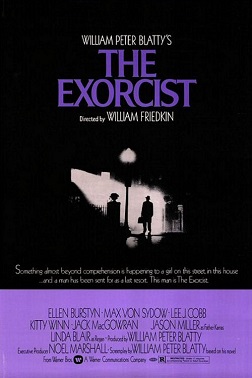
The Exorcist is a 1973 American supernatural horror film directed by William Friedkin from a screenplay by William Peter Blatty, based on his 1971 novel. The film stars Ellen Burstyn, Max von Sydow, Jason Miller, and Linda Blair, and follows the demonic possession of a young girl and the attempt to rescue her through an exorcism by two Catholic priests.
Blatty, who also produced, and Friedkin, his choice as director, had difficulty casting the film. Their choice of relative unknowns Burstyn, Blair, and Miller, instead of major stars, drew opposition from executives at Warner Bros. Principal photography was also difficult. Many cast and crew were injured, some died, and unusual accidents delayed shooting. Production took twice as long as scheduled and cost almost three times the initial budget; the many mishaps have led to a belief that the film was cursed.
The Exorcist was theatrically released in the United States on December 26, 1973, by Warner Bros. Reviews were mixed, but audiences waited in long lines during cold weather; the sold-out shows were even more profitable for Warner Bros., who had booked it into those theaters under four-wall distribution rental agreements, a first for any major studio. Some viewers suffered adverse physical reactions, fainting or vomiting to shocking scenes such as a realistic cerebral angiography. Many children were allowed to see the film, leading to charges that the Motion Picture Association of America (MPAA, now the MPA) had accommodated the studio by giving the film an R rating instead of an X rating to ensure the troubled production its commercial success. Several cities attempted to ban it outright or prevent children from attending. At the end of its original theatrical run, the film grossed $193 million, and has a lifetime gross of $441 million with subsequent re-releases.

The cultural conversation around the film helped it become the first horror film to be nominated for the Academy Award for Best Picture, as well as nine others. Blatty won Best Adapted Screenplay, while the sound engineers took Best Sound. It has had several sequels and was the highest-grossing R-rated horror film (unadjusted for inflation) until 2017's It. The Exorcist significantly influenced pop culture, and it has been included on lists of the greatest films ever made. In 2010, the Library of Congress selected the film for preservation in the United States National Film Registry as being "culturally, historically, or aesthetically significant".
Plot
In northern Iraq, priest Lankester Merrin takes part in an archaeological dig in the ancient ruins of Hatra. During the dig, he finds a stone talisman of a winged being that evokes a concerned look on his face. He then visits an ancient statue of the same being, silently confronting it.
In Georgetown, Washington, D.C., actress Chris MacNeil is starring in a film directed by her friend Burke Dennings. Chris, along with her 12-year-old daughter Regan MacNeil, rents a luxurious house with hired help. Meanwhile, Father Damien Karras, a psychiatrist who counsels Georgetown University priests, visits his ailing mother in New York City. He later confides to a colleague that he is having a crisis of faith.
Chris hosts a party with Karras's friend, Father Joseph Dyer, who explains Karras's role as counselor and notes his mother's recent death. Regan, seemingly unwell, appears and urinates before Chris comforts her. Regan's bed shakes violently after Chris returns her to it. Later, Dyer consoles Karras, guilty at not having been with his mother when she died.
Regan's personality becomes violent, and medical tests find no physical cause. During a house call, Regan exhibits abnormal strength and adult behavior, and speaks in an otherworldly voice. One night, Chris finds the house empty except for a sleeping Regan; Dennings had been left with her but is found dead at the bottom of a set of public stairs that begin beneath Regan's window. Detective William Kinderman questions Karras, confiding that Dennings's head was turned backward. Kinderman tells Chris that the only plausible explanation for Dennings's death is that he was pushed from Regan's window. As Kinderman leaves, a scarred and bloody Regan has another violent fit, furiously masturbating with a crucifix, turning her head backward and speaking in the voice of Dennings. She is confined to her bedroom and strapped to the bed. Now convinced that her daughter is possessed, Chris seeks out Karras, who visits Regan. The possessed Regan claims to be the Devil, and vomits into Karras's face while speaking in tongues. The demon says it will remain in Regan until she is dead. At night, Chris's assistant Sharon Spencer calls Karras to the house, where the words 'help me' appear on Regan's stomach; he concludes that an exorcism is warranted. His superior grants permission on the condition that an experienced priest lead the ritual. Merrin, having performed an exorcism before, is summoned.
Merrin arrives at the house. As the two priests read from the Roman Ritual, the demon curses them. The priests rest and Merrin, shaking, takes nitroglycerin. Karras enters the bedroom where the demon appears as his mother, perturbing Karras despite his denials. Merrin excuses Karras and continues the exorcism by himself. Chris approaches Karras and asks if Regan will die. He assures her that she will not and re-enters the room, finding Merrin dead from a heart attack while Regan watches and laughs. Enraged, Karras beats the possessed Regan and demands that the demon take him instead. The demon rips the medallion of Saint Joseph from Karras's neck and does so, freeing Regan in the process. Unwilling to let the demon harm Regan, Karras sacrifices himself by jumping out the window, tumbling down the stone stairs outside to his death. Chris and Kinderman enter the room. Chris embraces the freed Regan, and Kinderman surveys the scene. Outside, Dyer administers the dying Karras his last rites.

The MacNeils prepare to leave, and Father Dyer says goodbye. Despite having no memory of her ordeal, Regan, moved by the sight of Dyer's clerical collar, kisses him on the cheek. As the MacNeils leave, Chris gives Dyer the medallion found in Regan's room. Dyer briefly examines the steps where Karras died before walking away.
Cast
The demon Pazuzu is portrayed by Mercedes McCambridge (voice), Ron Faber (vocal effects), and Eileen Dietz (face). The demonic "spider walk" was performed by stunt double Ann Miles.
Uncredited members of the cast include writer-producer William Peter Blatty as Fromme, Paul Bateson as a Radiologist's assistant, Elinore Blair (Linda Blair's mother) as a nurse, Dick Callinan as Captain Billy Cutshaw, Barton Lane as an angiographer, and Vincent Russell as the subway vagrant.

Production
Development
Aspects of Blatty's novel were inspired by the 1949 exorcism performed by Jesuit priest William S. Bowdern. It sold poorly until Blatty captivated The Dick Cavett Show's audience with a discussion of whether the devil existed. Soon afterwards the novel topped the New York Times best seller list.
Despite Blatty's previous screenwriting experience on Blake Edwards' films, studios had been uninterested in adapting The Exorcist before publication. Lew Grade made a modest offer for the rights that Blatty said later he would have accepted due to his difficult financial circumstances, but for his requirement that he produce. Shirley MacLaine, a friend of Blatty's, had been interested, but wanted someone other than Blatty to produce. A later agreement to co-produce with Paul Monash, producer of Butch Cassidy and the Sundance Kid, collapsed over script differences and Blatty's discovery that Monash was trying to wrest control of the film.
Writing
Blatty's screenplay follows the plot of his novel closely, but narrows the story's focus. Subplots like the desecration of the churches and the subsequent relationship that develops between Karras and Kinderman, Karras's efforts to convince the Church bureaucracy to approve the exorcism, and the ongoing medical investigations of Regan's condition are less prominent in the film, as are supporting characters including Chris's household staff, Dennings, and Regan's father. The overall time frame is condensed.

Some scenes, particularly those with sexual content, were toned down for the film adaptation since an actress of approximately Regan's age was expected to be cast. The scene where Regan masturbates with a crucifix was, in the book, more prolonged and explicit, with Regan seriously injuring herself yet attaining orgasm. The film also excludes the possessed Regan's constant diarrhea, giving her room a strong, foul odor.
Blatty also made the screenplay unambiguous about Regan's condition. In his novel, every symptom and behavior she exhibits that might indicate possession is counterbalanced with a reference to an actual case where the same phenomena were found to have natural, scientific causes. Aside from Karras' initial professional skepticism, that perspective is absent from the film.
Casting
The lead roles, particularly Regan, were not easily cast. Although many major stars of the era were considered for them, Blatty and Friedkin ultimately went with lesser-known actors, to the studio's consternation.
Chris and Father Karras
Jack Nicholson was considered for Karras, and Paul Newman was interested, before Blatty hired Stacy Keach. Three A-list actresses of the time—Audrey Hepburn, Anne Bancroft and Jane Fonda—were considered for Chris, but rejected the part. Friedkin also rejected Blatty's friend Shirley MacLaine since she had starred in The Possession of Joel Delaney, a similar film. After meeting Carol Burnett, Friedkin believed she had the range beyond her comic television persona. Blatty agreed, but the studio turned her down. Ellen Burstyn received the part after she told Friedkin she was "destined" to play Chris, discussing the Catholic upbringing she had later rejected. Studio head Ted Ashley vigorously opposed casting her, but relented after no other alternatives emerged.
Friedkin had first spoken to stage actor and playwright Jason Miller after a performance of his play That Championship Season, and given him a copy of the novel. Miller had received a Catholic education and studied to be a Jesuit priest for three years at Catholic University of America until experiencing a spiritual crisis similar to Karras's. Upon reading the novel, he told Friedkin "[Karras] is me". Friedkin responded that Keach had already been signed, but granted his request for a screen test. During the test, Miller and Burstyn performed the scene where Chris informs Karras that she suspects Regan might be possessed. He then filmed Burstyn interviewing Miller about his life and asked him to recite Mass as if for the first time. After viewing the footage the next morning, Friedkin realized that Miller's "dark good looks, haunted eyes, quiet intensity, and low, compassionate voice" were exactly what the part needed. The studio then bought out Keach's contract.
Regan
Directors considered for The Exorcist doubted a young actress could carry the film; Mike Nichols had turned it down for that reason, but would later regret it. The first actresses considered had been in other successful films and television series. Pamelyn Ferdin was turned down as too familiar. Denise Nickerson, who had played Violet Beauregarde in Willy Wonka & the Chocolate Factory, said in later interviews her family found the script too dark. Janet Leigh would not let her daughter, Jamie Lee Curtis, audition. Friedkin was considering older actresses until Elinore Blair came in unannounced with her daughter Linda, whose credits were primarily in modeling and a single soap opera role. Friedkin later recalled her as "[S]mart but not precocious ... cute but not beautiful. A normal, happy 12-year-old girl". He asked if she knew what The Exorcist was about; she told him she had read the book. "[I]t's about a little girl who gets possessed by the devil and does a whole bunch of bad things." Friedkin then asked her what she meant. "[S]he pushes a man out of her bedroom window and she hits her mother across the face and she masturbates with a crucifix." Friedkin then asked Linda if she knew what masturbation meant. "It's like jerking off, isn't it?", and she giggled a little bit. "Have you ever done that?" he asked. "Sure; haven't you?" she responded.
Blair was cast after tests with Burstyn. "After all these difficult scenes she'd tiptoe around and giggle, after every bit", Blatty recalled. Friedkin said "there wasn't one other [actress] I would have considered". He had planned to use Blair's electronically treated voice for Pazuzu's dialogue, but decided that a more androgynous voice was better, and cast experienced voice actress Mercedes McCambridge. McCambridge ate raw eggs, drank whiskey and chainsmoked cigarettes to make Pazuzu's voice sound as intimidating as possible. After filming, the studio did not credit her, until Screen Actors Guild arbitration. McCambridge's name was included in the credits on all but the first 30 prints, but the dispute prevented the release of a soundtrack album with excerpts of dialogue. Warner Bros. reportedly forced Friedkin to use Eileen Dietz, then Blair's senior of 15 years, as Blair's stunt double. She stood in for Blair in the crucifix scene, the fistfight with Father Karras, and others too violent or disturbing for Blair to perform. She recalled that Friedkin gave her no notes and said, "I wasn't playing a little girl, I was playing the demon that possessed a little girl." Dietz appears on camera as the face of Pazuzu. Blair, who recalls Friedkin telling her the film would not succeed if she was not in as many shots as possible, estimates that Dietz is in 17 seconds of the film. Dietz, angry that her contribution to the film had been minimized, claimed in the media to have performed all the possession scenes. The studio ultimately measured her screen presence at 28.25 seconds, but denied that her contribution was dramatically significant.
Supporting roles
Warner Bros. wanted Marlon Brando for the role of Lankester Merrin, but Friedkin refused. A Philippe Halsman photograph of Pierre Teilhard de Chardin, one of Blatty's inspirations for Father Merrin, inspired Friedkin to cast Max von Sydow instead of Paul Scofield, whom Blatty had wanted.
The film's supporting roles were cast more quickly. At a play, Blatty and Friedkin ran into Lee J. Cobb, who was cast as Lt. Kinderman. Two priests were cast. Father William O'Malley, who had become acquainted with Blatty through his criticism of the novel, was cast as Father Dyer, whom he had considered clichéd in the novel. The Rev. Thomas Bermingham, a Georgetown professor who had assigned Blatty research on demonic possession as a student, took the role of the university president.
Jack MacGowran got the role of Dennings, which, earlier in the production, seemed to be going to J. Lee Thompson. A later cast listing adds Mary Boylan and The Rev. John Nicola, one of the film's technical advisors, in small roles. Greek actor Titos Vandis, cast as Karras's uncle, covered his face with a hat to avoid associations with his role in the recent Woody Allen film Everything You Always Wanted to Know About Sex* (*But Were Afraid to Ask). Friedkin cast Vasiliki Maliaros as Karras's mother after reportedly encountering her in a Greek restaurant.
Direction
In addition to Nichols, many directors were considered, including Arthur Penn, Stanley Kubrick, John Boorman and Peter Bogdanovich. The studio finally hired Mark Rydell, but Blatty insisted on Friedkin, with whom he was acquainted, as he had been impressed by his film The French Connection. Blatty saw Friedkin, an acquaintance, as "a director who can bring the look of documentary realism to this incredible story, and ... is never going to lie to me." The studio demurred, until Connection was released to commercial success and a Best Picture Academy Award.
During his press tour for Connection, Friedkin began reading a copy of the novel Blatty sent him. After the first 20 pages he canceled his dinner plans and finished the book, finding the story so gripping that he did not consider any problems adapting it to film. Friedkin felt that the film should unfold slowly, with audiences seeing everything that happened to Regan and the unsuccessful attempts at treating her condition. An early clash during production led to Warner Bros. telling Blatty he could not take any action against Friedkin. Afterwards, Blatty informed the studio he could no longer have any responsibility for controlling the budget; while he and Friedkin reconciled, production costs soon exceeded the initial $4.2 million ($23.8 million in 2024) budget.
Friedkin manipulated the actors to get genuine reactions. Unsatisfied with O'Malley's performance as Dyer ministers to the dying Karras at the end of the film, he slapped him hard across the face to generate a deeply solemn yet literally shaken reaction for the scene, offending many Catholic crew members. He also fired blanks without warning to elicit shock from Miller for a take; Dietz recalls him also doing this during the scene where Regan assaults the doctors at the house. Friedkin also told Miller that the vomit, porridge colored to resemble pea soup and pumped through a hidden tube, would hit him in the chest during the projectile vomiting scene, and rehearsed it that way. But when filmed, the soup hit his face, resulting in his disgusted reaction.
Crewmembers found Friedkin difficult to work with. On the first day of shooting, he had a wall removed to create space for the dolly to back up from a shot of bacon frying, then sent the prop master to look for preservative-free bacon, difficult to find at the time, since he did not like the way it curled. Another crewmember recalled returning after three days of sick leave to find Friedkin still shooting the same scene. Dietz recalls the main delay being reshoots, even of scenes that had been difficult to stage and film the first time, such as Regan's bed shaking. "People were literally placing bets on what he would reshoot next." He also fired and rehired crew regularly. One crewmember recalls seeing Friedkin shake hands warmly with someone, and then seconds later tell a second person to "get this guy outta here", earning him the nickname "Wacky Willy".
Cinematography
Owen Roizman, director of photography on The French Connection, worked in this position again on The Exorcist. He was in charge of filming every scene except for the Iraqi prolog, shot by Billy Williams. Roizman and Friedkin wanted The Exorcist, like their previous film, to appear to have been shot in available light. The MacNeil house was, unlike house interiors in horror films such as Psycho, designed to look normal and inviting, but lit to suggest an ominous presence. Otherwise, Roizman said, Friedkin "demanded complete realism" and "wanted to see pictures with glass in them, mirrors on the walls and all of the other highly reflective surfaces you would naturally find in a house[;] we never tried to cover anything up, as we would normally do for expedience in shooting." This meant that the kitchen set, with much stainless steel and glass, was "virtually impossible" to light beyond the practical ceiling fixtures and whatever other lights they could manage to sneak in and hide. "[W]e'd walk in, hit the switch and shoot—through not much choice."
Filming and locations
Principal photography began August 14, 1972. Although the film is set in Washington, D.C., many interior scenes were shot in New York City. The MacNeil residence interiors were filmed at CECO Studios in Manhattan, with Karras's confrontation with his uncle, shot at Goldwater Memorial Hospital, now the site of Cornell Tech, on Roosevelt Island in the East River between Manhattan and Queens; the scenes with Karras's mother in the hospital were filmed at Bellevue. The scene where Father Karras listens to the tapes of Regan was filmed in the basement of Fordham University's Keating Hall, where O'Malley was an assistant professor of theology.
The film's opening sequences were filmed in and near Mosul, Iraq, at a time when the US and Iraq did not have diplomatic relations; Warner Bros. feared that Friedkin and his crew might not be able to return. He negotiated filming arrangements directly with local officials of the ruling Ba'ath Party, who required that he hire local workers as crew and teach filmmaking to interested residents. The archaeological dig site shown is Hatra, south-west of Mosul. Temperatures during the days reached 130 °F (54 °C), limiting shooting to dawn and dusk.
The exterior of the MacNeil house was a family home on 36th and Prospect streets in Washington. A mansard roof was added to account for the attic scene. The neighboring stairs were padded with a half-inch (13 mm) of rubber for Karras's death. The house was set back slightly from the steps, so the crew built an eastward extension with a false front to allow the stunt double playing Karras to fall directly down.
Many Georgetown locations, on and off-campus, were used. Burstyn's first scene, where she lectures the protesters, was shot on the steps of Healy Hall; she is also seen walking down the steps of Lauinger Library. Other scenes used the interiors of Dahlgren Chapel and the university president's office, used as the archbishop's office. One scene was filmed in The Tombs, a popular local pub.
Exorcism scenes
The exorcism scenes were challenging to film. Friedkin wanted the bedroom set to be cold enough to see the actors' breath, as described in the novel. A $50,000 ($284,000 in 2024) refrigeration system was installed to cool the set to −20 °F (−29 °C). Since the set lighting warmed the air, it remained cold enough to film for only three minutes at a time. Due to frequent breakdowns, only five shots could be finished each day; the complete scene, filmed in script order, took a month to complete.
It was easier to film some of the other supernatural manifestations, such as the bed rocking and the curtains blowing since the walls and ceiling of the set were capable of being moved to accommodate a camera. After the scene where the ceiling cracks it was replaced with one attached to the walls, requiring a hole be cut in it for the rig to go through when Regan levitates, the most challenging shot in the sequence. The 80-pound (36 kg) Blair wore a bodysuit under her nightgown with attached hooks for monofilament wires.
Roizman had filmed similar scenes before, painting the wires to match the background so they would not show. This was difficult on The Exorcist because of the changes in background. "We had to practically paint them frame by frame", he said. While most directors would have been satisfied to smooth out the scene in post-production, Friedkin wanted it done in longer takes.
Friedkin did not want any scenes in the movie to have "any kind of spooky lights that you typically saw in horror films", so all the light in the bedroom comes from a visible source. The room's color scheme also suggested black and white film, with gray taupe walls, Regan's bedding a neutral beige, and the priests in black. According to Roizman, white would have been too dominant. "In toning everything down like this, the only real color in the room became the skin tones", he said.
Father Merrin's arrival scene
Father Merrin's arrival scene was filmed on Max von Sydow's first day on set. The scene where he steps out of a cab and stands in front of the MacNeil residence, silhouetted in a misty streetlamp's glow and staring up at a beam of light from a bedroom window, is one of the most famous scenes in the movie, used for film posters and home media release covers. It was inspired by René Magritte's 1954 painting Empire of Light. Friedkin wanted to evoke visually the language Blatty used in the novel for this scene, likening Merrin to "a melancholy traveler frozen in time", standing next to a streetlight in the fog when he gets out of the cab.
He gave the crew a full day to light the scene, using mainly arc lights and tripod-mounted Troupers, and boosting the brightness of the existing streetlamps. Roizman said this was the most difficult of all the film's nighttime exterior shots. To get the beam of light the way Friedkin wanted it, the crew had to take the window frame out of the facade they had attached to the house for filming, put it behind the window and then put the spotlight in between the window and frame. As they were shooting, Roizman said, the wind picked up, making it hard to hold the fog effect. By working quickly, he and the camera crew were able to get the shot, with Friedkin finding the first take satisfactory.
Head spinning
The scenes where the possessed Regan's head rotates so she appears to be looking directly backward drew notice from audiences and critics. "All I can tell you is that the way you think I did it is not the way we did it", Friedkin told Castle of Frankenstein at the time. Like the film's other special effects, it was performed live. A life-size animated dummy of Regan was built.
Critic Mark Kermode says the scene's impact results from the audience not expecting it so soon after the crucifix scene. He believes its recurrence during the exorcism was added on set since it is in neither the novel nor the screenplay. Blatty had argued against it, telling Friedkin "supernatural doesn't mean impossible". Friedkin inserted a shot of Karras, suggesting the scene might just be a hallucination. When audiences reacted strongly, Blatty said Friedkin "prov[ed] me an idiot once again".
Makeup artist Dick Smith built the latex dummy with help from effects supervisor Marcel Vercoutere. They tested its realism by putting it in the front seat of a taxicab and, when enough people were looking, turning the head. It was so realistic that Blair felt uncomfortable in its presence. They had given the dummy's face the capability to move and appear to speak, adding a condom so its throat would bulge. A tube was added for simulated breathing, which produced the requisite clouds of vapor.
Crucifix scene
While filming the scene where the possessed Regan masturbates with a crucifix, Dietz and Friedkin had "this long discussion about the right way to jerk off and I showed him why a woman has to churn her wrist [more than a man does]." At the time Friedkin said that the scene's power over audiences came from its unusual combination of sex and religion. To many viewers it lasted much longer than its 50 seconds. He had filmed much more, but ultimately decided that it was about "how much [he] could take".