
The Bahamas, officially the Commonwealth of The Bahamas, is an archipelagic country in the Caribbean located within the Lucayan Archipelago in the Atlantic Ocean. The country comprises 700 islands, and more than 2,500 cays in the Atlantic Ocean, located north of Cuba and north-west of the island of Hispaniola (split between the Dominican Republic and Haiti) and the Turks and Caicos Islands, southeast of the US state of Florida and east of the Florida Keys. The capital and largest city is Nassau on the island of New Providence. The Royal Bahamas Defence Force describes the Bahamas' territory as encompassing 470,000 km2 (180,000 sq mi) of ocean space.
The Bahama islands were inhabited by the Arawak and Lucayans, a branch of the Arawakan-speaking Taíno, for many centuries. Christopher Columbus was the first European to see the islands, making his first landfall in the New World in 1492 when he landed on the island of San Salvador (which the Lucayans called Guanahaní). Later, the Kingdom of Spain shipped the native Lucayans to Hispaniola and enslaved them there, leaving the Bahama islands mostly deserted from 1513 until 1648. In 1649, English colonists from Bermuda, known as the Eleutheran Adventurers, settled on the island of Eleuthera.
The Bahamas became a crown colony of the Kingdom of Great Britain in 1718 when the British clamped down on piracy. After the American Revolutionary War, the Crown resettled thousands of American Loyalists to the Bahamas; they took slaves with them and established plantations on land grants. African slaves and their descendants constituted the majority of the population from this period on. The slave trade was abolished by the British in 1807. Slavery in the Bahamas was not abolished until 1834, but in 1818 the Bahamas became a haven of manumission for African slaves from outside the British West Indies. Africans liberated from illegal slave ships were resettled on the islands by the Royal Navy, while some North American slaves and Seminoles escaped to the Bahamas from Florida. During this period, Bahamians were known to recognise the freedom of slaves carried by the ships of other nations which reached their country. Today Black Bahamians make up 90 per cent of the population of 400,516.

The Bahamas became an independent Commonwealth realm separate from the United Kingdom in 1973. Its first prime minister was Lynden Pindling. The Bahamas maintains King Charles III as its monarch; the appointed representative of the Crown is the governor-general of the Bahamas. The Bahamas has the fourteenth-largest gross domestic product per capita in the Americas. Its economy is based on tourism and offshore finance. Though the Bahamas is in the Lucayan Archipelago, and not in the Caribbean Sea, it is still considered part of the wider Caribbean region. The Bahamas is a full member of the Caribbean Community (CARICOM), but is not part of the CARICOM Single Market and Economy.
Naming and etymology
The name Bahamas is derived from the Lucayan name Bahama ('large upper middle island'), used by the Indigenous Lucayan people for the island of Grand Bahama. Bahama referred to Grand Bahama alone when first attested on the c. 1523 Turin Map, but was used in English for the archipelago as a whole by 1670.
Tourist guides often state that the name comes from the Spanish baja mar ('shallow sea'). Wolfgang Ahrens of York University argues that this is a folk etymology. Alternatively, Bahama may have been derived from Guanahaní, a local name of unclear meaning. Isaac Taylor, a toponymist, argues that the name was derived from Bimani (Bimini), which Spaniards in Haiti identified with Palombe, a legendary place where John Mandeville's Travels said there was a fountain of youth.

The Bahamas is one of two countries whose official short name starts with the definite article, the other being The Gambia.
History
Pre-Hispanic era
The first inhabitants of the Bahamas were Indigenous people Taíno, who moved into the uninhabited southern islands from Hispaniola and Cuba sometime between AD 500 and 800, having migrated there from mainland South America; they came to be known as the Lucayan people. An estimated 30,000 Lucayans inhabited the Bahamas at the time of Christopher Columbus' arrival in 1492.
Arrival of the Spanish
Columbus' first landfall in what was to Europeans a "New World" was on an island he named San Salvador (known to the Lucayans as Guanahani). While there is a general consensus that this island lay within the Bahamas, precisely which island Columbus landed on is a matter of scholarly debate. Some researchers believe the site to be present-day San Salvador Island (formerly known as Watling's Island), situated in the southeastern Bahamas, whilst an alternative theory holds that Columbus landed to the southeast on Samana Cay, according to calculations made in 1986 by National Geographic writer and editor Joseph Judge, based on Columbus' log. On the landfall island, Columbus made first contact with the Lucayans and exchanged goods with them, claiming the islands for the Crown of Castile, before proceeding to explore the larger isles of the Greater Antilles.

The 1494 Treaty of Tordesillas theoretically divided the new territories between the Kingdom of Castile and the Kingdom of Portugal, placing the Bahamas in the Spanish sphere; however, they did little to press their claim on the ground. The Spanish did, however, exploit the Native Lucayan peoples, many of whom were enslaved and sent to Hispaniola for use as forced labour. The slaves suffered harsh conditions and most died from contracting diseases to which they had no immunity; half of the Lucayans died from smallpox alone. As a result of these depredations the population of the Bahamas was severely diminished.
Arrival of the English
The English had expressed an interest in the Bahamas as early as 1629. However, it was not until 1648 that the first English settlers arrived on the islands. Known as the Eleutherian Adventurers and led by William Sayle, they migrated from Bermuda seeking greater religious freedom. These English Puritans established the first permanent European settlement on an island which they named Eleuthera, Greek for free. They later settled New Providence, naming it Sayle's Island. Life proved harder than envisaged however, and many – including Sayle – chose to return to Bermuda. To survive, the remaining settlers salvaged goods from wrecks.
In 1670 King Charles II granted the islands to the Lords Proprietors of the Carolinas in North America. They rented the islands from the king with rights of trading, tax, appointing governors, and administering the country from their base on New Providence. Piracy and attacks from hostile foreign powers were a constant threat. In 1684 the Spanish corsair Juan de Alcon raided the capital Charles Town (later renamed Nassau), and in 1703 a joint Franco-Spanish expedition briefly occupied Nassau during the War of the Spanish Succession.

18th century
During proprietary rule the Bahamas became a haven for pirates, including Blackbeard (circa 1680–1718). To put an end to the "Pirates' republic" and restore orderly government, Britain made the Bahamas a crown colony in 1718, which they dubbed "the Bahama islands" under the governorship of Woodes Rogers. After a difficult struggle he succeeded in suppressing piracy. In 1720 the Spanish attacked Nassau during the War of the Quadruple Alliance. In 1729 a local assembly was established giving a degree of self-governance for British settlers. The reforms had been planned by the previous Governor George Phenney and authorised in July 1728.
During the American War of Independence in the late 18th century, the islands became a target for US naval forces. Under the command of Commodore Esek Hopkins, US Marines, the US Navy occupied Nassau in 1776, before being evacuated a few days later. In 1782 a Spanish fleet appeared off the coast of Nassau, and the city surrendered without a fight. Later, in April 1783, on a visit made by Prince William of the United Kingdom (later King William IV) to Luis de Unzaga at his residence in the Captaincy General of Havana, they made prisoner exchange agreements and also dealt with the preliminaries of the Treaty of Paris (1783), in which the recently conquered Bahamas would be exchanged for East Florida, which would still have to conquer the city of St. Augustine, Florida in 1784 by order of Luis de Unzaga; after that, also in 1784, the Bahamas would be declared a British colony.
After US independence, the British resettled some 7,300 Loyalists with their African slaves in the Bahamas, including 2,000 from New York and at least 1,033 Europeans, 2,214 African descendants, and a few Native American Creeks from East Florida. Most of the refugees resettled from New York had fled from other colonies, including West Florida, which the Spanish captured during the war. The government granted land to the planters to help compensate for losses on the continent. These Loyalists, who included Deveaux and also Lord Dunmore, established plantations on several islands and became a political force in the capital. European Americans were outnumbered by the African-American slaves they brought with them, and ethnic Europeans remained a minority in the territory

19th century
The Slave Trade Act 1807 abolished slave trading to British possessions, including the Bahamas. The United Kingdom pressured other slave-trading countries to also abolish slave-trading, and gave the Royal Navy the right to intercept ships carrying slaves on the high seas. Thousands of Africans liberated from slave ships by the Royal Navy were resettled in the Bahamas.
In the 1820s during the period of the Seminole Wars in Florida, hundreds of North American slaves and African Seminoles escaped from Cape Florida to the Bahamas. They settled mostly on northwest Andros Island, where they developed the village of Red Bays. From eyewitness accounts, 300 escaped in a mass flight in 1823, aided by Bahamians in 27 sloops, with others using canoes for the journey. This was commemorated in 2004 by a large sign at Bill Baggs Cape Florida State Park. Some of their descendants in Red Bays continue African Seminole traditions in basket making and grave marking.
In 1818 the Home Office ruled that "any slave brought to the Bahamas from outside the British West Indies would be manumitted." This led to a total of nearly 300 enslaved people owned by US nationals being freed from 1830 to 1835. The American slave ships Comet and Encomium used in the United States domestic coastwise slave trade, were wrecked off Abaco Island in December 1830 and February 1834, respectively. When wreckers took the masters, passengers and slaves into Nassau, customs officers seized the slaves and British colonial officials freed them, over the protests of the Americans. There were 165 slaves on the Comet and 48 on the Encomium. The United Kingdom finally paid an indemnity to the United States in those two cases in 1855, under the Treaty of Claims of 1853, which settled several compensation cases between the two countries.
Slavery was abolished in the British Empire on 1 August 1834. After that British colonial officials freed 78 North American slaves from the Enterprise, which went into Bermuda in 1835; and 38 from the Hermosa, which wrecked off Abaco Island in 1840. The most notable case was that of the Creole in 1841: as a result of a slave revolt on board, the leaders ordered the US brig to Nassau. It was carrying 135 slaves from Virginia destined for sale in New Orleans. The Bahamian officials freed the 128 slaves who chose to stay in the islands. The Creole case has been described as the "most successful slave revolt in U.S. history".
These incidents, in which a total of 447 enslaved people belonging to US nationals were freed from 1830 to 1842, increased tension between the United States and the United Kingdom. They had been co-operating in patrols to suppress the international slave trade. However, worried about the stability of its large domestic slave trade and its value, the United States argued that the United Kingdom should not treat its domestic ships that came to its colonial ports under duress as part of the international trade. The United States worried that the success of the Creole slaves in gaining freedom would encourage more slave revolts on merchant ships.
During the American Civil War of the 1860s, the islands briefly prospered as a focus for blockade runners aiding the Confederate States.
Early 20th century
The early decades of the 20th century were ones of hardship for many Bahamians, characterised by a stagnant economy and widespread poverty. Many eked out a living via subsistence agriculture or fishing.
In August 1940 the Duke of Windsor (formerly King Edward VIII) was appointed Governor of the Bahamas. He arrived in the colony with his wife, Wallis, Duchess of Windsor. Although disheartened at the condition of Government House, they "tried to make the best of a bad situation". He did not enjoy the position, and referred to the islands as "a third-class British colony". He opened the small local parliament on 29 October 1940. The couple visited the "Out Islands" that November, on Axel Wenner-Gren's yacht, which caused controversy; the British Foreign Office strenuously objected because they had been advised by United States intelligence that Wenner-Gren was a close friend of the Luftwaffe commander Hermann Göring of Nazi Germany.
The Duke was praised at the time for his efforts to combat poverty on the islands. A 1991 biography by Philip Ziegler, however, described him as contemptuous of the Bahamians and other non-European peoples of the Empire. He was praised for his resolution of civil unrest over low wages in Nassau in June 1942, when there was a "full-scale riot". Ziegler said that the Duke blamed the trouble on "mischief makers – communists" and "men of Central European Jewish descent, who had secured jobs as a pretext for obtaining a deferment of draft". The Duke resigned from the post on 16 March 1945.
Post-Second World War
Modern political development began after the Second World War. The first political parties were formed in the 1950s, split broadly along ethnic lines, with the United Bahamian Party (UBP) representing the English-descended Bahamians (known informally as the "Bay Street Boys") and the Progressive Liberal Party (PLP) representing the Black-Bahamian majority.
A new constitution granting the Bahamas internal autonomy went into effect on 7 January 1964, with Chief Minister Sir Roland Symonette of the UBP becoming the first premier. In 1967 Sir Lynden Pindling of the PLP became the first black premier of the Bahamian colony; in 1968 the title of the position was changed to prime minister. In 1968 Pindling announced that the Bahamas would seek full independence. A new constitution giving the Bahamas increased control over its own affairs was adopted in 1968. In 1971, the UBP merged with a disaffected faction of the PLP to form a new party, the Free National Movement (FNM), a centre-right party which aimed to counter the growing power of Pindling's PLP.
Her Majesty's Government gave the Bahamas its independence by an Order in Council dated 20 June 1973. The Order came into force on 10 July 1973, on which date Charles, Prince of Wales, delivered the official documents to Pindling, the prime minister. July 10 is now celebrated as Independence Day. It joined the Commonwealth of Nations on the same day. Sir Milo Butler was appointed the first governor-general of the Bahamas (the official representative of Queen Elizabeth II) shortly after independence.
Post-independence
Shortly after independence, the Bahamas joined the International Monetary Fund and the World Bank on 22 August 1973, and later the United Nations on 18 September 1973.
Politically, the first two decades were dominated by Pindling's PLP, who went on to win a string of electoral victories. Allegations of corruption, links with drug cartels and financial malfeasance within the Bahamian government failed to dent Pindling's popularity. Meanwhile, the economy underwent a dramatic growth period fuelled by the twin pillars of tourism and offshore finance, significantly raising the standard of living on the islands. The Bahamas' booming economy led to it becoming a beacon for immigrants, most notably from Haiti.
In 1992, Pindling was unseated by Hubert Ingraham of the FNM. Ingraham went on to win the 1997 Bahamian general election, before being defeated in 2002, when the PLP returned to power under Perry Christie. Ingraham returned to power from 2007 to 2012, followed by Christie again from 2012 to 2017. With economic growth faltering, Bahamians re-elected the FNM in 2017, with Hubert Minnis becoming the fourth prime minister.
In September 2019, Hurricane Dorian struck the Abaco Islands and Grand Bahama at Category 5 intensity, devastating the northwestern Bahamas. The storm inflicted at least US$7 billion in damages and killed more than 50 people, with 1,300 people missing after two weeks.
The COVID-19 pandemic reached the Bahamas on 15 March 2020.
At the 2021 general election the governing Free National Movement (FNM) lost to the opposition Progressive Liberal Party (PLP) as the economy struggled to recover from its deepest crash since at least 1971. On 17 September 2021 the chairman of the PLP, Phillip Davis, was sworn in as the new prime minister, succeeding Hubert Minnis.
Geography
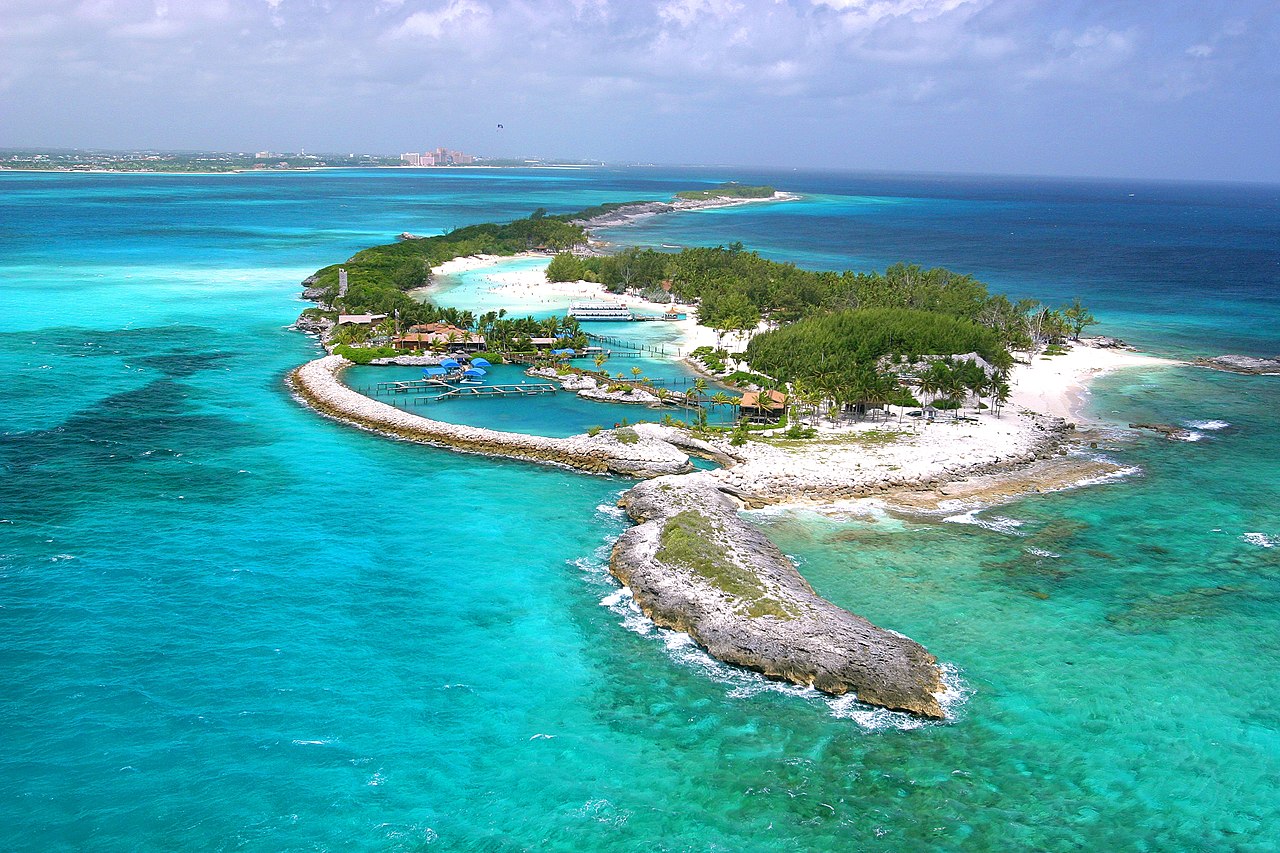
The Bahamas consists of a chain of islands spread out over some 800 km (500 mi) in the Atlantic Ocean, located to the east of Florida in the United States, north of Cuba and Hispaniola and west of the British Overseas Territory of the Turks and Caicos Islands (with which it forms the Lucayan archipelago). It lies between latitudes 20° and 28°N, and longitudes 72° and 80°W and straddles the Tropic of Cancer. There are some 700 islands and 2,400 cays in total (of which 30 are inhabited) with a total land area of 10,010 km2 (3,860 sq mi).
Nassau, capital city of the Bahamas, lies on the island of New Providence; the other main inhabited islands are Grand Bahama, Eleuthera, Cat Island, Rum Cay, Long Island, San Salvador Island, Ragged Island, Acklins, Crooked Island, Exuma, Berry Islands, Mayaguana, the Bimini islands, Great Abaco and Great Inagua. The largest island is Andros.
All the islands are low and flat, with ridges that usually rise no more than 15 to 20 m (49 to 66 ft). The highest point in the country is Mount Alvernia (formerly Como Hill) on Cat Island at 64 m (210 ft).
The country contains three terrestrial ecoregions: Bahamian dry forests, Bahamian pine mosaic, and Bahamian mangroves. It had a 2019 Forest Landscape Integrity Index mean score of 7.35/10, ranking it 44th globally out of 172 countries. In the Bahamas forest cover is around 51 per cent of the total land area, equivalent to 509,860 hectares (ha) of forest in 2020, which was unchanged from 1990. In 2020, naturally regenerating forest covered 509,860 hectares (ha) and planted forest covered 0 hectares (ha). Of the naturally regenerating forest 0 per cent was reported to be primary forest (consisting of native tree species with no clearly visible indications of human activity) and around 0 per cent of the forest area was found within protected areas. For the year 2015, 80 percent of the forest area was reported to be under public ownership while 20 percent was under private ownership.
Climate
According to the Köppen climate classification, the climate of the Bahamas is mostly tropical savannah climate or Aw, with a hot and wet season and a warm and dry season. The low latitude, warm tropical Gulf Stream, and low elevation give the Bahamas a warm and winterless climate.
The wet season of the archipelago runs from May to October. There is only a 7 °C (13 °F) difference between the warmest month and coolest month in most of the Bahama islands. Every few decades low temperatures can fall below 10 °C (50 °F) for a few hours when a severe cold outbreak comes down from the North American mainland, however there has never been a frost or freeze recorded in the Bahamian Islands. There is only one report in recorded history of snow being spotted anywhere in the Bahamas. This occurred in Freeport on 19 January 1977, when snow mixed with rain was visible in the air for a short time. The Bahamas are often sunny and dry for long periods, and average more than 3,000 hours or 340 days of sunlight annually. Much of the natural vegetation is tropical scrub and cactus and succulents are common in landscapes.
Tropical storms and hurricanes occasionally impact the Bahamas. In 1992, Hurricane Andrew passed over the northern portions of the islands, and Hurricane Floyd passed near the eastern portions of the islands in 1999. Hurricane Dorian of 2019 passed over the archipelago at destructive Category 5 strength with sustained winds of 298 km/h (185 mph) and wind gusts up to 350 km/h (220 mph), becoming the strongest tropical cyclone on record to impact the northwestern islands of Grand Bahama and Great Abaco.
Climate change is causing temperature increases in the Bahamas. The average temperature has increased by approximately 0.5 °C since 1960, and the rate of warming is more rapid in warmer seasons. Global temperature rise of 2 °C above preindustrial levels can increase the likelihood of extreme hurricane rainfall by four to five times in the Bahamas. The Bahamas is expected to be highly affected by sea level rise because at least 80 per cent of the total land is below 10 meters elevation. Climate change could also affect the seasonality of outbreaks and transmission of disease in the Bahamas.
Although the country's greenhouse gas emissions are comparatively small (2.94 million tonnes of green house gases emitted in 2023), The Bahamas is reliant on imported fossil fuels for energy generation. The government plans to increase solar energy capacity to 30 per cent of the country's total energy production by 2033. The Bahamas has pledged to reduce its emissions by 30 per cent by 2030, if international support is received.
Geology
It is generally believed that the Bahamas were formed approximately 200 million years ago, when Pangaea started to break apart. In current times, it endures as an archipelago containing over 700 islands and cays, fringed around different coral reefs. The limestone that comprises the Banks has been accumulating since at least the Cretaceous period, and perhaps as early as the Jurassic; today the total thickness under the Great Bahama Bank is over 4.5 kilometres (2.8 miles). As the limestone was deposited in shallow water, the only way to explain this massive column is to estimate that the entire platform has subsided under its own weight at a rate of roughly 3.6 centimetres (2 inches) per 1,000 years.
The Bahamas is part of the Lucayan Archipelago, which continues into the Turks and Caicos Islands, the Mouchoir Bank, the Silver Bank, and the Navidad Bank. The Bahamas Platform, which includes the Bahamas, Southern Florida, Northern Cuba, the Turks and Caicos, and the Blake Plateau, formed about 150 Ma, not long after the formation of the North Atlantic. The 6.4 km (4.0 mi) thick limestones, which predominate in the Bahamas, date back to the Cretaceous. These limestones would have been deposited in shallow seas, assumed to be a stretched and thinned portion of the North American continental crust. Sediments were forming at about the same rate as the crust below was sinking due to the added weight. Thus, the entire area consisted of a large marine plain with some islands. Then, at about 80 Ma, the area became flooded by the Gulf Stream. This resulted in the drowning of the Blake Plateau, the separation of the Bahamas from Cuba and Florida, the separation of the southeastern Bahamas into separate banks, the creation of the Cay Sal Bank, plus the Little and Great Bahama Banks. Sedimentation from the "carbonate factory" of each bank, or atoll, continues today at the rate of about 20 mm (0.79 in) per kyr. Coral reefs form the "retaining walls" of these atolls, within which oolites and pellets form.
Coral growth was greater through the Tertiary, until the start of the ice ages, and hence those deposits are more abundant below a depth of 36 m (118 ft). In fact, an ancient extinct reef exists half a kilometre seaward of the present one, 30 m (98 ft) below sea level. Oolites form when oceanic water penetrate the shallow banks, increasing the temperature about 3 °C (5.4 °F) and the salinity by 0.5 per cent. Cemented ooids are referred to as grapestone. Additionally, giant stromatolites are found off the Exuma Cays.
Sea level changes resulted in a drop in sea level, causing wind blown oolite to form sand dunes with distinct cross-bedding. Overlapping dunes form oolitic ridges, which become rapidly lithified through the action of rainwater, called eolianite. Most islands have ridges ranging from 30 to 45 m (98 to 148 ft), though Cat Island has a ridge 60 m (200 ft) in height. The land between ridges is conducive to the formation of lakes and swamps.
Solution weathering of the limestone results in a "Bahamian Karst" topography. This includes potholes, blue holes such as Dean's Blue Hole, sinkholes, beachrock such as the Bimini Road ("pavements of Atlantis"), limestone crust, caves due to the lack of rivers, and sea caves. Several blue holes are aligned along the South Andros Fault line. Tidal flats and tidal creeks are common, but the more impressive drainage patterns are formed by troughs and canyons such as Great Bahama Canyon with the evidence of turbidity currents and turbidite deposition.