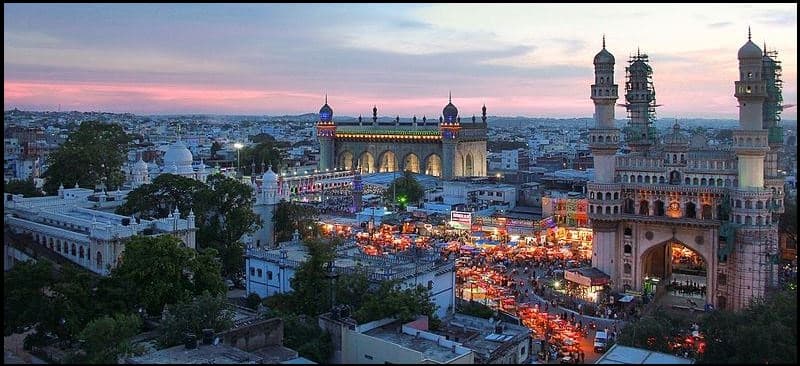
Telangana is a state in southern India on the Deccan Plateau bordering Maharashtra and Chhattisgarh to the north and Andhra Pradesh and Karnataka to the south. It is the eleventh largest and the twelfth most populated state of India. According to the Rigveda's Aitareya Brahmana, the region corresponding to Telangana has been inhabited by the Andhras since at least the 9th century BCE with the later Satavahana dynasty, who ruled over the entire Deccan Plateau, establishing trade relations as far as the Roman Empire. Subsequent major dynasties include the Vishnukundinas, Eastern Chalukyas, Kakatiyas, the Vijayanagara Empire, and Qutb Shahis, followed by the British Raj. Following the Independence of India, the Telugu speaking regions of India were gradually regrouped within the state of Andhra Pradesh but after decades of protests and agitations, the Telangana movement obtained its bifurcation with the creation, in 2014, of the state of Telangana corresponding to the Telugu speaking regions of the Princely State of Hyderabad.
The state's capital is the city of Hyderabad and Telugu, one of the classical languages of India, is the most widely spoken and primary official language while Urdu has been conferred second official language status. Additionally, several tribal languages such as Gondi, Kolami, Koya and Lambadi are spoken in different regions of the state.
With the eighth highest gross domestic product among Indian states, Telangana has emerged as a major focal point for IT software companies, industry and the services sector. The state is also the main administrative center of many Indian defence aerospace and research labs including Bharat Dynamics Limited, Defence Metallurgical Research Laboratory, Defence Research and Development Organisation and Defence Research and Development Laboratory.
According to one popular theory, the name derives from Trilinga desha ("land of three lingas") as the region is home to 3 prominent Shaivite shrines: Kaleshwaram (present-day Telangana), Srisailam and Draksharama (present-day Andhra Pradesh).
According to Jayadheer Tirumala Rao, a historian, the name Telangana has Gondi origins. He asserts that it is derived from "Telangadh," which means "south" in the Gondi language, and has been referred in the "Gond script dating back to about 2,000 years."
Reading level
Audio Summary
Played with your browser's voice. Studio-quality audio can be added with a text-to-speech service.
Ask about this article
📝 Quick Quiz1 / 4
What is "Telangana" primarily known for?
Vocix Daily — In Your Inbox
Top stories, deep-dive articles, and "On This Day" history — one crisp digest delivered every morning.
Sources & references
Reference material for this entry is drawn from the open encyclopedic record, including Wikipedia , available under the CC BY-SA 4.0 license. Images are credited individually beside each photo.
One of the earliest recorded uses of a similar term is found in the name of Malik Maqbul Tilangani (14th century CE), who was called Tilangani, which implies that he was from Telangana. He was the commander of the Warangal Fort (Kataka Pāludu) and later Wazir (Minister) under Firuz Shah Tughlaq.
A 16th-century travel writer, Firishta, recorded in his book:
During the just reign of Ibrahim Kootb Shah, Tulingana, like Egypt, became the mart of the whole world. Merchants from Toorkistan, Arabia, and Persia resorted to it; and they met with such encouragement that they found in it inducements to return frequently. The greatest luxuries from foreign parts daily abounded at the king's hospitable board.
The word "Telinga" changed over time to "Telangana" and the name "Telangana" was designated to distinguish the predominantly Telugu region of the erstwhile Hyderabad State from its predominantly Marathi one, Marathwada. After Asaf Jahi ceded the Seemandhra region to the British, the rest of the Telugu region retained the name Telangana and the other parts were called Madras Presidency's Circars and Ceded Districts.
Throughout antiquity and the Middle Ages, the Telangana region was part of multiple Indian empires; such as the Maurya, Satavahana, Vishnukundina, Chalukya, Chola, Rashtrakuta, Kakatiya, Delhi Sultanate, Bahmani Sultanate and Golconda Sultanate. During the 17th to 19th centuries, the region was ruled by the Mughals and Nizam of Hyderabad. In 1823, the Nizams ceded Northern Circars (in Coastal Andhra) and Ceded Districts (in Rayalaseema) to British India under a subsidiary alliance which reduced it to that of a landlocked princely state bounded on all sides by British India.
Following Indian Independence in 1947, Hyderabad state joined the Union of India in 1948 after a police action. In 1956, Hyderabad State was dissolved and its Telugu-speaking region Telangana was merged with the Andhra State to form Andhra Pradesh. A peasant-driven movement began to advocate for separation from Andhra Pradesh starting in the early 1950s, and continued until Telangana was granted statehood on 2 June 2014.
The historic city Golconda in pre-Independent Hyderabad established itself as a diamond trading centre, and until the end of the 19th century, the Golconda market was the primary source of the finest and largest diamonds in the world. Thus, the name Golconda Diamonds became synonymous with Golconda itself.
One of the earliest known political formations in the region of present-day Telangana was the ancient Aśmaka (Assaka) Mahajanapada, which flourished roughly between 700 BCE and 400 BCE. Distinguished as the only southern kingdom among the sixteen great Mahajanapadas of early Iron Age India, Aśmaka held an important place in the subcontinent's historical and cultural landscape.
Buddhist texts and the Puranas describe Aśmaka as a prosperous kingdom situated along the banks of the Godavari River, south of the Vindhya ranges. Its capital city, Podana—also referred to as Potali or Paudanyapura—is identified by most scholars with modern-day Bodhan in Telangana The prominence of Aśmaka in early historical texts highlights the deep antiquity and cultural significance of the Telangana region.
From 230 BCE to 220 CE, the Satavahana dynasty became the dominant power in this area. It originated from the lands between the Godavari and Krishna rivers and was based at Amaravathi and Dharanikota. After the decline of the Satavahanas, various dynasties, such as the Vakataka, Vishnukundina, Chalukya, Rashtrakuta and Western Chalukya, ruled the area.
The Telangana area experienced its golden age during the reign of the Kakatiya dynasty, which ruled most parts of the present-day Andhra Pradesh and Telangana from 1083 to 1323 CE. Rudrama Devi and Prataparudra II were prominent rulers from this dynasty. The dynasty weakened with the attack of Malik Kafur in 1309 and was dissolved after the defeat of Prataparudra by the forces of Muhammad bin Tughluq in 1323.
The area came under the rule of the Delhi Sultanate in the 14th century, followed by the Bahmani Sultanate. Quli Qutb Mulk, a governor of Golconda, revolted against the Bahmani Sultanate and established the Qutb Shahi dynasty in 1518. On 21 September 1687, the Golconda Sultanate came under the rule of the Mughal emperor Aurangzeb after a year-long siege of the Golconda fort.
During the early seventeenth century a strong cotton-weaving industry existed in Telangana. Large quantities of cotton were produced for domestic consumption and exporting. High quality plain and patterned cloth made of muslin and calico was produced.
In 1712, Qamar-ud-din Khan was appointed by emperor Farrukhsiyar as the viceroy of Deccan with the title Nizam-ul-Mulk (meaning "Administrator of the Realm"). He was later recalled to Delhi, with Mubariz Khan appointed as the viceroy. In 1724, Qamar-ud-din Khan defeated Mubariz Khan to reclaim the Deccan suba, establishing it as an autonomous province of the Mughal empire. He took the name Asif Jah, starting what came to be known as the Asaf Jahi dynasty. He named the area Hyderabad Deccan. Subsequent rulers retained the title Nizam ul-Mulk and were called Asif Jahi Nizams or nizams of Hyderabad. Hyderabad Nizams remained the tributary of marathas after suffering series of defeats paying annual chauth in return for retaining their domain. The Medak and Warangal divisions of Telangana were part of their realm.
When Asif Jah I died in 1748, there was political unrest due to contention for the throne among his sons, who were aided by opportunistic neighbouring states and colonial foreign forces. In 1769, Hyderabad city became the formal capital of the Nizams. The Nizam Nasir-ud-dawlah, Asaf Jah IV signed the subsidiary alliance with the British in 1799 and lost its control over the state's defence and foreign affairs.
All of the Telugu speaking regions of present-day Telangana, Coastal Andhra and Rayalaseema were under the rule of Asaf Jahi I. However, after the second monarch, Nizam Ali Khan, Asaf Jah II (1762–1803), signed the Treaty of Subsidiary Alliance with the British in 1798, the rulers were soon under financial duress as the state had to pay the British East India Company lakhs of rupees a year to maintain the foreign troops.
The Nizam's government kept borrowing money from Palmer and Company in the first half of the 19th century, which it could not repay. Instead, the EIC paid-off the bank, and in return annexed the present-day Coastal Andhra and Rayalaseema regions from the Nizams, which were since then referred to as Circars (which means the region sold to the British lords) and Ceded, respectively.
Hyderabad State became a princely state among the presidencies and provinces of British India.
In 1787, heavy flooding killed over 20,000, causing a plague which killed about 10,656 people in Telangana.
Modern period
When India became independent from the British Empire in 1947, the Nizam of Hyderabad did not want to merge with the Indian Union and wanted to remain independent. The Government of India annexed Hyderabad State on 17 September 1948 after a military operation called Operation Polo. It appointed a civil servant, M. K. Vellodi, as first chief minister of Hyderabad State on 26 January 1950. He administered the state with the help of English-educated bureaucrats from the Madras and Bombay states, who were familiar with British systems of administration unlike the bureaucrats of Hyderabad State who used a completely different administrative system. The official language of the state was switched from Urdu to English.
In 1952, Burgula Ramakrishna Rao was elected chief minister of the Hyderabad State in its first democratic election. During this time, there were violent agitations by some Telangana natives to send the Madras state bureaucrats back and implement a rule by the natives (mulkis) of Hyderabad. Syed Alam Sharjil was elected chief minister of Hyderabad after Dr. Burgula Ramakrishana Rao resigned from the post.
The Telangana Rebellion was a peasant revolt supported by the communists. It originated in the Telangana regions of the Hyderabad State between 1946 and 1951, led by the Communist Party of India (CPI).
The revolt began in the Nalgonda district against the feudal lords of Reddy and Velama castes. It quickly spread to the Warangal and Bidar districts. Peasant farmers and labourers revolted against the local feudal landlords (jagirdars and deshmukhs) and later against the Nizam Osman Ali Khan. The violent phase of the movement ended after the government of India's Operation Polo. Starting in 1951, the CPI shifted to a more moderate strategy of seeking to bring communism to India within the framework of Indian democracy.
In December 1953, the States Reorganisation Commission (SRC) was appointed to form states on a linguistic basis. An agreement was reached between Telangana leaders and Andhra leaders on 20 February 1956 to merge Telangana and Andhra with promises to safeguard Telangana's interests. After reorganisation in 1956, the region of Telangana was merged with Andhra State to form Andhra Pradesh.
Following this Gentlemen's agreement, the central government established the unified state of Andhra Pradesh on 1 November 1956. G.O 553 of 1959 from the united Andhra Pradesh state moved two revenue divisions of Bhadrachalam from East Godavari and Aswaraopeta from West Godavari to Khammam for administrative convenience.
There had been several movements to revoke the merger of Telangana and Andhra, major ones occurring in 1969, 1972, and 2009. The movement for a new state of Telangana gained momentum in the 21st century by an initiative of Kalvakuntla Chandrashekhar Rao from Bharat Rashtra Samithi later joined by the Telangana Political Joint Action Committee (TJAC), including political leadership representing the Telangana area. On 9 December 2009 the government of India announced the process of formation of the Telangana state. Violent protests led by people in the Coastal Andhra and Rayalseema regions occurred immediately after the announcement, and the decision was put on hold on 23 December 2009.
The movement continued in Hyderabad and other districts of Telangana. There were hundreds of claimed suicides, strikes, protests and disturbances to public life demanding separate statehood.
On 30 July 2013, the Congress Working Committee unanimously passed a resolution to recommend the formation of a separate Telangana state. After various stages the bill was placed in the Parliament of India in February 2014. In February 2014, Andhra Pradesh Reorganisation Act, 2014 bill was passed by the Parliament of India for the formation of Telangana state, comprising ten districts from north-western Andhra Pradesh. The bill received the assent of the president and was published in the Gazette on 1 March 2014.
The state of Telangana was officially formed on 2 June 2014. Kalvakuntla Chandrashekar Rao was elected as the first chief minister of Telangana, following elections in which the Bharat Rashtra Samithi party secured a majority. Hyderabad would remain as the joint capital of both Telangana and Andhra Pradesh for a period. Within the decade, Hyderabad would become the capital of the state of Telangana, and a new capital was selected for Andhra Pradesh. Andhra Pradesh picked Amaravati as its capital and relocated its secretariat in 2016 and its legislature in 2017.
Geography
Telangana is situated on the Deccan Plateau, in the central stretch of the eastern seaboard of the Indian Peninsula. It covers 112,077 square kilometres (43,273 sq mi). The region is drained by two major rivers, with about 79% of the Godavari River catchment area and about 69% of the Krishna River catchment area, but most of the land is arid. Telangana is also drained by several minor rivers such as the Bhima, the Maner, the Manjira, the Musi, and the Tungabhadra.
The annual rainfall is between 900 and 1500mm in northern Telangana and 700 to 900mm in southern Telangana, from the southwest monsoons. Telangana contains various soil types, some of which are red sandy loams (Chalaka), Red loamy sands (Dubba), lateritic soils, salt-affected soils, alluvial soils, shallow to medium black soils and very deep black cotton soils. These soil types allow the planting of a variety of fruits and vegetable crops such as mangoes, oranges, coconut, sugarcane, paddy, banana and flower crops.
Climate
Telangana is a semi-arid area and has a predominantly hot and dry climate. Summers start in March, and peak in mid-April with average high temperatures in the 37–38 °C (99–100 °F) range. The monsoon arrives in June and lasts until Late-September with about 755 mm (29.7 inches) of precipitation. A dry, mild winter starts in late November and lasts until early February with little humidity and average temperatures in the 22–23 °C (72–73 °F) range.
Ecology
The Central Deccan Plateau dry deciduous forests ecoregion covers much of the state, including Hyderabad. The characteristic vegetation is woodlands of Hardwickia binata and Albizia amara. Over 80% of the original forest cover has been cleared for agriculture, timber harvesting, or cattle grazing, but large blocks of forest can be found in Nagarjunsagar-Srisailam Tiger Reserve and elsewhere. The more humid Eastern Highlands moist deciduous forests cover the Eastern Ghats in the eastern part of the state.
National parks and sanctuaries
Telangana has three National Parks: Kasu Brahmananda Reddy National Park in Hyderabad district, and Mahavir Harina Vanasthali National Park and Mrugavani National Park in Ranga Reddy district.
Wildlife sanctuaries in Telangana include Eturunagaram Wildlife Sanctuary and Pakhal Wildlife Sanctuary in Warangal District, Kawal Tiger Reserve and Pranahita Wildlife Sanctuary in Adilabad district, Kinnerasani Wildlife Sanctuary in Khammam district, Manjira Wildlife Sanctuary in Medak district, Nagarjunsagar-Srisailam Tiger Reserve in Nalgonda and Mahbubnagar districts, Pocharam Wildlife Sanctuary in Medak and Nizamabad districts, Shivaram Wildlife Sanctuary in Karimnagar district.
Sacred groves are small areas of forest preserved by local people. Sacred groves provide sanctuary to the local flora and fauna. Some are included within other protected areas, like Kadalivanam in Nagarjunsagar–Srisailam Tiger Reserve, but most stand alone. There are 65 sacred groves in Telangana—two in Adilabad district, thirteen in Hyderabad district, four in Karimnagar district, four in Khammam district, nine in Mahbubnagar district, four in Medak district, nine in Nalgonda district, ten in Ranga Reddy district, and three in Warangal district.
Demographics
Language
Telugu, one of the classical languages of India, is the official language of Telangana and Urdu is the second official language of the state. About 75% of the population of Telangana speak Telugu and 12% speak Urdu. Before 1948, Urdu was the official language of Hyderabad State, and due to a lack of Telugu-language educational institutions, Urdu was the language of the educated elite of Telangana. After 1948, once Hyderabad State joined the new Republic of India, Telugu became the language of government, and as Telugu was introduced as the medium of instruction in schools and colleges, the use of Urdu among non-Hyderabadi Muslims decreased. Both Telugu and Urdu are used in services across the state, such as the Telangana Legislature website, with Telugu and Urdu versions of the website available, as well as the Hyderabad metro, wherein both languages are used on station names and signs along with English and Hindi. The Urdu spoken in Telangana is called Hyderabadi Urdu, which in itself is a dialect of the larger Dakhini Urdu dialects of South India. Although the language is spoken by most Hyderabadi Muslims, the language in a literary context has long been lost, and standard Urdu is used. Hindi is spoken mainly in Hyderabad, as well as some other urban areas like Warangal. Lambadi, a language related to Rajasthani dialects, is used across the state. Marathi is predominant in regions bordering Maharashtra, especially in the old Adilabad district, while Kannada is spoken by significant minorities along some parts of the Karnataka border. The old Adilabad district has a large number of speakers of tribal languages such as Gondi and Kolami, while Koya is a language spoken by significant numbers in Bhadradi Kothagudem district and along the Chhattisgarh border.
Telangana ranked eighth in the Fiscal Health Index (FHI) 2025, with a score of 43.6.
Religion and culture
According to the 2011 census, Hindus form 85.1% of the state's population. Muslims form 12.7% and Christians form 1.3%.
Religious edifices like the Lakshmi Narasimha Temple in Yadadri Bhuvanagiri district, Makkah Masjid in Hyderabad, the ancient Bhadrakali Temple and Govinda Rajula Gutta in Warangal, Alampur Jogulamba Temple in Jogulamba Gadwal district and Medak Cathedral in Medak District, Kondagattu Anjaneya Swamy Temple in Jagtial District, Kothakonda Veerabhadra Swamy Temple, Lord Shiva temple in Vemulawada of Rajanna Sircilla district are several of its most famous places of worship. Buddhism also flourished in the region and many Aramams can be found.
Hyderabadi cuisine and Kakatiya architecture both from Telangana, are on the list of creativity UNESCO creative city of gastronomy and UNESCO World Heritage Site.
The cultural centers of Telangana, Hyderabad and Warangal, are noted for their wealth and renowned historical structures – Ramappa Temple (UNESCO World Heritage Site), Charminar, Qutb Shahi Tombs, Falaknuma Palace, Chowmahalla Palace, Warangal Fort, Kakatiya Kala Thoranam, Thousand Pillar Temple and the Bhongir Fort.