
The Takarazuka Revue (Japanese: 宝塚歌劇団, Hepburn: Takarazuka Kagekidan) is a Japanese all-female musical theatre troupe based in Takarazuka, Hyōgo Prefecture, Japan. Women play all roles in lavish, Broadway-style productions of musicals and stories adapted from films, novels, shōjo manga, and Japanese folktales. The Takarazuka Revue Company is a wholly owned subsidiary of the Hankyu Railway company; all members of the troupe are employed by Takarazuka Revue.
History
The Takarazuka Revue was founded by Ichizō Kobayashi, an industrialist-turned-politician and president of Hankyu Railways, in Takarazuka, Japan in 1913. The city was the terminus of a Hankyu line from Osaka and already a popular tourist destination because of its hot springs. Kobayashi believed that it was the ideal spot to open an attraction of some kind that would boost train ticket sales and draw more business to Takarazuka. Since Western song and dance shows were becoming more popular and Kobayashi considered the kabuki theater to be old and elitist, he decided that an all-female theater group might be well received by the general public.
The Revue had its first performance in 1914. Ten years later, the company had become popular enough to obtain its own theater in Takarazuka, called the Dai Gekijō, meaning "Grand Theater". In 1934, the company opened the Tokyo Takarazuka Theater, which then underwent a renewal in 2001. Each Grand Theater show will typically perform for one month in the Takarazuka Grand Theater before a three-week break, followed by a one-month run in the Tokyo Theater. In 1978, the Bow Hall Theater was opened within the same complex as the Grand Theater. Seating 500, the Bow Hall features smaller shows that run for just over a week, and which often lack the grandiosity of Grand Theater shows. Currently, Takarazuka performs for 2 million people each year.

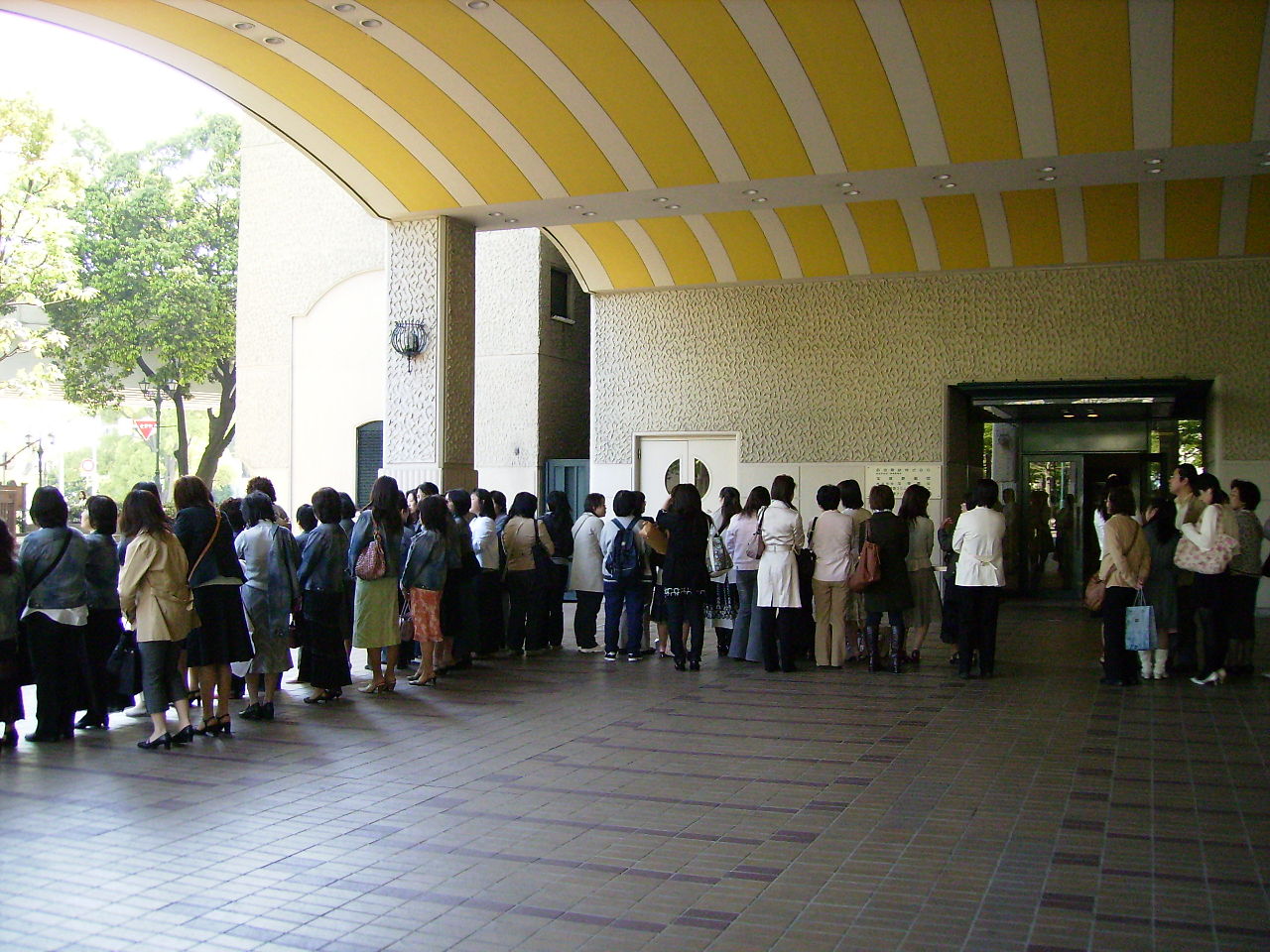
Tickets are famously difficult to acquire, though are not considered to be incredibly expensive – the cheapest ticket available for a Grand Theater performance is 3500 yen, and the most expensive is 12,500 yen. All tickets for Bow Hall performances are 6500 yen, regardless of seat assignment.
Part of the novelty of Takarazuka is that all the parts are played by women, based on the original model of kabuki before 1629 when women were banned from the theater in Japan. The women who play male parts are referred to as otokoyaku (男 役, "male role") and those who play female parts are called musumeyaku (娘 役, "girl role"). Collectively, the Takarazuka performers are called "Takarasiennes" (Takarajennu). This name derives from the revue's fondness of the French revues and the word "Parisienne".
The costumes, set designs, and lighting are lavish and the performances melodramatic. Side pathways extend the already-wide proscenium accommodating elaborate processions and choreography. Regardless of the era of the musical presented, period accuracy is relaxed for costumes during extravagant finales which include scores of glittering performers parading down an enormous stage-wide staircase, known as the ōkaidan, and a Rockette-style kick line. Lead performers portraying both male and female roles appear in the finale wearing huge, circular, feathered back-pieces reminiscent of Las Vegas or Paris costuming.

Before becoming a member of the troupe, a young woman must train for two years in the Takarazuka Music School, one of the most competitive of its kind in the world. Each year, thousands from all over Japan audition. The 40 to 50 who are accepted are trained in music, dance, and acting, and are given seven-year contracts. The school is famous for its strict discipline and its custom of having first-year students clean the premises each morning.
All first-year women train together before being divided by the faculty and the current troupe members into otokoyaku and musumeyaku at the end of the year. Those playing otokoyaku cut their hair short, take on a more masculine role in the classroom, and speak in the masculine form.
The company has five main troupes: Flower (花, hana), Moon (月, tsuki), Snow (雪, yuki), Star (星, hoshi) and Cosmos (宙, sora), as well as Superior (専科, senka), an emeritus troupe for senior actresses no longer part of a regular troupe who still wish to maintain their association with the revue and perform from time to time. Flower and Moon are the original troupes, founded in 1921. The Snow Troupe was founded in 1924, followed by the Star Troupe in 1931 (it was disbanded in 1939 and was later reestablished in 1948). Cosmos, founded in 1998, is the newest troupe.

The Revue faced many challenges during World War II. They were only allowed to perform in the Japanese language, forced to perform militaristic shows, and their theater was requisitioned by the military late in the war. They could not reopen until 1946, after the war ended.
Actors
Though Takarazuka Revue gives the appearance of having been created to grant Japanese women freedom from social oppression, it was created with the opposite intention, with Takarazuka scholar Lorie Brau stating that "The production office and corporate structure that control Takarazuka are overwhelmingly patriarchal." However, although Takarazuka embodies Shiraishi's idea that the actresses become "good wives and wise mothers" upon leaving the company, it also simultaneously represents progressive feminist points of view. Some believe that its appeal to the female audience is on account of the perceived link to freedom from traditional Japanese society's imposed ideas of gender and sexuality. Brau states that while the Takarazuka Revue "reinforces the status quo and sublimates women's desires through its dreamy narratives, there remains some possibility that certain spectators find it empowering simply to watch women play men."
Some Takarasienne shows, such as The Rose of Versailles and Elisabeth, feature androgynous characters. In Brau's view, the otokoyaku represents the woman's idealized man, free from the roughness or need to dominate found in real life. It is these male roles that offer an escape from the strict, gender-bound real roles lauded in Japanese society. In a sense, the otokoyaku provides the female audience with a "dream" of what they desire in reality.

In addition to their claim to "sell dreams", the actresses of the Takarazuka Revue take on another role, empowering themselves as women in a male-dominated culture. Kobayashi's desire to make his actresses into good wives and mothers has often been hindered by their own will to pursue careers in the entertainment business. It is becoming increasingly more common for women to stay in the company well into their thirties, beyond the perceived conventional limits of marriageable age. The actresses' role within the Takarazuka Revue thus overlaps into the culture surrounding it, adding to their appeal to the female-dominant audience. "In fact, it is the carrying over of this 'boyishness' into everyday life and the freedom that this implies that captures the attention of some fans."
The otokoyaku, however, is not bound to her assigned male role in the theater. Tsurugi Miyuki, top otokoyaku star of the Moon Troupe, said that she conceived male impersonation as just a "role" that she wore like the makeup and costume that helped create her otokoyaku image. She said she reverts to her nonperforming "feminine" self after performance. Other otokoyaku feel uncomfortable switching to female roles. Otokoyaku Matsu Akira, who retired in 1982, stated: "Even though I am a female, the thing called 'female' just won't emerge at all." Most actresses refer to otokoyaku as an "image", which they learn to create on stage.
Although traditionally an all-female troupe, in 1946 the Takarazuka employed male performers who were trained separately from the female members of the troupes. Ultimately, however, the female members opposed these new male counterparts, and the department was dissolved, the last male department terminating in 1954. A 2007 Japanese musical, Takarazuka Boys, was based on this chapter of the company's history.
While the casts are all-female, the staff (writers, directors, choreographers, designers, etc.) and orchestra musicians are predominantly male. It is not uncommon, however, in Takarazuka for a mostly male orchestra to be led by a female conductor.
Troupes
The five troupes (組, kumi) of the Takarazuka Revue have certain differences of style and material which make each unique.
Flower Troupe (Hana-gumi)
The Flower Troupe is considered the "treasure chest" of otokoyaku. Many of the most popular former and current top stars of the company originated in the Flower Troupe; these include Miki Maya (who held the first Budokan solo concert in Takarazuka's history), Sumire Haruno and Tomu Ranju of Flower, Jun Shibuki, Jun Sena and Kiriya Hiromu of Moon, and Hikaru Asami of Snow. Their performances tend to have larger budgets, with lavish stage and costume designs, and are often derived from operatic material.

Moon Troupe (Tsuki-gumi)
While tending to be a home for young performers (with Yūki Amami in her sixth year reaching the status of top star in the 1990s), the members of the Moon Troupe are also strong singers. The term "Musical Research Department" is occasionally used in articles about the troupe, underscoring the troupe's focus on music. Their material tends toward drama, Western musicals, and modern settings, such as Guys and Dolls and Me and My Girl. During the era of Makoto Tsubasa as top star, they had at least two musicals adopted from classic western novels.
Snow Troupe (Yuki-gumi)
The Snow Troupe is considered the upholder of traditional dance and opera for the whole company, being the vanguard of traditional Japanese drama in a company that tends towards Western material. They were the first troupe to perform Elisabeth in Japan. The troupe has been moving towards the opera and drama style of the Moon and Flower troupes.
Star Troupe (Hoshi-gumi)
The Star Troupe tends to be the home of Takarazuka's stars. They, along with the Flower Troupe, have very strong otokoyaku players. In recent years, many of the company's prominent musumeyaku have also originated from the Star Troupe, such as Hana Hizuki, Shizuku Hazakura, and Yuki Aono.
Cosmos Troupe (Sora-gumi)
Cosmos, the newest troupe, is less traditional and more experimental. When it was first formed, it culled talent from the other troupes. The Cosmos style is influenced by performers like Asato Shizuki, the founding otokoyaku top star; Yōka Wao and Mari Hanafusa, the "Golden Combi" who headed the troupe for six of its first eight years. Cosmos was the first troupe to perform Phantom and to have a Broadway composer (Frank Wildhorn) write their musical score. Most of the otokoyaku in this troupe are above 170 centimetres (5 ft 7 in) tall (the most notable is Hiro Yuumi, the tallest in the company since she joined in 1997 until her retirement in 2013). While it had a troupe-born actress become musumeyaku top back in 2006 with Asuka Toono, it was not until 2014 that an actress originating from this troupe became an otokoyaku top star: Seina Sagiri, the former top star of the Snow Troupe (2014–2017).
Superior Members (Senka)
While not necessarily being a troupe, members of the Takarazuka Revue who do not take part in any of the troupes mentioned above are called "Superior Members (Senka)". These members usually have one of a few roles in the troupe: playing a fukeyaku (role of old person), playing a supporting role, playing the role of elderly guys, etc. There can also be cases of playing the main role as an otokoyaku, in a play alongside other troupes such as former top stars Yachiyo Kusagano and Yu Todoroki as well as plays where all partaking members are superior members, such as Hanakuyō, in 1984.
Types of musicals performed
Adaptations of Western works
While the majority of Takarazuka works are written "in house" by members of the creative staff, they are often adapted from Western classic musicals, operas, plays, novels or films:
Adaptations of Japanese works
Stories based in Japan and modeled on historical accounts or traditional tales are often referred to as nihonmono (日本物) or, less frequently, wamono (和物). Among the most common of these adapted to the Takarazuka stage is The Tale of Genji.
Popular manga series have often shaped Takarazuka, such as in the case of Riyoko Ikeda's The Rose of Versailles or Moto Hagio's The Poe Clan. Other manga adaptations include The Window of Orpheus, also by Ikeda, Osamu Tezuka's Black Jack and Phoenix, and Yasuko Aoike's El Halcón.
Recent examples of works adapted from Japanese novels or short stories include Moon Troupe's Osaka Samurai (大阪侍), based upon the short story by Ryōtarō Shiba and Flower Troupe's Black Lizard (黒蜥蜴, Kurotokage), based upon the Kogoro Akechi story by Edogawa Rampo.
In 2009, Takarazuka Revue performed two shows based on an adaptation of Capcom's video game series Ace Attorney. They took the stage in January 2013 to represent the courtroom game again with the production titled Prosecutor Miles Edgeworth: Ace Attorney 3. In June 2013, the Revue would debut at Tokyo's Tokyu Theatre Orb an adaptation of another Capcom video game, Sengoku Basara, done by the Flower Troupe. This focused on character Yukimura Sanada, played by Tomu Ranju, the same actress who had taken the role of Phoenix Wright prior to becoming a top star.
In 2017, the Flower Troupe performed a stage adaptation of the shōjo (girls') manga series Haikara-San: Here Comes Miss Modern, and performed it again in 2020. In 2019, the Flower Troupe also performed a stage adaptation of the shōjo manga series Boys Over Flowers. In August 2022, the Cosmos Troupe performed a stage adaptation of the series High&Low in collaboration with LDH.
Adaptations of other Asian works
Among works adapted from other Asian sources is the Beijing opera The Hegemon-King Bids His Lady Farewell, detailing the romance between General Xiang Yu and his lover, Madam Yu.
Original stories and historical adaptations
Takarazuka has also performed original musicals written "in house" based upon people and events in American, European, and Asian history. Among the more recognizable of these biographical adaptations are Last Party: S. Fitzgerald's Last Day, about F. Scott Fitzgerald; Valentino, about Rudolph Valentino; Dean, about James Dean; and Saint-Exupéry: The Pilot Who Became "The Little Prince", about Antoine de Saint-Exupéry. They created a piece Wind in the Dawn: The Challenge of Shirasu Jirō, Samurai Gentleman about U.S. Occupations of Japan focusing on the rivalry between Shirasu Jirō and General Douglas MacArthur, Supreme Commander for the Allied Powers.
Finally, other original stories round out Takarazuka fare, including musicals such as Boxman by the Cosmos Troupe, Too Short a Time to Fall in Love performed by the Star and Moon Troupes, and Silver Wolf by the Moon and Snow Troupes.
Collaborations
Takarazuka has occasionally worked with notable writers, composers, and choreographers to create original content for the revue. In 1993, the American Tommy Tune wrote, directed and choreographed the revue Broadway Boys to accompany the Moon Troupe's rendition of Grand Hotel. In 2006, Takarazuka worked with Frank Wildhorn, musical writer and composer of Jekyll & Hyde and The Scarlet Pimpernel, to create Never Say Goodbye for the Cosmos Troupe. In 2019, Takarazuka worked with Dove Attia, the Tunisian music producer of 1789: Les Amants de la Bastille and La Légende du roi Arthur, to compose Casanova for the Flower Troupe.
Other types of performance
Dinner shows and music salons
High ranking otokoyaku often perform dinner shows towards the middle or end of their careers. Typically held as hotels like the Takarazuka Hotel, Hotel Hankyu International, or the Palace Hotel, dinner shows showcase an actresses popular songs, as well as covers of other non-Takarazuka songs. Attendees pay a premium for food and beverage, as well as a chance to see their star in closer quarters. When a Musumeyaku holds a similar event, it is referred to as a Music Salon. Many actresses continue to do dinner shows even after they have left the company.
Specials
Every year (with some exceptions) a Takarazuka Special is held, usually for one day only. Members from all five troupes come together for skits, dance and song numbers, as well as lengthy MC portions featuring current and former top-stars. From 1961 to 1982 this was referred to as "Takarazuka Festival". From 1984 to 1994 this was referred to as "Takarazuka Music Publication (TMP) Special". In 1995, TMP was renamed to "Takarazuka Creative Arts" (TCA), and thus specials from 1995 to 2007 were referred to as "TCA Specials". From 2008 to present, this has been simply referred to as "Takarazuka Special".
Class culture
Class
Each actor is referred to as being part of a Takarazuka Musical School class year, or ki (期), which corresponds with the year in which they graduate the music school. For instance, those graduating the music school in 2024 will be referred to as the 110th class. Before performing for the first time on the Grand Theater stage, the graduating class will perform what they have learned in their time at the school in the Bow Hall, through something called bunkasai (文化祭). Then will then go on to perform with one of the regular troupes for one Grand Theater run before being receiving individual troupe assignments. Before performances featuring the newly graduated class, all class members will appear sitting seiza on stage, wearing hakama. Three of their classmates will then make introductory remarks, before the main show begins. The line dance portion of these shows will be comprised only members of the newly graduated class. Actresses are referred to as students (生徒, seito) from the moment they enter the music school to the moment of their graduation.
Seniority
The gender-neutral terms senpai (upperclassmen) and kōhai (lowerclassmen) are used to distinguish senior and junior members of Takarazuka. Lowerclassmen are the actresses who have been performers in Takarazuka for less than seven years. They are employees of the company, and usually work as background dancers and in shinjin kōen (performances exclusively for underclassmen). After the seventh year they become upperclassmen, and negotiate contracts with the company instead of being employed by it.
Graduation
When an actress decides to leave the company, it is often referred to as retirement (退団, taidan), or graduation (卒業, sotsugyō). Actresses will often choose to graduate at the end of a Grand Theater run, but can also announce immediate retirement and forgo any ceremony. In the case of those graduating at the end of a show, they will participate in two graduation ceremonies; one at the end of the final performance at the Grand Theater, and one at the end of the final performance at the Tokyo Takarazuka Theater. Towards the end of the second act of these performances, it is common to see graduating members with flowers pinned to their dress or lapel. Top stars or prominent second-in-line (二番手, nibante) will often get a goodbye performance (さよならショー, sayonara shō), where they are able to perform several numbers from their most cherished and memorable roles. This tradition began in 1963 with the graduation of Akashi Teruko.