
The Sydney Swans are an Australian rules football club based in Sydney, New South Wales. The men's team competes in the Australian Football League (AFL), and the women's team in the AFL Women's (AFLW). The Swans also field a reserves men's team in the Victorian Football League (VFL). The Sydney Swans Academy, consisting of the club's best junior development signings, contests Division 2 of the men's and women's underage national championships and the Talent League.
The club's origins trace back to 21 March 1873, when a meeting was held at the Clarendon Hotel in South Melbourne to establish a junior football club, to be called the South Melbourne Football Club. The club commenced playing in 1874 at its home ground, Lakeside Oval in Albert Park. Playing as South Melbourne, it participated in the Victorian Football Association (VFA) competition from 1878 before joining the breakaway Victorian Football League (VFL) as a founding member in 1897. Originally known as the "Bloods" in reference to the red colour used on players' guernseys, the Swan emblem was adopted in 1933 after a journalist at the time referred to them using the moniker following a large influx of Western Australian players. In 1982, it became the first professional Australian football club to permanently relocate interstate (from Victoria to New South Wales). Initially playing in Sydney as "The Swans", it was given its current name in 1983.
The club has a rivalry with the Greater Western Sydney Giants, with whom they contest the Sydney Derby. Their headquarters and training facilities are located in the Moore Park sporting precinct, with offices and indoor training at the Royal Hall of Industries and outdoor sessions conducted on the adjacent Tramway Oval and Sydney Cricket Ground, the latter being the site of the club's senior men's team home matches since 1982. The Swans have won five VFL/AFL premierships including 1909, 1918, and 1933, before experiencing a 72-year premiership drought—the longest of any team in the competition's history. This premiership drought ended with the 2005 premiership, which was later followed by another title in 2012. Their five premierships are supplemented by fourteen grand final defeats, the most recent of which came in 2024. According to Roy Morgan statistics, the Swans are one of the most supported clubs in the AFL with more than a million fans in 2021; it has also been the most supported club in the league for the past nineteen years consecutively, dating back to 2006.
History
Origins: 1873–1876
The club's origins trace back to 21 March 1873, when a meeting was held at the Clarendon Hotel in South Melbourne for the purpose of establishing a junior football club, to be called the South Melbourne Football Club.
According to club historians, it was incorporated at the Temperance Hall, Napier Street at Emerald Hill 19 June 1874. It was first known as "Cecil Football Club" (after Cecil Street, South Melbourne, one of the early thoroughfares), but adopted the name "South Melbourne Football Club" four weeks later on 15 July. The club was based at Lake Oval alongside the lake in Albert Park, also home of the South Melbourne Cricket Club.
While one of the early favourites to win, South Melbourne were a notable exclusion from the Challenge Cup competitions of the 1870s with entry to this competition strictly limited to clubs playing under the Melbourne Football Club's rules. The club's lack of adherence to the Victorian Rules (and insistence on playing by its own rules) resulted in some controversial early wins. This, along with ability to regularly field a full senior team, may have contributed to its absence during the football season competition begun in the 1870s. Throughout this period South Melbourne, along with neighbouring Cup member club Albert Park, had experimented with rugby football rules which in May 1874 had advocated strongly for their widespread adoption in Victoria; however, this did not meet favour with the more powerful clubs in the colony.

Despite not being part of the big league of clubs, South Melbourne by the mid-1870s is recorded to have enough senior players to field two teams of twenty and played matches against non-Cup clubs during this time against nearby clubs including Fawkner Park, Elwood, West Melbourne, Southern Rifles in 1875 and Sandridge Alma, St Kilda Alma, Victoria Parade, and Williamstown in 1876 among others. Many of this group of clubs most of which had primarily juniors had also begun to discuss starting their own cup competition.
South was one of Victoria's most prolific touring clubs. Seeking more regular senior competition in 1876 South Melbourne also went on one of its first regional tours playing against newly formed clubs at Beechworth, Blackwood, Taradale and Ballarat.
VFA era: 1877–1896
South Melbourne was a junior foundation club of the Victorian Football Association in 1877, and attained senior status in 1879.

Amalgamation with Albert Park
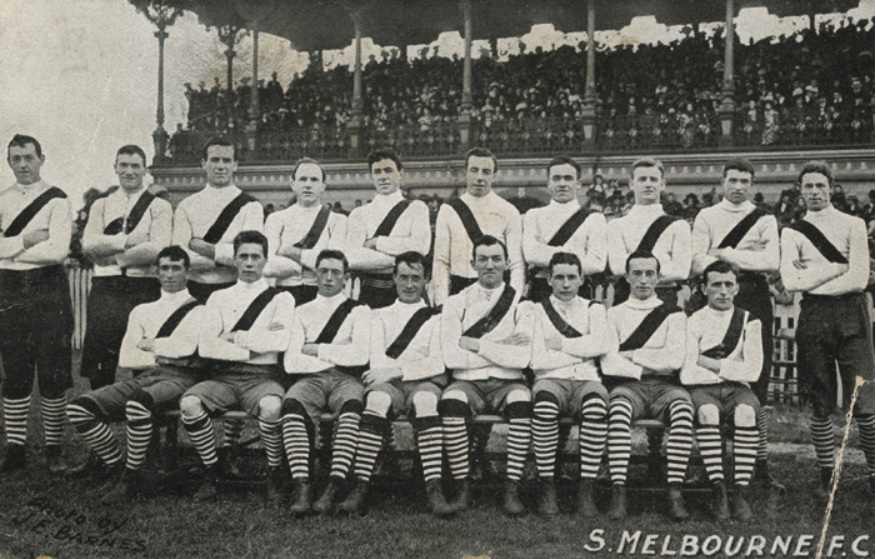
In 1880, South Melbourne amalgamated with the nearby Albert-park Football Club, which had a senior football history dating back to May 1867 (Albert-park had, in fact, been known as South Melbourne during its first year of existence). Following the amalgamation, the club retained the name South Melbourne, and adopted the club's now familiar red and white colours from Albert-park. Nicknamed the "Southerners", the team was more colourfully known as the "Bloods", in reference to the bright red diagonal sash on their white jumpers The colourful epithet the "Bloodstained Angels" was also in use. Following the 1880 amalgamation it became the strongest in metropolitan Melbourne.
VFA success
Over its first decade as an amalgamated club, South Melbourne won five VFA premierships – in 1881, 1885 (undefeated) and three-in-a-row in 1888, 1889 and 1890 – and was runner-up to the provincial Geelong Football Club in 1880, 1883 and 1886. The 1886 season was notable for its 4 September match against Geelong, which generated unprecedented public interest as both clubs had entered the match undefeated.
The club was the second Victorian club to visit New South Wales in 1883 travelling to Newcastle where it also defeated the Northern Districts League by a goal before travelling to Sydney where it defeated Sydney by just a single goal in front of a large crowd at the Sydney Cricket Ground and East Sydney Football Club by a goal in front of 600 spectators.

In May 1889, the Swans lost narrowly to a touring Maori team from New Zealand.
At the end of the 1896 season, Collingwood and South Melbourne finished equal at the top of the VFA's premiership ladder with records of 14–3–1, requiring a playoff match to determine the season's premiership; this was the first time this had occurred in VFA history. The match took place on 3 October 1896 at the East Melbourne Cricket Ground. Collingwood won the match, six goals to five, in front of an estimated crowd of 12,000.
This grand final would be the last match South Melbourne would play in the VFA, as the following season they would be one of eight founding clubs forming the breakaway Victorian Football League joining St Kilda, Essendon, Fitzroy, Melbourne, Geelong, Carlton and Collingwood.

VFL entry: 1897–1909
South Melbourne was one of the original founding clubs of the Victorian Football League that was formed in 1897.
Premiership success: 1909–1945
The club had early success and won three VFL premierships in 1909, 1918 and 1933. However, they were the subject of some off-field difficulties, and the late 1920s, the South Melbourne Districts Football Club donated 40 guineas to South Melbourne to stop them from folding. The Districts also often provided assistance payments to players when needed.
In 1932, the red sash on the guernsey was replaced with a red "V".

The club was at its most successful in the 1930s, when key recruits from both Victoria and interstate led to a string of appearances in the finals, including four successive grand final appearances from 1933 to 1936, albeit with only one premiership in 1933. The collection of players recruited from interstate in 1932/1933 became known as South Melbourne's "Foreign Legion".
On grand final eve, 1935, as the Swans prepared to take on Collingwood, star full-forward Bob Pratt was clipped by a truck moments after stepping off a tram and subsequently missed the match for South. Ironically, the truck driver was a South Melbourne supporter.
It was during this period that the team became known as the Swans. The nickname, which was suggested by a Herald and Weekly Times artist in 1933, was inspired by the number of Western Australians in the team (the black swan being the state emblem of Western Australia), and was formally adopted by the club before the following season 1934. The name stuck, in part due to the club's association with nearby Albert Park and Lake, also known for its swans (although there are no longer any non-native white swans and only black, indigenous swans in the lake).
After several years with only limited success, South Melbourne next reached the grand final in 1945. The match, played against Carlton, was to become known colloquially as "the Bloodbath", due to the player brawl that overshadowed the match, with a total of 9 players being reported by the umpires. Carlton won the match by 28 points, and from then on, South Melbourne struggled for many years.
Struggling times: 1946–1981
Following the end of the second world war, South Melbourne consistently struggled, as their traditional inner-city recruiting district largely emptied as a result of demographic shifts. The club missed the finals in 1946 and continued to fall such that by 1950 they were second-last on the ladder. They narrowly missed the finals in 1952, but from 1953 to 1969, they never finished any higher than eighth on the ladder. By the 1960s it was clear that South Melbourne's financial resources would not be capable of allowing them to compete in the growing market for country and interstate players, and their own local zone was never strong enough to compensate for this. The introduction of country zoning failed to help, as the Riverina Football League proved to be one of the least profitable zones.
Between 1945 and 1981, South Melbourne made the finals only twice: under legendary coach Norm Smith, South Melbourne finished fourth in 1970, but lost the first semi-final; and, in 1977, the club finished fifth under coach Ian Stewart, but lost the elimination final. In that time, they "won" three wooden spoons. Between Round 7, 1972 and Round 13, 1973, the team lost 29 consecutive games. By the end of the 1970s, South Melbourne were saddled with massive debts after struggling for such a long period of time.
A VFL club for Sydney
The VFL had been actively seeking an audience in Sydney since its first exhibition match in 1903 drew 20,000 people. For more than three quarters of a century, it had strategically scheduled matches in Sydney and through the Australian National Football Council – had allocated a significant share of its marketing budget to developing the code in Sydney, showcasing interstate tournaments and encouraging its clubs to play against the state representative side. At one point, it even attempted to negotiate a hybrid code with rugby league. However interest in the code in Sydney remained the poorest in the country (where it was behind three other football codes). In the late 1970s, however, with increasing professionalism of the sport there was an overall increase in national interest in the VFL competition.
In 1976, Melbourne journalist Jim Main began to break a story that a leading Melbourne businessman who had relocated to Sydney, Mannie Bongornio, had been meeting with Allen Aylett about luring a VFL club to Sydney. The idea began to gain traction and in 1977, Ron Barassi proposed the VFL setting up a club in Sydney, which he offered to coach believing that it would help spread the code in the state. Upon becoming league president, Aylett had the league investigate playing Sunday matches at the SCG. The VFL scheduled 2 premiership matches for the Sydney Cricket Ground in 1979. One of them, between the previous year's grand finalists North Melbourne and Hawthorn drew a record 31,395 to the gates. In 1979 the financially struggling Fitzroy Lions conducted a feasibility into the possibility of moving to North Sydney and a proposal was put forward, but was voted down by its board in 1980. To test the market further, the VFL scheduled 4 matches for the SCG in 1980 with an average attendance of 19,000. In April 1980, the VFL stated that its market study showed there was sufficient support for a Sydney team, finding that there was an increase in television ratings in Sydney and sustained attendance at matches and that it intended to have a team in Sydney, possibly as soon as 1982. A 1981 report by Graham Huggins concluded that there was an "untapped market in Sydney which represented an excellent opportunity for the league." The report claimed that 60,000 people in Sydney had stated that they would regularly support the new club and 90% of these supporters would watch VFL on television from Sydney and 80% of these supporters had not attended rugby and 92% believed that Australian rules could become popular in Sydney.
In 1981 the VFL had decided that it would establish an entirely new 13th VFL club in Sydney along with a possible 14th team. The VFL was under strong pressure from interests in Adelaide to admit a South Australian club and from the ACT for a new Canberra license, however VFL president Allan Aylett was convinced that Sydney was the most viable option. By 1981, Canberra's ACTAFL had edged out rugby league in popularity with an increase in participation it had become the number one sport. Under significant pressure from a rugby league junior development push and fearing the impact on its strong local competition of entry of a Sydney team made a formal bid for licence to enter a Canberra team into the VFL. With corporate backing and strong public support including local legend Alex Jesaulenko, the Canberra bid was confident it would be a successful expansion club. Aylett however, determined to pursue the entry of a Sydney team, dismissed the Canberra bid publishing a scathing report on the development of football in the ACT, stating that the VFL might consider Canberra for a licence in another 10 years. Aylett's view was that Sydney offered a much bigger television audience and the most potential to add to the league's lucrative television rights. The league had also estimated that the club could initially draw support from an estimated 300,000 ex-Victorians living in and around Sydney.
With the possibility of another club making Sydney a viable move, in 1981, the South Melbourne board, recognising the structural difficulties it faced with long-term viability and financial stability in Melbourne, decided not to miss what it saw as a strategic opportunity to capture an untapped market and save its club. The board made the decision to play all 1982 home games in Sydney. The club had been operating at a loss of at least $150,000 for the previous five years. News of the proposal broke on 2 July 1981, after which a letter was sent to members justifying the board's reasons for making the proposal and noting that the coach and current players were in favour of the move. On 29 July 1981, the VFL formally accepted the proposal, and paved the way for the Swans to shift to Sydney in 1982.
Inevitably, the move caused very great internal difficulties as a large supporters' group known as Keep South at South campaigned against the move throughout the rest of 1981; and, at an extraordinary general meeting on 22 September, the group democratically won control of the club's board. However, the new board did not have the power to unilaterally stop the move to Sydney: under the VFL constitution, to rescind the decision that had been made on 29 July required a three-quarters majority in a vote of all twelve clubs, and at a meeting on 14 October it failed to obtain this majority. The new board, whilst representative of most fans, lacked the support of the players, many of whom were in favour of a long-term move to Sydney; in early November, after the board promised that it would try to bring the club back to Melbourne in 1983, the players went on strike, seeking to force the new board to commit to Sydney in the long term as well as seeking payments that the cash-strapped club owed them from the previous season. The board ended up undermining its own position when it accepted a $400,000 loan from the VFL in late November in order to stay solvent, under the condition that it commit to Sydney for at least two years. Finally, in early December, the Keep South at South board resigned and a board in favour of the move to Sydney was installed.
Swans move to Sydney: 1982–1984
In 1982, the club was still technically a Melbourne-based club which played all of its home games at the Sydney Cricket Ground. Its physical "home club" was the "Southern Cross Social Club" at 120a Clovelly Road, Randwick In response to the move, the club's sponsors, Bond Corporation pulled out and the club was left without a major backer. At a major launch in Sydney, Aylett vindicated the league's decision, announcing it had signed a new sponsor, Ward Transport, and that on-field success for the Swans would soon follow. The Swans experienced success in the 1982 Escort Championships with 1,000 supporters packing out the Chevron Hotel ballroom in King Cross in response to the win, however Channel Seven did not broadcast the match in Sydney.
The club won their first official Sydney home game against Melbourne in front of 15,764.
In June 1982, it dropped the name "South Melbourne", officially becoming "the Swans" for the rest of the season. The name change, however, did not endear either the Sydney media or the Sydney public, and after successive games at home, began to draw as few as 10,000. Despite just missing the finals, and some good wins at home and respectable home crowds against league leaders Carlton and Richmond, the lack of success and cold reception in Sydney led to the lustre quickly leaving the league's glamour team. It was officially renamed the "Sydney Swans" in 1983.
In 1983 average crowds in Sydney continued to plummet to 12,000 and Swans supporter packages dropped to as low as 100 members (well short of the 20,000 average crowds predicted by the VFL's 1980 Hennessy Report). Television ratings and sponsorship revenue in Sydney were also far below the league's expectations.
Operating at a loss well short of the VFL's predicted $750,000 a year profit poor financial performance continued to drown the club in 1984, with the club flagging pay cuts to its players in order to survive. Coach Ricky Quade resigned and caretaker coach Bob Hammond, despite showing some promise, was unable to turn the club's poor performance around. In order to keep the club solvent during this time, the VFL began to write loans to the Swans that the club would have been unable to pay off on its own. The Swans were the league's most reliant on sponsorship and subsidies from the VFL to stay solvent and meet player payments due to its continued poor crowds, public apathy and poor TV ratings.
Public support for the Swans in Sydney was so bad that by the start of the 1985 season, the VFL began to backflip and the league's administrators, having sunk large amounts of money into the club began looking to offload it.
Edelsten era and privatisation: 1985–1987
On 31 July 1985, for what was thought to be $6.3 million, Geoffrey Edelsten "bought" the Swans; in reality it was $2.9 million in cash with funding and other payments spread over five years. Edelsten resigned as chairman in less than twelve months, but had already made his mark. He immediately recruited former Geelong coach Tom Hafey. Hafey, in turn, used his knowledge of Geelong's contracts to recruit David Bolton, Bernard Toohey and Greg Williams, who would all form a key part of the Sydney side, at a league-determined total fee of $240,000 (less than the $500,000 Geelong demanded and even the $300,000 Sydney offered). The likes of Gerard Healy, Merv Neagle and Paul Morwood were also poached from other clubs, and failed approaches were made to Simon Madden, Terry Daniher, Andrew Bews and Maurice Rioli.
During the Edelsten years, the Swans were seen by the Sydney public as a flamboyant, flashy club, typified by the style of its spearhead, Warwick Capper, his long bright blond mullet and bright pink boots made him unmissable on the field and his pink Lamborghini, penchant for girlfriends who were fashion models and his general showy eccentricity made him notorious off the field – all somewhat fashionable in the 1980s. During Capper's peak years, the Swans had made successive finals appearances for the first time since relocating. His consistently spectacular aerial exploits earned him the Mark of the Year award in 1987 while his goalkicking efforts (amassing 103 goals in 1987) made him runner up in the Coleman Medal two years running. The Swans' successive finals appearances saw crowds during this time peak at an average of around 25,000 per game. Edelsten also introduced the "Swanettes", becoming the sole such American-style cheerleading group among VFL teams following the disbandment of Carlton's Blue Birds in 1986. The Swanettes did not get much performance time, owing to the short intervals between quarters of play in the VFL and the lack of space in which they might perform while other activities take place on the field. The Swanettes were rapidly discontinued. During the Edelsten era, the club's owner and the private company Westec are reported to have sunk more than $10 million in additional private capital to keep the club afloat.
When the Southern Cross club went bankrupt in 1987, the club relocated to the newly built Sydney Football Stadium.
In 1987, the Swans scored 201 points against the West Coast Eagles and the following week scored 236 points against the Essendon Football Club. Both games were at the SCG. The Swans remain one of only two clubs to have scored consecutive team tallies above 200 points, the only other being Geelong in 1992. However, this was followed by several heavy losses, including defeat by Hawthorn by 99 points in the Qualifying Final and by 76 points against Melbourne in the First Semi-final.
Dark times: 1988–1994
The club's form was to slump in the following year. Losses were in the millions. It was obvious to most that the Swans were struggling financially, though the owners, Sydney Rules Pty Ltd a subsidiary of Powerplay International Ltd were not selling. In early 1988 the company advised the Australian Securities Exchange to cease trading its shares as it could not continue to trade until it had offloaded the Swans. A Canberra consortium including the ACTAFL initially proposed to buy the failed club and shift it to Canberra, however the VFL claimed this was too extreme a move. The league compromised and along with Aylett, who had denied Canberra a licence in 1981, proposed that the Swans play away games in the ACT with a dual aim of giving the club a sustainable supporter base and helping resurrect the code in the ACT which had lost enormous ground to rugby league since the introduction of the Canberra Raiders. However the VFL blocked the move feeling that the club would lose its identity if it were to play matches in Canberra.
By mid year the VFL had revoked the Swans licence and took over ownership of the club, after an investigation under VFL CEO Ross Oakley determined that it was unable to continue operating. However, there were no buyers. On 6 May 1988 the VFL paid Powerplay just $10 to transfer ownership of the club in an attempt to keep it afloat until a buyer could be found. The VFL would wait months for the club to regain financial security. The VFL had reported that it needed to find a buyer willing to pay at least $4 million in order to make the club financially viable in the medium to long term. In the meantime, the league had secured a sponsor which helped underwrite the club until the sale.
At the end of 1988 the VFL re-tendered the Swans licence and a group of financial backers including Mike Willesee, Basil Sellers, Peter Weinert and Craig Kimberley, purchased the licence and bankrolled the club.
Morale at the side plummeted as players were asked to take pay cuts. Coach Tom Hafey was sacked by the club in 1988 after a player-led rebellion at his tough training methods (unusual in the semi-professional days of that era). The Willesee consortia appointed Col Kinnear as the new coach.
Capper was sold to the Brisbane Bears for AUD$400,000 in a desperate attempt to improve the club's finances. Instead, it only led to disastrous on-field performances. Instead of a 100-goal-a-season forward, Sydney's goalkicking was led by Bernard Toohey (usually a defender) with 29 in 1989, then Jim West with 34 in 1990. Players left the club in droves, including Brownlow Medalist Greg Williams, Bernard Toohey and Barry Mitchell. The careers of stars such as Dennis Carroll, David Bolton, Ian Roberts, Tony Morwood and David Murphy wound down, while promising young players like Jamie Lawson, Robert Teal and Paul Bryce had their careers cut short by injury.
Attendances consistently dropped below 10,000 when the team performed poorly between 1990 and 1994. Kinnear in 1990 urged his players rally to support the club's loyal fans and stem their mass exodus however he was ultimately stood down in August 1991. The nadir came with three consecutive wooden spoons in 1992, 1993 and 1994.
In October 1992, members from the 15 AFL clubs voted on axing the struggling Swans. To fill the void left by the Swans, the league floated a radical proposal for Carlton or Collingwood to play all of their away games in Sydney, however it was felt that even the leagues most popular clubs wouldn't be able to draw a sufficient audience in Sydney to cover for the loss of the Swans. The AFL extended an offer for a Tasmanian licence which was declined, and received an offer from the ACTAFL to relocate the club to Canberra, however the AFL rejected this. There were also strong rumours that the AFL intended to merge the club with the Brisbane Bears to form a combined New South Wales/Queensland team, fold altogether, or even move back to South Melbourne. Without adequate alternatives the AFL Commission instead decided to step in and save the club, offering substantial monetary and management support, with the 15 clubs asked to cover the club's AUD$1.2 million annual expenses including licence fee and hire of the SCG. With draft and salary cap concessions in the early 1990s and a series of notable recruits, the team became competitive after the early part of the decade.
During this time, the side was largely held together by two inspirational skippers, both from the Wagga Wagga region of country New South Wales, Dennis Carroll and later the courageous captain Paul Kelly. However coach Gary Buckenara was sacked after 18 straight losses, managing to register just 2 wins and a draw during his term.
Desperate to hang on, the club was keen to enlist the biggest names and identities in the AFL, and recruited Ron Barassi as coach who helped save the club from extinction while serving them as coach from Round 7, 1993 to 1995. At roughly the same time, Dermott Brereton was also recruited from Hawthorn on a three-year contract becoming one of the swans highest paid players, and was considered to replace Paul Kelly as club captain. However Brereton's time in Sydney was marred by multiple tribunal appearances including 6 and 7 week bans and while he starred in some upset wins he spent more time off the field than on it; resulting in Barassi labelling the experiment as a disappointment, and not offering a contract extension.