
Stamford School is a co-educational independent school in Stamford, Lincolnshire in the English public school tradition. Founded in 1532, it has been a member of the Headmasters' and Headmistresses' Conference since 1920. With the former Stamford High School and the coeducational Stamford Junior School, it is part of the Stamford Endowed Schools (SES). From September 2023, Stamford became co-educational.
History
The school was founded in 1532 by a local merchant and alderman, William Radcliffe, who had been encouraged when younger by Lady Margaret Beaufort, (died 1509) mother of Henry VII, though there is evidence to suggest that a school existed from the beginning of the fourteenth century. Founded as a chantry school, it fell foul of the Protestant reformers and was only saved from destruction under the Dissolution of Colleges Act 1547 (1 Edw. 6. c. 14) of Edward VI by the personal intervention of Sir William Cecil (later Lord Burghley) who worked in the service of Edward Seymour, 1st Duke of Somerset and who secured a specific act of Parliament in 1549, the Confirmation of Stamford School Act 1548 (2 & 3 Edw. 6. c. 21 Pr.), ensuring its survival. Apart from the chantries of the University of Oxford and the University of Cambridge, only those of Eton College, Winchester College, Berkhamsted, St Albans and Stamford schools survived.
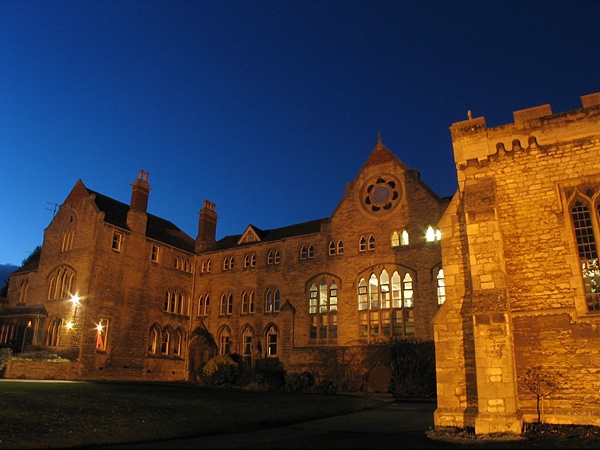
Teaching is believed to have begun in the Corpus Christi chapel of Stamford's twelfth-century St Mary's Church, but by 1566 was taking place in the remaining portion of the redundant St Paul's Church, originally built no later than 1152. This building continued in use as a school room until the early twentieth century when it was restored and extended and, in 1930, returned to use as a chapel. In 1961, a nineteenth-century Gray and Davison pipe organ was installed although this was removed in the 1990s and replaced with an electronic substitute. Over its history the school has built or absorbed seventeenth-, eighteenth- and nineteenth-century buildings, besides the site of a further demolished medieval church (Holy Trinity/St Stephen's) and remains of Brazenose College built by the secessionists from the University of Oxford in the fourteenth century. Brasenose College, Oxford bought Brazenose House in 1890 to recover the original medieval brass Brazenose knocker.

The right of appointment of the school's master, a position hotly contested in past centuries on account of the post's disproportionately large salary, was shared between the Mayor of Stamford and the Master of St John's College, Cambridge. Both Stamford Town Council and St John's College still have nominees on the school's governing body. Stamford School had a sister school, Stamford High School which was founded in 1877. It closed in 2023 as part of the co-educational merger with Stamford School. The funds for the foundation of the High School and the further financial endowment of the existing boys' school were appropriated from the endowment of Browne's Hospital by Act of Parliament in 1871. This trust had been established for the relief of poverty by William Browne (died 1489), another wealthy wool merchant and alderman of the town, and his gift is commemorated in the name of a school house.
From 1975, Lincolnshire County Council purchased places at Stamford School and Stamford High School on the basis that Stamford had no LEA grammar school (unlike the county's other towns). This local form of the Assisted Places Scheme provided funding to send children to the two schools that were formerly direct-grant grammars. The national Assisted Places Scheme was ended by the Labour government in 1997 but the Stamford arrangements remained in place as an increasingly protracted transitional arrangement. In 2006, Lincolnshire County Council agreed to taper down from 50 the number of county scholarships to the Stamford Endowed Schools so that there would be no new scholarships from 2012.
In recent years, the two schools were united under the leadership of a single principal as the Stamford Endowed Schools. This organisation comprised Stamford Junior School, a co-educational establishment for pupils aged between 2 and 11 years and Stamford School and Stamford High School for students aged 11–18. Sixth form teaching was carried out jointly between Stamford School and Stamford High School. This was referred to as the diamond school model.

In 2012 the Memorial Sports Centre was opened by Lord Sebastian Coe. The facility contains a 25m swimming pool, replacing the outdoor Memorial Swimming Pool which opened in 1956. This was followed by the opening of the multi-million pound Wothorpe Sports Centre in 2022, built opposite Stamford Junior School on Wothorpe Road.
Stamford Endowed Schools became co-educational from September 2023 and fully co-educational in every year group from 2024. The High School site is now used as the Sixth Form campus, named 'St Martin's'.
Since 1885 The Stamfordian has been the school magazine of Stamford School. Currently published annually in the Autumn term, it provides for current pupils and parents as well as Old Stamfordians and prospective parents an account of a year in the life of the school.
School crest
The school's crest is a stork (the spede bird) with wings displayed on a wool bale over the motto + me spede, that is Christ me spede. The emblem was adopted from medieval wool merchant, William Browne, after the school had been re-endowed from Browne's Charity in 1873. (The stork is supposed to be a rebus on his wife, Margaret's maiden name of Stoke). The current form was designed by Nelson Dawson.
Notable alumni (Old Stamfordians)
Politics and public service
Nick Anstee, Lord Mayor of London
Simon Burns, Conservative MP for West Chelmsford, Minister of State

John Cecil, 5th Earl of Exeter, MP for Stamford, Grand Tourist and connoisseur
William Cecil, 1st Baron Burghley, Lord High Treasurer of England and chief advisor to Queen Elizabeth I
Alfred Harmsworth, 1st Viscount Northcliffe, newspaper magnate, founder of the Daily Mail and Daily Mirror, owner of The Times

J. F. Horrabin, Labour MP for Peterborough, journalist and broadcaster
Sir Thomas Wilson, author, translator, diplomat, Member of Parliament, Keeper of the King's Records
Robert Wardle Director of the Serious Fraud Office

Law
Sir Richard Cayley, Chief Justice of Ceylon
Sir Ronald Long, President of the Law Society
Nicholas Fluck, President of the Law Society
Music
Sir Malcolm Sargent, conductor
Sir Michael Tippett, composer
Julian Wastall, composer
Literature and the arts
Michael Asher, author and explorer
Oliver Bayldon, production designer and writer
Torben Betts, playwright
Tom Butcher, film, television and stage actor
Nelson Dawson, silversmith, jeweller, designer, etcher and painter of the Arts and Crafts movement.
Colin Dexter, author of the Inspector Morse detective novels; Morse is described as an Old Stamfordian
Neil McCarthy, film and television actor
Francis Peck, antiquary
John Radford, wine writer and broadcaster
George Robinson, television actor
Ralph Robinson, Renaissance scholar, first translator into English of Thomas More's Utopia
Thomas Seaton, founder of Seatonian Prize for Poetry at the University of Cambridge
John Terraine, military historian
Ben Willbond, film and television actor
Peter Baynton, Oscar-winning director of The Boy, the Mole, the Fox and the Horse
Military
Apparanda Aiyappa, Indian Army
Simon Bryant, Commander-in-Chief, RAF Air Command
John Drewienkiewicz
Mike Jackson, Chief of the General Staff.
Academia and the church
Martin Aitken, professor of archaeometry, University of Oxford, Fellow of Linacre College, Oxford
Zachary Brooke, Lady Margaret's Professor of Divinity, University of Cambridge
Henry Edwards, Dean of Bangor
Charles John Ellicott, professor of divinity at King's College London and the University of Cambridge and Bishop of Gloucester and Bristol
Philip Goodrich, Bishop of Worcester
Malcolm Jeeves, psychologist
Steven V. Ley, Professor of Chemistry at the University of Cambridge, Fellow of Trinity College, Cambridge
Cecil Richard Norgate, bishop of Masasi, Tanzania