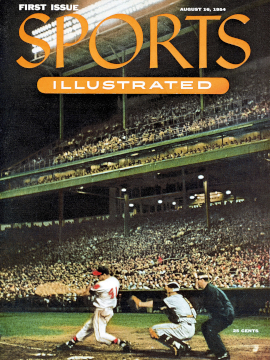
Sports Illustrated (SI) is an American sports magazine first published in August 1954. Founded by Stuart Scheftel, it was the first magazine with a circulation of over one million to win the National Magazine Award for General Excellence twice. It is also known for its annual swimsuit issue, which has been published since 1964, and has spawned other complementary media works and products.
Owned until 2018 by Time Inc., it was sold to Authentic Brands Group (ABG) following the sale of Time Inc. to Meredith Corporation. The Arena Group (formerly theMaven, Inc.) was subsequently awarded a 10-year license to operate the Sports Illustrated–branded editorial operations, while ABG licenses the brand for other non-editorial ventures and products. In January 2024, The Arena Group missed a quarterly licensing payment, leading ABG to terminate the company's license. Arena, in turn, laid off the publication's editorial staff.
In March 2024, ABG licensed the publishing rights to Minute Media in a 10-year deal, jointly announcing that the print and digital editions would be revived by rehiring some of the editorial staff. On May 17, 2024, Sports Illustrated failed to deliver a print copy of the publication for the month to its subscribers for the first time in the magazine's 70-year history, according to the New York Post's Josh Kosman.

History
Establishment
There were two previous magazines named Sports Illustrated before the current magazine was launched on August 9, 1954. In 1936, Stuart Scheftel created Sports Illustrated with a target market of sportsmen. He published the magazine monthly from 1936 to 1942. The magazine focused on golf, tennis, and skiing with articles on the major sports. He then sold the name to Dell Publications, which released Sports Illustrated in 1949 and this version lasted six issues before closing. Dell's version focused on major sports (baseball, basketball, boxing) and competed on magazine racks against Sports and other monthly sports magazines. During the 1940s, these magazines were monthly, which prevented them from covering current events. There was no large-base, general, weekly sports magazine with a national following on actual active events. It was then that Time patriarch Henry Luce began considering whether his company should attempt to fill that gap. At the time, many believed sports was beneath the attention of serious journalism and did not think sports news could fill a weekly magazine, especially during the winter. A number of advisers to Luce, including Life magazine's Ernest Havemann, tried to kill the idea, but Luce, who was not a sports fan, decided the time was right.
Luce and editors of the planned magazine met in 1954 at Pine Lakes Country Club, the oldest golf course in Myrtle Beach, South Carolina. The course's pro shop has a plaque mentioning the meetings, and the plaque also states that the first issue was given to the course. It is on display there. Myrtle Beach Area Golf Course Owners Association executive director Tracy Conner credits the magazine with making Myrtle Beach a golf destination.
Many at Time-Life scoffed at Luce's idea; in his Pulitzer Prize–winning biography, Luce and His Empire, W. A. Swanberg wrote that the company's intellectuals dubbed the proposed magazine "Muscle", "Jockstrap", and "Sweat Socks". Launched on August 9, 1954, it was not profitable (and would not be for 12 years) and not particularly well-run at first, but Luce's timing was good. The popularity of spectator sports in the United States was about to explode, and that popularity came to be driven largely by three things: economic prosperity, television, and Sports Illustrated.

The early issues of the magazine seemed caught between two opposing views of its audience. Much of the subject matter was directed at upper-class activities such as yachting, polo and safaris, but upscale would-be advertisers were unconvinced that sports fans were a significant part of their market.
Color printing
In 1965, offset printing began. This allowed the color pages of the magazine to be printed overnight, not only producing crisper and brighter images, but also finally enabling the editors to merge the best color with the latest news. By 1967, the magazine was printing 200 pages of "fast color" a year; in 1983, SI became the first American full-color newsweekly. An intense rivalry developed between photographers, particularly Walter Iooss and Neil Leifer, to get a decisive cover shot that would be on newsstands and in mailboxes only a few days later.
In the late 1970s and early 1980s, during Gilbert Rogin's term as Managing Editor, the feature stories of Frank Deford became the magazine's anchor. "Bonus pieces" on Pete Rozelle, Woody Hayes, Bear Bryant, Howard Cosell and others became some of the most quoted sources about these figures, and Deford established a reputation as one of the best writers of the time.
Expansion of sports coverage
After more than a decade of steady losses, the magazine's fortunes finally turned around in the 1960s when Andre Laguerre became its managing editor. A European correspondent for Time, Inc., who later became chief of the Time-Life news bureaux in Paris and London (for a time he ran both simultaneously), Laguerre attracted Henry Luce's attention in 1956 with his singular coverage of the Winter Olympic Games in Cortina d'Ampezzo, Italy, which became the core of SI's coverage of those games. In May 1956, Luce brought Laguerre to New York to become the assistant managing editor of the magazine. He was named managing editor in 1960, and he more than doubled the circulation by instituting a system of departmental editors, redesigning the internal format, and inaugurating the unprecedented use in a news magazine of full-color photographic coverage of the week's sports events. He was also one of the first to sense the rise of national interest in professional football.
Laguerre also instituted the innovative concept of one long story at the end of every issue, which he called the "bonus piece". These well-written, in-depth articles helped to distinguish Sports Illustrated from other sports publications, and helped launch the careers of such legendary writers as Frank Deford, who in March 2010 wrote of Laguerre, "He smoked cigars and drank Scotch and made the sun move across the heavens ... His genius as an editor was that he made you want to please him, but he wanted you to do that by writing in your own distinct way." Laguerre is also credited with the conception and creation of the annual Swimsuit Issue.
In 1984, Mark Mulvoy became the youngest managing editor in the magazine's history. He sought for Sports Illustrated "to be the conscience of sports" through investigative journalism. He established the Golf Plus insert for the older golfing audience, established Sports Illustrated Kids for a younger audience, and doubled the swimsuit issue to 40 pages. The swimsuit issue became an annual special edition, and profits for Sports Illustrated more than quadrupled. In 1986, co-owned property HBO/Cannon Video had inked a pact to produce video versions of the magazine for $20 on the sell-through market, running just 30–45 minutes on the tape. In 1990, Time Inc. merged with Warner Communications to form the media conglomerate Time Warner. Sports Illustrated acquired FanNation.com in 2007 to compete in the Web 2.0 market; the site aggregated sports news and allowed user-generated content. In 2014, Time Inc. was spun off from Time Warner.
Sale to Authentic Brands Group, Maven
In 2018, Meredith Corporation acquired parent company Time Inc. Meredith planned to sell Sports Illustrated due to not aligning with its lifestyle properties. Authentic Brands Group announced its intent to acquire Sports Illustrated for $110 million the next year, stating that it would leverage its brand and other assets for new opportunities that "stay close to the DNA and the heritage of the brand." Upon the announcement, Meredith would enter into a licensing agreement to continue as publisher of the Sports Illustrated editorial operations for at least the next two years. In June 2019, the rights to publish the Sports Illustrated editorial operations were licensed to the digital media company theMaven, Inc. under a 10-year contract, with Ross Levinsohn as CEO. The company had backed a bid by Junior Bridgeman to acquire SI. In preparation for the closure of the sale to ABG and Maven, The Wall Street Journal reported that there would be Sports Illustrated employee layoffs, which was confirmed after the acquisition had closed.
In October 2019, editor-in-chief Chris Stone stepped down. Later that month, Sports Illustrated announced its hiring of veteran college sports writer Pat Forde. In January 2020, it announced an editorial partnership with The Hockey News, focusing on syndication of NHL-related coverage. In 2021, it announced a similar partnership with Morning Read for golf coverage, with its website being merged into that of Sports Illustrated. It also partnered with iHeartMedia to distribute and co-produce podcasts.
In September 2021, Maven, now known as The Arena Group, acquired the New Jersey–based sports news website The Spun, which would integrate into Sports Illustrated. In 2022, ABG announced several non-editorial ventures involving the Sports Illustrated brand, including an apparel line for JCPenney "inspired by iconic moments in sports" (it was not the brand's first foray into clothing, as it launched a branded swimsuit line in conjunction with its Swimsuit Issue in 2018), and resort hotels in Orlando and Punta Cana. In September 2023, it expanded its resorts name licensing through a new partnership with Travel + Leisure.
On November 27, 2023, Futurism published an article alleging that Sports Illustrated was publishing AI-generated articles credited to authors who were also AI-generated; the latter practice apparently extended to their profile photos, which the website alleged were sourced from online marketplaces selling such photos. After Futurism reached out to The Arena Group, the magazine purportedly removed some of the implicated writers and republished their articles under other AI-generated authors with notes disclaiming its staff's involvement. In response to the report, a spokesperson for Sports Illustrated claimed that the affected articles were product reviews written without the involvement of AI by AdVon Commerce, a third-party company who they claimed used pseudonyms to "protect author privacy" and had already severed ties with; meanwhile, writers and editors at the magazine sharply criticized the alleged practices.
On January 5, 2024, The Arena Group missed a $3.75 million quarterly licensing payment to Authentic Brands Group. Two weeks later, on January 19, Authentic Brands Group terminated its licensing agreement. As a result, The Arena Group announced that it would lay off the entire Sports Illustrated staff. In March 2024, Authentic Brands Group licensed the publishing rights to Minute Media in a 10-year deal, jointly announcing that the print and digital editions would be revived by rehiring some of the editorial staff. Minute converted the Fan Nation-branded sites to "On SI". In August 2024, Minute Media and RTA Media Holdings (and RTA's brand Racing America) entered into a partnership, forming Racing America on SI. This partnership allows Racing America's coverage of NASCAR and grassroots racing to be presented to a wider audience through Sports Illustrated's platforms.
Regular segments
Who's Hot, Who's Not: a feature on who is on a roll and who is going to fold.
Inside the NFL, MLB, NHL, NBA, College Football, College Basketball, NASCAR, Golf, Boxing, Horse Racing, Soccer, and Tennis (sports vary from issue to issue): a section where writers from each sport address the latest news and rumors in their respective fields.
Faces in the Crowd: a section which honors talented amateur athletes and their accomplishments.
The Point After: a back-page column featuring a rotation of SI writers as well as other contributors. Content varies from stories to opinion, focusing on both the world of sports and the role sports play in society.
Awards
American Sportswear Designer Award (ASDA Awards)
In 1956, Sports Illustrated began presenting annual awards to fashion or clothing designers who had excelled in the field of sportswear/activewear. The first ASDAs of 1956, presented to Claire McCardell with a separate Designer of the Year award to Rudi Gernreich, were chosen following a vote of 200 American top retailers. The following year, the voting pool had increased to 400 fashion industry experts, including Dorothy Shaver and Stanley Marcus, when Sydney Wragge and Bill Atkinson received the awards. The Italian designer Emilio Pucci was the first non-American to receive the award in 1961. The awards were presented up until at least 1963, when Marc Bohan received the prize. Other winners include Jeanne S. Campbell, Bonnie Cashin, and Rose Marie Reid who formed the first all-women winning group in 1958.
Performer of the Year
Maya Moore of the WNBA's Minnesota Lynx was the inaugural winner of the award in 2017.
Sportsperson of the Year
Since 1954, Sports Illustrated has annually presented the Sportsperson of the Year award to "the athlete or team whose performance that year most embodies the spirit of sportsmanship and achievement." Roger Bannister won the first-ever Sportsman of the Year award thanks to his record-breaking time of 3:59.4 for a mile, the first-ever time a mile had been run under four minutes. Both men and women have won the award, originally called "Sportsman of the Year" and renamed "Sportswoman of the Year" or "Sportswomen of the Year" when applicable; it is currently known as "Sportsperson of the Year."
Recent winners
The 2017 award winners were Houston Texans defensive end J. J. Watt and Houston Astros second baseman Jose Altuve. Both athletes were recognized for their efforts in helping rebuild the city of Houston following Hurricane Harvey in addition to Altuve being a part of the Astros team that won the franchise's first World Series in 2017. The 2018 winners were the Golden State Warriors as a team for winning their third NBA Title in four years. The 2021 winner was Tom Brady for his Super Bowl LV win. The 2023 winner was Deion Sanders, coach of the Colorado Buffaloes football team.
Sportsman of the Century
In 1999, Sports Illustrated named Muhammad Ali the Sportsman of the Century at the Sports Illustrated's 20th Century Sports Awards in New York City's Madison Square Garden.
Sports Illustrated's Muhammad Ali Legacy Award
In 2015, the magazine renamed its Sportsman Legacy Award to the Sports Illustrated's Muhammad Ali Legacy Award. The annual award was originally created in 2008 and honors former "sports figures who embody the ideals of sportsmanship, leadership and philanthropy as vehicles for changing the world." Ali first appeared on the magazine's cover in 1963 and went on to be featured on numerous covers during his storied career. His widow, Lonnie Ali, is consulted when choosing a recipient. In 2017, football quarterback Colin Kaepernick was honored with the Award, which was presented by Beyoncé. In 2018, WWE professional wrestler John Cena was honored with the award.
All-decade awards and honors
Top 20 Female Athletes of the Decade (2009)
Top 20 Male Athletes of the Decade (2009)
All-Decade Team (2009) (MLB, NBA, NFL, NHL, college basketball, college football)
Top 10 Coaches/Managers of the Decade (2009)
Top 10 GMs/Executives of the Decade (2009)
Top Team of the Decade (2009) (MLB, NBA, NFL, NHL, college basketball, college football)
Top 25 Franchises of the Decade (2009)
Major League Baseball honors
National Basketball Association honors
National Football League honors
National Hockey League honors
College basketball honors
College football honors
Top sports colleges
For a 2002 list of the top 200 Division I sports colleges in the U.S., see footnote.
Wrestling
Male/Men's Wrestler of the Year
Women's Wrestler of the Year
Wrestler of the Year
Cover history
The magazine's cover is the basis of a sports myth, known as the Sports Illustrated cover jinx. Several athletes and other figures appeared many times on the magazine's cover.