
The Soviet invasion of Manchuria, formally known as the Manchurian Strategic Offensive Operation or simply the Manchurian Operation (Маньчжурская операция) and sometimes, mainly in the West, as Operation August Storm, began on 9 August 1945 with the Soviet Union's invasion of the Empire of Japan's puppet states of Manchukuo and Mengjiang, in Japanese-occupied Manchuria and Inner Mongolia respectively. It was the largest campaign of the 1945 Soviet–Japanese War, which resumed hostilities between the Union of Soviet Socialist Republics and the Empire of Japan after almost six years of peace.
The invasion began hours before the atomic bombing of Nagasaki and three days after the atomic bombing of Hiroshima. The Soviet entry into the war against Japan and the defeat of the Kwantung Army are often considered a major factor, alongside the atomic bombings, in the Japanese government's decision to surrender unconditionally by 15 August. The Japanese government had previously hoped the Soviet Union would act as a third party, and end the Pacific War by negotiating a conditional surrender for Japan with the Western Allies. The Kwantung Army officially surrendered on 16 August, although fighting continued until 2 September, when the Japanese Instrument of Surrender was signed.
The Soviet Union occupied Manchuria as well as the Japanese Mengjiang puppet state in Inner Mongolia. The Soviet Navy also launched an amphibious assault capturing the northern half of Japanese-occupied Korea, later establishing the Soviet Civil Administration. On 14 August it signed the Sino-Soviet Treaty of Friendship and Alliance with the Kuomintang government. The resumption of full-scale conflict in the Chinese Civil War prompted the Red Army to withdraw by 3 May 1946, handing much of Manchuria and Inner Mongolia to territories controlled by the Chinese Communist Party. The Soviets continued to occupy northern Korea until 1948 and the Port Arthur naval base until 1955.

Soviet forces also captured scientists of the Kwantung Army's Unit 731 division, involved in Japanese biological warfare and chemical warfare, sentencing them in the 1949 Khabarovsk war crimes trials while allegedly using their information and experience in the Soviet biological weapons program.
Summary
As agreed with the United Kingdom and the United States (Western Allies) at the Tehran Conference in November 1943 and the Yalta Conference in February 1945, the Soviet Union entered World War II's Pacific Theatre within three months of the end of the war in Europe. The invasion began on 9 August 1945, exactly three months after the German surrender on May 8 (9 May, 0:43 Moscow time).
Although the commencement of the invasion fell between the American atomic bombing of Hiroshima on 6 August, and only hours before the Nagasaki bombing on 9 August, the timing of the invasion had been planned well in advance and was determined by the timing of the agreements at Tehran and Yalta, the long-term buildup of Soviet forces in the Far East since Tehran, and the date of the German surrender some three months earlier; on August 3, Marshal Vasilevsky reported to Premier Joseph Stalin that, if necessary, he could attack on the morning of 5 August.

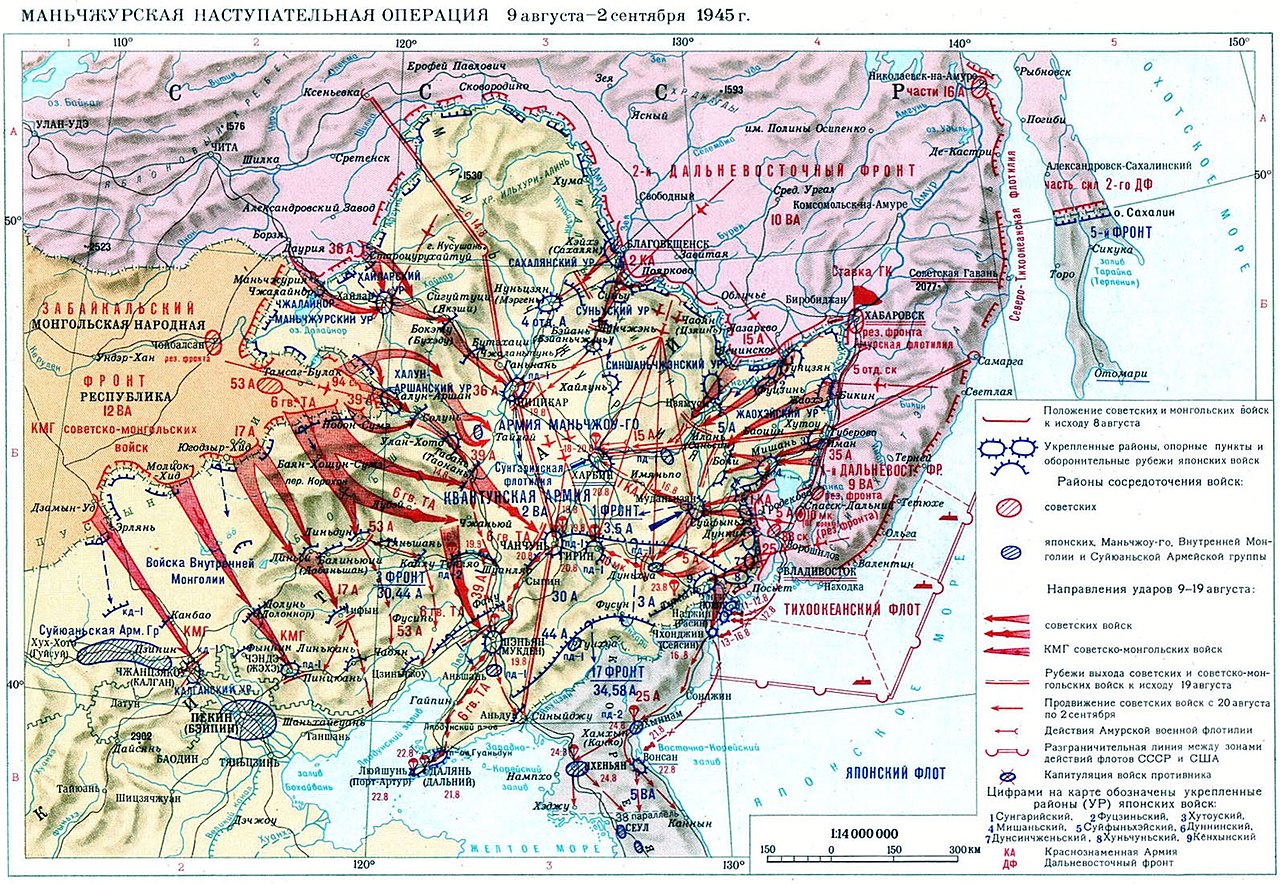
At 5 p.m. Moscow time (11 p.m. Trans-Baikal time (UTC+9)) on 8 August 1945, Soviet foreign minister Vyacheslav Molotov informed Japanese ambassador Naotake Satō that the Soviet Union had declared war on Japan, and that from 9 August the Soviet government would consider itself to be at war with Japan. At one minute past midnight Trans-Baikal time on 9 August 1945, or just over an hour after the declaration of war, the Soviets commenced their invasion simultaneously on three fronts to the east, west and north of Manchuria:
Khingan–Mukden Offensive Operation (9 August 1945 – 2 September 1945) (Lesser Khingan-Mukden area);
Harbin–Kirin Offensive Operation (9 August 1945 – 2 September 1945) (Harbin-Jilin area); and

Sungari Offensive Operation (9 August 1945 – 2 September 1945).
Though the battle extended beyond the borders traditionally known as Manchuria—that is, the traditional lands of the Manchus—the coordinated and integrated invasions of Japan's northern territories has also been called the Battle of Manchuria. It has also been referred to as the Manchurian strategic offensive operation.
Background and buildup
The Russo-Japanese War of the early 20th century resulted in a Japanese victory and the Treaty of Portsmouth by which, in conjunction with other later events including the Mukden incident and Japanese invasion of Manchuria in September 1931, Japan eventually gained control of Korea, Manchuria and South Sakhalin. In the late 1930s there were a number of Soviet-Japanese border incidents, the most significant being the Battle of Lake Khasan (Changkufeng Incident, July–August 1938) and the Battle of Khalkhin Gol (Nomonhan Incident, May–September 1939), which led to the Soviet–Japanese Neutrality Pact of April 1941. The Neutrality Pact freed up forces from the border incidents and enabled the Soviets to concentrate on their war with Germany, and the Japanese to concentrate on their southern expansion into Asia and the Pacific Ocean.

With success at Stalingrad, and the eventual defeat of Germany becoming increasingly certain, the Soviet attitude to Japan changed, both publicly, with Stalin making speeches denouncing Japan, and covertly with the building up of forces and supplies in the Far East. At the Tehran Conference in November 1943, Joseph Stalin, Winston Churchill, and Franklin D. Roosevelt agreed that the Soviet Union would enter the war against Japan once Germany was defeated. Stalin faced a dilemma: he wanted to avoid a war on two fronts at almost any cost, yet he also saw an opportunity to secure gains in the Far East on top of those he expected in Europe. The only way Stalin could ensure these gains without a two-front war would be for Germany to capitulate before Japan.
Due to the Soviet–Japanese Neutrality Pact, the Soviets made it official policy to intern Allied aircraft and crews who landed in Soviet territory following operations against Japan. However, the Soviets and Western Allies soon came to informal arrangements to circumvent official policy. Under the auspices of Lend-Lease, the Allies officially transferred aircraft of the same types interned by the Soviets in the Far East, the mutual understanding being that the Soviets would also be able use "interned" Allied aircraft against the Germans without revealing their true origins. In return, Allied airmen held in the Soviet Union were usually transferred to camps near Iran or other Allied-controlled territory, from where they were typically allowed to "escape" after some period of time. Nevertheless, the Soviet buildup in the Far East steadily accelerated even before the defeat of Germany. By early 1945 it had become apparent to the Japanese that the Soviets were preparing to invade Manchuria, though they correctly calculated that they were unlikely to attack prior to Germany's defeat. In addition to their problems in the Pacific, the Japanese realized the need to determine when and where a Soviet invasion would occur.
At the Yalta Conference in February 1945, Stalin secured Roosevelt's acceptance of Soviet expansion in the Far East, in return for agreeing to enter the Pacific war within two or three months after the defeat of Germany. By the middle of March, things were not going well in the Pacific for the Japanese, and they had withdrawn their elite troops from Manchuria to support actions in the Pacific. Meanwhile, the Soviets continued their Far Eastern buildup, having decided that they did not wish to renew the Neutrality Pact. The terms of the Pact required a notification of expiry 12 months ahead of time, so on 5 April 1945 the Soviets ostensibly obliged, informing the Japanese that they did not wish to renew the treaty. This caused the Japanese considerable concern, but the Soviets went to great efforts to assure the Japanese that the treaty would still be in force for another twelve months, and that the Japanese had nothing to worry about.

Germany surrendered just after midnight Moscow time on 9 May 1945, meaning that if the Soviets were to honor the agreement at Yalta, they would need to enter the war with Japan by 9 August. The situation continued to deteriorate for the Japanese, now the only Axis power left in the war. They were keen to stay at peace with the Soviets, and ultimately to achieve an end to the war. Since Yalta, they had repeatedly tried to convince the Soviets to extend the Neutrality Pact, as well as attempting to enlist them to mediate peace negotiations with the Western Allies. The Soviets did nothing to discourage these overtures, instead happy to draw out the process for as long as possible whilst continuing to prepare their invasion forces. One of the goals of Admiral Baron Suzuki's cabinet upon taking office in April was to try to secure any peace terms whatsoever short of unconditional surrender. In late June, they once again approached the Soviets, inviting them to mediate with the Western Allies in support of Japan, providing them with specific proposals. In exchange, they were prepared to offer the Soviets very attractive territorial concessions. Stalin ostensibly expressed interest, and the Japanese now awaited an official Soviet response, even as the Soviets continued to deliberately avoid providing one. The Potsdam Conference was held from 16 July to 2 August; on 24 July the Soviet Union recalled all its embassy staff and families from Japan. On 26 July the conference produced the Potsdam Declaration whereby Churchill, Harry S. Truman and Chiang Kai-shek demanded Japan's unconditional surrender. The Japanese avoided responding to the declaration, instead continuing to wait on a clarifying Soviet reply.
The Japanese had been monitoring Trans-Siberian Railway traffic and Soviet activity to the east of Manchuria. In conjunction with the delaying tactics, this suggested that the Soviets would not be ready to invade east Manchuria before the end of August. The Japanese did not have any concrete evidence as to when or where any invasion would occur. They had estimated that an attack was not likely before the spring of 1946, but the Stavka had in fact been planning for a mid-August offensive, successfully concealing the buildup of a force of 90 divisions. Many Soviet units had crossed Siberia in their vehicles to avoid straining the rail link.
The Japanese were caught completely by surprise upon receiving the Soviet declaration of war an hour before midnight on 8 August, now facing a simultaneous invasion on three fronts that began just after midnight on 9 August.
Combatants
Soviets
The Far East Command, under Marshal of the Soviet Union Aleksandr Vasilevsky, had a plan to conquer Manchuria that was simple but huge in scale, calling for a massive pincer movement over all of Manchuria. This was to be performed by the Transbaikal Front from the west and by the 1st Far Eastern Front from the east; the 2nd Far Eastern Front was to attack the center of the pocket from the north. The only Soviet equivalent of a theater command that operated during the war (apart from the short-lived 1941 "Directions" in the west), Far East Command, consisted of three Red Army fronts.
Transbaikal Front
The Transbaikal Front, under Marshal Rodion Malinovsky, included:
17th Army
36th Army
39th Army
53rd Army
6th Guards Tank Army
Soviet Mongolian Cavalry Mechanized Group under Issa Pliyev
12th Air Army.
The Transbaikal Front was to form the western half of the Soviet pincer movement, attacking across the Inner Mongolian desert and over the Greater Khingan mountains. These forces had as their objectives firstly to secure Mukden (present day Shenyang), then to meet troops of the 1st Far Eastern Front at the Changchun area in south central Manchuria, and in doing so finish the pincer movement.
Amassing over one thousand tanks and self-propelled guns, the 6th Guards Tank Army was to serve as an armored spearhead, leading the Front's advance and capturing objectives 350 km (220 mi) inside Manchuria by the fifth day of the invasion.
The 36th Army was also attacking from the west, but with the objective of meeting forces of the 2nd Far Eastern Front at Harbin and Qiqihar.
1st Far Eastern Front
The 1st Far Eastern Front, under Marshal Kirill Meretskov, included:
1st Red Banner Army
5th Army
25th Army
35th Army
10th Mechanized Corps
9th Air Army.
The 1st Far Eastern Front was to form the eastern half of the pincer movement. This attack involved the 1st Red Banner Army, the 5th Army and the 10th Mechanized Corps striking towards Mudanjiang (or Mutanchiang). Once that city was captured, this force was to advance towards the cities of Jilin (or Kirin), Changchun and Harbin. Its final objective was to link up with the forces of the Transbaikal Front at Changchun and Jilin thus closing the double envelopment movement.
As a secondary objective, the 1st Far Eastern Front was to prevent Japanese forces from escaping to Korea, and then invade the Korean Peninsula up to the 38th parallel, establishing in the process what later became North Korea. This secondary objective was to be carried out by the 25th Army. Meanwhile, the 35th Army was tasked with capturing the cities of Boli (or Poli), Linkou and Mishan.
2nd Far Eastern Front
The 2nd Far Eastern Front, under General Maksim Purkayev, included:
2nd Red Banner Army
15th Army
16th Army (whose 56th Rifle Corps was its only formation to see combat, on South Sakhalin)
5th Separate Rifle Corps
Chuguevsk Operational Group
Amur Military Flotilla
10th Air Army
The 2nd Far Eastern Front was deployed in a supporting attack role. Its objectives were the cities of Harbin and Qiqihar, and to prevent an orderly withdrawal to the south by the Japanese forces. The front also included the 88th Separate Rifle Brigade, composed of Chinese and Korean guerrillas of the Northeast Anti-Japanese United Army who had retreated into the USSR in the beginning of the 1940s. The unit, led by Zhou Baozhong, was set to participate in the invasion for use in sabotage and reconnaissance missions, but was considered too valuable to be sent into the battlefield. They were thus withheld from participating in combat and instead used for leadership and administrative positions for district offices and police stations in the liberated areas during the subsequent occupation. The Korean battalion of the brigade (including future leader of the DPRK, Kim Il Sung) were also sent to assist in the following occupation of Northern Korea as part of the 1st Far Eastern Front.
Once troops from the 1st Far Eastern Front and Transbaikal Front captured the city of Changchun, the 2nd Far Eastern Front was to attack the Liaotung Peninsula and seize Port Arthur (present day Lüshun).
Each front had "front units" attached directly to the front instead of an army. The forces totaled 89 divisions with 1.5 million men, 3,704 tanks, 1,852 self propelled guns, 85,819 vehicles and 3,721 aircraft. Approximately one-third of its strength was in combat support and services. The Soviet plan incorporated all of the experience in maneuver warfare that they had acquired in fighting the Germans.
Japanese
The Kwantung Army of the Imperial Japanese Army, under General Otozo Yamada, was the major part of the Japanese occupation forces in Manchuria and Korea, and consisted of two Area Armies and three independent armies:
First Area Army (northeastern Manchukuo), including: