
Sirima Ratwatte Dias Bandaranaike (née Ratwatte; 17 April 1916 – 10 October 2000), commonly known as Sirimavo Bandaranaike, was a Sri Lankan stateswoman, politician and public official who thrice served as Prime Minister of Sri Lanka from 1960 to 1965, from 1970 to 1977, and from 1994 to 2000. A chairperson of the Sri Lanka Freedom Party (SLFP), she was the first woman in the world to be elected prime minister in 1960. She was the wife of S. W. R. D. Bandaranaike, the fourth Prime Minister of Sri Lanka, and the mother of Chandrika Kumaratunga, the fifth President of Sri Lanka. She is the longest-serving prime minister in Sri Lankan history.
Born into a Sinhalese Kandyan aristocratic family, Bandaranaike was educated in Anglican, English-medium schools, but remained a Buddhist, and spoke Sinhala as well as English. As a hostess for her husband S. W. R. D. Bandaranaike, who founded the socialist SLFP in 1951 and became prime minister in 1956, she became an informal advisor, and focused on improving the lives of women and girls in rural areas of Sri Lanka.
Following her husband's assassination in 1959, she was persuaded by the party leadership to join active politics and succeed her late husband as chairwoman, and returned her party to government by defeating prime minister Dudley Senanayake's UNP in the July 1960 election. Her opponents dubbed her as the "Weeping Widow".

As a result of her election victory, the British Press coined the term "stateswoman" as they could not use "statesman". She was then unseated by Senanayake in the 1965 election and became Leader of the Opposition, before winning a large majority in 1970 due to a cleverly structured election alliance with rival Marxist parties.
Bandaranaike attempted to reform the former Dominion of Ceylon into a socialist republic by nationalising organisations in the banking, education, industry, media and trade sectors. Changing the administrative language from English to Sinhala and routinely campaigning on Sinhalese nationalist and anti-Tamil policies exacerbated discontent among the native Tamil population, and with the estate Tamils, who had become stateless under the Citizenship Act of 1948.
During Bandaranaike's first two terms as prime minister the country experienced high unemployment, inflation and taxes, and became dependent on food imports, although it also oversaw land reform. Surviving an attempted coup d'état in 1962, as well as a 1971 insurrection of radical youths, in 1972 she oversaw the drafting of a new constitution and the formation of the Sri Lankan republic, separating it from the British Empire. In 1975, Bandaranaike created what would eventually become the Sri Lankan Ministry of Women and Child Affairs, and played a large role abroad as a negotiator and a leader among the Non-Aligned Nations.

After losing against J. R. Jayewardene in a landslide in the 1977 election, Bandaranaike was stripped of her civil rights in 1980 for claimed abuses of power during her tenure and barred from government for seven years. The new government initially improved the domestic economy, but failed to address social issues, and led the country into a protracted civil war against Tamil militants, which escalated in brutality, especially when the Indian Peace Keeping Force intervened. Bandaranaike opposed the Indian intervention, believing it violated Sri Lankan sovereignty.
Failing to win the office of President against new UNP leader Ranasinghe Premadasa in 1988, she restored her party, which had by now developed more centrist policies and advocated for a reconciliatory approach towards Tamils in the civil war, as a relevant force in the first parliamentary election after 12 years and served a second time as Leader of the Opposition from 1989 to 1994. When her daughter Chandrika Kumaratunga, who succeeded her as party leader, won the 1994 presidential election, Bandaranaike was appointed to her third term as prime minister and served until her retirement in 2000, two months prior to her death.
Early life (1916–1940)
Bandaranaike was born Sirima Ratwatte on 17 April 1916 at Ellawala Walawwa, her aunt's residence in Ratnapura, in British Ceylon. Her mother was Rosalind Hilda Mahawalatenne Kumarihamy, an informal Ayurvedic physician, and her father was Barnes Ratwatte, a native headman and politician. Her maternal grandfather Mahawalatenne, and later her father, served as Rate Mahatmaya, a native headman, of Balangoda. Her father was a member of the Radala Ratwatte family, chieftains of the Kingdom of Kandy. Her paternal ancestry included her uncle Sir Jayatilaka Cudah Ratwatte, the first person from Kandy to receive a British knighthood, as well as courtiers serving Sinhalese monarchs. One of these, Ratwatte, Dissawa of Matale, was a signatory of the 1815 Kandyan Convention.

Sirima was the eldest in a family of six children. She had four brothers, Barnes Jr., Seevali, Mackie, and Clifford, and one sister, Patricia, who married Colonel Edward James Divitotawela, founder of the Central Command of the Ceylon Army. The family resided at the walawwa, or colonial manor house, of Sirima's maternal grandfather Mahawalatenne, and then later at their own walawwa in Balangoda. From a young age, Sirima had access to her grandfather's vast library of literary and scientific works. She first attended a private kindergarten in Balangoda, moved briefly in 1923 to the primary classes of Ferguson High School in Ratnapura, and was then sent to boarding school at St Bridget's Convent, Colombo. Though her education was in the Anglican school system, Sirima remained a practising Buddhist throughout her life and was fluent in both English and Sinhala.
After completing her schooling at age 19, Sirima Ratwatte became involved in social work, distributing food and medicine to jungle villages, organising clinics and helping create rural industry to improve the living standards of village women. She became the treasurer of the Social Service League, serving in that capacity until 1940. Over the next six years, she lived with her parents while they arranged her marriage. After rejecting two suitors – a relative, and the son of the first family of Ceylon – Ratwatte's parents were contacted by a matchmaker who proposed a union with Solomon West Ridgeway Dias (S.W.R.D.) Bandaranaike, an Oxford-educated lawyer-turned-politician, who was at the time Minister of Local Administration in the State Council of Ceylon. Initially, S.W.R.D. Bandaranaike was not considered to be from an "acceptable" family, as the Ratwattes were an aristocratic Kandyan family, which had inherited their service to the traditional royal family, while the Bandaranaikes were a wealthy family from the low-country, which had been in service of the colonial rulers for centuries. Astrologers reported their horoscopes were compatible, the benefits of uniting the families was weighed, and approval was given by the Ratwatte family. The couple, who had previously met, were in agreement with the choice.
Raising a family, social work (1940–1959)
On 2 October 1940, Ratwatte and Bandaranaike married at the Mahawelatenne Walawwa in what was dubbed "the wedding of the century" by the press for its grandeur. The newly married couple moved into Wendtworth in Colombo's Guildford Crescent, which they rented from Lionel Wendt. Their daughters, Sunethra (1943) and Chandrika (1945), were born at Wendtworth where the family lived until 1946, when S.W.R.D.'s father bought them a mansion known as Tintagel at Rosmead Place in Colombo.

From this point onward, the family lived part of the year at Tintagel and part of the year at S.W.R.D.'s ancestral manor, Horagolla Walawwa. A son, Anura was born at Tintagel in 1949. Over the next 20 years, Sirima Bandaranaike devoted most of her time to raising her family and playing hostess to her husband's many political acquaintances.
All three of Bandaranaike's children were educated abroad. Sunetra studied at Oxford, Chandrika at the University of Paris, and Anura at the University of London. All would later return and serve in the Sri Lankan government.
In 1941 Bandaranaike joined the Lanka Mahila Samiti (Lankan Women's Association), the country's largest women's voluntary organisation. She participated in many of the social projects initiated by the Mahila Samiti for the empowerment of rural women and disaster relief. One of her first projects was an agricultural programme to meet food production shortages. Her first office, as secretary of the organisation, involved meeting with farming experts to develop new methods for producing yields of rice crops. Over time, Bandaranaike served as the treasurer, vice-president, and eventually president of Mahila Samiti, focusing on issues of girls' education, women's political rights, and family planning. She was also a member of the All Ceylon Buddhist Women's Association, the Cancer Society, the Ceylon National Association for the Prevention of Tuberculosis, and the Nurses Welfare Association.
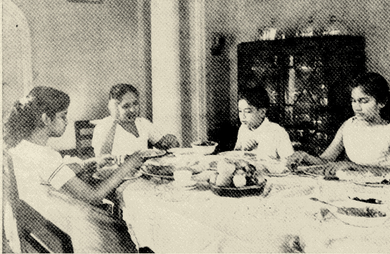
Bandaranaike often accompanied S.W.R.D. on official trips, both locally and abroad. She and her husband were both present after the psychiatric hospital in Angoda was bombed by the Japanese during the Easter Sunday Raid in 1942, killing many. As Ceylon moved toward self-governing status in 1947, S.W.R.D. became more active in the nationalist movement. He ran for – and was elected to – the House of Representatives from the Attanagalla Electoral District. He was appointed Minister of Health and served as Leader of the House, but became increasingly frustrated with the inner workings and policies of the United National Party. Though he did not encourage Bandaranaike to engage on political topics and was dismissive of her in front of colleagues, S.W.R.D. came to respect her judgment.
In 1951, she persuaded him to resign from the United National Party and establish the Sri Lanka Freedom Party (Freedom Party, aka SLFP). Bandaranaike campaigned in S.W.R.D.'s Attanagalla constituency during the 1952 parliamentary election, while he travelled around the country to garner support. Though the Freedom Party won only nine seats during that election, S.W.R.D. was elected to Parliament and became Leader of the Opposition.
When fresh elections were called in 1956 by Prime Minister Sir John Kotelawala, S.W.R.D. sensed an opportunity and formed the Mahajana Eksath Peramuna (MEP), a broad four-party coalition, to contest the 1956 elections. Bandaranaike once again campaigned for her husband in Attanagalla, in her home town of Balangoda, and in Ratnapura for the Freedom Party. The Mahajana Eksath Peramuna won a landslide victory and S.W.R.D. became the prime minister.
While on a state visit to Malaysia on its Independence in 1957, the couple had to cut short their stay when they received news that Bandaranaike's father was gravely ill following a heart attack. He died two weeks after their hasty return.
Bandaranaike was at home in Rosmead Place on the morning of 25 September 1959, when her husband was shot multiple times by a Buddhist monk, disgruntled over what he believed to be lack of support for traditional medicine. Bandaranaike accompanied her husband to hospital, where he succumbed to his wounds the following day.
In the political chaos that followed under the caretaker government of Wijeyananda Dahanayake, many cabinet ministers were removed, and some were arrested and tried for the assassination. The Mahajana Eksath Peramuna coalition collapsed without S.W.R.D.'s influence, and elections were called for March 1960 to fill the seat for the Attanagalla constituency. Bandaranaike reluctantly agreed to run as an independent candidate, but before the election could be held, Parliament was dissolved, and she decided not to contest the seat. When the election was held in March 1960, the United National Party won a four-seat majority over the Sri Lanka Freedom Party. Dudley Senanayake, the new prime minister, was defeated within a month in a vote of confidence and a second general election was called for July 1960.
Political career
In May 1960, Bandaranaike was unanimously elected party president by the executive committee of the Freedom Party, although at the time she was still undecided about running in the July election. Disavowing former party ties with Communists and Trotskyists, by early June she was campaigning with promises to carry forward the policies of her husband – in particular, establishing a republic, enacting a law to establish Sinhala as the official language of the country, and recognising the predominance of Buddhism, though tolerating the estate Tamils' use of their own language and Hindu faith.
Though there had been Tamil populations in the country for centuries, the majority of the estate Tamils had been brought to Ceylon from India by the British authorities as plantation workers. Many Ceylonese viewed them as temporary immigrants, even though they had lived for generations in Ceylon. With Ceylon's independence, the Citizenship Act of 1948 excluded these Indian Tamils from citizenship, making them stateless. S.W.R.D.'s policy toward the stateless Tamils had been moderate, granting some citizenship and allowing productive workers to remain. His successor, Dudley Senanayake, was the first to recommend compulsory repatriation for the population. Bandaranaike toured the country and made emotional speeches, frequently bursting into tears as she pledged herself to continue her late husband's policies. Her actions earned her the title "The Weeping Widow" from her opponents.
First female Prime Minister (1960–1965)
On 21 July 1960, following a landslide victory for the Freedom Party, Bandaranaike was sworn in as the first female prime minister in the world, as well as Minister of Defence and External Affairs. As she was not an elected member of parliament at the time, but leader of the party holding the majority in parliament, the constitution required her to become a member of Parliament within three months if she was to continue holding office as prime minister. To make a place for her, Manameldura Piyadasa de Zoysa resigned his seat in the Senate. On 5 August 1960, Governor General Goonetilleke appointed Bandaranaike to the Senate of Ceylon, the upper house of Parliament.
Initially, she struggled to navigate the issues facing the country, relying on her cabinet member and nephew, Felix Dias Bandaranaike. Opponents made dismissive comments about her "kitchen cabinet": she would continue to face similar sexism while in office.
To further her husband's policy of nationalising key sectors of the economy, Bandaranaike established a corporation with public-private shareholders, taking control of seven newspapers. She nationalised banking, foreign trade, and insurance, as well as the petroleum industry. In taking over the Bank of Ceylon and establishing branches of the newly created People's Bank, Bandaranaike aimed to provide services to communities with no previous banking facilities, spurring local business development.
In December 1960, Bandaranaike nationalised all the parochial schools that were receiving state funding. In doing so she curtailed the influence of the Catholic minority, who tended to be members of the economic and political elite, and extended the influence of Buddhist groups.
In January 1961, Bandaranaike implemented a law making Sinhala the official language, replacing English. This action caused wide discontent among the more than two million Tamil-speakers. Urged on by members of the Federal Party, a campaign of civil disobedience began in the provinces with Tamil majorities. Bandaranaike's response was to declare a state of emergency and send in troops to restore peace.
Beginning in 1961, trade unions began a series of strikes in protest of high inflation and taxes. One such strike immobilised the transport system, motivating Bandaranaike to nationalise the transport board.
In January 1962, conflicts erupted between the established elites: the predominantly right-wing Westernized urban Christians – including large contingents of Burghers and Tamils – and the emerging native elite, who were predominantly leftist Sinhala-speaking Buddhists. The changes caused by Bandaranaike's policies created an immediate shift away from the Anglophilic class system, power structures, and governance, significantly influencing the composition of the officer corps of the civil service, armed forces, and the police.
Some military officers plotted a coup d'état, which included plans to detain Bandaranaike and her cabinet members at the Army Headquarters. When the police official Stanley Senanayake was taken into the confidence of the coup leadership, his father-in-law Patrick de Silva Kularatne informed the IGP. Immediately calling all service commanders and junior officers to an emergency meeting at Temple Trees, Felix Dias Bandaranaike and members of Criminal Investigation Department (CID) began questioning the military personnel and uncovered the plot.
Because the coup was aborted before it began, the trial process for the 24 accused conspirators was lengthy and complex. The retroactive Criminal Law Special Provision Act of 1962, which allowed consideration of hearsay evidence, was passed to aid in the conviction of the plotters. Though rumours circulated against Sir Oliver Goonatillake, the governor general, there was no real evidence against him and therefore no means of prosecuting him. He was neither "removed from office nor did he resign". He agreed to answer questions about his suspected involvement once he was replaced. In February Bandaranaike's uncle, William Gopallawa was appointed Governor General. Goonatillake was escorted to the airport, left Ceylon, and went into voluntary exile.
In an attempt to balance east–west interests and maintain neutrality, Bandaranaike strengthened the country's relationship with China, while eliminating ties with Israel. She worked to maintain good relationships with both India and Russia, while keeping ties to British interests through the export of tea and supporting links with the World Bank. Condemning South Africa's apartheid policy, Bandaranaike appointed ambassadors to and sought relationships with other African nations. In 1961, she attended both the Commonwealth Prime Ministers' Conference in London and the 1st Summit of the Non-Aligned Movement in Belgrade, SFR Yugoslavia making Sri Lanka one of the founding members of the Non-Aligned Movement.
She was a key player in reducing tensions between India and China after their 1962 border dispute erupted into the Sino-Indian War. In November and December of that year, Bandaranaike called conferences in Colombo with delegates from Burma, Cambodia, Ceylon, Ghana and the United Arab Republic to discuss the dispute. She then travelled with Ghanaian Justice Minister Kofi Ofori-Atta to India and Peking, China in an attempt to broker peace. In January 1963, Bandaranaike and Orofi-Atta were rewarded in New Delhi, when Jawaharlal Nehru, the Indian Prime Minister, agreed to make a motion in the Indian Parliament recommending the settlement Bandaranaike had advocated for.
At home, difficulties were mounting. Despite her success abroad, Bandaranaike was criticised for her ties with China and lack of economic development policies. Tensions were still high over the government's apparent favouritism of Sinhala-speaking Ceylonese Buddhists. The import-export imbalance, compounded by inflation, was impacting the buying power of middle- and lower-class citizens. In the mid-year by-election, although Bandaranaike held a majority, the United National Party made gains, indicating that her support was slipping.
Lack of support for austerity measures, specifically the inability to import adequate rice – the main dietary staple – caused the resignation of Minister Felix Dias Bandaranaike. Other cabinet ministers were reassigned in an attempt to stem the drift toward Soviet trade partnerships, which had gained ground after the creation of the Ceylon Petroleum Corporation. The Petroleum Corporation had been launched in 1961 to bypass the monopolistic pricing imposed on Middle Eastern oil imports, allowing Ceylon to import oil from the United Arab Republic and the Soviet Union. Some of the storage facilities of western oil operatives were co-opted with a compensation agreement, but continuing disputes over non-payment resulted in suspension of foreign aid from the United States in February 1963. In reaction to the suspension of aid, the Parliament passed the Ceylon Petroleum Corporation Amendment Act nationalising all distribution, import-export, sales and supply of most oil products in the country, from January 1964.
Also in 1964, Bandaranaike's government abolished the independent Ceylon Civil Service and replaced it with the Ceylon Administrative Service, which was subject to government influence. When the United Left Front coalition between the Communist, Revolutionary Socialist and Trotskyist Parties was formed in late 1963, Bandaranaike moved left to try to gain their support. In February 1964, Chinese Premier Zhou Enlai visited Bandaranaike in Ceylon with offers of aid, gifts of rice and textiles, and discussions to extend trade. The two also discussed the Sino-Indian border dispute and nuclear disarmament. The ties with China were attractive, as Bandaranaike's recent formal recognition of East Germany had eliminated incoming aid from West Germany and her nationalisation of the insurance industry had impacted her relationships with Australia, Britain and Canada.
In preparation for the second Non-Aligned Conference, Bandaranaike hosted presidents Tito and Nasser in Colombo in March 1964, but continued domestic unrest caused her to suspend parliamentary sessions until July. In the interim, she entered into a coalition with the United Left Front and was able to shore up her majority, though only by a margin of three seats.
In September 1964 Bandaranaike led a delegation to India to discuss the repatriation of the 975,000 stateless Tamils residing in Ceylon. Along with Indian Prime Minister Lal Bahadur Shastri, she ironed out the terms of the Srimavo-Shastri Pact, a landmark agreement for the foreign policy of both nations. Under the agreement, Ceylon was to grant citizenship to 300,000 of the Tamils and their descendants while India was to repatriate 525,000 stateless Tamils. During the 15 years allotted to complete their obligations, the parties agreed to negotiate terms for the remaining 150,000. In October, Bandaranaike attended and co-sponsored the Non-Aligned Conference held in Cairo.
In December 1964, her United Front government put forward the "Press Take Over Bill" in an attempt to nationalise the country's newspapers. The opposition and Bandaranaike's critiques claimed that the move was to muzzle a free press and strike at her major critic, the Lake House Group led by the press baron Esmond Wickremesinghe. Wickremesinghe responded with a campaign to remove her from office to safeguard the freedom of the press. On 3 December 1964, C. P. de Silva, who was at one time S. W. R. D. Bandaranaike's deputy, led thirteen SLFP parliamentarians and crossed over to the opposition citing the Press Take Over Bill. The government of Sirima Bandaranaike lost the throne speech by one vote and a general election was called for in March 1965. Her political coalition was defeated in the 1965 elections, ending her first term as prime minister.
Leader of the opposition (1965–1970)
In the 1965 elections, Bandaranaike won a seat in the House of Representatives from the Attanagalla Electoral District. With her party gaining 41 seats, she became the Leader of the Opposition, the first woman ever to hold the post. Dudley Senanayake was sworn in as prime minister on 25 March 1965.
Soon after, Bandaranaike's position as a member of parliament was challenged, when allegations were made that she had accepted a bribe, in the form of a car, while in office. A committee was appointed to investigate and she was later cleared of the charge.
During her five-year term in the opposition, she maintained her alliance with leftist parties. Of the seven by-elections held between November 1966 and April 1967, six were won by the opposition under Bandaranaike's leadership. Continued inflation, trade imbalance, unemployment, and the failure of expected foreign aid to materialise led to widespread discontent. This was further fuelled by austerity measures, which reduced the weekly rice stipend. By 1969, Bandaranaike was actively campaigning to return to power. Among other pledges, she promised to give two measures of rice per household, nationalise foreign banks and the import-export industry, establish watchgroups for monitoring business and government corruption, return to a foreign policy which leaned away from "imperialist" partners, and hold a Constituent Assembly charged with drafting a new Constitution.
Second term (1970–1977)
Bandaranaike regained power after the United Front coalition between the Communist Party, the Lanka Sama Samaja Party and her own Freedom Party won the 1970 elections with a large majority in May 1970. By July, she had convened a Constitutional Assembly to replace the British-drafted constitution with one drafted by the Ceylonese. She introduced policies requiring that permanent secretaries in the government ministries have expertise in their division. For example, those serving in the Ministry of Housing had to be trained engineers, and those serving in the Ministry of Health, medical practitioners. All government employees were allowed to join Workers Councils and at the local level and she established People's Committees to allow input from the population at large on government administration. The changes were intended to remove elements of British colonial and foreign influence from the country's institutions.
Facing budget deficits of $195 million – caused by rising energy and food-importation costs and declining revenue from coconut, rubber and tea exports – Bandaranaike attempted to centralise the economy and implement price controls. Pressed by the leftist members of her coalition to nationalise the foreign banks of British, Indian and Pakistani origin, she realised that doing so would impact the need for credit. As she had in her previous regime, she tried to balance the flow of foreign assistance from both capitalist and communist partners.
In September 1970, Bandaranaike attended the third Non-Aligned Conference in Lusaka, Zambia. That month, she also travelled to Paris and London to discuss international trade. Ordering representatives of The Asia Foundation and the Peace Corps to leave the country, Bandaranaike began re-evaluating trade agreements and proposals that had been negotiated by her predecessor. She announced that her government would not recognise Israel until the country peacefully settled its problem with its Arab neighbours. She officially granted recognition to East Germany, North Korea, North Vietnam, and the National Liberation Front of South Vietnam. Bandaranaike opposed the development of an Anglo-US communications centre in the Indian Ocean, maintaining that the area should be a "neutral, nuclear-free zone". In December, the Business Undertaking Acquisition Act was passed, allowing the state to nationalise any business with more than 100 employees. Ostensibly, the move aimed to reduce foreign control of key tea and rubber production, but it stunted both domestic and foreign investment in industry and development.
Despite Bandaranaike's efforts to address the country's economic problems, unemployment and inflation remained unchecked. After just 16 months in power, Bandaranaike's government was almost toppled by the 1971 Janatha Vimukthi Peramuna Insurrection of left-wing youths. Though aware of the militant stance of the Janatha Vimukthi Peramuna (People's Liberation Front), Bandaranaike's administration initially failed to recognise them as an imminent threat, dismissing them as idealists.
On 6 March, militants attacked the U.S. Embassy in Colombo, leading to the declaration of a state of emergency on 17 March. In early April, attacks on police stations evidenced a well-planned insurgency which Ceylon's small army was ill-equipped to handle. Calling on its allies for assistance, the government was saved largely because of Bandaranaike's neutral foreign policy. The Soviet Union sent aircraft to support the Ceylonese government; arms and equipment came from Britain, the United Arab Republic, the United States and Yugoslavia; medical supplies were provided by East and West Germany, Norway and Poland; patrol boats were sent from India; and both India and Pakistan sent troops. On 1 May, Bandaranaike suspended government offensives and offered an amnesty, which resulted in thousands of surrenders. The following month a second amnesty was offered. Bandaranaike established a National Committee of Reconstruction to re-establish civil authority and provide a strategic plan for dealing with those captured or surrendered insurgents. One of the Bandaranaike's first actions after the conflict was to expel North Korean diplomats, as she suspected they had fomented the radical discontent. The saying "She was the only man in her cabinet" – attributed to her political opponents in the 1960s – resurfaced during the height of the insurgency, as Bandaranaike proved that she had become a "formidable political force".
In May 1972, Ceylon was replaced by the Republic of Sri Lanka after a new Constitution was ratified. Though the country remained within the Commonwealth of Nations, Queen Elizabeth II was no longer recognised as its sovereign. Under its terms, the Senate, suspended since 1971, was officially abolished and the new unicameral National State Assembly was created, combining the powers of the executive, judicial and legislative branches in one authority.
The constitution recognised the supremacy of Buddhism, though it guaranteed equal protection to Buddhism, Christianity, Hinduism, and Islam. It failed to provide a charter of inalienable rights, recognised Sinhala as the only official language, and contained no "elements of federalism".
The new constitution also extended Bandaranaike's term by two years, resetting the mandated five-year term of the prime minister to the coincide with the creation of the republic. These limits caused concern for various sectors of the population, specifically those who were uneasy about authoritarian rule, and the Tamil-speaking population. Before the month was out, the discontent escalated before leading to the passage of the Justices Commission Bill, establishing separate tribunals to deal with the imprisoned insurgents from the previous year. Those in opposition to the tribunals argued that they were a violation of the principles of human rights. By July, sporadic incidents of violence were resurfacing, and by the end of the year, a second wave of revolt was anticipated. Widespread unemployment fuelled the public's growing disillusionment with the government, in spite of land redistribution programmes enacted to establish farming cooperatives and limit the size of privately held lands.
In 1972, Bandaranaike introduced major land reforms in Sri Lanka, with the enactment of the Land Reform Act of No. 01 of 1972 which imposed a ceiling of twenty hectares on privately owned land, this was later followed up by the Land Reform (Amendment) Act in 1975 that nationalized plantations owned by public companies. The objective of these land reforms were to grant lands to landless peasants. Critiques claimed that the second wave of reforms were targeted the wealthy landowners that had traditionally supported the United National Party. As a result of these reforms the state became the largest plantation owner and two entities, the Sri Lanka State Plantations Corporation, the Janatha Estate Development Board (People's Estate Development Board) and the USAWASAMA (Upcountry Cooperative Estate Development Board) were established to manage these estates. In the years following these land reforms, the production of the key export crops which Sri Lanka depended on for the in follow of foreign currency dropped.
The 1973 oil crisis had a traumatic effect on the Sri Lankan economy. Still dependent on foreign assistance, goods and monetary aid from Australia, Canada, China, Denmark, Hungary, and the World Bank, Bandaranaike eased the austerity programmes that limited importation of consumer goods. The United States terminated aid grants, which required no repayment, and changed to a policy of providing foreign loans. Devaluation of the Sri Lankan currency, coupled with inflation and high taxes, slowed economic growth, consequently creating cyclical pressure to address deficits with even higher taxes and austerity measures. Uncontrolled inflation between 1973 and 1974 led to economic uncertainty and public dissatisfaction.
In 1974, Bandaranaike forced the shut-down of the last independent newspaper group, The Sun, believing their criticism was fuelling unrest. Fissures appeared in the United Front coalition, largely resulting from the Lanka Sama Samaja Party's continued influence on trade unions and threats of strike actions throughout 1974 and 1975. When newly confiscated estates were placed under the Ministry of Agriculture and Lands, controlled by the Lanka Sama Samaja Party, fears that they would unionise plantation workers led Bandaranaike to oust them from the government coalition.