
Sir Syed Ahmad Khan (17 October 1817 – 27 March 1898), also spelled Sayyid Ahmad Khan, was an Indian Muslim reformer, philosopher, and educationist in nineteenth-century British India.
Though initially espousing Hindu–Muslim unity, he later became the pioneer of Muslim nationalism in India and is widely credited as the father of the two-nation theory, which formed the basis of the Pakistan movement. Born into a family with strong ties to the Mughal court, Ahmad studied science and the Quran within the court. He was awarded an honorary LLD from the University of Edinburgh in 1889.
In 1838, Syed Ahmad entered the service of East India Company and went on to become a judge at a Small Causes Court in 1867, retiring from this position in 1876. During the Indian Mutiny of 1857, he remained loyal to the British Raj and was noted for his actions in saving European lives. After the rebellion, he penned the booklet The Causes of the Indian Mutiny – a daring critique, at the time, of various British policies that he blamed for causing the revolt. Believing that the future of Muslims was threatened by the rigidity of their orthodox outlook, Sir Ahmad began promoting Western–style scientific education by founding modern schools and journals and organising Islamic entrepreneurs. He founded Victoria School at Ghazipur in 1863 and a scientific society for Muslims in 1864. In 1875, he founded the Muhammadan Anglo-Oriental College, the first Muslim university in Southern Asia. During his career, Syed repeatedly called upon Muslims to loyally serve the British Raj and promoted the adoption of Urdu as the lingua franca of all Indian Muslims. He disagreed with the Indian National Congress over parliamentary democracy, believing it would lack impartiality given the widespread communal tensions and limitations of education in South Asia. He remained committed to secularism and inclusive politics.

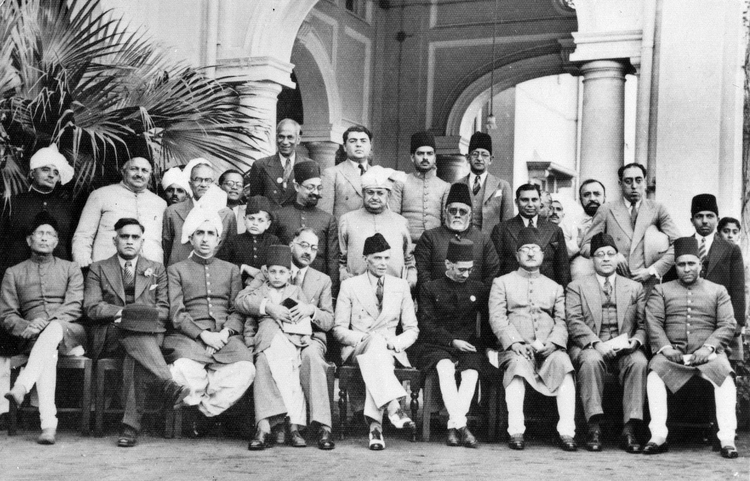
Sir Syed maintains a strong legacy in Pakistan and among Indian Muslims. He became a source of inspiration for the Pakistan Movement and its activists, including Allama Iqbal and Muhammad Ali Jinnah. His advocacy of Islam's rationalist tradition, and a broader, radical reinterpretation of the Quran to make it compatible with science and modernity, continues to influence the global Islamic reformation. Many universities and public buildings in Pakistan bear Sir Syed's name. Aligarh Muslim University celebrated Sir Syed's 200th birth centenary with much enthusiasm on 17 October 2017.
Early life
Do not show the face of Islam to others; instead show your face as the follower of true Islam representing character, knowledge, tolerance and piety.
Syed Ahmad Taqvi 'Khan Bahadur' was born on 17 October 1817 to Syed Muhammad Muttaqi and Aziz-un-Nisa in Delhi, which was the capital of the Mughal Empire during the reign of Mughal Emperor Akbar II. Many generations of his family had been highly connected with the Mughal administration. His maternal grandfather Khwaja Fariduddin served as Wazir in the court of Emperor Akbar Shah II. His paternal grandfather Syed Hadi Jawwad bin Imaduddin held a mansab (lit. General) – a high-ranking administrative position - and the honorary name of "Mir Jawwad Ali Khan" in the court of Emperor Alamgir II. Sir Syed's father, Syed Muhammad Muttaqi, was personally close to Emperor Akbar Shah II and served as his personal adviser. However, Syed Ahmad was born at a time when his father was involved in regional insurrections aided and led by the East India Company, which had replaced the power traditionally held by the Mughal state, reducing its monarch to a figurehead.
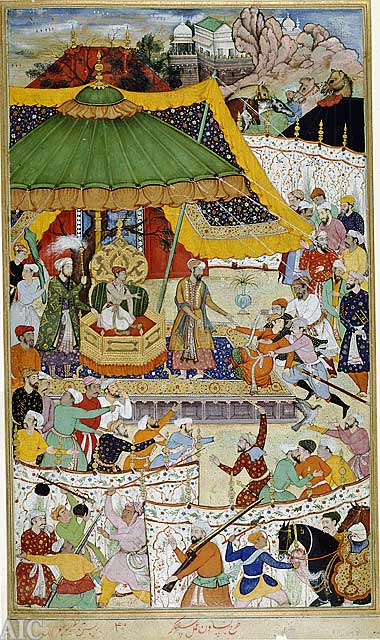
Syed Ahmad was the youngest of three siblings. With his elder brother Syed Muhammad bin Muttaqi Khan and elder sister Safiyatun Nisa, Sir Syed was raised in the house of his maternal grandfather in a wealthy area of the city. They were raised in strict accordance with Mughal noble traditions and they were exposed to politics. Their mother Aziz-un-Nisa played a formative role in Sir Syed's early life, raising him with rigid discipline and a strong emphasis on modern education.
Education
Sir Syed's education was initiated by Shah Ghulam Ali, his father's spiritual mentor in 1822. He was taught to read and understand the Qur'an by a female tutor Areeba Sehar. He received an education traditional to Muslim nobility in Delhi. He attended a maktab run by a learned scholar, Moulvi Hamiduddin, in a house adjacent to his ancestral home and started learning Persian and Arabic. He read the works of Muslim scholars and writers such as Sahbai, Zauq and Ghalib. Other tutors instructed him in mathematics, astronomy and algebra. He also pursued the study of medicine for several years under Hakim Ghulam Haider Khan. Sir Syed was also adept at swimming, shooting and other sports. He took an active part in the Mughal court's cultural activities and attended parties, festivals and recitations.
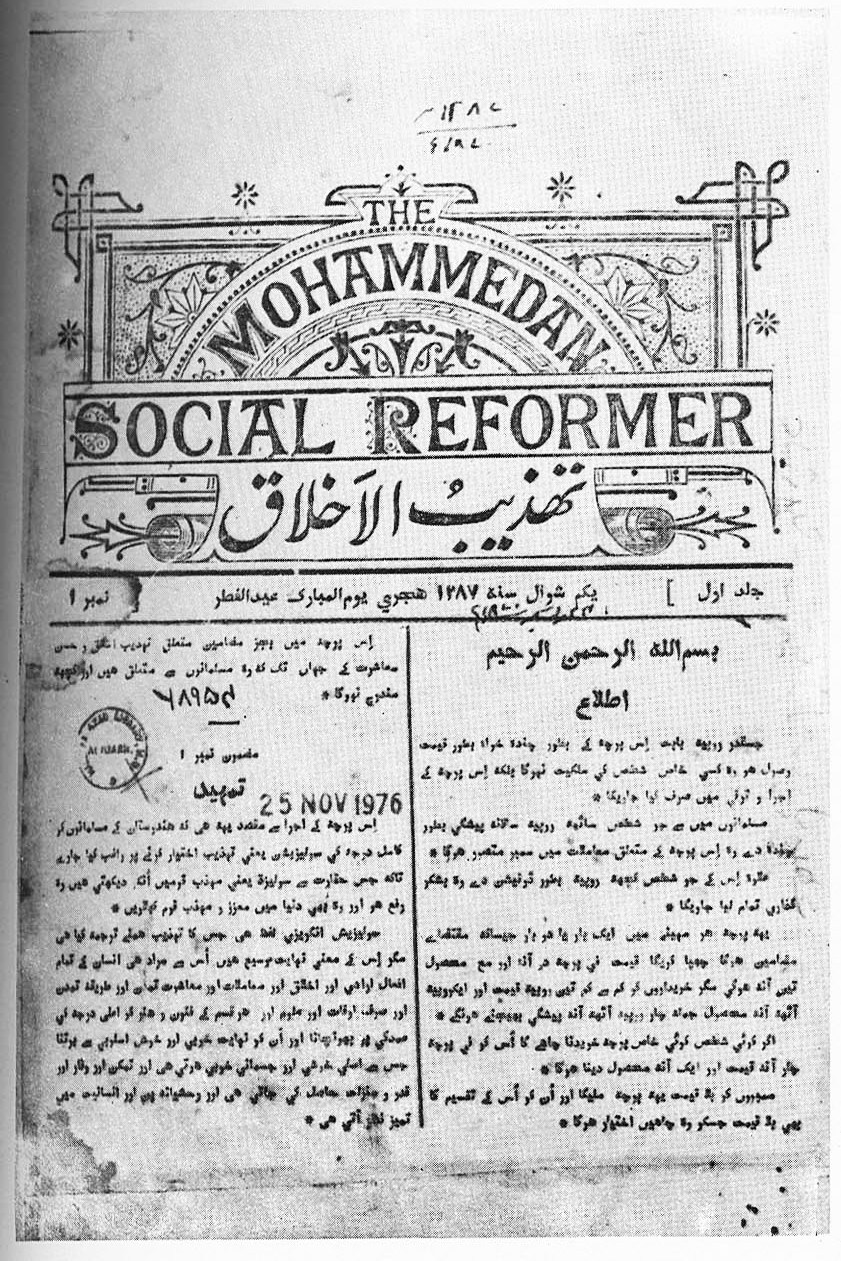
Syed Ahmad's elder brother launched a weekly, “Syedul Akhbar”, from Delhi, which was one of the earliest Urdu newspapers in northern India. Until the death of his father in 1838, Sir Syed had lived a life customary for an affluent young Muslim noble. Upon his father's death, he inherited the titles of his grandfather and father and was awarded the title of Arif Jung by the emperor Bahadur Shah Zafar. Financial difficulties put an end to Sir Syed's formal education, although he continued to study in private, using books on a variety of subjects.

Career
Having recognised the steady decline in Mughal political power, Sir Syed decided to enter the service of the East India Company. He could not enter the colonial civil service because it was only in the 1860s that Indians were admitted. His first appointment was as a Serestadar (lit. Clerk) of the Criminal Department in the Sadr Amin's office in Delhi, responsible for record-keeping and managing court affairs. In February 1839, he was transferred to Agra and promoted to the title of Naib Munshi or deputy reader in the office of the Commissioner. In 1841 he was appointed as the Munsif or Sub-Judge of Fatehpur Sikri and later transferred to Delhi in 1846. He remained in Delhi until 1854 except for two short-term postings to Rohtak as officiating Sadr Amin in 1850 and 1853. In 1855 he was promoted to the post of Sadr Amin in Bijnor.
Acquainted with high-ranking British officials, Sir Syed obtained close knowledge about British colonial politics during his service at the courts. At the outbreak of the Indian rebellion, on 10 May 1857, Sir Syed was serving as the chief assessment officer at the court in Bijnor. He stood by the British officers of Bijnor and saved the lives of many officers and their family members from the revolting soldiers. The conflict had left large numbers of civilians dead. Erstwhile centres of Muslim power such as Delhi, Agra, Lucknow and Kanpur were severely affected. He lost several close relatives who died in the violence. Although he succeeded in rescuing his mother from the turmoil, she died in Meerut, owing to the privations she had experienced.
In 1858, he was appointed as Sadarus Sudoor, a high-ranking post at the court in Muradabad, where he began working on his most famous literary work, The Cause of the Indian Revolt. In 1862, he was transferred to Ghazipur, and later to Aligarh in 1864. In 1864 he was sent to Banaras and elevated to the position of a Sub-Judge of Small Causes.

In April 1869, he accompanied his two sons Syed Hamid and Syed Mahmood to England, the latter had obtained a scholarship to study in England.
Sir Syed retired from government service in 1876 and settled in Aligarh. In 1878, he was nominated as an additional member of the Imperial Legislative Council, which he served from July 1878 to July 1880. He also served a second term that lasted until 1883. He served the Legislative Council of the Lieutenant Governor of the North- Western Provinces for two terms from 1887 until 1893.
Influences
Sir Syed's early influences were his mother Aziz-un-Nisa and maternal grandfather Khwaja Fariduddin both of whom took special interest in his education. Apart from serving as a Wazir in the Mughal court, Khwaja Fariduddin was also a teacher, mathematician and astronomer. He was also disposed towards Sufism, which left its impact on Sir Syed since his early childhood. His maternal uncle Khwaja Zainuddin Ahmad, who was an expert in music and mathematics, also influenced him in his early days.
Sir Syed's early theological writings demonstrate the influence of three school of religious thought on his outlook - the Naqshbandi tradition of Shah Ghulam Ali Dahlavi, Shah Waliullah Dehlawi and his teachings, and the Mujahidin movement of Syed Ahmad Barelvi and his earliest disciple Shah Ismail Dehlvi. While Sir Syed shared the desire for religious forms in India with the Mujahidin movement, he was opposed to the Indian Wahhabi movement.
During his formative years in Delhi he came in contact with Ghalib and Zauq whose exquisite style of prose and poetry influenced Sir Syed's style of writing. He would often visit Imam Baksh Sahbai and Sadruddin Khan Azurda Dehlawi in his learning years. Another influence on him was his teacher and friend in Agra, Nur al Hasan of Kandhala, a teacher in Arabic at Agra College in the early 1840s who encouraged and corrected his early works.
He was also influenced by the works of the Tunisian reformer Hayreddin Pasha and adopted his approach of utilising freedom of expression for bringing reforms in the Muslim community.
The western writers who most influenced his political thoughts were the Utilitarians such as John Stuart Mill, whose works he often quoted in his own writings. He was also influenced by the essays of Joseph Addison and Richard Steele and modelled his own journals after their Tatler and Spectator.
Literary works
While continuing to work as a junior clerk, Sir Syed began focusing on writing, from the age of 23 (in 1840), on various subjects (from mechanics to educational issues), mainly in Urdu, where he wrote, at least, 6000 pages. He also wrote a well known book on archaeology called Athar-ul-Sandeed. He also developed interest in literature as he met a few of India's well known writers.
Religious works
Sir Syed Ahmad Khan's career as an author began when he published a series of treatises in Urdu on religious subjects in 1842. In his early religious writings his religious thoughts were more orthodox; over time, with his increasing contact with the West, his views gradually became more independent. His early works show the influence of Sufism and his upbringing in Delhi. The main themes of these works are popularisation of the practices of the Islamic prophet Muhammad as the one true path and the desire to reform the lives of Indian Muslims from religious innovations, thus endeavoring for the purity of Islamic belief in India.
His later religious writings, such as his commentary on the Torah and Gospel and his essays on Muhammad, were stimulated in response to Christian missionary activities in India and the aggressive view of British historians towards Islam.
Early treatises
His first treatise published in 1842 was a biographical sketch of Muhammad, called Jila al-Qulub bi Zikr al-Mahbub (Delight of the Hearts in Remembering the Beloved), in line with the reformist ideas of Shah Waliullah. It was prose for recitation on Mawlid written in idiomatic Urdu. He published his second treatise Tuhfa-i Hasan (The Gift to Hasan) in 1844 on the encouragement of his friend Nur al Hasan. It is an Urdu translation of the tenth and twelfth chapter of Shah Abdul Aziz Dehlavi's Tuhfah-i Ithna Ashariyya (A treatise on the 12 Imams), which was a critique of Shia beliefs. The tenth chapter deals and answers the Shia accusations against the Sahabi and Hazrat Aisha and the twelfth deals with the Shia doctrines of tawalli and tabarri.
His third treatise, entitled Kalimat al-Haqq (The True Discourse), was published in 1849. It is a critique of the prevalent Sufi practices around pir–murid relationships. The first part of the work is devoted to the concept of piri. In this part, he argues that Muhammad is the only valid pir. The work's second part is focused on muridi and the notion of bay'ah. He calls for reforms in the pir-murid relationship and the associated practises. Rah i Sunna dar radd i Bid'a (The Sunna and the Rejection of Innovations), his fourth treatise, was published in 1850. In this work, he expressed his opposition to certain religious practices and beliefs of his fellow Muslims, which he felt were mixed with innovation and deviated from the true Sunnah. In 1852 he published Namiqa dar bayan masala tasawwur-i-Shaikh (A Letter Explaining the Teaching of tasawwur i shaikh), in which he defended tasawwur-i-Shaikh, the Sufi practice of visualising within, the image of one's spiritual guide. In 1853 he translated some passages of al-Ghazali's Kimiya al-Sa'ada (The Alchemy of Happiness).
Commentary of the Torah and Gospel
In 1862 while stationed at Ghazipur, Sir Syed started working on a commentary on the Bible and its teaching, with the aim to explain them in terms of Islam. It was published in Urdu and English in three parts from 1862 to 1865 under the title Tabin al-al-kalam Fi tafsir altawrat Wa ‘I-injil’ala millat al Islam (Elucidation of the World in Commentary of the Torah and Gospel According to the Religion of Islam). While the first part deals with the Islamic approach towards biblical writings, the second and third part contains commentary on the Book of Genesis and the Gospel of Matthew respectively.
Essays on the Life of Muhammad
In 1869 he wrote Al-Khutbat al-Ahmadiya fi'l Arab wa'I Sirat al-Muhammadiya (A Series of Essays on the Life of Prophet Muhammad and Subjects Subsidiary Therein) as a rejoinder to William Muir's widely known four-part book, The Life of Mahomet published in 1864. He was deeply distressed by Muir's portrayal of Islam and the character of Muhammad. He was concerned that the book might create doubts among the younger generation of Muslims. In order to prepare for the book, he accompanied his son to England, as he wanted to get a first-hand impression of Western civilisation.
He was also a reader of Darwin and, while not agreeing with all of his ideas, he could be described as a sort of theistic evolutionist like his contemporary Asa Gray. Syed Ahmad was one of the first in the Islamic world to adopt this view. His arguments in favour of the idea were based on both findings from his own scientific research and quotes from earlier Islamic scholars like Al-Jahiz, Ibn Khaldun and Shah Waliullah.
Tafsir-ul-Quran
Sir Syed started working on a tafsir, or commentary on the Quran, in 1877. It was published as Tafsir ul-Quran in seven volumes; the first volume appeared in 1880 and the last volume was published six years after his death in 1904. In this work, he analysed and interpreted 16 paras and 13 surahs of the Quran. In the first volume, he also included a detailed article titled Tahrir fi Usool al-Tafsir (The Notes on the Principles of Commentary), in which he laid down 15 principles on which he based his commentary.
Historical works
History was Sir Syed's preferred area of study and in 1840, Sir Syed compiled a book of chronological tables about the Timurid rulers of Delhi from Timur to Bahadur Shah Zafar at the behest of Robert N. C. Hamilton, his patron. It was later published under the title Jam-i-Jum (Jamshed's Cup). In Silsilat-ul-Mulk he compiled the biographical data of all the rulers of Delhi in history. During his stay in Bijnor, he wrote a history on the city of Bijnor, but it was destroyed during the 1857 rebellion. He also wrote critical editions of books like Ziauddin Barani's Tarikh-e-Firoz Shahi published in 1862, and Tuzk-e-Jahangiri published in 1864. However, his most important historical works that brought him fame as a scholar were the two editions of Asar-us-Sanadid and that of the Ain-e-Akbari.
Asar-us-Sanadid
In 1847, he published the book Asar-us-Sanadid (The Remnants of Ancient Heroes) documenting antiquities of Delhi dating from the medieval era. The work is divided into four sections: the first describes the buildings outside the city of Delhi; the second describes the buildings around the Delhi Fort; the third describes the monuments in Shahjahanabad; and the last section presents a brief historical account of the various settlements of Delhi as well as the prominent inhabitants of Delhi, including Sufis (such as Shah Ghulam Ali and Saiyid Ahmad Shahid), physicians, scholars, poets, calligraphers, and musicians. It also contained around 130 illustrations drawn by Faiz Ali Khan and Mirza Shahrukh Beg, which were the first lithographically produced book illustrations in India. Syed Ahmad released the second edition of Ansar-as-Sanadid in 1854. However, the second edition was radically different from the first – the second was abbreviated and more factual. This work brought Sir Syed a wider fame and earned him the reputation of a cultured scholar. In 1861, it was translated into French by Gracin de Tassy in Paris. The book was also presented to the Royal Asiatic Society of Great Britain and Ireland in London, which made him an honorary fellow.
Ain-e-Akbari
In 1855, he finished his scholarly, and illustrated edition of Abul Fazl's A'in-e Akbari. The first and the third volume of the work were both published in 1855. The second volume, sent to the publisher in 1857, was destroyed in the rebellion that took place that year. Having finished the work to his satisfaction, and believing that Mirza Asadullah Khan Ghalib was a person who would appreciate his labours, Syed Ahmad approached the great Ghalib to write a taqriz (in the convention of the times, a laudatory foreword) for it. Ghalib obliged, but what he did produce was a short Persian poem castigating the A'in-e Akbari, and by implication, the imperial, sumptuous, literate and learned Mughal culture of which it was a product. The least that could be said against it was that the book had little value even as an antique document. Ghalib practically reprimanded Syed Ahmad Khan for wasting his talents and time on dead things. Worse, he praised sky-high the "sahibs of England" who at that time held all the keys to all the a’ins in this world.
Sir Syed Ahmad Khan never again wrote a word in praise of the A'in-e Akbari and in fact gave up taking an active interest in history and archaeology. He did edit another two historical texts over the next few years, but neither of them was anything like the A'in: a vast and triumphalist document on the governance of Akbar.
Political works
During the uprising of 1857, Sir Syed was posted as a chief assessment officer at the court in Bijnor. He recorded the history of the mutiny in Tarikh i Sarkashi-ye Bijnor (History of the Bijnor Rebellion), which was published in 1858. He was deeply worried about the consequences of the mutiny for his fellow Muslims in particular. He wrote a number of articles and pamphlets such as Asbab-e-Baghawat-e-Hind (The Causes of the Indian Revolt), Loyal Muhammadans of India, and Review on Dr Hunter's Indian Musalmans: Are They Bound in Conscience to Rebel Against the Queen? to defend Muslims and Islam and create a cordial relations between the British authorities and the Muslim community.
Causes of the Indian Revolt
Sir Syed supported the East India Company during the 1857 uprising, a role which has been criticised by some nationalists such as Jamaluddin Afghani. In 1859 Sir Syed published the booklet Asbab-e-Baghawat-e-Hind (The Causes of the Indian Revolt) in Urdu in which he studied the causes of the Indian revolt. In this, his most famous work, he rejected the common notion that the conspiracy was planned by Muslim elites, who resented the diminishing influence of Muslim monarchs. He blamed the East India Company for its aggressive expansion as well as the ignorance of British politicians regarding Indian culture. Sir Syed advised the British to appoint Muslims to assist in administration, to prevent what he called ‘haramzadgi’ (a vulgar deed) such as the mutiny.
Maulana Altaf Hussain Hali wrote in the biography of Sir Syed that: "As soon as Sir Syed reached Muradabad, he began to write the pamphlet entitled The Causes of the Indian Revolt (Asbab-e-Baghawat-e-Hind), in which he did his best to clear the people of India, and especially the Muslims, of the charge of Mutiny. In spite of the obvious danger, he made a courageous and thorough report of the accusations people were making against the Government and refused theory which the British had invented to explain the causes of the Mutiny."
When the work was finished, without waiting for an English translation, Sir Syed sent the Urdu version to be printed at the Mufassilat Gazette Press in Agra. Within a few weeks, he received 500 copies back from the printers. One of his friends warned him not to send the pamphlet to the British Parliament or to the Government of India. Rae Shankar Das, a great friend of Sir Syed, begged him to burn the books rather than put his life in danger. Sir Syed replied that he was bringing these matters to the attention of the British for the good of his own people, of his country, and of the government itself. He said that if he came to any harm while doing something that would greatly benefit the rulers and the subjects of India alike, he would gladly suffer whatever befell him. When Rae Shankar Das saw that Sir Syed's mind was made up and nothing could be done to change it, he wept and remained silent. After performing a supplementary prayer and asking God's blessing, Sir Syed sent almost all the 500 copies of his pamphlet to England, one to the government, and kept the rest himself.
When the government of India had the book translated and presented before the council, Lord Canning, the governor-general, and Sir Bartle Frere accepted it as a sincere and friendly report. The foreign secretary Cecil Beadon, however, severely attacked it, calling it 'an extremely seditious pamphlet'. He wanted a proper inquiry into the matter and said that the author, unless he could give a satisfactory explanation, should be harshly dealt with. Since no other member of the Council agreed with his opinion, his attack did no harm.
Later, Sir Syed was invited to attend Lord Canning's durbar in Farrukhabad and happened to meet the foreign secretary there. He told Sir Syed that he was displeased with the pamphlet and added that if he had really had the government's interests at heart, he would not have made his opinion known in this way throughout the country; he would have communicated it directly to the government. Sir Syed replied that he had only had 500 copies printed, the majority of which he had sent to England, one had been given to the government of India, and the remaining copies were still in his possession. Furthermore, he had the receipt to prove it. He was aware, he added, that the view of the rulers had been distorted by the stress and anxieties of the times, which made it difficult to put even the most straightforward problem in its right perspective. It was for this reason that he had not communicated his thoughts publicly. He promised that for every copy that could be found circulating in India he would personally pay 1,000 rupees. At first, Beadon was not convinced and asked Sir Syed over and over again if he was sure that no other copy had been distributed in India. Sir Syed reassured him on this matter, and Beadon never mentioned it again. Later he became one of Sir Syed's strongest supporters.
Many official translations were made of the Urdu text of The Causes of the Indian Revolt. The one undertaken by the India Office formed the subject of many discussions and debates. The pamphlet was also translated by the government of India and several members of parliament, but no version was offered to the public. A translation which had been started by Auckland Colvin, a government official was finished by Sir Syed's friend, Colonel G.F.I. Graham, and finally published in 1873.
Loyal Muhammadans of India
In 1860, Sir Syed wrote a series of bilingual pamphlets called the Risala Khair Khwahan-e Musalmanan-e-Hind (An Account of the Loyal Mohammedans of India) from Meerut containing episodes in the life of those Muslims who stood by the British during the 1857 uprising. It was published in three issues, the first and second issues appeared in 1860, while the third was published in 1861. The first issue highlighted the bravery of those Muslims who stood by the British while the second issue carried an article on jihad in which he makes a clear distinction between jihad and rebellion.
Review on Hunter's Indian Musalmans
In August 1871 William Wilson Hunter, a Scottish historian and member of the Indian Civil Service published Indian Musalmans: Are They Bound in Conscience to Rebel Against the Queen? in which he discussed the Indian Wahabi movement, its role in the rebellion and argued that the Muslims were a threat to the Empire. Hunter links Wahhabism with rebellion and terms them as self-stylised jihadis. His accusations led to the prosecution of Muslims in India especially in the North Western Provinces and those associated with Wahhabism were severely punished. Many Muslims found his arguments one-sided and this prompted Sir Syed to write a rejoinder of the book. He reviewed the book in The Pioneer in a series of articles which were reprinted in Aligarh Institute Gazette from 24 November 1871, to 23 February 1872. They were later collected and published in a book in England by Hafiz Ahmad Hasan, the Vakil of Tonk. Sir Syed based his arguments upon Muhammad's own conduct during holy wars.
Muslim reformer
Through the 1850s, Syed Ahmad Khan began developing a strong passion for education. While pursuing studies of different subjects including European jurisprudence, Sir Syed began to realise the advantages of Western-style education, which was being offered at newly established colleges across India. Despite being a devout Muslim, Sir Syed criticised the influence of traditional dogma and religious orthodoxy, which had made most Indian Muslims suspicious of British influences. Sir Syed began feeling increasingly concerned for the future of Muslim communities. A scion of Mughal nobility, Sir Syed had been reared in the finest traditions of Muslim elite culture and was aware of the steady decline of Muslim political power across India. The animosity between the British and Muslims before and after the Indian Rebellion of 1857 threatened to marginalise Muslim communities across India for many generations.