
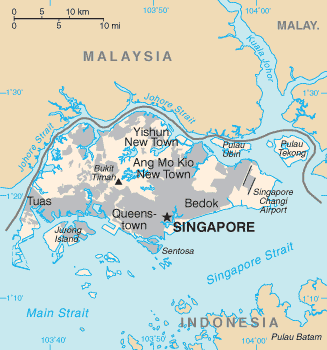
Singapore, officially the Republic of Singapore, is an island country in Southeast Asia. Its territory comprises a main island, over 60 satellite islands and islets, and one outlying islet. The country is about one degree of latitude (137 kilometres or 85 miles) north of the equator, off the southern tip of the Malay Peninsula, bordering the Strait of Malacca to the west, the Singapore Strait to the south along with the Riau Islands in Indonesia, the South China Sea to the east and the Straits of Johor along with the State of Johor in Malaysia to the north.
In its early history, Singapore was a maritime emporium known as Temasek; subsequently, it was a major constituent of several successive thalassocratic empires. Its contemporary era began in 1819, when Stamford Raffles established Singapore as an entrepôt trading post of the British Empire. In 1867, Singapore came under direct British control as part of the Straits Settlements. During World War II, Singapore was occupied by Japan in 1942 and returned to Britain as a Crown colony following Japan's surrender in 1945. Singapore gained self-governance in 1959 and in 1963 became part of the new federation of Malaysia, alongside Malaya, North Borneo and Sarawak. Ideological differences led to Singapore's expulsion from the federation two years later; it became an independent sovereign country in 1965. After early years of turbulence and despite lacking natural resources and a hinterland, the nation rapidly developed to become one of the Four Asian Tigers.
As a highly developed country, Singapore has the highest PPP-adjusted GDP per capita in the world and is the only country in Asia with a AAA sovereign credit rating from all major rating agencies. Identified as a tax haven, it is a major aviation, financial and maritime shipping hub and has consistently been ranked as one of the most expensive cities for expatriates and foreign workers. Singapore ranks highly in key social indicators: education, healthcare, housing, peacefulness, passport strength, personal safety and infrastructure, with a high home-ownership rate. Singaporeans enjoy one of the longest life expectancies, fastest Internet connection speeds, lowest infant mortality rates and lowest levels of corruption in the world. Singapore is organised into five regions, 55 planning areas and hundreds of subzones. It has the second highest population density of any country, although there are numerous green and recreational spaces as a result of urban planning. With a multicultural population and in recognition of the cultural identities of the country's major ethnic groups, Singapore has four official languages: English, Malay, Mandarin and Tamil. English is the common language, with exclusive use in numerous public services. Multi-racialism is enshrined in the constitution and continues to shape national policies.

Singapore is a parliamentary republic and its legal system is based on common law. While it is constitutionally a multi-party democracy where free elections are regularly held, it functions as a de facto one-party state, with the People's Action Party (PAP) maintaining continuous political dominance since 1959. The PAP's longstanding control has resulted in limited political pluralism and a highly centralised governance structure over national institutions. One of the five founding members of ASEAN, Singapore is also the headquarters of the Asia-Pacific Economic Cooperation Secretariat, the Pacific Economic Cooperation Council Secretariat and is the host city of many international conferences and events. Singapore is also a member of the United Nations, the World Trade Organization, the East Asia Summit, the Non-Aligned Movement and the Commonwealth of Nations.
Name and etymology
The English name of "Singapore" is an anglicisation of the native Malay name for the country, Singapura (Malay pronunciation: [siŋapura] ), which was in turn derived from the Sanskrit word for 'lion city' (Sanskrit: सिंहपुर; romanised: Siṃhapura; Brahmi: 𑀲𑀺𑀁𑀳𑀧𑀼𑀭; literally "lion city"; siṃha means 'lion', pura means 'city' or 'fortress'). Pulau Ujong was one of the earliest names for the island of Singapore, which corresponds to a Chinese account from the third century referred to a place as Pú Luó Zhōng (Chinese: 蒲 羅 中), a transcription of the Malay name for 'island at the end of a peninsula'. Early references to the name Temasek (or Tumasik) are found in the Nagarakretagama, a Javanese eulogy written in 1365, and a Vietnamese source from the same time period. The name possibly means Sea Town, being derived from the Malay tasek, meaning 'sea' or 'lake'. The Chinese traveller Wang Dayuan visited a place around 1330 named Danmaxi (Chinese: 淡馬錫; pinyin: Dànmǎxí; Wade–Giles: Tan Ma Hsi) or Tam ma siak, depending on pronunciation; this may be a transcription of Temasek, alternatively, it may be a combination of the Malay Tanah meaning 'land' and Chinese xi meaning 'tin', which was traded on the island.
Variations of the name Siṃhapura were used for a number of cities throughout the region prior to the establishment of the Kingdom of Singapura. In Hindu–Buddhist culture, lions were associated with power and protection, which may explain the attraction of such a name. The name Singapura supplanted Temasek sometime before the 15th century, after the establishment of the Kingdom of Singapura on the island by a fleeing Sumatran Raja (prince) from Palembang. However, the precise time and reason for the name change is unknown. The semi-historical Malay Annals state that Temasek was christened Singapura by Sang Nila Utama, a 13th-century Sumatran Raja from Palembang. The Annals state that Sang Nila Utama encountered a strange beast on the island that he took to be a lion. Seeing this as an omen, he established the town of Singapura where he encountered the beast. The second hypothesis, drawn from Portuguese sources, postulates that this mythical story is based on the real life Parameswara of Palembang. Parameswara declared independence from Majapahit and mounted a Lion Throne. After then being driven into exile by the Javanese, he usurped control over Temasek. He may have rechristened the area as Singapura, recalling the throne he had been driven from.

Under Japanese occupation, Singapore was renamed Syonan-to (Japanese: 昭 南, Hepburn: Shōnan), meaning 'light of the south'. Singapore is sometimes referred to by the nickname the "Garden City", in reference to its parks and tree-lined streets. Another informal name, the "Little Red Dot", was adopted after an article in the Asian Wall Street Journal of 4 August 1998 said that Indonesian President B. J. Habibie referred to Singapore as a red dot on a map.
History
Ancient Singapore
In 1299, according to the Malay Annals, the Kingdom of Singapura was founded on the island by Sang Nila Utama. Although the historicity of the accounts as given in the Malay Annals is the subject of academic debates, it is nevertheless known from various documents that Singapore in the 14th century, then known as Temasek, was a trading port under the influence of both the Majapahit Empire and the Siamese kingdoms, and was a part of the Indosphere. These Indianised kingdoms were characterised by surprising resilience, political integrity and administrative stability. Historical sources also indicate that around the end of the 14th century, its ruler Parameswara was attacked by either the Majapahit or the Siamese, forcing him to move to Malacca where he founded the Sultanate of Malacca. Archaeological evidence suggests that the main settlement on Fort Canning Hill was abandoned around this time, although a small trading settlement continued in Singapore for some time afterwards. In 1613, Portuguese raiders burned down the settlement, and the island faded into obscurity for the next two centuries. By then, Singapore was nominally part of the Johor Sultanate. The wider maritime region and much trade was under Dutch control for the following period after the 1641 Dutch conquest of Malacca.
British colonisation
The British governor Stamford Raffles arrived in Singapore on 28 January 1819 and soon recognised the island as a natural choice for the new port. The island was then nominally ruled by Tengku Abdul Rahman, the Sultan of Johor, who was controlled by the Dutch and the Bugis. However, the Sultanate was weakened by factional division: Abdul Rahman, the Temenggong of Johor to Tengku Abdul Rahman, as well as his officials, were loyal to the Sultan's elder brother Tengku Long, who was living in exile in Penyengat Island, Riau Islands. With the Temenggong's help, Raffles managed to smuggle Tengku Long back into Singapore. Raffles offered to recognise Tengku Long as the rightful Sultan of Johor, under the title of Sultan Hussein, as well as provide him with a yearly payment of $5000 and another $3000 to the Temenggong; in return, Sultan Hussein would grant the British the right to establish a trading post on Singapore. The Treaty of Singapore was signed on 6 February 1819.

In 1824, a further treaty with the Sultan led to the entire island becoming a part of the British Empire. In 1826, Singapore became part of the Straits Settlements, then under the jurisdiction of British India. Singapore became the regional capital in 1836. Prior to Raffles' arrival, there were only about a thousand people living on the island, mostly indigenous Malays along with a handful of Chinese. By 1860 the population had swelled to over 80,000, more than half being Chinese. Many of these early immigrants came to work on the pepper and gambier plantations. In 1867, the Straits Settlements were separated from British India, coming under the direct control of Britain. Later, in the 1890s, when the rubber industry became established in Malaya and Singapore, the island became a global centre for rubber sorting and export.
Singapore was not greatly affected by the First World War (1914–1918), as the conflict did not spread to Southeast Asia. The only significant event during the war was the 1915 Singapore Mutiny by Muslim sepoys from British India, who were garrisoned in Singapore. After hearing rumours that they were to be sent to fight the Ottoman Empire, a Muslim state, the soldiers rebelled, killing their officers and several British civilians before the mutiny was suppressed by non-Muslim troops arriving from Johore and Burma.
After World War I, the British built the large Singapore Naval Base as part of the defensive Singapore strategy. Originally announced in 1921, the construction of the base proceeded at a slow pace until the Japanese invasion of Manchuria in 1931. Costing $60 million and not fully completed in 1938, it was nonetheless the largest dry dock in the world, the third-largest floating dock, and had enough fuel tanks to support the entire British navy for six months. The base was defended by heavy 15-inch (380 mm) naval guns stationed at Fort Siloso, Fort Canning and Labrador, as well as a Royal Air Force airfield at Tengah Air Base. Winston Churchill touted it as the "Gibraltar of the East", and military discussions often referred to the base as simply "East of Suez". However, the British Home Fleet was stationed in Europe, and the British could not afford to build a second fleet to protect their interests in Asia. The plan was for the Home Fleet to sail quickly to Singapore in the event of an emergency. As a consequence, after World War II broke out in 1939, the fleet was fully occupied with defending Britain, leaving Singapore vulnerable to Japanese invasion.

Japanese occupation
During the Pacific War, the Japanese invasion of Malaya culminated in the Battle of Singapore. When the British force of 60,000 troops surrendered on 15 February 1942, British prime minister Winston Churchill called the defeat "the worst disaster and largest capitulation in British history". British and Empire losses during the fighting for Singapore were heavy, with a total of nearly 85,000 personnel captured. About 5,000 were killed or wounded, of which Australians made up the majority. Japanese casualties during the fighting in Singapore amounted to 1,714 killed and 3,378 wounded. The occupation was to become a major turning point in the histories of several nations, including those of Japan, Britain, and Singapore. Japanese newspapers triumphantly declared the victory as deciding the general situation of the war. Between 5,000 and 25,000 ethnic Chinese people were killed in the subsequent Sook Ching massacre. British forces had planned to liberate Singapore in 1945/1946; however, the war ended before these operations could be carried out.
Post-war period
After the Japanese surrender to the Allies on 15 August 1945, Singapore fell into a brief state of violence and disorder; looting and revenge killings particularly against collaborators were widespread. British, Australian, and Indian troops led by Lord Louis Mountbatten returned to Singapore to receive the formal surrender of Japanese forces in the region from General Seishirō Itagaki on behalf of General Hisaichi Terauchi on 12 September 1945. Meanwhile, Tomoyuki Yamashita was tried by a US military commission for war crimes, but not for crimes committed by his troops in Malaya or Singapore. He was convicted and hanged in the Philippines on 23 February 1946.
Much of the infrastructure in Singapore had been destroyed during the war, including those needed to supply utilities. A shortage of food led to malnutrition, disease, and rampant crime and violence. A series of strikes in 1947 caused massive stoppages in public transport and other services. However, by late 1947 the economy began to recover, facilitated by a growing international demand for tin and rubber. The failure of Britain to successfully defend its colony against the Japanese changed its image in the eyes of Singaporeans. The British Military Administration ended on 1 April 1946, and Singapore became a separate crown colony in its own right, as the Straits Settlements were formally dissolved that year. In July 1947, an Executive and Legislative Council (LegCo) were reconstituted and the election of six members of the LegCo was scheduled for 1948. Only one political party, the Progressive Party, contested in the highly restricted general election, which continued in 1951.

During the 1950s, Chinese communists, with strong ties to the trade unions and Chinese schools, waged a guerrilla war against the government, leading to the Malayan Emergency. The 1954 National Service riots, 1955 Hock Lee bus riots, and 1956 Chinese middle schools riots in Singapore were all linked to these events. David Marshall, pro-independence leader of the Labour Front, won Singapore's general election in 1955 which had an expanded but not universal suffrage. During his chief ministership, he led a delegation to London for complete self-rule, but Britain had rejected his demand. He subsequently resigned and was replaced by Lim Yew Hock in 1956, and after further negotiations, Britain agreed to grant Singapore full internal self-government for all matters except defence and foreign affairs on 3 June 1959. Days before, in the general election of 30 May which had universal suffrage, the PAP won a landslide victory under Lee Kuan Yew. Governor William Goode served as the first head of state, also known as the Yang di-Pertuan Negara.
Within Malaysia
PAP leaders believed that Singapore's future lay with Malaya, due to strong ties between the two. It was thought that reuniting with Malaya would benefit the economy by creating a common market, alleviating ongoing unemployment woes in Singapore. However, a sizeable left-wing faction of the PAP was strongly opposed to the merger, fearing a loss of influence, and hence formed the Barisan Sosialis, after being kicked out from the PAP. The ruling party of Malaya, United Malays National Organisation (UMNO), was staunchly anti-communist, and it was suspected UMNO would support the non-communist factions of PAP. UMNO, initially sceptical of the idea of a merger due to distrust of the PAP government and concern that the large ethnic Chinese population in Singapore would alter the racial balance in Malaya on which their political power base depended, became supportive of the idea of the merger due to joint fear of a communist takeover.
On 27 May 1961, Malaya's prime minister, Tunku Abdul Rahman, made a surprise proposal for a new Federation called Malaysia, which would unite the current and former British possessions in the region: the Federation of Malaya, Singapore, Brunei, North Borneo, and Sarawak. UMNO leaders believed that the additional Malay population in the Bornean territories would balance Singapore's Chinese population. The British government, for its part, believed that the merger would prevent Singapore from becoming a haven for communism. To obtain a mandate for a merger, the PAP held a referendum on the merger. This referendum included a choice of different terms for a merger with Malaysia and had no option for avoiding merger altogether. On 16 September 1963, Singapore joined with Malaya, the North Borneo, and Sarawak to form the new Federation of Malaysia under the terms of the Malaysia Agreement. Under this Agreement, Singapore had a relatively high level of autonomy compared to the other states of Malaysia.
Indonesia opposed the formation of Malaysia due to its own claims over Borneo and launched Konfrontasi in response to the formation of Malaysia. On 10 March 1965, a bomb planted by Indonesian saboteurs on a mezzanine floor of MacDonald House exploded, killing three people and injuring 33 others. It was the deadliest of at least 42 bomb incidents which occurred during the Konfrontasi. Two members of the Indonesian Marine Corps, Osman bin Haji Mohamed Ali and Harun bin Said, were eventually convicted and executed for the crime. The explosion caused US$250,000 (equivalent to US$2,554,118 in 2025) in damages to MacDonald House.
Even after the merger, the Singaporean government and the Malaysian central government disagreed on many political and economic issues. Despite an agreement to establish a common market, Singapore continued to face restrictions when trading with the rest of Malaysia. In retaliation, Singapore did not extend to Sabah and Sarawak the full extent of the loans agreed to for economic development of the two eastern states. Talks soon broke down, and abusive speeches and writing became rife on both sides. This led to communal strife in Singapore, culminating in the 1964 race riots. On 7 August 1965, after series of secret negotiations between the Malaysian and Singaporean leaders, a separation agreement was signed, paving way for a sudden but planned independence for Singapore. On 9 August 1965, the Malaysian Parliament voted 126 to 0 to pass a constitutional amendment bill, thereby separating Singapore from Malaysia, which left Singapore as a newly independent country.
Republic of Singapore
After its expulsion from Malaysia, Singapore became independent as the "Republic of Singapore" on 9 August 1965, with Lee Kuan Yew and Yusof bin Ishak as the first prime minister and president respectively. In 1967, the country co-founded the Association of Southeast Asian Nations (ASEAN). Race riots erupted again in 1969 as a spillover from the 13 May incident in Malaysia. On this occasion, the unrest was more firmly contained. Lee's emphasis on rapid economic growth, racial integration, promotion of business entrepreneurship and curbs on democratic freedoms by governing with extensive legal powers shaped Singapore's policies for the next half century. Economic growth continued throughout the 1980s, with the unemployment rate falling to 3% and real GDP growth averaging at about 8% up until 1999. During the 1980s, Singapore began to shift towards high-tech industries, such as the wafer fabrication sector, in order to remain competitive as neighbouring countries began manufacturing with cheaper labour. Singapore Airlines was formed in 1972 and Changi Airport was opened in 1981, replacing the international airport at Paya Lebar. Lee's government capitalised on Singapore's favourable geographical position to develop the Port of Singapore into one of the world's busiest ports, while the service and tourism industries also expanded significantly during this period.
The PAP has remained in power since 1959. Often described as a de facto one-party state because of its uncommon longevity for a nominal liberal democracy, some activists and opposition politicians view the PAP government's tight regulation of political and media activities, along with its stringent laws, as an infringement on political rights. In response, the PAP introduced several significant political changes, including the creation of the Non-constituency Members of Parliament (NCMPs) scheme from the 1984 election, which allowed a limited number of the best performing losing opposition candidates to be appointed as MPs. Group representation constituencies (GRCs) were subsequently introduced in the 1988 election as multi-member electoral divisions intended to guarantee minority representation in parliament, although the opposition has accused the scheme of enabling gerrymandering. In addition, Nominated Members of Parliament (NMPs) were introduced in 1990 to allow non-elected and non-partisan representatives from diverse professional fields to serve in parliament. The constitution was amended in 1991 to provide for an elected president with veto powers over the use of past reserves and key public service appointments. The first such election was held in 1993.
In 1990, Goh Chok Tong succeeded Lee and became Singapore's second prime minister, leading the PAP into the 1991 election. During Goh's tenure, the country went through the 1997 Asian financial crisis and the 2002–2004 SARS outbreak. In 2004, Lee Hsien Loong, the eldest son of Lee Kuan Yew, became the country's third prime minister. Lee Hsien Loong's tenure included the 2008 financial crisis, the resolution of a dispute over land ownership at Tanjong Pagar railway station between Singapore and Malaysia, the introduction of the two integrated resorts (IRs) located at the Marina Bay Sands and Resorts World Sentosa as well as the COVID-19 pandemic. The PAP experienced its worst electoral performance in 2011, securing only 60% of the vote. While this would be considered a landslide victory in many countries since it preserved the party's supermajority, it was regarded locally as a poor outcome, reflecting public debate over issues such as the high rates of immigration and the rising cost of living. On 23 March 2015, Lee Kuan Yew died, and a one-week period of public mourning was observed nationwide. Subsequently, the PAP regained its dominance in Parliament through the September general election, receiving 69.9% of the popular vote, although this remained lower than the 2001 tally of 75.3% and the 1968 tally of 86.7%. The 2020 election held in July during COVID saw the PAP drop to 61% of the vote, while the Workers' Party (WP) took 10 of the 93 seats, including its leader Pritam Singh becoming the first de jure leader of the opposition since independence. On 15 May 2024, Lawrence Wong became Singapore's fourth prime minister and the first born after independence. Wong's first electoral test came at the 2025 election, which saw the PAP winning 65.5% of the vote and 87 out of 97 seats in Parliament; the WP retained their 10 seats. Singapore was one of eight cities worldwide that was classified as an "Alpha+" city by the Globalization and World Cities Research Network (GaWC) in 2024.
Geography
Singapore consists of over 60 islands, including the main island, also known as Pulau Ujong. There are two man-made connections to Johor, Malaysia: the Johor–Singapore Causeway in the north and the Tuas Second Link in the west. Jurong Island, Pulau Tekong, Pulau Ubin and Sentosa Island are the largest of Singapore's smaller islands. The highest natural point is Bukit Timah Hill at 163.63 m (537 ft). Under British rule, Christmas Island, the Cocos (Keeling) Islands, and Labuan were administered from Singapore. Labuan was under this arrangement from 1907 until it was eventually merged into the Crown Colony of North Borneo in 1948. Shortly before Singapore achieved full internal self-governance in 1959, both Christmas Island and the Cocos (Keeling) Islands were transferred to Australia in 1958. Today, Pedra Branca at the South China Sea is the nation's easternmost point.
Land reclamation projects have increased Singapore's land area from roughly 580 km2 (220 sq mi) in the 1960s to 770 km2 (300 sq mi) by the 2030s, an increase of over 30% or 190 km2 (73 sq mi). Some projects involve merging smaller islands to form larger and more functional landmasses, as was the case with Jurong Island. The type of sand used in reclamation works is found in rivers and beaches rather than deserts and remains in great demand worldwide. As such, neighbouring Southeast Asian countries have either restricted or barred sand exports to Singapore since the 2010s. As a result, Singapore has increasingly used polders for reclamation works, a method most notably used at Tekong Island in which an area is enclosed and then pumped dry. The country is projected to reclaim roughly another 100 km2 (40 sq mi) by 2040, which includes major projects such as Tuas Port, the Long Island project located south of East Coast Park for commercial and residential developments, and an aviation park at Changi Bay.
Nature
Singapore's urbanisation means that it has lost 95% of its historical forests, and now over half of the naturally occurring fauna and flora in Singapore is present in nature reserves, such as the Bukit Timah Nature Reserve and the Sungei Buloh Wetland Reserve, which comprise only 0.25% of Singapore's land area. In 1967, to combat this decline in natural space, the government introduced the vision of making Singapore a "garden city", aiming to improve quality of life. Since then, nearly 10% of Singapore's land has been set aside for parks and nature reserves. The government has created plans to preserve the country's remaining wildlife. Singapore's well known gardens include the Singapore Botanic Gardens, a tropical garden and Singapore's first UNESCO World Heritage Site.
Climate
Singapore has a tropical rainforest climate (Köppen: Af) with no distinctive seasons, uniform temperature and pressure, high humidity, and abundant rainfall. Temperatures usually range from 23 to 32 °C (73 to 90 °F). While temperature does not vary greatly throughout the year, there is a wetter monsoon season from November to February.
From July to October, there is often haze caused by bush fires in neighbouring Indonesia, usually from the island of Sumatra. Singapore follows the GMT+8 time zone, one hour ahead of the typical zone for its geographical location. This causes the sun to rise and set particularly late during February, where the sun rises at 7:15 am and sets around 7:20 pm. During July, the sun sets at around 7:15 pm. The earliest the sun rises and sets is in late October and early November when the sun rises at 6:46 am and sets at 6:50 pm.
Singapore recognises that climate change and rising sea levels in the decades ahead will have major implications for its low-lying coastline. It estimates that the nation will need to spend $100 billion over the course of the next century to address the issue. In its 2020 budget, the government set aside an initial $5 billion towards a Coastline and Flood Protection Fund. Singapore is the first country in Southeast Asia to levy a carbon tax on its largest carbon-emitting corporations producing more than 25,000 tons of carbon dioxide per year, at $5 per ton. In February 2026, Singapore introduced a new bill legally requiring landowners along Singapore's coastline to implement or upgrade coastal defences in order to protect against rising sea levels.
To reduce the country's dependence on fossil fuels, it has ramped up deployment of solar panels on rooftops and vertical surfaces of buildings, and other initiatives like building one of the world's largest floating solar farms at Tengeh Reservoir in Tuas.
Government and politics
Singapore is a parliamentary republic based on the Westminster system. The Constitution of Singapore is the supreme law of the country, establishing the structure and responsibility of governance. The President is the head of state. The governance of Singapore is separated into three branches:
Executive: The executive consists of the Cabinet, led by the prime minister, and the Attorney-General's chambers, led by the attorney-general. The Cabinet is collectively responsible for all government policies and the day-to-day administration of the affairs of state. It is typically composed of members of the Singapore Parliament. The prime minister is appointed by the president, and the ministers in the Cabinet and the attorney-general are appointed by the president, acting on the advice and consent of the prime minister. The prime minister is the effective head of the executive branch of government.
Legislature: The Singapore Parliament is unicameral and, together with the president, comprises the legislature. Members of parliament (MP) consist of elected, non-constituency, and nominated members. The majority of MPs are elected into parliament at a general election. The Singapore Parliament is collectively responsible for enacting the laws governing the state. The president holds limited discretionary powers of oversight over the government. The president's veto powers are further subject to parliamentary overruling.
Judiciary: The judiciary's function is to independently administer justice and is headed by the chief justice of the Republic of Singapore. The judges and judicial commissioners are appointed by the president on the advice of the prime minister. The Supreme Court and State Courts adjudicates in civil disputes between persons, convicts or acquits accused persons in criminal prosecutions, and interprets laws to decide on its constitutionality. Any law or provision of a law found to be unconstitutional can be struck down by the Supreme Court.
The president is directly elected by popular vote for a renewable six-year term. Requirements for this position, which were enacted by the PAP government, are extremely stringent, such that only a handful of people qualify for the candidacy. These qualifications include that a candidate needs to be a person at least 45 years of age who is no longer a member of a political party, to either have held public office for at least 3 years in a number of specific public service leadership roles, or to have 3 years experience as chief executive of a fully profitable private sector company with at least S$500 million in shareholders' equity, be a resident in Singapore for at least 10 years, not have a criminal record, and more. Candidates must also "satisfy" the Presidential Elections Committee (PEC) that they are a person of integrity, good character and reputation.
From 2017, the Constitution requires that presidential elections be "reserved" for a racial community if no one from that ethnic group has been elected to the presidency in the five most recent terms. Only members of that community may qualify as candidates in a reserved presidential election. In the 2017 presidential election, this combination of stringent requirements and a reserved election that required the candidate to be of the 13% Malay ethnic group led to the PEC approving a single candidate for the presidency; Halimah Yacob, considered part of the Malay community, won in an uncontested election. She also became Singapore's first female president.
Members of Parliament (MPs) are elected at least every five years (or sooner with a snap election). The 15th and current Parliament has 108 members; 97 were directly elected from the 33 constituencies, nine are nonpartisan nominated members appointed by the president, and two are non-constituency members from opposition parties who were not elected in the last general election but appointed to the legislature to increase opposition party representation. In group representation constituencies (GRCs), political parties assemble teams of candidates to contest elections. At least one MP in a GRC must be of an ethnic minority background. All elections are held using first-past-the-post voting. MPs host weekly political surgeries, called "Meet-the-People Sessions", where they help constituents resolve personal issues which can be related to housing, financial assistance, and immigration.
The PAP occupies a dominant position in Singaporean politics, having won large parliamentary majorities in every election since self-governance was granted in 1959. The PAP, self-described as pragmatic, have a syncretic ideology combining free-market principles, civil nationalism, and welfarism. Despite promulgating restrictions on civil liberties, Singapore under the PAP has seen consistent economic growth and political stability. The most represented and popular opposition party is the centre-left Workers' Party (WP), which holds 12 seats in Parliament.
The long-standing hegemony of the PAP has led to Singapore being described by academics as an illiberal democracy, or a soft-authoritarian state in which the PAP faces little to no feasible political competition to its rule of the country. The multi-party democratic process of Singapore has been described as "minimal" in comparison to the state's focus on economic development and social order. According to Gordon P. Means, professor emeritus of political science at McMaster University, Singapore reinvented the "benevolent" yet "highly authoritarian" colonial system of governance inherited from Britain rather than forging a full democracy. A conservative ideology of "Asian values" evolved to replace British rule, based on "communal loyalty, distrust of government, and avoidance of individual or collective responsibility for wider public interests", with less regard for human rights in the nascent Western sense. The fact that "neither the public nor elites had experience with democracy" helped create Singapore's political culture, as dominated by status-focused hierarchies committed to economic development. The legacy of Asian values and the limited political culture within Singapore has led to the country being described as "classic illustration of soft authoritarianism", and "profoundly illiberal".
The judicial system is based on English common law, continuing the legal tradition established during British rule and with substantial local differences. Criminal law is based on the Indian Penal Code originally intended for British India, and was at the time as a crown colony also adopted by the British colonial authorities in Singapore and remains the basis of the criminal code in the country with a few exceptions, amendments and repeals since it came into force. Trial by jury was abolished in 1970. Singapore is known for its strict laws and conservative stances on crime; both corporal punishment (by caning) and capital punishment (by hanging) are retained and commonly used as legal penalties.
The right to freedom of speech and association is guaranteed by Article 14(1) of the Constitution of Singapore, although there are provisions in the subsequent subsection that regulate them. The government has restricted freedom of speech and freedom of the press as well as some civil and political rights. In 2023, Singapore was ranked 129th out of 180 nations by Reporters Without Borders on the global Press Freedom Index. Freedom House ranks Singapore as "partly free" in its Freedom in the World report, and the Economist Intelligence Unit ranks Singapore as a "flawed democracy", the second freest rank of four, in its "Democracy Index". All public gatherings of five or more people require police permits, and protests may legally be held only at the Speakers' Corner.
In the Corruption Perceptions Index, which ranks countries by "perceived levels of public sector corruption", Singapore has consistently ranked as one of the least corrupt countries in the world, in spite of being illiberal. Singapore's unique combination of a strong, soft-authoritarian government with an emphasis on meritocracy is known as the "Singapore model", and is regarded as a key factor behind Singapore's political stability, economic growth, and harmonious social order. In 2021, the World Justice Project's Rule of Law Index ranked Singapore as 17th overall among the world's 193 countries for adherence to the rule of law. Singapore ranked high on the factors of order and security (#3), absence of corruption (#3), regulatory enforcement (#4), civil justice (#8), and criminal justice (#7), and ranked significantly lower on factors of open government (#34), constraints on government powers (#32), and fundamental rights (#38).
Foreign relations
Singapore's stated foreign policy priority is maintaining security in Southeast Asia and surrounding territories. An underlying principle is political and economic stability in the region. It has diplomatic relations with more than 180 sovereign states.
As one of the five founding members of ASEAN, Singapore is a strong supporter of the ASEAN Free Trade Area (AFTA) and the ASEAN Investment Area (AIA); it is also the host of the APEC Secretariat. Singapore is also a founding member of The Forum of Small States (FOSS), a voluntary and informal grouping at the UN.
Singapore maintains membership in other regional organisations, such as Asia–Europe Meeting, the Forum for East Asia-Latin American Cooperation, the Indian Ocean Rim Association, and the East Asia Summit. It is also a member of the Non-Aligned Movement, the United Nations and the Commonwealth. While Singapore is not a formal member of the G20, it has been invited to participate in G20 processes in most years since 2010. Singapore is also the location of the Pacific Economic Cooperation Council (PECC) Secretariat.
In general, bilateral relations with other ASEAN members are strong; however, disagreements have arisen, and relations with neighbouring Malaysia and Indonesia have sometimes been strained. Malaysia and Singapore have clashed over the delivery of fresh water to Singapore, and access by the Singapore Armed Forces to Malaysian airspace. Border issues exist with Malaysia and Indonesia, and both have banned the sale of marine sand to Singapore over disputes about Singapore's land reclamation. Some previous disputes, such as the Pedra Branca dispute, have been resolved by the International Court of Justice. Piracy in the Strait of Malacca has been a cause of concern for all three countries. Close economic ties exist with Brunei, and the two share a pegged currency value, through a Currency Interchangeability Agreement between the two countries which makes both Brunei dollar and Singapore dollar banknotes and coins legal tender in either country.
The first diplomatic contact with China was made in the 1970s, with full diplomatic relations established in the 1990s. China has been Singapore's largest trading partner since 2013, after surpassing Malaysia. Singapore and the United States share a long-standing close relationship, in particular in defence, the economy, health, and education. Singapore has also increased co-operation with ASEAN members and China to strengthen regional security and fight terrorism, and participated in ASEAN's first joint maritime exercise with China in 2018. It has also given support to the US-led coalition to fight terrorism, with bilateral co-operation in counter-terrorism and counter-proliferation initiatives, and joint military exercises.