
The siege of Leningrad was a military blockade undertaken by the Axis powers against the city of Leningrad (present-day Saint Petersburg) in the Soviet Union on the Eastern Front of World War II from 1941 to 1944. Leningrad, the country's second largest city, was besieged by Germany and Finland for 872 days, but never captured. The siege was the most destructive in history and possibly the most deadly, causing an estimated 1.5 million deaths, from a prewar population of 3.2 million. It was not classified as a war crime at the time, but since then, some historians have classified it as a genocide due to the intentional destruction of the city and the systematic starvation of its civilian population.
In August 1941, Germany's Army Group North reached the suburbs of Leningrad as Finnish forces moved to encircle the city from the north. Land routes from Leningrad to the rest of the Soviet Union were cut on 8 September 1941, beginning the siege. The Germans decided to bomb the city and starve its inhabitants rather than attempt to capture it; many residents starved during the winter of 1941–1942. Supplies were delivered to the city by air, by ship over Lake Ladoga, or over the Road of Life, a highway built on the lake when it was frozen. A Red Army offensive opened a narrow land corridor to Leningrad on 18 January 1943, but the siege was not fully broken until 27 January 1944.
Background
The capture of Leningrad was one of three strategic goals of the German Operation Barbarossa and as a result, Leningrad was the main target of Army Group North. The strategy was motivated by Leningrad's political status as the former capital of Russia, its symbolic status as the birthplace of the Russian Revolution and the ideological center of Bolshevism, its military importance as a main base of the Soviet Baltic Fleet, and its industrial strength, including its numerous arms factories. In 1939, the city was responsible for 11% of all Soviet industrial output.

It has been said that Adolf Hitler was so confident that he would capture Leningrad that he stated that the victory celebrations would be held in the city's Hotel Astoria and he also had invitations printed.
Although various theories about Germany's plans for Leningrad have been put forward, including the theory that Germany planned to make it the capital of the new Ingermanland province of the Reich in Generalplan Ost, it is clear that Hitler intended to utterly destroy the city along with its population. According to a directive which was sent to Army Group North on 29 September 1941:
After the defeat of Soviet Russia there can be no interest in the continued existence of this large urban center. [...] Following the city's encirclement, requests for surrender negotiations shall be denied, since the problem of relocating and feeding the population cannot and should not be solved by us. In this war for our very existence, we can have no interest in maintaining even a part of this very large urban population.

Hitler's ultimate plan was to raze Leningrad and give areas north of the Neva to the Finns.
Preparations
German plans
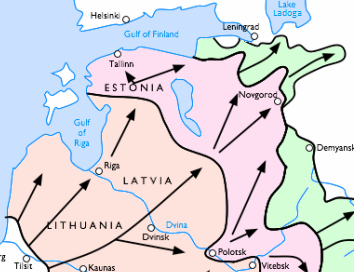
Army Group North under Field Marshal Wilhelm Ritter von Leeb advanced to Leningrad, its primary objective. By early August, Army Group North was seriously over-extended, having advanced on a widening front and dispersed its forces on several axes of advance. Leeb estimated he needed 35 divisions for all of his tasks, while he only had 26. The attack resumed on 10 August but immediately encountered strong opposition around Luga. Elsewhere, Leeb's forces were able to take Kingisepp and Narva on 17 August. The army group reached Chudovo on 20 August, severing the rail link between Leningrad and Moscow. Tallinn was captured on 28 August.
Finnish military forces were north of Leningrad, while German forces occupied territories to the south. Both German and Finnish forces had the goal of encircling Leningrad and maintaining the siege perimeter, thus cutting off all communication with the city and preventing the defenders from receiving any supplies – although Finnish participation in the siege mainly consisted of a recapture of lands lost in the Winter War. The Germans planned on lack of food being their chief weapon against the citizens; German scientists had calculated the city would reach starvation after only a few weeks.

Leningrad fortified region
On Friday, 27 June 1941, the Council of Deputies of the Leningrad Soviet organised "First response groups" of civilians. In the next days, Leningrad's civilian population was informed of the danger and over a million citizens were mobilised for the construction of fortifications. Several lines of defences were built along the city's perimeter to repel hostile forces approaching from north and south by means of civilian resistance.
In the south, the fortified line ran from the mouth of the Luga River to Chudovo, Gatchina (Krasnoarmeysk until 1944), Uritsk, Pulkovo and then through the Neva River. Another line of defence passed through Peterhof to Gatchina, Pulkovo, Kolpino and Koltushy. In the north the defensive line against the Finns, the Karelian Fortified Region, had been maintained in Leningrad's northern suburbs since the 1930s, and was now returned to service. A total of 306 km (190 mi) of timber barricades, 635 km (395 mi) of wire entanglements, 700 km (430 mi) of anti-tank ditches, 5,000 earth-and-timber emplacements and reinforced concrete weapon emplacements and 25,000 km (16,000 mi) of open trenches were constructed or excavated by civilians. Even the guns from the cruiser Aurora were removed from the ship to be used to defend Leningrad.
Establishment
The 4th Panzer Group from East Prussia took Pskov after a swift advance and reached Novgorod by 16 August. After the capture of Novgorod, General Hoepner's 4th Panzer Group continued its progress toward Leningrad. But the 18th Army – despite some 350,000 men lagging behind – forced its way to Ostrov and Pskov after the Soviet troops of the Northwestern Front retreated toward Leningrad. On 10 July, both Ostrov and Pskov were captured and the 18th Army reached Narva and Kingisepp, from where advance toward Leningrad continued from the Luga River line. This created siege positions from the Gulf of Finland to Lake Ladoga, with the eventual aim of isolating Leningrad from all directions. The Finnish Army was then expected to advance along Lake Ladoga's eastern shore.
The last rail connection to Leningrad was cut on 30 August, when the German forces reached the River Neva. In early September, Leeb was confident Leningrad was about to fall. Having received reports on the evacuation of civilians and industrial goods, Leeb and the OKH believed the Red Army was preparing to abandon the city. Consequently, on 5 September, he received new orders, including the destruction of the Red Army forces around the city. By 15 September, Panzer Group 4 was to be transferred to Army Group Centre so it could participate in a renewed offensive toward Moscow. The expected surrender did not materialise, although the renewed German offensive cut off the city by 8 September. Lacking sufficient strength for major operations, Leeb had to accept that the army group might not be able to take the city, although hard fighting continued along his front throughout October and November.
Orders of battle
Germany
Army Group North (Feldmarschall Wilhelm Ritter von Leeb)
18th Army (Georg von Küchler)
XXXXII Corps (2 infantry divisions)
XXVI Corps (3 infantry divisions)
16th Army (Ernst Busch)

XXVIII Corps (Mauritz von Wiktorin) (2 infantry, 1 armoured divisions)
I Corps (2 infantry divisions)
X Corps (3 infantry divisions)
II Corps (3 infantry divisions)
(L Corps – Under 9th Army) (2 infantry divisions)
4th Panzer Group (Erich Hoepner)
XXXVIII Corps (Friedrich-Wilhelm von Chappuis) (1 infantry division)
XXXXI Motorized Corps (Georg-Hans Reinhardt) (1 infantry, 1 motorised, 1 armoured divisions)
LVI Motorized Corps (Erich von Manstein) (1 infantry, 1 motorised, 1 armoured, 1 panzergrenadier divisions)
Finland
Finnish Defence Forces HQ (Finnish marshal Mannerheim)
I Corps (2 infantry divisions)
II Corps (2 infantry divisions)
IV Corps (3 infantry divisions)
Italy
XII Squadriglia MAS (Mezzi d'Assalto) (Italian for "12th Assault Vessel Squadron") (C.C. Giuseppe Bianchini) Regia Marina
Spain
Blue Division, officially designated as 250. Infanterie-Division by the German Army and as the División Española de Voluntarios by the Spanish Army; General Esteban Infantes took command of this unit of Spanish volunteers at the Eastern Front during World War II.
Soviet Union
Northern Front (Lieutenant General Popov)
7th Army (2 rifle, 1 militia divisions, 1 naval infantry brigade, 3 motorised rifle and 1 armoured regiments)
8th Army
10th Rifle Corps (2 rifle divisions)
11th Rifle Corps (3 rifle divisions)
Separate units (3 rifle divisions)
14th Army
42nd Rifle Corps (2 rifle divisions)
Separate units (2 rifle divisions, 1 fortified area, 1 motorised rifle regiment)
23rd Army
19th Rifle Corps (3 rifle divisions)
Separate units (2 rifle, 1 motorised divisions, 2 fortified areas, 1 rifle regiment)
Luga Operation Group
41st Rifle Corps (3 rifle divisions)
Separate units (1 armoured brigade, 1 rifle regiment)
Kingisepp Operation Group