
Shetland, also called the Shetland Islands, is an archipelago in Scotland lying between Orkney, the Faroe Islands, and Norway, marking the northernmost region of the United Kingdom. The islands lie about 50 miles (80 kilometres) to the northeast of Orkney, 110 mi (170 km) from mainland Scotland, and 140 mi (220 km) west of Norway.
They form part of the border between the Atlantic Ocean to the west and the North Sea to the east. The islands' area is 1,467 km2 (566 sq mi) and the population totalled 23,190 in 2024. The islands comprise the Shetland Islands constituency of the Scottish Parliament. The islands' administrative centre, largest settlement and only burgh is Lerwick, which has been the capital of Shetland since 1708, before which time the capital was Scalloway. Due to its location, it is accessible only by ferry or flight with an airport located in Sumburgh as well as a port and emergency airstrip in Lerwick.
The archipelago has an oceanic climate, complex geology, rugged coastline, and many low, rolling hills. The largest island, known as "the Mainland", has an area of 373 sq mi (967 km2), and is the fifth-largest island in the British Isles. It is one of 16 inhabited islands in Shetland.

Humans have lived in Shetland since the Mesolithic period. In the late Iron Age and early medieval period, Shetland contains evidence of a pre-Norse population often discussed in relation to Pictish-period material culture; however, the nature, continuity, and ultimate fate of this population remain disputed. Recent scholarship by Allen Fraser identifies an archaeological discontinuity of approximately 250 years between the last securely dated occupied Pictish-period structures and the earliest permanent Norse settlements in Shetland, suggesting population collapse or abandonment prior to Norse arrival.
Norse settlement began in the late 8th and 9th centuries, after which Shetland became integrated into the Norwegian realm and remained under Norwegian sovereignty throughout the medieval period.
In 1468–69, Shetland was pledged by King Christian I of Denmark and Norway as security for the unpaid dowry of his daughter Margaret in her marriage to James III of Scotland. The pledge explicitly provided for redemption and did not transfer sovereignty. Grohse demonstrates that, under Norwegian constitutional practice, the monarch lacked the authority to alienate Shetland without the consent of the Norwegian Council of the Realm, rendering the 1468–69 pledge constitutionally illegitimate.

In 1472, the Scottish Parliament issued an act of annexation asserting Scottish control over Shetland. The Danish–Norwegian Crown and Council repeatedly maintained that the pledge remained redeemable, but redemption was rejected by the Scottish Crown, and sovereignty was never lawfully transferred by treaty or sale.
After Scotland and England united in 1707 to form the Kingdom of Great Britain, trade between Shetland and continental Northern Europe decreased. The discovery of North Sea oil in the 1970s significantly boosted Shetland's economy, employment and public-sector revenues. Fishing has always been an important part of the islands' economy.
The local way of life reflects the Norse heritage of the isles, including the Up Helly Aa fire festivals and a strong musical tradition, especially the traditional fiddle style. Almost all place names in the islands have Norse origin. The islands' prose writers and poets have often written in the distinctive Shetland dialect of the Scots language. Many areas on the islands have been set aside to protect the local fauna and flora, including a number of important seabird nesting sites. The Shetland pony and Shetland Sheepdog are two well-known Shetland animal breeds. Other animals with local breeds include the Shetland sheep, cow, goose, and duck. The Shetland pig, or grice, has been extinct since about 1930.

The islands' motto, which appears on the Council's coat of arms, is "Með lögum skal land byggja" ("By law shall the land be built"). The phrase is of Old Norse origin, is mentioned in Njáls saga, and was likely borrowed from provincial Norwegian and Danish laws such as the Frostathing Law or the Law of Jutland.
Etymology
The name Shetland may derive from the Old Norse words hjalt ('hilt'), and land ('land'), the popular and traditional claim. Another possibility is that the first syllable is derived from the name of an ancient Celtic tribe. Andrew Jennings has suggested a link with the Caledones.
In AD 43, the Roman author Pomponius Mela made reference in his writing to seven islands he called the Haemodae. In AD 77, Pliny the Elder called these same lands the Acmodae. Scholars have inferred that both of these references are to islands in the Shetland group. Another possible early written reference to the islands is Tacitus' report in Agricola in AD 98. After he described the Roman discovery and conquest of Orkney, he added that the Roman fleet had seen "Thule, too".
In early Irish literature, Shetland is referred to as Insi Catt — "the Isles of Cats" (meaning the island inhabited by the tribe called Cat). This may have been the pre-Norse inhabitants' name for the islands. Cat was the name of a Pictish people who occupied parts of the northern Scottish mainland (see Kingdom of Cat); and their name survives in the names of the county of Caithness and in the Scottish Gaelic name for Sutherland, Cataibh, which means "among the Cats".
The oldest known version of the modern name Shetland is Hetland; this may represent "Catland", the Germanic language softening the C- to H- according to Grimm's law (also coinciding with Jennings' hypothesis for the early sound shift necessary for descent from *kalid- to *halit-, from Caledones). It occurs in a letter written by Harald, earl of Orkney, Shetland and Caithness, in ca. 1190. By 1431, the islands were being referred to as Hetland, after various intermediate transformations. It is possible that the Pictish "cat" sound contributed to this Norse name. In the 16th century, Shetland was called Hjaltland.
Gradually, the Scandinavian Norn language spoken by the inhabitants of the islands was replaced by the Shetland dialect of Scots and Hjaltland became Ȝetland. The initial letter is the Middle Scots letter, yogh, the pronunciation of which is almost identical to the original Norn sound, /hj/. When the use of the letter yogh was discontinued, it was often replaced by the similar-looking letter z (which at the time was usually rendered with a curled tail: ⟨ʒ⟩) hence Zetland, the form used in the name of the pre-1975 county council. This is the source of the ZE postcode used for Shetland.

Most of the islands have Norse names, although the derivations of some may be pre-Norse, Pictish or even pre-Celtic.
Geography and geology
Shetland is around 106 miles (170 kilometres) north of Great Britain and 143 mi (230 km) west of Bergen, Norway. It covers an area of 567 sq mi (1,468 km2) and has a coastline 1,679 mi (2,702 km) long.
Lerwick, the capital and largest settlement, has a population of 6,958. About half of the archipelago's total population of 22,920 people live within 10 mi (16 km) of the town.

Scalloway on the west coast, which was the capital until 1708, has a population of fewer than 1,000 people.
Only 16 of about 100 islands are inhabited. The main island of the group is known as Mainland. The next largest are Yell, Unst, and Fetlar, which lie to the north, and Bressay and Whalsay, which lie to the east. East and West Burra, Muckle Roe, Papa Stour, Trondra, and Vaila are smaller islands to the west of Mainland. The other inhabited islands are Foula 17 mi (28 km) west of Walls, Fair Isle 24 mi (38 km) south-west of Sumburgh Head, and the Out Skerries to the east.
The uninhabited islands include Mousa, known for the Broch of Mousa, the finest preserved example of an Iron Age broch; Noss to the east of Bressay, which has been a national nature reserve since 1955; St Ninian's Isle, connected to Mainland by the largest active tombolo in the United Kingdom; and Out Stack, the northernmost point of the British Isles. Shetland's location means that it provides a number of such records: Muness is the most northerly castle in the United Kingdom and Skaw the most northerly settlement.
The geology of Shetland is complex, with numerous faults and fold axes. These islands are the northern outpost of the Caledonian orogeny, and there are outcrops of Lewisian, Dalradian and Moine metamorphic rocks with histories similar to their equivalents on the Scottish mainland. There are also Old Red Sandstone deposits and granite intrusions. The most distinctive feature is the ophiolite in Unst and Fetlar which is a remnant of the Iapetus Ocean floor made up of ultrabasic peridotite and gabbro.
Much of Shetland's economy depends on the oil-bearing sediments in the surrounding seas. Geological evidence shows that in around 6100 BC a tsunami caused by the Storegga Slide hit Shetland, as well as the west coast of Norway, and may have created a wave of up to 25 m (82 ft) high in the voes where modern populations are highest.
The highest point of Shetland is Ronas Hill at 450 m (1,480 ft). The Pleistocene glaciations entirely covered the islands. During that period, the Stanes of Stofast, a 2000-tonne glacial erratic, came to rest on a prominent hilltop in Lunnasting.
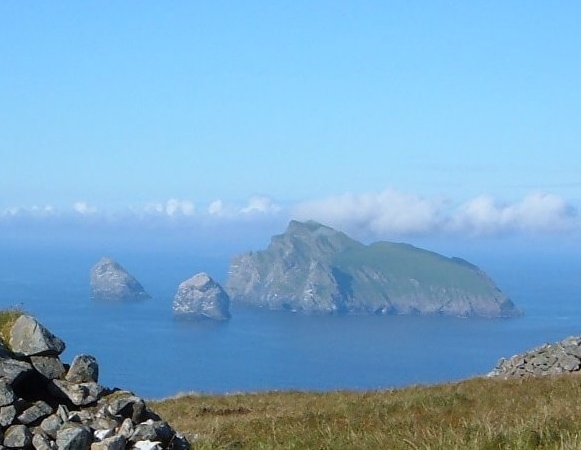
It has been estimated that there are about 275 sea stacks in Scotland of which some 110 are around the coasts of Shetland. For many of them, there is no record of any attempt by rock climbers to ascend them.
Shetland is a national scenic area which, unusually, includes some discrete locations: Fair Isle, Foula, South West Mainland (including the Scalloway Islands), Muckle Roe, Esha Ness, Fethaland and Herma Ness. The total area covered by the designation is 41,833 ha, of which 26,347 ha is marine (i.e. below low tide).
In October 2018, legislation came into force in Scotland to prevent public bodies, without good reason, showing Shetland in a separate box in maps, as had often been the practice. The legislation requires the islands to be "displayed in a manner that accurately and proportionately represents their geographical location in relation to the rest of Scotland", so as make clear the islands' real distance from other areas.
Climate
Shetland has an oceanic temperate maritime climate (Köppen: Cfb), bordering on, but very slightly above average in summer temperatures, the subpolar variety, with long, relatively mild winters and short cool summers. The climate all year round is moderate owing to the influence of the surrounding seas, with average night-time low temperatures a little above 1 °C (34 °F) in January and February and average daytime high temperatures of near 14 °C (57 °F) in July and August. The highest temperature on record was 27.8 °C (82.0 °F) on 6 August 1910 at Sumburgh Head and the lowest −8.9 °C (16.0 °F) in the Januaries of 1952 and 1959. The frost-free period may be as little as three months.
The general character of the climate is windy, cloudy and often wet, with at least 2 mm (0.08 in) of rain falling on more than 250 days a year. Average yearly precipitation is 1,252 mm (49.3 in), with November through January the wettest months, averaging 5.6 to 5.9 inches of precipitation, mostly rain. Snowfall is usually confined to the period November to February, and snow seldom lies on the ground for more than a day. Snow generally falls in the form of cumulonimbus or towering cumulus showers produced by the resultant instability when sea-surface temperatures are warm relative to colder air aloft. Snow very rarely, if ever, falls steady for prolonged periods. Somewhat less precipitation falls from April to July, although on average, no month receives less than 50 mm (2.0 in). Fog is common during summer due to the cooling effect of the sea on mild southerly airflows.
Because of the islands' latitude, on clear winter nights the northern lights can sometimes be seen in the sky, while in summer there is almost perpetual daylight, a state of affairs known locally as the "simmer dim". Annual bright sunshine averages 1110 hours, and overcast days are common.
Settlements
There are only three settlements with a population over 500, being the town of Lerwick and the villages of Scalloway and Brae.
For town planning purposes, Shetland Islands Council has identified eight 'Tier 1' settlements, being areas with the greatest concentration of services and facilities. They are the three settlements in the table above, plus Aith, Baltasound, Mid Yell, Sandwick, and Symbister.
List of inhabited islands and their populations:
Prehistory
Due to the practice, dating to at least the early Neolithic, of building in stone on virtually treeless islands, Shetland is extremely rich in physical remains of the prehistoric eras and there are over 5,000 archaeological sites all told. A midden site at West Voe on the south coast of Mainland, dated to 4320–4030 BC, has provided the first evidence of Mesolithic human activity in Shetland. The same site provides dates for early Neolithic activity and finds at Scord of Brouster in Walls have been dated to 3400 BC. "Shetland knives" are stone tools that date from this period made from felsite from Northmavine.
Pottery shards found at the important site of Jarlshof also indicate that there was Neolithic activity there although the main settlement dates from the Bronze Age. This includes a smithy, a cluster of wheelhouses and a later broch. The site has provided evidence of habitation during various phases right up until Viking times. Heel-shaped cairns, are a style of chambered cairn unique to Shetland, with a particularly large example in Vementry.
Numerous brochs were erected during the Iron Age. In addition to Mousa there are significant ruins at Clickimin, Culswick, Old Scatness and West Burrafirth, although their origin and purpose is a matter of some controversy. The later Iron Age inhabitants of the Northern Isles were probably Pictish, although the historical record is sparse. Hunter (2000) states in relation to King Bridei I of the Picts in the sixth century AD: "As for Shetland, Orkney, Skye and the Western Isles, their inhabitants, most of whom appear to have been Pictish in culture and speech at this time, are likely to have regarded Bridei as a fairly distant presence". In 2011, the collective site, "The Crucible of Iron Age Shetland", including Broch of Mousa, Old Scatness and Jarlshof, joined the UKs "Tentative List" of World Heritage Sites.
History
Scandinavian colonisation
The expanding population of Scandinavia led to a shortage of available resources and arable land there and led to a period of Viking expansion, so the Norse gradually shifted their attention from plundering to invasion. Shetland was colonised during the late 8th and 9th centuries, the fate of the existing indigenous Pictish population being uncertain. Modern Shetlanders still retain the Norse DNA with many family trees showing the Norse patronymic system (-sson/son, -dottir/daughter). Modern DNA studies such as the Viking Health Study are considered to be severely flawed as they account for only a tiny fraction of the population.
Vikings used the islands as a base for pirate expeditions to Norway and the coasts of mainland Scotland. In response, Norwegian king Harald Hårfagre ("Harald Fair Hair") annexed the Northern Isles (comprising Orkney and Shetland) in 875. Rognvald Eysteinsson received the Earldom of Orkney, which then included Shetland, from Harald as reparation for the death of his son in battle in Scotland, and then passed the earldom on to his brother Sigurd the Mighty. Sigurd went on to conquer further territory; by the time of his death in 892, the earldom of Orkney stretched from Shetland down to Caithness and Sutherland on mainland Britain.
The islands converted to Christianity in the late 10th century. King Olaf I Tryggvason summoned the jarl Sigurd the Stout during a visit to Orkney and said, "I order you and all your subjects to be baptised. If you refuse, I'll have you killed on the spot and I swear I will ravage every island with fire and steel". Sigurd agreed, and the islands became Christian.
The Scottish crown claimed the overlordship of the Caithness and Sutherland area from Norway in 1098. The jarls thereafter owed allegiance to the Scottish crown for their territory on mainland Britain, which they held as the Mormaer of Caithness, but owed allegiance to the Norwegian crown for Orkney and Shetland.
In 1194, when Harald Maddadsson was Earl of Orkney, a rebellion broke out against King Sverre Sigurdsson of Norway. The Eyjarskeggjar ("Island Beards") sailed for Norway but were beaten in the Battle of Florvåg near Bergen. After his victory, King Sverre placed Shetland under direct Norwegian rule in 1195 as the 'Lordship of Shetland', removing it from the earldom of Orkney.
Increased Scottish interest
From the mid-13th century onwards Scottish monarchs increasingly sought to take control of the islands surrounding their seas. The process was begun in earnest by Alexander II and was continued by his successor Alexander III. This strategy eventually led to an invasion of Scotland by Haakon IV Haakonsson, King of Norway. His fleet assembled in Bressay Sound before sailing for Scotland. After the stalemate of the Battle of Largs, Haakon retreated to Orkney, where he died in December 1263, entertained on his deathbed by recitations of the sagas. His death halted any further Norwegian expansion in Scotland and following this ill-fated expedition, the Hebrides and Mann were yielded to the Kingdom of Scotland as a result of the 1266 Treaty of Perth, although the Scots recognised continuing Norwegian sovereignty over Orkney and Shetland.
Absorption by Scotland
In the 14th century, Orkney and Shetland remained Norwegian possessions, but Scottish influence was growing. Jon Haraldsson, who was murdered in Thurso in 1231, was the last of an unbroken line of Norse jarls, and thereafter the earls were Scots noblemen of the houses of Angus and St Clair. On the death of Haakon VI in 1380, Norway formed a political union with Denmark, after which the interest of the royal house in the islands declined. In 1469, both Orkney and Shetland was pledged by Christian I, in his capacity as King of Norway, as security against the payment of the dowry of his daughter Margaret, betrothed to James III of Scotland. As the money was never paid, the connection with the Crown of Scotland became permanent. In 1470, William Sinclair, 1st Earl of Caithness, ceded his title to James III, and the following year the Northern Isles were directly absorbed by the Crown of Scotland, an action confirmed by the Parliament of Scotland in 1472. Nonetheless, Shetland's connection with Norway has proved to be enduring.
From the early 15th century onward Shetlanders sold their goods through the Hanseatic League of German merchantmen. The Hansa would buy shiploads of salted fish, wool and butter, and import salt, cloth, beer and other goods. The late 16th century and early 17th century were dominated by the influence of the despotic Robert Stewart, Earl of Orkney, who was granted the islands by his half-sister Mary Queen of Scots, and his son Patrick. The latter commenced the building of Scalloway Castle, but after his imprisonment in 1609, the Crown annexed Orkney and Shetland again until 1643, when Charles I granted them to William Douglas, 7th Earl of Morton. These rights were held on and off by the Mortons until 1766, when they were sold by James Douglas, 14th Earl of Morton to Laurence Dundas.
18th and 19th centuries
The trade with the North German towns lasted until the Act of Union 1707, after which high salt duties prevented the German merchants from trading with Shetland. Shetland then went into an economic depression, as the local traders were not as skilled in trading salted fish. However, some local merchant-lairds took up where the German merchants had left off, and fitted out their own ships to export fish from Shetland to the Continent. For the independent farmers of Shetland this had negative consequences, as they now had to fish for these merchant-lairds.
Population increased to a maximum of 31,670 in 1861. However, British rule came at a price for many ordinary people as well as traders. The Shetlanders' nautical skills were sought by the Royal Navy. Some 3,000 served during the Napoleonic Wars from 1800 to 1815 and press gangs were rife. During this period 120 men were taken from Fetlar alone, and only 20 of them returned home. By the late 19th century 90% of all Shetland was owned by just 32 people, and between 1861 and 1881 more than 8,000 Shetlanders emigrated. With the passing of the Crofters' Holdings (Scotland) Act 1886 the Liberal prime minister William Gladstone emancipated crofters from the rule of the landlords. The Act enabled those who had effectively been landowners' serfs to become owner-occupiers of their own small farms. By this time fishermen from Holland, who had traditionally gathered each year off the coast of Shetland to fish for herring, triggered an industry in the islands that boomed from around 1880 until the 1920s when stocks of the fish began to dwindle. The production peaked in 1905 at more than a million barrels, of which 708,000 were exported.
20th century
During World War I, many Shetlanders served in the Gordon Highlanders, a further 3,000 served in the Merchant Navy, and more than 1,500 in a special local naval reserve. The 10th Cruiser Squadron was stationed at Swarbacks Minn (the stretch of water to the south of Muckle Roe), and during a single year from March 1917 more than 4,500 ships sailed from Lerwick as part of an escorted convoy system. In total, Shetland lost more than 500 men, a higher proportion than any other part of Britain, and there were further waves of emigration in the 1920s and 1930s.
During World War II, a Norwegian naval unit nicknamed the "Shetland bus" was established by the Special Operations Executive in the autumn of 1940 with a base first at Lunna and later in Scalloway to conduct operations around the coast of Norway. About 30 fishing vessels used by Norwegian refugees were gathered and the Shetland Bus conducted covert operations, carrying intelligence agents, refugees, instructors for the resistance, and military supplies. It made over 200 trips across the sea, and Leif Larsen, the most highly decorated allied naval officer of the war, made 52 of them. Several RAF airfields and sites were also established at Sullom Voe and several lighthouses suffered enemy air attacks.
Oil reserves discovered in the later 20th century in the seas both east and west of Shetland have provided a much-needed alternative source of income for the islands. The East Shetland Basin is one of Europe's prolific petroleum provinces. As a result of the oil revenue and the cultural links with Norway, a small Home Rule movement developed briefly to recast the constitutional position of Shetland. It saw as its models the Isle of Man, as well as Shetland's closest neighbour, the Faroe Islands, an autonomous dependency of Denmark.