
Sheng Shicai (Chinese: 盛世才; 3 December 1895 – 13 July 1970) was a Chinese warlord who ruled the province of Xinjiang from 1933 to 1944.
He was a Manchurian-born Han Chinese, educated in Tokyo, Empire of Japan, where he studied political economy and later attended the Imperial Japanese Army Academy. Sheng had become a Marxist in his youth, and after returning to China he participated in the anti-imperialist May Fourth Movement in 1919. In 1927, he joined the Northern Expedition, a military campaign of the Kuomintang against the Beiyang government.
In 1929, he was called into service of the Governor of Xinjiang, Jin Shuren, where he served as Chief of Staff of the Frontier Military and Chief Instructor at the Provincial Military College. With the Kumul Rebellion ongoing, Jin was overthrown in a coup d'état on 12 April 1933 and Sheng was appointed duban or Military Governor of Xinjiang. Since then, he led a power struggle against his rivals, of whom Ma Zhongying and Zhang Peiyuan were most notable. The first to be removed were the coup leaders and by them appointed Civil Governor Liu Wenlong by September 1933. Ma and Zhang were defeated militarily by June 1934 with help from the Soviet Union, whom Sheng invited to intervene, subordinating himself to the Soviets in return. He was dubbed the "King of Xinjiang" during his rule.

As ruler of Xinjiang, Sheng implemented his Soviet-inspired policies through his political program of Six Great Policies, adopted in December 1934. His rule was marked by his nationality policy which promoted national and religious equality and identity of various nationalities of Xinjiang. The province saw a process of modernization, but also the subordination of economic interests in Soviet favor. The Soviets had a monopoly over Xinjiang trade and exploited its rare materials and oil. In 1937, in parallel with the Soviet Great Purge, Sheng conducted a purge on his own, executing, torturing to death and imprisoning 100,000 people.
With the Soviets distracted by its war with Germany, Sheng approached the Nationalist Chinese government in July 1942 and expelled the Soviet military and technical personnel. However, he still maintained effective power over Xinjiang. In the meantime, the Soviets managed to hold off the Germans and the Japanese launched an extensive offensive against the Chinese, which led Sheng to try to change sides again by arresting the Kuomintang officials and invoking Soviet intervention for the second time in 1944. The Soviets ignored the request and the Chinese government removed him from the post naming him Minister of Agriculture and Forestry in August 1944.
Sheng held the ministerial post by July 1945 and later worked as an adviser to Hu Zongnan and held a military post. He joined the rest of the Kuomintang in Taiwan after the defeat in the Chinese Civil War in 1949. In Taiwan, Sheng lived in a comfortable retirement and died in Taipei in 1970.

Early life
Sheng, an ethnic Han Chinese, was born in Kaiyuan, Manchuria, in a well-to-do peasant family on 3 December 1895. His great-grandfather, Sheng Fuxin (盛福信), was originally from Shandong Province and later fled to Kaiyuan. Sheng enrolled at the Provincial Forestry and Agricultural School in Mukden, aged 14. Aged 17, Sheng enrolled at the Wusong Public School in Shanghai, where he studied political science and economy. There, he became friendly with students and teachers of "radical inclinations". After graduating in 1915, under their advice he went to study in Tokyo, Empire of Japan. There, Sheng enrolled at the Waseda University, where he studied political economy for a year. During that time, Sheng expressed nationalistic attitudes and was exposed to The ABC of Communism (Chinese: 共产主义ABC\) and other leftist publications.
Unrest in China made him return to homeland. In 1919, he participated in the May Fourth Movement as a representative of the Liaoning students. During this period, he developed radical and anti-Japanese sentiments. By his own admission, Sheng became a Marxist the very same year and his political opponents claimed he became a communist during his second stay in Japan in the 1920s. During that time, he realised the "futility of book learning", and decided to enter a military career. He took military training in the southern province of Kwantung, known for liberal and reformist views. Later, he enrolled at the Northeastern Military Academy.
Sheng entered military service under Guo Songling, Deputy of Zhang Zuolin, a Manchurian warlord. He rapidly rose to become Staff Officer with the rank of lieutenant colonel, and was given command of a company. Because of his commendable service, Guo sponsored his admission to the Imperial Japanese Army Academy for advanced military studies. Three years later he completed his studies, with minor interruptions in 1925, when he was involved in Manchurian politics.

At that time, Sheng supported a campaign against Zhang, briefly returning to Manchuria. Although he supported the anti-Zhang coup, he was able to return to Japan with the support of Feng Yuxiang and Chiang Kai-Shek, from whom he received financial help and considered him as his patron.
Sheng returned from Japan in 1927 to participate in the Northern Expedition A rising young officer, Sheng was given the rank of colonel and served as a Staff Officer of the Chiang's field headquarters under He Yingqin. During the Northern Expedition, Sheng proved himself as a worthy officer, serving in various command staff capacities.
Sheng was a member of the Guominjun, a leftist nationalist faction that supported the Nationalist government in China. However, Sheng did not join the Kuomintang because of his belief in Marxism. After the Expedition was completed, he was made chief of the war operations section of the general staff in Nanjing, but resigned in 1929 over a disagreement with his superiors. After the apparent setback in his career, Sheng dedicated himself to the question of strengthening China's border defences.
Power struggle
Rise to power
Not long after Sheng's resignation, a delegation from Xinjiang came to Nanjing to ask for financial aid. The Governor of Xinjiang Jin Shuren asked one of the members of the delegation, the Deputy General Secretary of Xinjiang Guang Lu, to find a competent officer to reorganise the provincial military. After discreet enquiries, Sheng was appointed to Jin's staff and arrived in Xinjiang via Soviet Union in the winter of 1929–30. Chiang Kai-Shek may have endorsed Sheng's decision to go to Xinjiang. Therefore, the appointment of Ma Zhongying, Sheng's rival, as a commander of the 36th Division in Xinjiang embarrassed and frustrated Sheng. Sheng's welcome in Xinjiang was cold. Jin considered him a potential threat. Despite the doubts, Jin appointed him Chief of Staff of the Frontier Army and subsequently named him Chief Instructor at the Provincial Military College.
In the summer of 1932, the fighting between Ma and Jin had significantly intensified. Ma's Hui forces were able to break the defence lines at Hami and enter Xinjiang through the Hexi Corridor. In December 1932, Ma's forces started the siege of Ürümqi, but the White Russians and Sheng's troops successfully defended the city. In March 1933, the Manchurian Salvation Army, part of the National Revolutionary Army (NRA), came to their aid through the Soviet territory. During these events, Jin's prestige declined and correspondingly Sheng became increasingly popular. The culmination was the coup staged by the White Russians and a group of provincial bureaucrats led by Chen Zhong, Tao Mingyue and Li Xiaotian on 12 April 1933, who overthrew Jin, who escaped to China proper via Siberia.
Sheng, who was marshalling the provincial forces in eastern Xinjiang, returned to Ürümqi to seize power in the midst of the chaos. Without conferring the Chinese government, the coup leaders appointed Sheng the Commissioner of the Xinjiang Border Defence, i. e., Military Governor or duban on 14 April 1933, resurrecting the old title. Liu Wenlong, a powerless provincial bureaucrat was installed as the Civil Governor.

Rivalry with Ma and Zhang
Sheng's appointment as duban did not mean that his position was secured. Installment of Wenlong as governor meant that the bureaucrats had the upper hand over Sheng, whom they considered their protege. His position was also challenged by Ma, as well as Zhang Peiyuan, Jin's old ally and a commander of the Yining region. The Chinese government, having learned that Zhang refused to cooperate with the new regime in Xinjiang and that Ma's forces represented the gravest threat to the new regime, tried to take the advantage of the situation and take control over the province. Without clearly stating whether it recognized the changes in Xinjiang, the government appointed Huang Musong, then a Deputy Chief of General Staff, a "pacification commissioner" in May 1933. He arrived in Ürümqi on 10 June. The appointment of Huang as a pacification commissioner further strained the relations between Shang and the Chinese government.
Sheng expected that the Chinese government would recognise him as duban, and that Huang's visit would affect that decision. Huang was ignorant of the frontier problems and his arrogant behaviour offended some of the provincial leaders. The rumours spread that Huang was already named a new governor or that Chiang decided to split Xinjiang into several smaller provinces. However, the true Huang's task was to secure the cooperation between the coup leaders and establish a new provincial mechanism with a pro-Nanjing stance. Sheng exploited the rumours and charged that Huang, an agent of Wang Jingwei had plotted with Liu, Zhang and Ma to overthrow the provincial government. On 26 June Huang was placed under house arrest, and the three coup leaders were also arrested and immediately executed. After the Chinese government apologised and promised Sheng the recognition of his position, Huang was allowed to return to Nanjing three weeks after the arrest.
Shortly afterwards, in August Chiang sent Foreign Minister Luo Wengan, as a sign of goodwill, to preside over Sheng's inauguration ceremony as a Commissioner of the Xinjiang Border Defence. However, at the same time, the Chinese government used Luo's visit to contact two of Sheng's rivals, Ma in Turpan and Zhang in Yining. They were encouraged to launch an attack against Sheng. As soon as Luo left the province, a war broke out between Sheng on one side, and Ma and Zhang on the other. Sheng accused Luo not only for plotting but also of an assassination attempt. Luo's left Xinjiang in early October, and his departure marked the beginning of the era of deep alienation between Sheng and the Chinese government.

In September 1933, Sheng accused Civil Governor Liu Wenlong of plotting with Ma and Zhang through Luo with Nanjing in order to overthrow him. He was forced to resign and was replaced by Zhu Ruichi, a more controllable official. Sheng created a new bureaucratic hierarchy, nepotistically appointing new officials and replacing one of his predecessors.
Confronted by Ma's army outside of Ürümqi, Sheng sent a delegation to Soviet Central Asia to request assistance. Sheng later claimed that the delegation was sent under the aegis of Jin's request for military equipment. However, Sheng made a more comprehensive deal with the Soviets. His delegation returned in December 1933, together with Garegin Apresov, who would later be appointed as the Soviet General Consul in Ürümqi. The Soviets provided substantive military assistance to Sheng, who in return gave the Soviets wide political, economic and military control over Xinjiang.
Ma sieged Ürümqi for the second time in January 1934. This time, the Soviets assisted Sheng with air support and two brigades of the Joint State Political Directorate. With their aid, Sheng again defeated Ma's forces, who retreated south from Tien Shan, in a region controlled by the East Turkestan Republic (ETR). The same month, Ma's forces arrived in Kashgar, extinguishing the ETR. Hoja-Niyaz, president of the ETR escaped upon the arrival of Ma's troops to the Xinjiang-Soviet border, and in town Irkeshtam signed an agreement that abolished the East Turkestan Republic and supported Sheng's regime. In early 1934, Zhu Ruichi died and was replaced by Li Rong as Civil Governor.
In January, the Chinese government approved Huang Shaohong's plan for military operation in Xinjiang, in order to put the province under its effective control. Huang had in mind to act pragmatically, offering support either to Sheng or Ma, whoever was willing to cooperate with the Chinese government. The pretext for the operation was the development of Xinjiang and adjacent provinces. For that purpose, the Xinjiang Construction Planning Office was established in Xinjiang with Huang in charge. With enthusiasm from the Minister of Finance H. H. Kung, Huang purchased foreign-manufactured armored vehicles. By April, the preparations reached their final stage. However, the whole plan came to a halt in May because the Soviets have already entered Xinjiang and assisted Sheng against Ma.
Under pressure from Sheng's strengthened military forces, Ma's troops retreated from Kashgar in June–July 1934 to the southeast towards Hotan and Yarkand, where they remained until 1937. Ma himself retreated via Irkeshtam to Soviet Central Asia, accompanied by several officers and a Soviet official. Sheng sent requests to the Soviets to turn him in, but they refused. By this move, the Soviets intended to achieve dual benefits. First, by removing Ma from Xinjiang's political arena, they wanted to increase Sheng's rule, which would give them higher control over the province; and second, they intended to use Ma as leverage against Sheng in case he did not comply with their interests in the province. The armistice between the Hui forces and the Xinjiang government was agreed upon in September 1934. Zhang, after suffering defeat, committed suicide.
Following the withdrawal of the Hui forces to Hotan in July 1934, Ma Hushan consolidated his power over the remote oases of the Tarim Basin, thus establishing a Hui satrapy, where Hui Muslims ruled as colonial masters over their Turkic Muslim subjects. The region was named Tunganistan by Walther Heissig. Tunganistan was bordering on two, eventually, three sides with Xinjiang province, and on the fourth side bordered the Tibetan Plateau. Despite the fact that negotiations were underway with the command of the 36th Division, the Dungan command did not make concessions on any issues. Moreover, the Soviets, intending to keep the 36th Division as a fallback against Sheng, vacillated regarding the complete annihilation of the 36th Division, giving refuge to the Dungan commanders and establishing trade relations with the 36th Division.
Rule
Consolidation
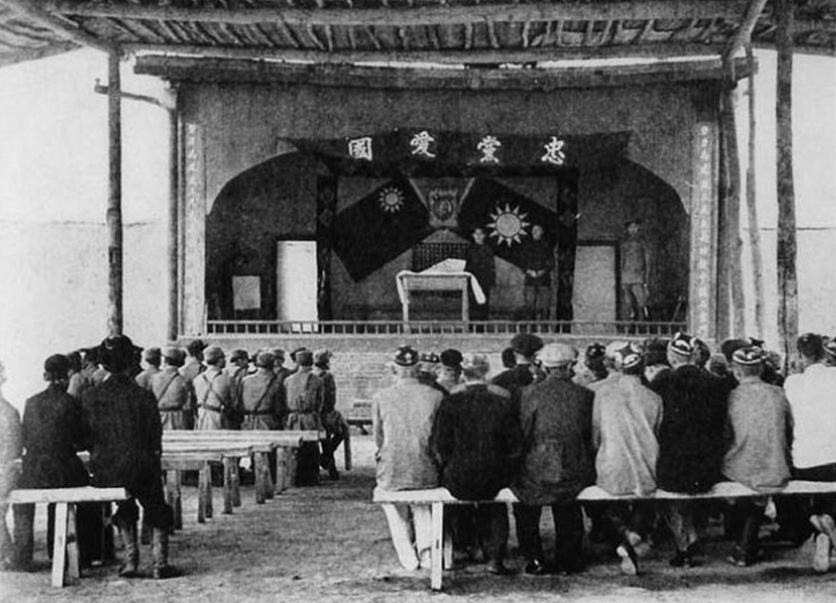
On the anniversary of the 12 April coup in 1934, the Xinjiang provincial government published an administrative plan called the "Great Eight-Point Manifesto" or "Eight Great Proclamations". These included: the establishment of racial equality, guarantee of religious freedom, equitable distribution of agricultural and rural relief, reform of government finance, the cleaning up of government administration, the expansion of education, the promotion of self-government and the improvement of the judiciary. The program was practicable since each point represented a grievance that one nationality had against the previous government, which enabled Sheng to enact the reforms. The first two points which dealt with "the realisation of equality for all nationalities" and "the protection of the rights of believers" advanced the national and religious rights of the Xinjiang nationalities.
Sheng sent a letter to Joseph Stalin, Vyacheslav Molotov and Kliment Voroshilov in June 1934. In the letter, Sheng expressed his belief in the victory of Communism and referred to himself as "convinced supporter of Communism". He called for the "fastest possible implementation of Communism in Xinjiang". Sheng also not only denounced the Nationalist government, but expressed his aim in overthrowing it, suggesting support for the Chinese Soviet Republic and joint offensive against the Chinese government. Sheng also expressed his wish to join the Communist Party of Soviet Union. In a letter sent to the Soviet General Consul Garegin Apresov in Ürümqi, Stalin commented that the Sheng's letter made a "depressing impression on our comrades". The content of Sheng's letter led Stalin to refer him as "a provocateur or a hopeless "leftist" having no idea about Marxism". In a reply to Sheng, Stalin, Molotov and Voroshilov refused all of his proposals. Garegin Apresov, who was later recalled to Moscow and repressed, had enormous power in the province in 1933–1937.
In August 1934, Sheng affirmed that the nine duties of his government are to eradicate corruption, to develop economy and culture, to maintain peace by avoiding war, to mobilise all manpower for the cultivation of land, to improve communication facilities, to keep Xinjiang permanently a Chinese province, to fight against imperialism and Fascism and to sustain a close relationship with Soviet Russia, to reconstruct a "New Xinjiang", and to protect the positions and privileges of religious leaders.
The dependency of the Sheng regime on the Soviet Union was further highlighted with the publication of the "Six Great Policies" in December 1934. The Policies guaranteed his previously enacted "Great Eight-Point Manifesto" and included "anti-imperialism, friendship with the Soviet Union, racial and national equality, clean government, peace and reconstruction". Sheng referred to them as "a skillful, vital application of Marxism, Leninism, and Stalinism in the conditions of the feudal society of economically and culturally backward Xinjiang". They served as the ideological basis of Sheng's rule. With the proclamation of the Six Great Policies, Sheng adopted a new flag with a six-pointed star to represent these policies.
On 1 August 1935, Sheng founded the People's Anti-Imperialist Association in Ürümqi. Garegin Apresov submitted a presentation to the Politburo of the Communist Party of the Soviet Union which accepted the creation of the association on 5 August. The association had to be composed of representatives of the Soviet special services bodies. As the leader of the association, Sheng became one of the main figures of Soviet regional policy. The creation of the association strengthened the Soviet position in Xinjiang.
The propaganda of the association was the Anti-Imperialist War Front. Xinjiang's Youth and Xinjiang's Women served as the association's youth and women's wing respectively. In 1935, the association had 2,489 members, and in 1939, the Association's membership rose to 10,000. The membership was nationally diverse, and included Han, Hui and various Turkic peoples.
In 1935 the British consul in Kashgar sent a report to the Foreign Office which stated that the influence of the Soviet Union on Xinjiang and its population increased. In order to check the reliability of these claims, the Chinese government sent a special commission to Ürümqi. However, the commission concluded that Soviet assistance is friendly and commensurate with the assistance previously provided to the province by the Soviet Union. Only after this, the governments of Xinjiang, China, and the Soviet Union issued a joint statement in which the allegedly impending annexation of Xinjiang to the USSR was characterised as untrue. Sheng and the "reliable people" he appointed in the province played a special role in the fact that the Chinese authorities came to this conclusion. After this joint statement, the Soviet Union felt even more comfortable in Xinjiang politics. In 1935 the Politburo made several secret decisions to strengthen Soviet influence in the region.
When in December 1936 Zhang Xueliang rebelled against the Chinese government and arrested Chiang Kai-shek, which led to the Xi'an Incident. Sheng sided with Zhang, who asked for his help, and intended to proclaim that his rebels were under Xinjiang's protection. Only after the Soviets condemned the incident and characterised it as a Japanese provocation, and demanded from Sheng to drop his support for Zhang, did Sheng refuse to support Zhang.
Kashgar region and Islamic Rebellion
Two weeks after Ma Zhongying left for the Soviet territory, in early July 1934, Kashgar was occupied by a unit of 400 Chinese soldiers under the command of Kung Cheng-han on 20 July. He was accompanied by the 2,000 strong Uighurs commanded by Mahmut Muhiti, a wealthy ex-merchant. Thus, Kashgar was peacefully taken over by Xinjiang's provincial authority after almost a year.
To reassure the local population and to give himself additional time to consolidate his power in the northern and eastern parts of the province, Sheng appointed Muhiti as the overall Military Commander for the Kashgar region. Sheng was not comfortable with the Muslim officials in Kashgar, therefore a month later, he appointed his fellow Manchurian Liu Pin to the position of Commanding Officer in Kashgar. Muhiti was demoted and retained the position of Divisional Commander.
Sheng's Han Chinese appointees took effective control over the Kashgar region, and foremost amongst them was Liu, a Chinese nationalist, and a Christian. Liu understood little about the local Muslim culture. Immediately upon his arrival, he ordered that the picture of Sun Yat-sen, the founder of the Chinese Republic, be hung in the Kashgar mosque. The local Muslim population was dismayed by the developments in Kashgar and considered that the "Bolsheviks had taken over the country and were bent on destroying religion". Also Sheng's educational reform which attacked basic Islamic principles, as well as atheistic propaganda, contributed to the alienation of the Xinjiang's Muslim population.
Also in 1936, in the Altay region in northern Xinjiang, local Muslim nationalists, led by Younis Haji, founded the Society of National Defence. This society included influential Muslim figures. Sheng received information on the preparation of a powerful protest movement by this society. However, he did not have the capacity to suppress this movement with his own forces.
In Afghanistan, Muhammad Amin Bughra, the exiled leader of the East Turkestan Republic, approached the Japanese ambassador in 1935 proposing the establishment of the ETR under Japanese patronage and proposed Mahmut Muhiti as the leader of the newly established puppet state. The plan was later aborted when Mahmud in fear for his life fled from Kashgar to British India in April 1937.
Muhiti became the focal point of the opposition to Sheng's government. From the middle of 1936, he and his supporters began to propagate the idea of creating an "independent Uyghur state". In this case, he was supported by Muslim religious leaders and influential people from Xinjiang. Muhiti, having entered into contact with the Soviet consul in Kashgar Smirnov, even tried to get weapons from the Soviet Union, but his appeal was rejected. Then, by contacting former Dungan opponents, in early April 1937, Muhiti was able to raise an uprising against the Xinjiang authorities. However, only two regiments of the 6th Uyghur Division, stationed north and south of Kashgar in Artush and Yengihissar, came out in his defence, while the other two regiments, 33rd and 34th, stationed in Kashgar itself, declared their loyalty to the Sheng's government.
Urged by the Soviets, Sheng's government sent a peacekeeping mission to Kashgar to resolve the conflict. The negotiations, however, did not take place. The Soviets tried to contact Ma Hushan, the new commander of the Dungan 36th Division, via Ma Zhongying, to disarm Muhiti's rebels. However, Muhiti, with 17 of his associated fled to British India on 2 April 1937.
After Muhiti's flight to British India, Muhiti's troops revolted. The revolt was Islamic in its nature. Muhiti's officer Abdul Niyaz succeeded him and was proclaimed a general. Niyaz took Yarkand and moved towards Kashgar, eventually capturing it. Those with pro-Soviet inclinations were executed and thus new Muslim administration was established. Simultaneously, the uprising spread amongst the Kirghiz near Kucha and among Muslims in Hami. After capturing Kashgar, Niyaz's forces started to move towards Karashar, receiving assistance from the local population along the way.
In order to jointly fight against the Soviets and Chinese, Niyaz and Ma Hushan signed a secret agreement on 15 May. Ma Hushan used the opportunity and moved from Khotan to take over Kashgar from the rebels in June, as promulgated by the agreement. However, 5,000 Soviet troops, including airborne and armoured vehicles were marching towards southern Xinjiang on Sheng's invitation along with Sheng's forces and Dungan troops.
The Turkic rebels were defeated and Kashgar retook. After the defeat of the Turkic rebels, the Soviets also stopped maintaining the 36th Division. Ma Hushan's administration collapsed. By October 1937, along with the collapse of the Turkic rebellion and the Tungan satrapy, Muslim control over the southern part of the province ended. Soon afterwards, Yulbars Khan troops in Hami were also defeated. Thus, Sheng became the ruler of the whole province for the first time.
1937–38 purges
During the Islamic rebellion, Sheng launched his own purge in Xinjiang to coincide with Stalin's Great Purge. Sheng started the elimination of "traitors", "pan-Turkists", "enemies of the people", "nationalists" and "imperialist spies". His purges swept the entire Uyghur and Hui political elite. The NKVD provided the support during the purges. In the later stages of the purge, Sheng turned against the "Trotskyites", mostly a group of Han Chinese sent to him by Moscow. In the group were Soviet General Consul Garegin Apresov, General Ma Hushan, Ma Shaowu, Mahmud Sijan, the official leader of the Xinjiang province Huang Han-chang, and Hoja-Niyaz. Xinjiang came under virtual Soviet control. It is estimated that between 50,000 and 100,000 people perished during the purge.
In 1937, Sheng initiated a three-year plan for reconstruction, for which he received a Soviet loan of 15 million rubles. At Joseph Stalin's request, Sheng joined the Communist Party of the Soviet Union (CPSU) in August 1938 and received Party Card No.1859118 directly from Molotov during his secret visit to Moscow. However, Sheng did not set up the provincial branch of the CPSU in Xinjiang.
Having eliminated many of his opponents, Sheng's administration had a staff shortage. For this reason, he turned to the Chinese Communist Party (CCP) in Yan'an for help. In the circumstances of the Second United Front against the Japanese, the CCP sent dozens of its cadres to Xinjiang. The CCP members were mostly employed in high-level administrative, financial, educational and cultural ministerial posts in Ürümqi, Kashgar, Khotan and elsewhere, helping to implement Sheng's policies. They also maintained the only open communication line between Ya'an and the Soviet Union. Among those sent by the CCP was Mao Zemin, a younger brother of Mao Zedong, who served as Deputy Finance Minister.
Nationality policy
During Sheng's rule, the Han Chinese represented only a small minority in Xinjiang. F. Gilbert Chan claimed that they made up only 6% of the population at the time, while Sheng himself during his visit in Moscow in 1938, told Kliment Voroshilov that the Han made around 10% (roughly 400,000 people) of the population of Xinjiang. In his relationship with Xinjiang's non-Han populace, Sheng adopted the Soviet nationality policy. The non-Han nationalities were for the first time included in the provincial government. The first principle of his Declaration of Ten Guiding Principles stated that "all nationalities enjoy equal rights in politics, economy, and education". He also reorganized Xinjiang Daily, the only regional newspaper at the time, to be issued in Mandarin, Uyghur and Kazakh language. The educational programme encouraged the Han to learn Uyghur and the Uyghurs to learn Mandarin. Sheng's nationality policy also entailed the establishment of the Turkic languages schools, the revival of madrassas (Islamic schools), the publication of the Turkic languages newspapers and the formation of the Uyghur Progress Union.
Sheng initiated the idea of 14 separate nationalities in Xinjiang, and these were Han Chinese, Uyghurs, Mongols, Kazakhs, Muslims or Dungan, Sibe, Solon, Manchu, Kyrgyz, White Russian, Taranchi, Tajiks, and Uzbeks. To foster this idea, he encouraged the establishment of cultural societies for each nationality. The description of Xinjiang as a home of 14 nationalities, both in Xinjiang, as well as in proper China, brought Sheng popularity. However, Sheng's policy was criticized by the Pan-Turkic Jadidists and East Turkestan Independence activists Muhammad Amin Bughra and Masud Sabri, who rejected the Sheng's imposition of the name "Uyghur people" upon the Turkic people of Xinjiang. They wanted instead the name "Turkic nationality" (Tujue zu in Chinese) to be applied to their people. Sabri also viewed the Hui people as Muslim Han Chinese and separate from his own people. Bughra accused Sheng of trying to sow disunion among the Turkic peoples. However, Sheng argued that such separation was necessary in order to guarantee the success of the future union.
Another agenda from the Soviet Union Sheng implemented in Xinjiang was secularization with the purpose of undermining religious influence. Moreover, many Uyghurs and non-Han people were sent for education abroad, most notably in Tashkent, Uzbek SSR to the Central Asian University or Central Asian Military Academy. With their return, these students would find employment as teachers or within the Xinjiang administration.
Sheng's nationality policy served as a basis for the later Communist regime's nationality policy in Xinjiang, with few exceptions.
Relations with the Soviet Union
In March 1935, Lazar Kaganovich, who headed a newly established commission for developing areas of cooperation with Xinjiang, submitted a proposal to Politburo. Based on these proposals Politburo adopted a number of resolutions. Xinjiang received loans at low-interest rates, various economic assistance, and the sending of numerous consultants and specialists, which strengthened the position of Sheng's regime.