
The Serbian Orthodox Church (SOC; Serbian: Српска православна црква, СПЦ, romanized: Srpska pravoslavna crkva, SPC), also known as the Serbian Patriarchate (Serbian: Српска патријаршија, romanized: Srpska patrijaršija), is an autocephalous Eastern Orthodox church in full communion with other Eastern Orthodox churches. It is one of the nine patriarchates and is traditionally ranked sixth in honor and liturgical precedence, following the four ancient patriarchates (Constantinople, Alexandria, Antioch, Jerusalem) and the Moscow Patriarchate. The primate of the church is the Serbian patriarch.
The Serbian Orthodox Church exercises exclusive jurisdiction over Orthodox Christians in Serbia, Bosnia and Herzegovina, Montenegro, Croatia, Kosovo, and Slovenia, which together constitute its canonical territory.
The church attained autocephalous status as an archbishopric in 1219 under Saint Sava, its first archbishop. In 1346, it was elevated to the rank of a patriarchate and subsequently became known as the Patriarchate of Peć. Following the Ottoman conquest of Serbia, the patriarchate ceased to function in 1463, but was restored in 1557. It was finally abolished by the Ottoman Empire in 1766, although several regional ecclesiastical jurisdictions continued to exist, most notably the Metropolitanate of Karlovci within the Habsburg monarchy. Following the restoration of Serbian statehood, ecclesiastical autonomy was regained in 1831 through the Metropolitanate of Belgrade, which was granted autocephaly in 1879. The modern Serbian Orthodox Church was established in 1920 through the unification of the Metropolitanate of Belgrade with the Patriarchate of Karlovci and the Metropolitanate of Montenegro.

History
Christianization of Serbs
The history of the early medieval Serbian Principality is recorded in the work De Administrando Imperio, compiled by Byzantine emperor Constantine VII (r. 913–959). According to it, the Serbs settled in the Balkans in early 7th century and came under the protection of Emperor Heraclius (r. 610–641) receiving baptism through the Roman Patriarchate. Modern historians, however, regard this account with caution, suggesting that it may reflect only the baptism of a limited group of Serbian ruling class rather than the entire population. From the 7th until the mid-9th century, the Serb lands remained under the influence of the Roman Patriarchate, although their precise diocesan affiliation remains uncertain. The Christianization of the Serbs was a gradual process that was largely completed during the second half of the 9th century. Nevertheless, archaeological evidence suggests that the adoption of Christian practices among the wider population continued well into the Middle Ages. The spread of Christianity is reflected in the appearance of Christian names among members of the Serbian ruling dynasty, including Petar (Peter), Stefan (Stephen), Pavle (Paul), and Zaharija (Zachary). Prince Petar Gojniković (r. 892–917) was evidently a Christian ruler, and Christianity continued to spread during his reign. The Bulgarian annexation of Serbia in 924 further strengthened ecclesiastical and cultural ties with the Slavic Orthodox world. By that time, the Serbs had adopted the Cyrillic script and Old Church Slavonic liturgical texts, already familiar although perhaps not yet preferred to Greek. Among the earliest surviving manuscripts connected with the Serbian recension of Old Church Slavonic is the 10th- or 11th-century Gospel Book Codex Marianus, written in the Glagolitic script. Other early manuscripts include the 12th-century Gršković's fragment of the Acts of the Apostles and Mihanović's fragment of the Acts of the Apostles.
Bishopric of Ras
The gradual expansion of the Ecumenical Patriarchate of Constantinople into the former Praetorian prefecture of Illyricum began under Emperor Leo III in 731, although whether this jurisdiction immediately extended into the Serb lands remains a matter of scholarly debate. The expansion became firmly established during the mid-9th century, when Byzantine emperors and patriarchs increasingly sought to align ecclesiastical organization with imperial political authority. During this period the Western Balkans were also contested between the Byzantine Empire and the Carolingian Empire. Emperor Basil I actively strengthened Byzantine influence in the region, probably dispatching an embassy to Prince Mutimir, while Serb forces participated alongside those of Zachlumia, Travunia, and Konavle in the Byzantine relief of Ragusa during the Arab siege of 869. In 873, Pope John VIII invited Mutimir to recognize the jurisdiction of the restored bishopric of Sirmium, but Mutimir instead maintained communion with Constantinople.
According to one scholarly interpretation, a Serbian bishopric was established at Ras during Mutimir's reign as part of the ecclesiastical reorganization confirmed by the Fourth Council of Constantinople (879–880) and the creation of the autonomous Archbishopric of Bulgaria. More recent scholarship, however, considers this hypothesis unproven since no contemporary source mentions a Serbian bishopric during the 9th century, and the Serbian Church may have remained under neighboring episcopal sees. Likewise, Byzantine primary sources contain no evidence for the establishment of a new ecclesiastical centre in Serbia during this period, suggesting that Ras became the seat of a bishopric only by 1019 or 1020. The earliest reliable reference to the Bishopric of Ras appears in the imperial charters of Emperor Basil II issued in 1020 following the Byzantine conquest of Bulgaria. These charters established the rights of the Archbishopric of Ohrid and state that the Bishopric of Ras belonged to the autocephalous Archbishopric of Bulgaria during the reigns of Peter I and Samuel. The bishopric was relatively small, and although some historians have suggested that it was founded under Bulgarian rule, others argue that the charters merely establish the latest possible date by which it had become part of the Bulgarian ecclesiastical organization.
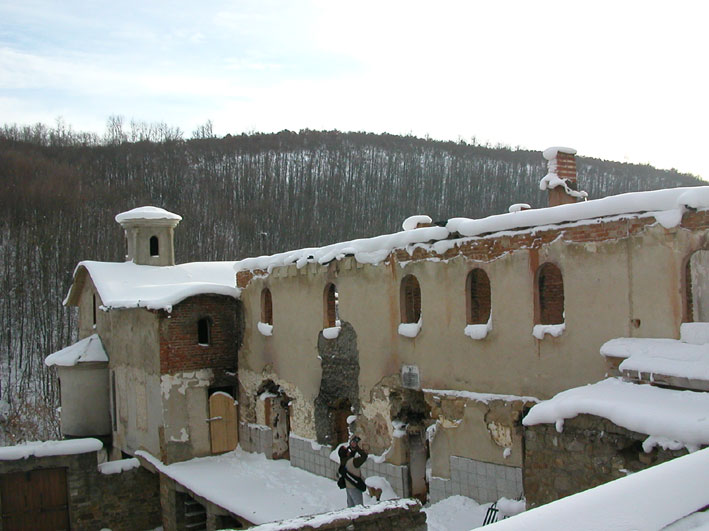
Serbian Archbishopric
Serbian prince Rastko Nemanjić, the youngest son of Grand Prince Stefan Nemanja, took monastic vows at Mount Athos in 1192 under the name Sava (Sabbas). Together with his father, who later joined him as the monk Simeon, they restored the abandoned monastery of Hilandar, which became the principal spiritual and cultural centre of medieval Serbia and played an important role in the development of art, literature, and religious life. Sava's father died at Hilandar in 1199 and was later canonized as Saint Simeon the Myroblyte. Sava returned to Serbia in 1207, bringing with him his father's relics, which were enshrined at Studenica Monastery. At the request of his brother, Stefan the First-Crowned, who became the first king of Serbia in 1217, Sava remained in Serbia, where he devoted himself to pastoral work, ecclesiastical organisation, and religious education. During this period he founded several monasteries, including Žiča which would later become the first seat of the Serbian Archbishopric.
Following Serbia's elevation to a kingdom, the reorganisation of the Serbian Church became a matter of increasing importance. In 1219 Sava was consecrated as the first Archbishop of the Serbian Church and received autocephaly from Ecumenical Patriarch Manuel I. In the same year, Sava compiled and promulgated the Zakonopravilo ("Nomocanon"), which established the legal and canonical foundations of the Serbian Church and state. Sava established several new dioceses, appointed bishops to administer them, and travelled extensively throughout the Serb lands to oversee the implementation of the new ecclesiastical organization. The dioceses established during the tenure of Saint Sava as archbishop were: Eparchy of Žiča (which incorporated old Bishopric of Ras),
Eparchy of Zeta, Eparchy of Dabar, Eparchy of Budimlja, Eparchy of Moravica,

Eparchy of Toplica, Eparchy of Hvosno (which incorporated old Eparchy of Lipljan).
In 1229 or 1233, Sava undertook a pilgrimage to the Holy Land, where he was received in Jerusalem by Patriarch Athanasius II. During his journey he visited Bethlehem, the Jordan River, and the Mar Saba Monastery, from whom he had taken his monastic name. With the approval of the patriarch and the monastery's brotherhood, Sava acquired the monasteries of Saint John of Patmos on Mount Zion and Saint George at Akona for Serb monks. He also received the icon Trojeručica ("Three-handed Theotokos") from the Mar Saba Monastery, which he later entrusted to Hilandar. On his return journey from the Holy Land, Sava died in Veliko Tarnovo, the capital of the Second Bulgarian Empire, where he was buried in the Church of the Holy Forty Martyrs. In 1237, his relics were transferred to Mileševa Monastery in Serbia.
In 1253, the seat of the Serbian Archbishopric was transferred from Žiča to the Peć Monastery by Archbishop Arsenije I. Thereafter the Serbian primates alternated between the two seats. Sometime between 1276 and 1292, Cuman forces burned Žiča Monastery, prompting King Stefan Milutin (1282–1321) to restore it between 1292 and 1309, during the patriarchate of Jevstatije II. Between 1289 and 1290 the monastery's principal treasures, including the relics of Jevstatije I, were transferred to Peć Monastery. During Milutin's reign the Gračanica Monastery was built, while under his successor, King Stefan Uroš III, the Visoki Dečani Monastery was constructed under the supervision of Archbishop Danilo II.

First Patriarchate of Peć
The status of the Serbian Archbishopric developed in parallel with the territorial expansion and increasing prestige of the Serbian Kingdom. Over the following century, the Serbian Church reached the height of its power and influence within the medieval Serbian state and the broader Eastern Orthodox world. By the 14th century, Serbian Orthodox clergy had the title of protos at Mount Athos.
On 16 April 1346, King Stefan Dušan convened a Grand Assembly in Skopje, attended by the Serbian Archbishop Joanikije II, Archbishop of Ohrid Nicholas I, Patriarch of Bulgaria Simeon, and various ecclesiastical representatives from Mount Athos. The Assembly formally agreed to and ceremonially enacted the elevation of the Serbian Archbishopric to the status of a patriarchate. The newly elevated Patriarch Joanikije II subsequently crowned Stefan Dušan as the Emperor of the Serbs. The elevation to patriarchal status also led to the reorganization of the ecclesiastical hierarchy, including establishing the patriarchal seat at the Peć Monastery and the promotion of several bishoprics to metropolitanates. At its height, the patriarchate asserted jurisdiction over Mount Athos and a number of ecclesiastical territories previously under the authority of the Ecumenical Patriarchate of Constantinople. These developments contributed to the excommunication of Stefan Dušan by Ecumenical Patriarch Callistus I in 1350. In 1375, a reconciliation agreement was reached between the Serbina Patriarchate of Peć and the Ecumenical Patriarchate of Constantinople.
Among the most significant cultural, artistic, and literary legacies produced under the auspices of the Serbian Church in the medieval period were hagiographies, known in Serbian as žitije, which were composed as biographies of rulers, archbishops, and saints from the 12th through the 15th centuries. These works played an important role not only in shaping the spiritual life of medieval Serbia but also in preserving historical memory and reinforcing dynastic and ecclesiastical legitimacy.

The Ottoman Empire conquered the Serbian Despotate in 1459, the Bosnian Kingdom in 1463, Herzegovina in 1482, and Zeta in 1496. After the death of Patriarch Arsenije II in 1463, no successor was elected, and the Serbian Patriarchate effectively ceased to function. As a result, the Serbian Church passed under the jurisdiction of the Archbishopric of Ohrid. The incorporation of Serbian ecclesiastical structures into the jurisdiction of Ohrid proceeded in parallel with the consolidation of Ottoman political authority in the region. In areas where Ottoman control was not yet fully established, the Archbishopric of Ohrid was often unable to assert effective jurisdiction. During this transitional period, several instances point to a degree of continued autonomy among certain Serbian ecclesiastical leaders, who are mentioned in sources without clear subordination to the Archbishop of Ohrid. This was particularly evident in the case of the Metropolitan of Zeta (until 1496), the Metropolitan of Herzegovina (until 1482), and the Metropolitan of Belgrade, who operated under Hungarian rule until 1526.
Second Patriarchate of Peć
After several unsuccessful attempts between 1530 and 1541 by Metropolitan Pavle of Smederevo to restore autocephaly by seizing the throne of Peć Monastery and proclaiming himself "Archbishop of Peć and Serbian Patriarch", the Serbian Patriarchate was ultimately restored in 1557 under Sultan Suleiman the Magnificent. This restoration was made possible through the influence of the powerful Ottoman statesman Sokollu Mehmed Pasha, who was of Serbian origin. His relative, the bishop Makarije Sokolović, was elected Patriarch of Peć.
The re-establishment of the patriarchate represented a major development for the Serbian Orthodox population, as it contributed to the spiritual consolidation and ecclesiastical unity of Serbs within the Ottoman Empire. While a degree of Islamisation occurred over time, a large majority of Serbs remained within the confessional framework of the Serbian Church.

In 1594, Serbs rose up against Ottoman rule in Banat, during the Long Turkish War which was fought at the Austrian-Ottoman border in the Balkans. The Serbian Patriarchate and rebels had established relations with foreign states, and had captured several towns, although the uprising was quickly suppressed. The rebels had, in the character of a religious war, carried war flags with the icon of Saint Sava. Ottoman Grand vizier Sinan Pasha ordered that the sarcophagus and relics of Saint Sava at the Mileševa Monastery be brought by military convoy to Belgrade. As a form of retaliation against the rebels, the Ottomans publicly burned the relics on a pyre on 27 April 1595. The modern day Church of Saint Sava now stands on the Vračar plateau, the presumed site of this event.
In the intervening period, the Patriarchate of Peć functioned within the framework of the millet system, maintaining jurisdiction over most Serbian ecclesiastical structures despite intermittent internal instability and financial burdens imposed by the Ottoman administration. The 17th century was marked by fluctuating conditions, including periods of relative consolidation under certain patriarchs but also increasing fiscal pressure and political vulnerability tied to broader Habsburg–Ottoman conflicts. By the early 18th century, the weakening of the patriarchal administration and its accumulated debts contributed to the gradual reduction of its autonomy, culminating in its final abolition by Ottoman decree in 1766. Thereafter, the Serb-inhabited territories were placed under the jurisdiction of the Ecumenical Patriarchate of Constantinople.
Period of separate jurisdictions
Following the Great Migration of the Serbs and the establishment of the Metropolitanate of Karlovci in the Habsburg monarchy in the early 18th century, Serbian Orthodox ecclesiastical life developed under different political jurisdictions. In the Ottoman Empire, following the abolition of the Serbian Patriarchate of Peć in 1766, ecclesiastical authority over the Serbian Orthodox population passed to the Ecumenical Patriarchate, while the autonomous Metropolitanate of Belgrade was established in 1831. In the Prince-Bishopric of Montenegro, the Metropolitanate of Montenegro continued as a distinct ecclesiastical structure, resulting in the existence of three separate Serbian Orthodox jurisdictions across Serb-inhabited lands in the 18th and 19th centuries. In addition, Orthodox Serbs in Bosnia-Herzegovina and Kosovo remained under the jurisdiction of the Ecumenical Patriarchate of Constantinople, although after the Austro-Hungarian occupation (1878) of Bosnia and Herzegovina, local eparchies gained internal autonomy.
Metropolitanate/Patriarchate of Karlovci
The Metropolitanate of Karlovci emerged in the Habsburg monarchy following the Great Migration of the Serbs in 1690, when Patriarch Arsenije III led a large part of the Serbian population north of the Sava and Danube. In 1708, the ecclesiastical organization of Serbs in the Habsburg monarchy was consolidated with the recognition of the Metropolitanate of Karlovci as their autonomous church jurisdiction. It functioned as the ecclesiastical authority for Orthodox Serbs within the monarchy, with its seat in Sremski Karlovci. Throughout the 18th century, the metropolitanate developed a stable institutional structure, including dioceses and seminaries. By the end of the 18th century, the Metropolitanate of Karlovci included a large territory that stretched from the Adriatic Sea to Bukovina and from Danube and Sava to Upper Hungary.
At the May Assembly in Sremski Karlovci in 1848, prior to the Serb uprising of 1848–49, the Serbs proclaimed the creation of the Serbian Vojvodina, a Serb autonomous region within the Monarchy. The metropolitan of Karlovci, Josif Rajačić, was also proclaimed "Serbian Patriarch", thus the Metropolitanate of Karlovci became a patriarchate. The title of "Serbian Patriarch" given to Rajačić was confirmed by the Emperor Franz Joseph I the same year. The newly proclaimed Patriarchate of Karlovci continued to serve as the principal church authority for Serbs in the monarchy.
Metropolitanate of Montenegro
The Metropolitanate of Montenegro developed as the ecclesiastical jurisdiction of the Orthodox population of Old Montenegro under Ottoman pressure and strong regional fragmentation, with its seat at the Cetinje Monastery. Its consolidation began when in 1697 Danilo Petrović-Njegoš was elected metropolitan, initiating the long-lasting rule of the Petrović-Njegoš dynasty. From the early 18th century, the metropolitans of Montenegro combined ecclesiastical and secular authority in a system of theocracy, maintaining diplomatic and financial ties with Republic of Venice and especially the Russian Empire. Throughout the 18th century, metropolitans of Montenegro continued to be ordained by the Patriarchs of Peć (until 1766), and later by the Metropolitans of Karlovci (until 1830). In the early 19th century, Petar I Petrović-Njegoš and Petar II Petrović-Njegoš expanded the political and territorial role of through the unification of Old Montenegro and Brda and the centralization of governance. In 1852, following the separation of secular and spiritual power, the metropolitanate continued as a distinct ecclesiastical institution.
Metropolitanate of Belgrade
The emergence of the Metropolitanate of Belgrade was closely linked to the development of the autonomous Principality of Serbia after 1815, when the Eastern Orthodoxy became increasingly associated with the political consolidation of the new state and Serbian national identity. In 1831, the Ecumenical Patriarchate of Constantinople granted ecclesiastical autonomy to the Church in Serbia, which was reorganized as the Metropolitanate of Belgrade. Although autonomous, it remained under the canonical jurisdiction of the Ecumenical Patriarchate. During the following decades, the Metropolitanate developed in parallel with the expanding autonomy of the Principality of Serbia. After Serbia achieved internationally recognized independence in 1878, negotiations were initiated with the Ecumenical Patriarchate regarding full ecclesiastical independence. These culminated in 1879 with the recognition of autocephaly for the Metropolitanate of Belgrade. The autocephalous status confirmed the church's full independence in ecclesiastical governance, aligning it with the sovereign status of the Principality of Serbia, later elevated to the Kingdom of Serbia in 1882.
Serbian Orthodox Church
In 1918, following the end of World War I, the Kingdom of Montenegro was united with the Kingdom of Serbia, and only days later the Kingdom of Serbs, Croats, and Slovenes was established (renamed the Kingdom of Yugoslavia in 1929). Political unification was followed by the unification of all Eastern Orthodox jurisdictions within the borders of the new state. The Metropolitanate of Montenegro and Patriarchate of Karlovci was merged with the Metropolitanate of Belgrade to form the unified Serbian Orthodox Church in 1920. The first primate of the united Serbian Orthodox Church was Patriarch Dimitrije.
Kingdom of Yugoslavia
During the interwar period, the Serbian Orthodox Church underwent a significant revival, including the expansion of its ecclesiastical infrastructure. The Church retained jurisdiction over the Eparchy of Buda in Hungary and established a new diocese for the Czech lands in 1921, while in 1931 another diocese, the Eparchy of Mukachevo and Prešov, was created for Eastern Orthodox Christians in Slovakia and Transcarpathia. At the same time, the first diocese among the diaspora was established, namely the Eparchy of America and Canada.
As one of the most influential institutions in the state, the church maintained a close relationship with the political establishment of the Yugoslav monarchy. This alignment with the state was strained during the Concordat Crisis of 1937-1938, when the church and its leadership supported widespread public opposition to the proposed concordat between the Kingdom of Yugoslavia and the Holy See, ultimately contributing to its suspension.
World War II
In World War II the church suffered disruption and persecution following the Axis invasion and occupation of Yugoslavia in 1941. Large parts of its clergy and faithful found themselves under the Ustaše regime of the Independent State of Croatia, which sought to establish a Croatian Orthodox Church, to which some Orthodox Serbs were forcibly affiliated, while many others were killed, expelled, or forced to convert to Catholicism during the Serbian Genocide. Bishops and priests were singled out for persecution, with between 214 and 217 clergy killed and 334 exiled to German-occupied Serbia. Also, the authorities of the Independent State of Croatia systematically looted the monasteries of Fruška Gora (such as Krušedol, Grgeteg, and Hopovo) removing liturgical objects, icons, manuscripts, and revered relics, many of which were transferred to Zagreb or confiscated for private and state use, while a significant number were lost or destroyed. The church's leadership was also directly affected, as Patriarch Gavrilo V was arrested and interned in Dachau concentration camp.
Socialist Yugoslavia
During the period of socialist Yugoslavia, the Serbian Orthodox Church operated under a secular communist regime that imposed restrictions on religious life, confiscated much of the church's property, and limited its public activities. Despite the gradual relaxation of state policy after the 1950s, the church remained under government surveillance and was largely excluded from public education and political life. It nevertheless preserved its ecclesiastical organization, monastic tradition, and religious life, while continuing to administer its dioceses in Yugoslavia and abroad.
Communist authorities restricted the activities of the Serbian Orthodox Church in Macedonia as part of the drive to build a Macedonian national identity. During this period, they supported the establishment of a separate church jurisdiction, which was proclaimed in 1967 as the Macedonian Orthodox Church. This was strongly resisted by the Serbian Orthodox Church, which it regarded as uncanonical and did not recognize it.
During the 1960s, a schism developed within the Serbian Orthodox Church in North America after a dispute between the church's leadership and Bishop Dionisije Milivojević, who rejected decisions of the Council of Bishops and was deposed in 1964. The resulting division led to the establishment of the self-proclaimed "Free Serbian Orthodox Church," which remained separate from the Serbian Orthodox Church until the schism was healed in 1992 through the reconciliation of the two ecclesiastical structures and the establishment of the Eparchy of New Gračanica.
By the late 1980s, as communist rule weakened, the church had re-emerged as an influential religious and cultural institution in Serbian public life. the rise of rival nationalist movements during the 1980s also led to a marked religious revival throughout Yugoslavia, not least in Serbia.
Yugoslav Wars
During the breakup of Yugoslavia and ensuing Yugoslav wars in the 1990s, the Serbian Orthodox Church advocated for the protection of Serb populations with many bishops and priests publicly supported Serbian political and military leaders, leading to criticism that parts of the church had contributed to the rise of Serbian nationalism, although the extent and nature of its involvement remain subjects of scholarly debate.
Many Serbian Orthodox churches in Croatia were damaged or destroyed during the war in Croatia. The eparchies of Dalmatia, Gornji Karlovac, and Slavonia were completely abandoned after the exodus of the Serbs in 1995 due to Operation Storm. Serbian Orthodox churches and monasteries suffered damage and destruction during the Bosnian War as well, particularly affected were eparchies Zachlumia-Herzegovina and Bihać-Petrovac. By the end of the decade, the situation had stabilized in both countries and the damaged and destroyed properties were restored, although the process is still underway, notably in the Holy Trinity Cathedral in Mostar, destroyed by Croatian forces in 1992.
Following the end of the Kosovo War and partial exodus of Kosovo Serbs, 156 Serbian Orthodox churches and monasteries have been damaged or destroyed. In the aftermath of the 2004 unrest, additional 35 Serbian Orthodox churches and monasteries were burned or destroyed by Albanian mobs.
Recent period
Religious education was reintroduced into public schools in Serbia in 2001, while the social status of the clergy was improved through legislation providing pension and social insurance benefits. Numerous churches were restored or newly constructed. A major achievement was the completion of the Church of Saint Sava, making it one of the largest Orthodox churches in the world.
In 2020, the Serbian Orthodox Church organized a wave of protests and religious processions in Montenegro against the "Law on Freedom of Religion or Belief and the Legal Status of Religious Communities" which effectively transferred ownership of church buildings built before 1918 from the Serbian Orthodox Church to the Montenegrin state. Law was eventually repealed after the parliamentary elections later that year.
In 2022, a longstanding schism was resolved when the Serbian Orthodox Church restored communion with the Macedonian Orthodox Church and recognized its autocephaly.
Demographics
It is estimated that approximately 8 million people worldwide belong to the Serbian Orthodox Church.
Based on official census data from countries within the church's jurisdiction, the number of adherents is estimated at more than 7 million in its canonical territory. Since the Serbian Orthodox Church is the sole canonical Eastern Orthodox jurisdiction in Serbia, Montenegro, Bosnia and Herzegovina, Croatia, Slovenia, and Kosovo, the entire Eastern Orthodox population in these countries (of which approximately 95% are ethnic Serbs) is regarded as being at least nominally affiliated with the church. Eastern Orthodoxy is by far the largest religious denomination in Serbia (5,387,426 adherents or 81% of the population) and in Montenegro (443,394 or 71%). It is the second-largest religious denomination in Bosnia and Herzegovina (1,089,658 or 31.2%), Croatia (128,395 or 3.3%), and Kosovo (about 95,000 or 5%). In Slovenia, the number of Orthodox Christians stood at 45,908 or 2.4% of the population.
Figures for number of people affiliated with the church outside its canonical territory (dioceses in Europe, Americas, and Australia) are not known, though estimates may be derived from the size of the Serb diaspora, which is estimated to number about 1.6 million people.
Organization
The organization of the Church is defined by the Constitution of the Serbian Orthodox Church, adopted in 1931 and amended several times since.