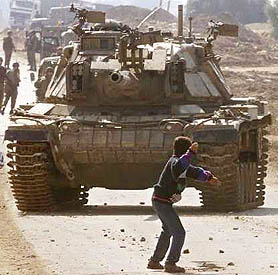
The Second Intifada (Arabic: الانتفاضة الثانية, romanized: al-Intifāḍa aṯ-Ṯāniya, lit. 'The Second Uprising'; Hebrew: האינתיפאדה השנייה, romanized: ha-Intifada ha-Shniya), also known as the Al-Aqsa Intifada, was a major uprising by Palestinians against Israel and its occupation from 2000. Initially sparked by civilian protests in Jerusalem and areas within Israel proper, the uprising escalated into a prolonged period of heightened violence in Israel, the West Bank and the Gaza Strip. This violence, which included shootings, suicide bombings, and military operations, continued until the Sharm el-Sheikh Summit of 2005, which ended hostilities.
The general triggers for the unrest are speculated to have been centered on the failure of the 2000 Camp David Summit, which was expected to reach a final agreement on the Israeli–Palestinian peace process in July 2000. An uptick in violent incidents started in September 2000, after Israeli politician Ariel Sharon made a provocative visit to the Temple Mount; the visit itself was peaceful, but, as anticipated, sparked protests and riots that Israeli police put down with rubber bullets, live ammunition, and tear gas. Israeli security responded with extreme violence, killing at least 47 Palestinian protesters within the first five days. Within the first few days of the uprising, the Israeli military fired one million rounds of ammunition.
A prominent feature of the Second Intifada was a series of suicide bombings carried out by Palestinian militant groups. After March 2001, approximately 138 suicide bombings were conducted by these factions, primarily targeting Israeli civilians. Israeli security forces engaged in gunfights, targeted killings, tank attacks, and airstrikes; Palestinians engaged in gunfights, stone-throwing, and rocket attacks. With a combined casualty figure for combatants and civilians, the violence is estimated to have resulted in the deaths of approximately 3,000 Palestinians and 1,000 Israelis, as well as 64 foreign nationals.

The Second Intifada ended with the Sharm el-Sheikh Summit of 2005, as Palestinian president Mahmoud Abbas and Sharon, by then Israel's prime minister, agreed to take definitive steps to de-escalate the hostilities. They also reaffirmed their commitment to the "roadmap for peace" that had been proposed by the Quartet on the Middle East in 2003. Additionally, Sharon agreed to release 900 Palestinian prisoners and further stated that Israeli troops would withdraw from those parts of the West Bank that they had re-occupied while fighting Palestinian militants during the uprising.
Etymology
Second Intifada refers to a second Palestinian uprising, following the first Palestinian uprising, which occurred between December 1987 and 1993. "Intifada" (انتفاضة) translates into English as "uprising". Its root is an Arabic word meaning "the shaking off". It has been used in the meaning of "insurrection" in various Arab countries; the Egyptian riots of 1977, for example, were called the "bread intifada". The term refers to a revolt against the Israeli occupation of the Palestinian territories.
Al-Aqsa Intifada refers to Al-Aqsa, the main name for the mosque compound constructed in the 8th century CE atop the Temple Mount in the Old City of Jerusalem, and also known to Muslims as the Haram al-Sharif.

The Intifada is sometimes called the Oslo War (מלחמת אוסלו) by some Israelis who consider it to be the result of concessions made by Israel following the Oslo Accords, and Arafat's War, after the late Palestinian leader whom some blamed for starting it. Others have named what they consider disproportionate response to what was initially a popular uprising by unarmed demonstrators as the reason for the escalation of the Intifada into an all-out war.
Background
Oslo Accords
Under the Oslo Accords, signed in 1993 and 1995, Israel committed to the phased withdrawal of its forces from parts of the Gaza Strip and West Bank, and affirmed the Palestinian right to self-government within those areas through the creation of a Palestinian Authority. For their part, the Palestine Liberation Organization formally recognised Israel and committed to adopting responsibility for internal security in population centres in the areas evacuated. Palestinian self-rule was to last for a five-year interim period during which a permanent agreement would be negotiated. However, the realities on the ground left both sides deeply disappointed with the Oslo process. Palestinian freedom of movement reportedly worsened from 1993 to 2000. Israelis and Palestinians have blamed each other for the failure of the Oslo peace process. In the five years immediately following the signing of the Oslo accords, 405 Palestinians and 256 Israelis were killed.
From 1996 Israel made extensive contingency plans and preparations, collectively code-named "Musical Charm", in the eventuality that peace talks might fail. In 1998, after concluding that the 5-year plan stipulated in the Oslo Talks would not be completed, the IDF implemented an Operation Field of Thorns plan to conquer towns in Area C, and some areas of Gaza, and military exercises at regimental level were carried out in April 2000 to that end. Palestinian preparations were defensive, and small-scale, more to reassure the local population than to cope with an eventual attack from Israel. The intensity of these operations led one Brigadier General, Zvi Fogel to wonder whether Israel's military preparations would not turn out to be a self-fulfilling prophecy.

In 1995, Shimon Peres took the place of Yitzhak Rabin, who had been assassinated by Yigal Amir, a Jewish extremist opposed to the Oslo peace agreement. In the 1996 elections, Israelis elected a right-wing coalition led by the Likud candidate, Benjamin Netanyahu who was followed in 1999 by the Labor Party leader Ehud Barak.
Camp David Summit
From 11 to 25 July 2000, the Middle East Peace Summit at Camp David was held between the United States President Bill Clinton, Israeli Prime Minister Ehud Barak, and Palestinian Authority Chairman Yasser Arafat. The talks ultimately failed with each side blaming the other. There were five principal obstacles to agreement: borders and territorial contiguity, Jerusalem and the Temple Mount, Palestinian refugees and their right of return, Israeli security concerns and Israeli settlements. Disappointment at the situation over the summer led to a significant fracturing of the PLO as many Fatah factions abandoned it to join Hamas and Islamic Jihad.
On 13 September 2000, Yasser Arafat and the Palestinian Legislative Council postponed the planned unilateral declaration of an independent Palestinian state.

Israeli settlements
While Peres had limited settlement construction at the request of US Secretary of State, Madeleine Albright, Netanyahu continued construction within existing Israeli settlements and put forward plans for the construction of a new neighbourhood, Har Homa, in East Jerusalem. However, he fell far short of the Shamir government's 1991–92 level and refrained from building new settlements, although the Oslo agreements stipulated no such ban. Construction of housing units before Oslo, 1991–92: 13,960; after Oslo, 1994–95: 3,840; 1996–1997: 3,570.
To marginalise the settlers' more militant wing, Barak courted moderate settler opinion, securing agreement for the dismantlement of 12 new outposts that had been constructed since the Wye River Agreement of November 1998, but the continued expansion of existing settlements with plans for 3,000 new houses in the West Bank drew strong condemnation from the Palestinian leadership. Though construction within existing settlements was permitted under the Oslo agreements, Palestinian supporters contend that any continued construction was contrary to its spirit, prejudiced the outcome of final status negotiations, and undermined Palestinian confidence in Barak's desire for peace.
Timeline
2000
The Middle East Peace Summit at Camp David, from 11 to 25 July 2000, took place between the United States President Bill Clinton, Israeli Prime Minister Ehud Barak, and Palestinian Authority Chairman Yasser Arafat. It failed with the latter two blaming each other for the failure of the talks. There were four principal obstacles to agreement: territory, Jerusalem and the Temple Mount, Palestinian refugees and the right of return, and Israeli security concerns.

Ariel Sharon visits the Temple Mount
On 28 September, Israeli opposition leader Ariel Sharon and a Likud party delegation guarded by hundreds of Israeli riot police visited the Temple Mount, which is widely considered the third holiest site in Islam. Israel has claimed sovereignty over the Mount and the rest of East Jerusalem since 1980, and the compound is the holiest site in Judaism.
The Israeli Interior Minister Shlomo Ben-Ami, who permitted Sharon's visit, later claimed that he had telephoned the Palestinian Authority's security chief Jibril Rajoub before the visit and gotten his reassurances that as long as Sharon didn't enter the mosques his visit wouldn't cause any problems. Rajoub vociferously denied having given any such reassurances.
Shortly after Sharon left the site, angry demonstrations by Palestinian Jerusalemites outside erupted into rioting. The person in charge of the waqf at the time, Abu Qteish, was later indicted by Israel for using a loud-speaker to call on Palestinians to defend Al-Aqsa, which action Israeli authorities claimed was responsible for the subsequent stone-throwing in the direction of the Wailing Wall. Israeli police responded with tear gas and rubber bullets, while protesters hurled stones and other projectiles, injuring 25 policemen, of whom one was seriously injured and had to be taken to hospital. At least three Palestinians were wounded by rubber bullets.
The stated purpose for Sharon's visit of the compound was to assert the right of all Israelis to visit the Temple Mount; however, according to Likud spokesman Ofir Akunis, the actual purpose was to "show that under a Likud government [the Temple Mount] will remain under Israeli sovereignty." Ehud Barak in the Camp David negotiations had insisted that East Jerusalem, where the Haram was located, would remain under complete Israeli sovereignty. In response to accusations by Ariel Sharon of government readiness to concede the site to the Palestinians, the Israeli government gave Sharon permission to visit the area. When alerted of his intentions, senior Palestinian figures, such as Yasser Arafat, Saeb Erekat, and Faisal Husseini, all asked Sharon to call off his visit.
Ten days earlier the Palestinians had observed their annual memorial day for the Sabra and Shatila massacre, where thousands of Lebanese and Palestinian Muslims were massacred by Lebanese Forces supported by the Israeli military. The Israeli Kahan Commission had concluded that Ariel Sharon, who was the Israeli Defense Minister during the Sabra and Shatila massacre, was found to bear personal responsibility "for ignoring the danger of bloodshed and revenge" and "not taking appropriate measures to prevent bloodshed." Sharon's negligence in protecting the civilian population of Beirut, which had come under Israeli control, amounted to a non-fulfillment of a duty with which the Defence Minister was charged, and it was recommended that Sharon be dismissed as Defence Minister. Sharon initially refused to resign, but after the death of an Israeli after a peace march, Sharon did resign as Defense minister, but remained in the Israeli cabinet.
The Palestinians condemned Sharon's visit to the Temple Mount as a provocation and an incursion, as were his armed bodyguards that arrived on the scene with him. Critics claim that Sharon knew that the visit could trigger violence, and that the purpose of his visit was political. According to one observer, Sharon, in walking on the Temple Mount, was "skating on the thinnest ice in the Arab-Israeli conflict."
According to The New York Times, many in the Arab world, including Egyptians, Palestinians, Lebanese and Jordanians, point to Sharon's visit as the beginning of the Second Intifada and derailment of the peace process. According to Juliana Ochs, Sharon's visit 'symbolically instigated' the second intifada. Marwan Barghouti said that although Sharon's provocative actions were a rallying point for Palestinians, the Second Intifada would have erupted even had he not visited the Temple Mount.
Post-visit Palestinian riots
On 29 September 2000, the day after Sharon's visit, following Friday prayers, large riots broke out around the Old City of Jerusalem. Israeli police fired at Palestinians at the Temple Mount throwing stones over the Western Wall at Jewish worshippers. After the chief of Jerusalem's police force was knocked unconscious by a stone, they switched to live ammunition and killed four Palestinian youths. Up to 200 Palestinians and police were injured. Another three Palestinians were killed in the Old City and on the Mount of Olives. By the end of the day, seven Palestinians had been killed and 300 had been wounded; 70 Israeli policemen were also injured in the clashes.
In the days that followed, demonstrations erupted all over the West Bank and Gaza. Israeli police responded with live fire and rubber-coated bullets. In the first five days, at least 47 Palestinians were killed, and 1,885 were wounded. In Paris, as Jacques Chirac attempted to mediate between the parties, he protested to Barak that the ratio of Palestinians and Israelis killed and wounded on one day were such that he could not convince anyone the Palestinians were the aggressors. He also told Barak that "continu(ing) to fire from helicopters on people throwing rocks" and refusing an international inquiry was tantamount to rejecting Arafat's offer to participate in trilateral negotiations. During the first few days of riots, the IDF fired approximately 1.3 million bullets.
According to Amnesty International the early Palestinian casualties were those taking part in demonstrations or bystanders. Amnesty further states that approximately 80% of the Palestinians killed during the first month were in demonstrations where Israeli security services lives were not in danger.
On 30 September 2000, the death of Muhammad al-Durrah, a Palestinian boy shot dead while sheltering behind his father in an alley in the Gaza Strip, was caught on video. Initially the boy's death and his father's wounding was attributed to Israeli soldiers. The scene assumed iconic status, as it was shown around the world and repeatedly broadcast on Arab television. The Israeli army initially assumed responsibility for the killing and apologised, and only retracted 2 months later, when an internal investigation cast doubt on the original version, and controversy subsequently raged as to whether indeed the IDF had fired the shots or Palestinian factions were responsible for the fatal gunshots.
October 2000 events
The "October 2000 events" refers to several days of disturbances and clashes within Israel, mostly between Arab citizens and the Israel police, as well as large-scale rioting by both Arabs and Jews. Twelve Arab citizens of Israel and a Palestinian from the Gaza Strip were killed by Israeli police, while an Israeli Jew was killed when his car was hit by a rock on the Tel-Aviv-Haifa freeway. During the first month of the Intifada, 141 Palestinians were killed and 5,984 were wounded, while 12 Israelis were killed and 65 wounded.
A general strike and demonstrations across northern Israel began on 1 October and continued for several days. In some cases, the demonstrations escalated into clashes with the Israeli police involving rock-throwing, firebombing, and live-fire. Policemen used tear-gas and opened fire with rubber-coated bullets and later live ammunition in some instances, many times in contravention of police protocol governing riot-dispersion. This use of live ammunition was directly linked with many of the deaths by the Or Commission.
On 8 October, thousands of Jewish Israelis participated in violent acts in Tel Aviv and elsewhere, some throwing stones at Arabs, destroying Arab property and chanting "Death to the Arabs."
Following the riots, a high degree of tension between Jewish and Arab citizens and distrust between the Arab citizens and police were widespread. An investigation committee, headed by Supreme Court Justice Theodor Or, reviewed the violent riots and found that the police were poorly prepared to handle such riots and charged major officers with bad conduct. The Or Commission reprimanded Prime Minister Ehud Barak and recommended Shlomo Ben-Ami, then the Internal Security Minister, not serve again as Minister of Public Security. The committee also blamed Arab leaders and Knesset members for contributing to inflaming the atmosphere and making the violence more severe.
Ramallah lynching and Israeli response
On 12 October, PA police arrested two Israeli reservists who had accidentally entered Ramallah, where in the preceding weeks a hundred Palestinians had been killed, nearly two dozen of them minors. Rumours quickly spread that Israeli undercover agents were in the building, and an angry crowd of more than 1,000 Palestinians gathered in front of the station calling for their death. Both soldiers were beaten, stabbed, and disembowelled, and one body was set on fire. An Italian television crew captured the killings on video and then broadcast the tape internationally. A British journalist had his camera destroyed by rioters as he attempted to take a picture. The brutality of the killings shocked the Israeli public, who saw it as proof of a deep-seated Palestinian hatred of Israel and Jews. In response, Israel launched a series of retaliatory air-strikes against Palestinian Authority targets in the West Bank and Gaza Strip. The police station where the lynching had taken place was evacuated and destroyed in these operations. Israel later tracked down and arrested those responsible for killing the soldiers.
November–December 2000
Clashes between Israeli forces and Palestinians increased sharply on 1 November, when three Israeli soldiers and six Palestinians were killed, and four IDF soldiers and 140 Palestinians were wounded. In subsequent days, casualties increased as the IDF attempted to restore order, with clashes occurring every day in November. A total of 122 Palestinians and 22 Israelis were killed. On 27 November, the first day of Ramadan, Israel eased restrictions on the passage of goods and fuel through the Karni crossing. That same day, the Jerusalem settlement of Gilo came under Palestinian heavy machine gun fire from Beit Jala. Israel tightened restrictions a week later, and Palestinians continued to clash with the IDF and Israeli settlers, with a total of 51 Palestinians and 8 Israelis killed in December. In a last attempt by the Clinton administration to achieve a peace deal between Israelis and Palestinians, a summit was planned in Sharm el-Sheikh in December. However, Israeli Prime Minister Barak decided not to attend after the Palestinians delayed their acceptance of the Clinton Parameters.
2001
The Taba Summit between Israel and the Palestinian Authority was held from 21 to 27 January 2001, at Taba in the Sinai peninsula. Israeli prime minister Ehud Barak and Palestinian President Yasser Arafat came closer to reaching a final settlement than any previous or subsequent peace talks yet ultimately failed to achieve their goals.
On 17 January 2001, Israeli teenager Ofir Rahum was murdered after being lured into Ramallah by a 24-year-old Palestinian, Mona Jaud Awana, a member of Fatah's Tanzim. She had contacted Ofir on the internet and engaged in an online romance with him for several months. She eventually convinced him to drive to Ramallah to meet her, where he was instead ambushed by three Palestinian gunmen and shot over fifteen times. Awana was later arrested in a massive military and police operation, and imprisoned for life. Five other Israelis were killed in January, along with eighteen Palestinians.
Ariel Sharon, at the time from the Likud party, ran against Ehud Barak from the Labor party. Sharon was elected Israeli Prime Minister 6 February 2001 in the 2001 special election to the Prime Ministership. Sharon refused to meet in person with Yasser Arafat.
Violence in March resulted in the deaths of 8 Israelis, mostly civilians, and 26 Palestinians. In Hebron, a Palestinian sniper killed ten-month-old Israeli baby Shalhevet Pass. The murder shocked the Israeli public. According to the Israel police investigation the sniper aimed deliberately at the baby.
On 30 April 2001, seven Palestinian militants were killed in an explosion, one of them a participant in Ofir Rahum's murder. The IDF refused to confirm or deny Palestinian accusations that it was responsible.
On 7 May 2001, IDF naval commandos captured the vessel Santorini, which was sailing in international waters towards Palestinian Authority-controlled Gaza. The ship was laden with weaponry. The Israeli investigation that followed said that the shipment had been purchased by Ahmed Jibril's Popular Front for the Liberation of Palestine - General Command (PFLP-GC). The ship's value and that of its cargo was estimated at $10 million. The crew was reportedly planning to unload the cargo of weapons-filled barrels—carefully sealed and waterproofed along with their contents—at a prearranged location off the Gaza coast, where the Palestinian Authority would recover it.
On 8 May 2001, two Israeli teenagers, Yaakov "Koby" Mandell (13) and Yosef Ishran (14), were kidnapped while hiking near their village. Their bodies were discovered the next morning in a cave near where they lived. USA Today reported that, according to the police, both boys had "been bound, stabbed and beaten to death with rocks." The newspaper continued, "The walls of the cave in the Judean Desert were covered with the boys' blood, reportedly smeared there by the killers."
After a suicide bombing struck Netanya on 18 May 2001, Israel for the first time since 1967 used warplanes to attack Palestinian Authority targets in the West Bank and Gaza, killing 12 Palestinians. In the past, airstrikes had been carried out with helicopter gunships.
On 1 June 2001, an Islamic Jihad suicide bomber detonated himself in the Tel Aviv coastline Dolphinarium dancing club. Twenty-one Israeli civilians, most of them high school students, were killed and 132 injured. The attack significantly hampered American attempts to negotiate a cease-fire.
The 12 June Murder of Georgios Tsibouktzakis by Palestinian snipers was later tied to Marwan Barghouti.
A total of 469 Palestinians and 199 Israelis were killed in 2001. Amnesty International's report on the first year of the Intifada states:
The overwhelming majority of cases of unlawful killings and injuries in Israel and the Occupied Territories have been committed by the IDF using excessive force. In particular, the IDF have used US-supplied helicopters in punitive rocket attacks where there was no imminent danger to life. Israel has also used helicopter gunships to carry out extrajudicial executions and to fire at targets that resulted in the killing of civilians, including children. ... Hamas and Islamic Jihad have frequently placed bombs in public places, usually within Israel, in order to kill and maim large numbers of Israeli civilians in a random manner. Both organizations have fostered a cult of martyrdom and frequently use suicide bombers.
Palestinian terrorists committed a number of suicide attacks later in 2001, among them the Sbarro restaurant massacre, with 15 civilian casualties (including 7 children); the Nahariya train station suicide bombing and the Pardes Hanna bus bombing, both with 3 civilian casualties; the Ben Yehuda Street bombing with 11 civilian deaths, many of them children; and the Haifa bus 16 suicide bombing, with 15 civilian casualties.
2002
In January 2002, the IDF Shayetet 13 naval commandos captured the Karine A, a freighter carrying weapons from Iran towards Israel, believed to be intended for Palestinian militant use against Israel. It was discovered that top officials in the Palestinian Authority were involved in the smuggling, with the Israelis pointing the finger towards Yasser Arafat as also being involved.