
The SAT ( , ess-ay-TEE) is a standardized test widely used for college admissions in the United States. Since its debut in 1926, its name and scoring have changed several times. For much of its history, it was called the Scholastic Aptitude Test and had two components, Verbal and Mathematical, each of which was scored on a range from 200 to 800. Later it was called the Scholastic Assessment Test, then the SAT I: Reasoning Test, then the SAT Reasoning Test, then simply the SAT.
The SAT is wholly owned, developed, and published by the College Board and is administered by the Educational Testing Service. The test is intended to assess students' readiness for college. Historically, starting around 1937, the tests offered under the SAT banner also included optional subject-specific SAT Subject Tests, which were called SAT Achievement Tests until 1993 and then were called SAT II: Subject Tests until 2005; these were discontinued after June 2021. Originally designed not to be aligned with high school curricula, several adjustments were made for the version of the SAT introduced in 2016. College Board president David Coleman added that he wanted to make the test reflect more closely what students learn in high school with the new Common Core standards.
Many students prepare for the SAT using books, classes, online courses, and tutoring, which are offered by a variety of companies and organizations. However, (expensive) preparatory courses do not offer significant improvements on their performance, and neither do elite secondary schools. In the past, the SAT was taken on paper. But starting March 2023 for international students and March 2024 for those within the U.S., the SAT has been administered using a computer program called Bluebook. The test was also made adaptive, customizing the questions that are presented to the student based on how they perform on questions asked earlier in the test, and shortened from 3 hours to 2 hours and 14 minutes.
While a considerable amount of research has been done on the SAT, many questions and misconceptions remain. Outside of college admissions, the SAT is also used by researchers studying human intelligence in general and intellectual precociousness in particular, and by some employers in the recruitment process.
Function
The SAT is typically taken by high school juniors and seniors. The College Board states that the SAT is intended to measure literacy, numeracy and writing skills that are needed for academic success in college. They state that the SAT assesses how well the test-takers analyze and solve problems—skills they learned in school that they will need in college.
The College Board also claims that the SAT, in combination with high school grade point average (GPA), provides a better indicator of success in college than high school grades alone, as measured by college freshman GPA. Various studies conducted over the lifetime of the SAT show a statistically significant increase in correlation of high school grades and college freshman grades when the SAT is factored in. The predictive validity and powers of the SAT are topics of research in psychometrics.

The SAT is a norm-referenced test intended to yield scores that follow a bell curve distribution among test-takers. To achieve this distribution, test designers include challenging multiple-choice questions with plausible but incorrect options, known as "distractors", exclude questions that a majority of students answer correctly, and impose tight time constraints during the examination.
There are substantial differences in funding, curricula, grading, and difficulty among U.S. secondary schools due to U.S. federalism, local control, and the prevalence of private, distance, and home schooled students. SAT (and ACT) scores are intended to supplement the secondary school record and help admission officers put local data—such as course work, grades, and class rank—in a national perspective.
Historically, the SAT was more widely used by students living in coastal states and the ACT was more widely used by students in the Midwest and South; in recent years, however, an increasing number of students on the East and West coasts have been taking the ACT. Since 2007, all four-year colleges and universities in the United States that require a test as part of an application for admission will accept either the SAT or ACT, and as of Fall 2022, more than 1400 four-year colleges and universities did not require any standardized test scores at all for admission, though some of them were planning to apply this policy only temporarily due to the coronavirus pandemic.

SAT test-takers are given 2 hours and 14 minutes to complete the test (plus a 10-minute break between the Reading and Writing section and the Math section), and as of 2024 the test costs US$60, plus additional fees for late test registration, registration by phone, registration changes, rapid delivery of results, delivery of results to more than four institutions, result deliveries ordered more than nine days after the test, and testing administered outside the United States, as applicable, and fee waivers are offered to low-income students within the U.S. and its territories. Scores on the SAT range from 400 to 1600, combining test results from two 200-to-800-point sections: the Mathematics section and the Evidence-Based Reading and Writing section. Although taking the SAT, or its competitor the ACT, is required for freshman entry to many colleges and universities in the United States, during the late 2010s, many institutions made these entrance exams optional, but this did not stop the students from attempting to achieve high scores as they and their parents were skeptical of what "optional" meant in this context. In fact, the test-taking population was increasing steadily, and while this may have resulted in a long-term decline in scores, experts cautioned against using this to gauge the scholastic levels of the entire U.S. population.
Scores are typically released two to four weeks after the exam. SAT weekend scores are typically released after two weeks whereas SAT school day scores being more variable. Students may be able to cancel their scores up to one week after their exam.
Structure
The current digitally-administered SAT has two main sections: reading and writing, and math. Each of these sections is further broken down into two equal-length "modules". (Until the summer of 2021, the test taker was also optionally able to write an essay as part of an additional test section. The essay was dropped after June 2021, except in a few states and school districts.) The total time for the scored portion of the SAT is 2 hours and 14 minutes.

A score for each section is reported on a scale of 200 to 800, and each section score is a multiple of ten. A total score for the SAT is calculated by adding the two section scores, resulting in total scores that range from 400 to 1600. In addition to the two section scores, several subsection "performance" scores (example subsections: "Craft and Structure" in Reading and Writing, and "Algebra" in Math) are also reported for each section. There is no penalty or negative marking for guessing on the SAT: scores are based on the number of questions answered correctly.
The essay, if taken as part of an SAT School Day administration, is scored separately from the two section scores. Two people score each essay by each awarding 1 to 4 points in each of three categories: reading, analysis, and writing. These two scores from the different examiners are then combined to give a total score from 2 to 8 points per category. Though sometimes people quote their essay score out of 24, the College Board themselves do not combine the different categories to give one essay score, instead giving a score for each category.
The optional essay was last featured nationally in the June 2021 administration. College Board said it discontinued the essay section because "there are other ways for students to demonstrate their mastery of essay writing," including the test's reading and writing portion. It also acknowledged that the COVID-19 pandemic had played a role in the change, accelerating 'a process already underway'.

Reading and Writing
The reading and writing section consists of two equal modules, each 32 minutes long with 27 questions. The modules consist of short reading passages or passage pairs, each of which is followed by a single multiple-choice question. The passages are 25 to 150 words in length. Content domains of the reading and writing section include vocabulary, sentence structure and usage, and interpretation of tables and graphs.
Mathematics
The mathematics portion of the SAT is divided into two modules, each 35 minutes long with 22 questions. The topics covered are algebra (13 to 15 questions), advanced high school math (13 to 15 questions), problem solving and data analysis (5 to 7 questions), and geometry and trigonometry (5 to 7 questions). Roughly 75% of the math questions are 4-option multiple-choice; the remaining 25% are student-produced response (SPR) questions and require the student to type in a numerical response. The SPR questions may have more than one correct answer. Calculators are permitted on all questions in the math portion of the SAT. A Desmos-based calculator is available and built into the testing software; in addition, students may use an approved type of physical calculator.
A study of calculator use on SAT I: Reasoning Test math scores found that performance on the math section was associated with the extent of calculator use: those using calculators on about one third to one half of the items averaged higher scores than those using calculators more or less frequently. However, the effect was "more likely to have been the result of able students using calculators differently than less able students rather than calculator use per se." There is some evidence that the frequent use of a calculator in school outside of the testing situation has a positive effect on test performance compared to those who do not use calculators in school.

Style of questions
Most of the questions on the SAT, except for the student-produced responses (SPR) in the math section, are multiple choice; all multiple-choice questions have four answer choices, one of which is correct. About 25% of the math section is SPR. They instead require the test taker to enter in a number.
Not all questions on each section of the SAT are weighted equally; students earn more scores for answering more difficult questions correctly. There are experimental problems which are used by College Board to test future test questions. Answering experimental questions, either correctly or incorrectly, does not impact the test score. Experimental questions are used for evaluating new types of questions for future SATs.
Logistics
Frequency
The SAT is currently offered eight times a year worldwide: in August, September, October, November, December, March, May, and June. Originally, for international students, the SAT was offered four times a year: in October, December, March and May (2020 exception: to cover worldwide May cancelation, an additional September exam was introduced, and August was made available to international test-takers as well). The test is typically offered on the first Saturday of the month for the October, November, December, May, and June administrations. The test was taken by 2,004,965 high school graduates in the class of 2025.
Candidates wishing to take the test may register online at the College Board's website or by mail at least three weeks before the test date.
There are also SAT School Day tests for students taking the SAT during school. They are offered from March to April and October.
Fees
As of 2024, the SAT costs US$68, plus additional fees if testing outside the United States. The College Board makes fee waivers available for low-income students. Additional fees apply for late registration, standby testing, registration changes, scores by telephone, and extra score reports (beyond the four provided for free).
Accommodation for candidates with disabilities
Students with verifiable disabilities, including physical and learning disabilities, are eligible to take the SAT with accommodations. The standard time increase for students requiring additional time due to learning disabilities or physical handicaps is time + 50%; time + 100% is also offered.
Change from paper-based to digital
In January 2022, College Board announced that the SAT would change from paper-based to digital (computer-based). International (non-U.S.) testing centers began using the digital format on March 11, 2023. The December 2023 SAT was the last SAT test offered on paper. The switch to the digital format occurred on March 9, 2024, in the U.S. The digital SAT takes about an hour less to do than the paper-based test (two hours vs. three). It is administered in an official test center, as before, but the students use their own testing devices (a portable computer or tablet). However, a school may require the use of school-issued devices for students taking the digital SAT on its campus. If a student cannot bring his or her own device, one can be requested from College Board. Before the test, College Board's "Bluebook" app must have been successfully installed on the testing device.
Students have two modules per section (reading/writing and math). On the reading and writing modules, the questions will have shorter passages for each question. On the math modules, the word problems will be more concise. Students have a ten-minute break after the first two English modules and before the two math modules. A timer is built into the testing software and will automatically begin once the student finishes the second English module. New tools such as a question flagger, a timer, and an integrated Desmos-powered graphing calculator are included in the digital SAT.
The new test is adaptive, with the second module being adaptive to the demonstrated level based on the results from the first module. Specifically, the difficulty of Module 2 in each section is determined by a student's performance in Module 1. Strong performance in the first module leads to placement in a more challenging Module 2, which contains the most difficult questions on the test. Weaker performance results in assignment to an easier Module 2. The harder reading module often includes short passages that can be highly academic and rhetorically complex, while the harder math module focuses on more abstract and advanced concepts and problems.
Scaled scores and percentiles
Students receive their online score reports approximately two to four weeks after test administration (longer for mailed, paper scores). Included in the report is the total score (the sum of the two section scores, with each section graded on a scale of 200–800) and three subscores (in reading, writing, and analysis, each on a scale of 2–8) for the optional essay. Students may also receive, for an additional fee, a score verification service; the question and answer service, which provided the test questions, the student's answers, the correct answers, and the type and difficulty of each question, is not available for the digital SAT.
In addition, students receive two percentile scores, each of which is defined by the College Board as the percentage of students in a comparison group with equal or lower test scores. One of the percentiles, called the "Nationally Representative Sample Percentile", uses as a comparison group all 11th and 12th graders in the United States, regardless of whether or not they took the SAT. This percentile is theoretical and is derived using methods of statistical inference. The second percentile, called the "SAT User Percentile", uses actual scores from a comparison group of recent United States students that took the SAT. For example, for the school year 2019–2020, the SAT User Percentile was based on the test scores of students in the graduating classes of 2018 and 2019 who took the SAT (specifically, the 2016 revision) during high school. Students receive both types of percentiles for their total score as well as their section scores.
Percentiles for total scores (2019)
Percentiles for total scores (2006)
The following chart summarizes the original percentiles used for the version of the SAT administered in March 2005 through January 2016. These percentiles used students in the graduating class of 2006 as the comparison group.
Percentiles for total scores (1984)
Percentiles for verbal and math scores (1969–70)
The mean verbal score was 461 for students taking the SAT, 383 for the sample of all students.
The mathematical scores for 1969–70 were broken out by gender rather than reported as a whole; the mean math score for boys was 415, for girls 378. The differences for the nationally sampled population for math (not shown in table) were similar to those for the verbal section.
Ceilings and trends
The version of the SAT administered before April 1995 had a very high ceiling. For example, in the 1985–1986 school year, only 9 students out of 1.7 million test takers obtained a score of 1600.
In 2015 the average score for the class of 2015 was 1490 out of a maximum 2400. That was down 7 points from the previous class's mark and was the lowest composite score of the past decade.
SAT–ACT score comparisons
The College Board and ACT, Inc., conducted a joint study of students who took both the SAT and the ACT between September 2004 (for the ACT) or March 2005 (for the SAT) and June 2006. Tables were provided to concord scores for students taking the SAT after January 2005 and before March 2016. In May 2016, the College Board released concordance tables to concord scores on the SAT used from March 2005 through January 2016 to the SAT used since March 2016, as well as tables to concord scores on the SAT used since March 2016 to the ACT.
In 2018, the College Board, in partnership with the ACT, introduced a new concordance table to better compare how a student would fare one test to another. This is now considered the official concordance to be used by college professionals and is replacing the one from 2016. The new concordance no longer features the old SAT (out of 2,400), just the new SAT (out of 1,600) and the ACT (out of 36).
As of 2018, the most appropriate corresponding SAT score point for the given ACT score is also shown in the table below.
Elucidation
Preparation
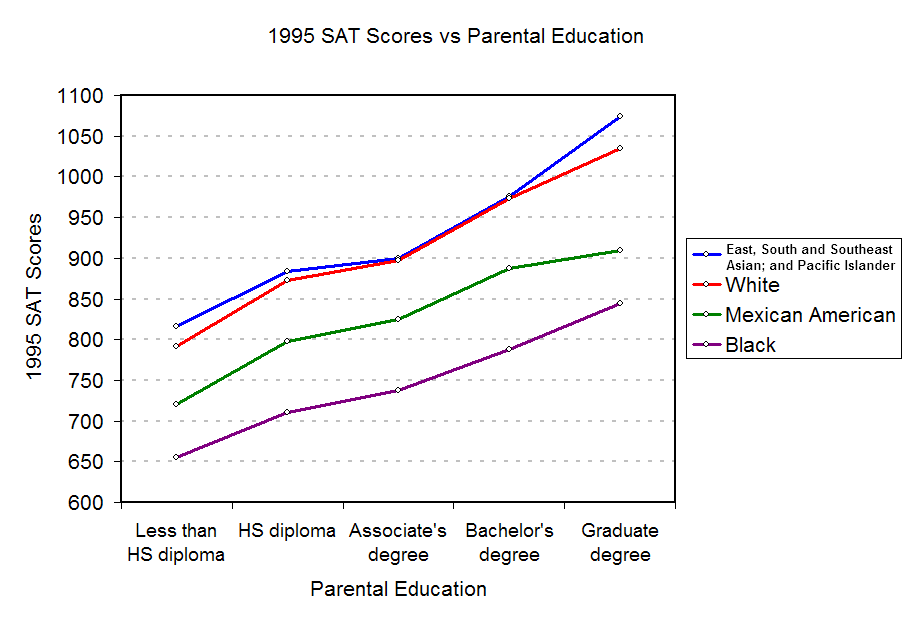
Pioneered by Stanley Kaplan in 1946 with a 64-hour course, SAT preparation has become a highly lucrative field. Many companies and organizations offer test preparation in the form of books, classes, online courses, and tutoring. The test preparation industry began almost simultaneously with the introduction of university entrance exams in the U.S. and flourished from the start. Test-preparation scams are a genuine problem for parents and students. In general, East Asian Americans, especially Korean Americans, are the most likely to take private SAT preparation courses while African Americans typically rely more one-on-one tutoring for remedial learning.
Nevertheless, the College Board maintains that the SAT is essentially uncoachable and research by the College Board and the National Association of College Admission Counseling suggests that tutoring courses result in an average increase of about 20 points on the math section and 10 points on the verbal section. Indeed, researchers have shown time and again that preparation courses tend to offer at best a modest boost to test scores. Like IQ scores, SAT scores tend to be stable over time, meaning SAT preparation courses offer only a limited advantage. An early meta-analysis (from 1983) found similar results and noted "the size of the coaching effect estimated from the matched or randomized studies (10 points) seems too small to be practically important." Statisticians Ben Domingue and Derek C. Briggs examined data from the Education Longitudinal Survey of 2002 and found that the effects of coaching were only statistically significant for mathematics; moreover, coaching had a greater effect on certain students than others, especially those who have taken rigorous courses and those of high socioeconomic status. A 2012 systematic literature review estimated a coaching effect of 23 and 32 points for the math and verbal tests, respectively. A 2016 meta-analysis estimated the effect size to be 0.09 and 0.16 for the verbal and math sections respectively, although there was a large degree of heterogeneity. Meanwhile, a 2011 study found that the effects of one-on-one tutoring to be minimal among all ethnic groups. Public misunderstanding of how to prepare for the SAT continues to be exploited by the preparation industry.
While there is a link between family background and taking an SAT preparation course, not all students benefit equally from such an investment. In fact, any average gains in SAT scores due to such courses are primarily due to improvements among East Asian Americans. When this group is broken down even further, Korean Americans are more likely to take SAT prep courses than Chinese Americans, taking full advantage of their Church communities and ethnic economy.