
The Russian Academy of Sciences (RAS; Russian: Росси́йская акаде́мия нау́к, РАН, romanized: Rossiyskaya akademiya nauk, RAN) consists of the national academy of Russia; a network of scientific research institutes from across the Russian Federation; and additional scientific and social units such as libraries, publishing units, and hospitals. Peter the Great established the academy (then the St. Petersburg Academy of Sciences) in 1724 with guidance from Gottfried Leibniz.
From its establishment, the academy benefited from a slate of foreign scholars as professors; the academy then gained its first clear set of goals from the 1747 Charter. The academy functioned as a university and research center throughout the mid-18th century until the university was dissolved, leaving research as the main pillar of the institution. The rest of the 18th century continuing on through the 19th century consisted of many published academic works from Academy scholars and a few Academy name changes, ending as The Imperial Saint Petersburg Academy of Sciences right before the Soviet period.
Now headquartered in Moscow, the academy (RAS) is a non-profit organization established in the form of a federal state budgetary institution chartered by the Government of Russia. In 2013, the Russian government restructured RAS, assigning control of its property and research institutes to a new government agency headed by Mikhail Kotyukov. As of November 2017, the academy included 1,008 institutions and other units; in total, about 125,000 people were employed of whom 47,000 were scientific researchers.
Membership
There are three types of membership in the RAS: full members (academicians), corresponding members, and foreign members. Academicians and corresponding members must be citizens of the Russian Federation when elected; however, some academicians and corresponding members were elected before the collapse of the USSR and are now citizens of other countries. Members of RAS are elected based on their scientific contributions – election to membership is considered very prestigious.
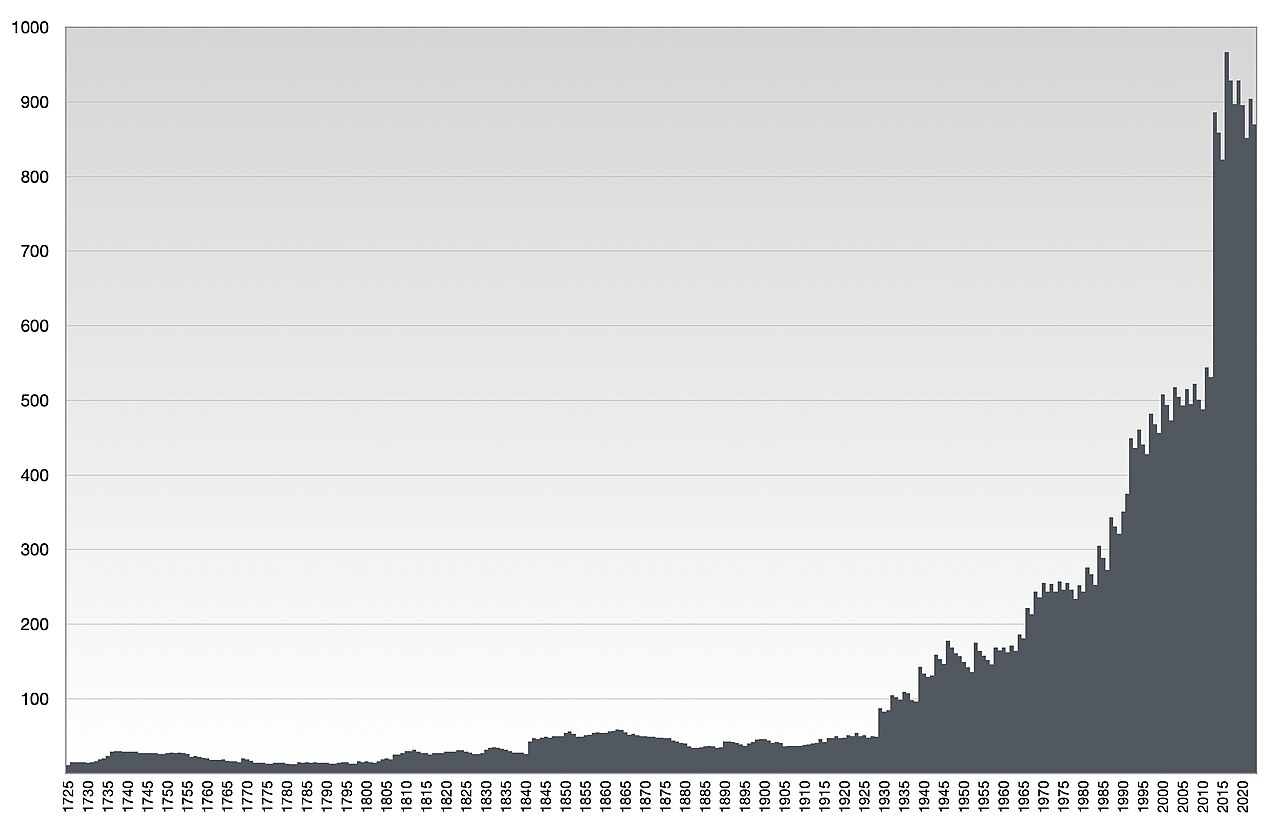
In the years 2005–2012, the academy had approximately 500 full and 700 corresponding members. In 2013, after the Russian Academy of Agricultural Sciences and the Russian Academy of Medical Sciences became incorporated into the RAS, a number of the RAS members accordingly increased. The last elections to the renewed Russian Academy of Sciences were organized on May 26–30, 2025.
As of January 2, 2026, the academy had 1960 living Russian members (full: 841, corresponding: 1119) and about 445 foreign members. Since 2015, the academy also awards, on a competitive basis, the honorary scientific rank of a RAS Professor to the top-level researchers with Russian citizenship; there are 797 scientists with this rank. RAS professorship is not a membership type but its holders are considered as possible candidates for membership; some professors became members already in 2016, 2019, 2022 or 2025 and are henceforth titled "RAS professor, corresponding member of the RAS" (188 scientists) or even "RAS professor, academician of the RAS" (31 scientists).
Present structure
The Academy is headquartered in Moscow at the Presidium of the Academy of Sciences (built between 1967 and 1990).
The RAS consists of 13 specialized scientific divisions, four territorial branches and 15 regional scientific centers. The system of scientific divisions will soon be changed by splitting or fusion of the existing ones. The academy has numerous councils, committees, and commissions, all organized for different purposes.
Territorial branches
Siberian Branch of the Russian Academy of Sciences (SB RAS)

The Siberian Branch was established in 1957, with Mikhail Lavrentyev as founding chairman. Research centers are in Novosibirsk (Akademgorodok), Tomsk, Krasnoyarsk, Irkutsk, Yakutsk, Ulan-Ude, Kemerovo, Tyumen and Omsk. The Branch employes over 12,500 scientific researchers, 199 of whom are now members of the Academy (126 full + 73 corresponding).
Ural Branch of the Russian Academy of Sciences (UB RAS)
The Ural Branch was established in 1932, with Alexander Fersman as its founding chairman. Research centers are in Yekaterinburg, Perm, Cheliabinsk, Izhevsk, Orenburg, Ufa and Syktyvkar. Presently, 113 Ural scientists were members of the Academy (38 full + 75 corresponding).

St. Petersburg Branch of the Russian Academy of Sciences (SPbB RAS)
The St. Petersburg Branch was established in 2023. As of July 6, 2026, 180 scientists from St. Petersburg were members of the Academy (68 full + 112 corresponding).
Far East Branch of the Russian Academy of Sciences (FEB RAS)

The Far East Branch includes the Primorsky Scientific Center in Vladivostok, the Amur Scientific Center in Blagoveschensk, the Khabarovsk Scientific Center, the Sakhalin Scientific Center in Yuzhno-Sakhalinsk, the Kamchatka Scientific Center in Petropavlovsk-Kamchatsky, the North-Eastern Scientific Center in Magadan, the Far East Regional Agriculture Center in Ussuriysk and several Medical institutions. There are 71 Academy members in the Branch (24 full + 47 corresponding).
Regional centers
Kazan Scientific Center
Pushchino Scientific Center

Samara Scientific Center
Saratov Scientific Center
Vladikavkaz Scientific Center of the RAS and the Government of the Republic Alania – Northern Ossetia
Dagestan Scientific Center
Kabardino-Balkarian Scientific Center
Karelian Research Centre of RAS
Kola Scientific Center
Nizhny Novgorod Center
Scientific Center of the RAS in Chernogolovka
St. Petersburg Scientific Center
Ufa Scientific Center
Southern Scientific Center
Troitsk Scientific Center
Institutions
The Russian Academy of Sciences comprises a large number of research institutions, including:
Member institutions are linked via a dedicated Russian Space Science Internet (RSSI). Started with just three members, The RSSI now has 3,100 members, including 57 from the largest research institutions. Russian universities and technical institutes are not under the supervision of the RAS (they are subordinated to the Ministry of Education of Russian Federation), but a number of leading universities, such as Moscow State University, St. Petersburg State University, Novosibirsk State University, and the Moscow Institute of Physics and Technology, make use of the staff and facilities of many institutes of the RAS (as well as of other research institutions); the MIPT faculty refers to this arrangement as the "Phystech System".
From 1933 to 1992, the main scientific journal of the Soviet Academy of Sciences was the Proceedings of the USSR Academy of Sciences (Doklady Akademii Nauk SSSR); after 1992, it became simply Proceedings of the Academy of Sciences (Doklady Akademii Nauk). The academy is also increasing its presence in the educational area. In 1990, the Higher Chemical College of the Russian Academy of Sciences was founded, a specialized university intended to provide extensive opportunities for students to choose an academic path.
Awards
The academy gives out a number of different prizes, medals and awards among which:
History
In the Russian Empire
Creation of the Academy
The academy was a culmination of Emperor Peter the Great's inspiration from his tours to Western Europe and its higher education centers along with the beginning of his correspondence with Gottfried Leibniz, a philosopher, mathematician, and diplomat. Peter's Western European travels introduced him to the new inventions and ideas of the Enlightenment period. Leibniz was attracted to Peter's desire to promote education and science in Russia through modernization of the academic system as he had seen in Western Europe, although he could not get a meeting with Peter during Peter's first European tour. Leibniz did, however, begin correspondence with Peter's advisors where he discussed different plans to achieve the westernization of Russia. Leibniz suggested an education reform which divided schools, universities, and academies, as well as creating new academies and schools. Also, Leibniz suggested creating an arts and sciences institution with faculty consisting of leading foreign scholars.
Following Leibniz's advice, Peter founded the St. Petersburg Academy of Science a year before he died, in January 1724 and the Senate decree of February 8, 1724 implemented the academy. It was modeled after the centralized structure of the Paris Academy and the Berlin Academy of Sciences. These model institutions had led to an educated society of philosophical men, something Peter wanted in Russia. In particular, the Berlin Academy of Sciences was founded by Leibniz, exemplary of the influence which Leibniz had on the creation of the St Petersburg Academy of Science. The Paris Academy was administered directly by the King, which inspired Peter to make himself the supreme head of the St Petersburg Academy of Science, although there could be an academy president.
Early years of the Academy
Peter's widow and Empress Catherine I followed through with the establishment and formation of the academy, opening it in December 1725. Mathematics, physical sciences, and humanities were the three departments which made up the academy upon its opening. The academy also contained a university and secondary school, promoting higher education in Russia. As such, the initial 17 scholars had to teach and administer research. They were a portion of the 84 Academy staff in 1726 There were also student assistants who helped the scholars and taught in the secondary school. 112 students ages 5–18 made up the total first year enrollment in 1726. 76 of the 112 students were Russian while the other 36 students were foreign. The academy did not have an official charter until 1747. Peter I did lay out the goals for the academy in a document signed before his death called the "Project". In the document, Peter wished for the academy to be a model for Russia.
Since the academy was under the Tsar, the presidents, vice-presidents, directors, and vice-directors were all appointed by the crown. Catherine I started this precedent which lasted until the end of the Russian Empire. The academy hit hard times during Empress Anna's rule. A low of six students remained in 1744 and the teaching was in German, contrary to Peter I's wishes. The academy achieved a major goal in the 1740s by turning out the first Russian scholar members, Stepan Krasheninnikov and Mikhail Lomonosov.
Post-1747 Charter
The academy's charter in 1747 brought some changed to the academy's organization which stood until the end of the century. Among some of the changes were Russian and Latin as the official languages, a push to translate literature into Russian, and restrictive working hours for faculty. The charter also emphasized the hope for Russian Academy graduates to replace all the foreign scholars in time. Most of the secondary school graduates went into civil service instead of continue to the university. The university part of the academy gradually deteriorated and eventually died by 1767. Prior to its move to Moscow in the 20th century, the Academy was headquartered in St Petersburg, initially at the Kunstkammer before relocating to the purpose built St Peterbsurg Academy of Sciences Building in 1789.
During Catherine the Great's rule, she enacted reforms to improve the academy for scholars. She created a commission of academy faculty to lead the academy instead of bureaucratic rule. Also, in the second half of the 18th century, Russian scholars grew in number among the faculty of the academy. To heal the growing internal German versus Russian conflict of the faculty, Catherine the Great convinced Leonhard Euler to return to St Petersburg and head the academy in 1766, where he stayed until he died in 1783. Catherine the Great's son Paul I's short reign marked a decline for the academy as he cut funding for academic institutions and prohibited Russians from attending Western influenced institutions. In 1803, Alexander I reverted to reforms from Catherine the Great's era and gave the academy self-administration power in a new charter. The new charter came with a name change to the Imperial Academy of Sciences.
Scholars and research
Following Leibniz's instructions, Peter reached out to the German philosopher Christian Wolff, a correspondent of Leibniz, in the early 1720s and unsuccessfully offered him the Vice-Presidency of the academy. While Wolff declined a position in the academy, he did invite western scholars to work at the academy to improve higher education within the Russian Empire as outlined in Leibniz's letters. Foreign scholars invited to work at the academy included the mathematicians Leonhard Euler (1707–1783), Anders Johan Lexell, Christian Goldbach, Georg Bernhard Bilfinger, Nicholas Bernoulli (1695–1726) and Daniel Bernoulli (1700–1782), botanist Johann Georg Gmelin, embryologists Caspar Friedrich Wolff, astronomer and geographer Joseph-Nicolas Delisle, physicist Georg Wolfgang Kraft, historian Gerhard Friedrich Müller and English Astronomer Royal Nevil Maskelyne (1732–1811).
Expeditions to explore remote parts of the country had Academy scientists as their leaders or most active participants. These included Vitus Bering's Second Kamchatka Expedition of 1733–1743, expeditions to observe the 1769 transit of Venus from eight locations in Russian Empire, and the expeditions of Peter Simon Pallas (1741–1811) to Siberia. The expeditions led to the creation of an atlas of Russia and to research in astronomy, geography, and fauna and flora. From 1750 to 1777, the academy published 20 volumes of their academic journal called Novi Commentarii Academiae Scientiarum Imperialis Petropolitanae. The majority of Russian scientific research in the 18th century was done by members of the academy.
Academy name changes
Originally called The Saint Petersburg Academy of Sciences (Russian: Петербургская академия наук), the organization went under various names over the years, becoming The Imperial Academy of Sciences and Arts (Императорская академия наук и художеств; 1747–1803), The Imperial Academy of Sciences (Императорская академия наук; 1803–1836), and finally, The Imperial Saint Petersburg Academy of Sciences (Императорская Санкт-Петербургская академия Наук, from 1836 and until the end of the empire in 1917).
A separate organization, called the Russian Academy (Russian: Академия Российская), was created in 1783 to work on the study of the Russian language. Presided over by Princess Yekaterina Dashkova (who at the same time was the Director of the Imperial Academy of Arts and Sciences, i.e., the country's "main" academy), the Russian Academy was engaged in compiling the six-volume Academic Dictionary of the Russian Language (1789–1794). The Russian Academy was merged into the Imperial Saint Petersburg Academy of Sciences in 1841.
In the Soviet Union
Shortly after the October Revolution, in December 1917, Sergey Fedorovich Oldenburg, a leading ethnographer and political activist in the Kadet party, met with Vladimir Lenin to discuss the future of the academy. They agreed that the expertise of the academy would be applied to addressing questions of state construction, while in return the Soviet government would give the academy financial and political support.