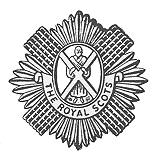
The Royal Scots (The Royal Regiment), once known as the Royal Regiment of Foot, was the oldest and most senior infantry regiment of the line of the British Army, having been raised in 1633 during the reign of Charles I. The regiment existed continuously until 2006, when it amalgamated with the King's Own Scottish Borderers to become the Royal Scots Borderers, which merged with the Royal Highland Fusiliers (Princess Margaret's Own Glasgow and Ayrshire Regiment), the Black Watch, the Highlanders (Seaforth, Gordons and Camerons) and the Argyll and Sutherland Highlanders to form the Royal Regiment of Scotland.
History
17th century
In April 1633, Sir John Hepburn was granted a warrant by Charles I to recruit 1200 Scots for service with the French army in the 1618–1648 Thirty Years War. The nucleus came from Hepburn's previous regiment, which fought with the Swedes from 1625 until August 1632, when Hepburn quarrelled with Gustavus Adolphus. It absorbed other Scottish units in the Swedish army, as well as those already with the French and by 1635 totalled around 8,000 men.
Sir John was killed in 1636 and succeeded as Colonel by his brother George, then, after his death in 1637, Lord James Douglas; following the custom of the time, the unit became known as the Régiment de Douglas. James died in a skirmish near Douai in 1645 and was replaced by his elder brother Archibald Douglas, Earl of Angus, who remained in Scotland and had little contact with the regiment, other than supplying recruits. In 1653, he assigned the Colonelcy to his younger half-brother, George Douglas, later Earl of Dumbarton.

In 1660, Charles II was restored as king; in January 1661, Douglas's was sent to England in response to Venner's Rising, an attempted coup by Fifth Monarchists. The revolt was quickly crushed and it returned to France, since the recently elected Cavalier Parliament quickly disbanded the New Model Army but refused to fund replacements. It remained in France until 1679, apart from a period during the 1664-67 Second Anglo-Dutch War when it was based at the naval dockyard of Chatham. The diarist Pepys met George Douglas in Rochester and recorded that "Here in the streets, I did hear the Scotch march beat by the drums before the soldiers, which is very odde." In 1667, the regiment was accused of looting after the Raid on the Medway and ordered back to France; while awaiting transport, over 700 of the 1,500 men deserted.
During the 1672-74 Third Anglo-Dutch War, Douglas's was part of the British Brigade that fought with the French, commanded by the Duke of Monmouth. It served in the Rhineland throughout the Franco-Dutch War, even after the Anglo-Dutch war ended in February 1674; it became the Régiment de Dumbarton in 1675, after George Douglas was made Earl of Dumbarton. The 1678 Treaties of Nijmegen required the repatriation of all Scots and English units from France; reluctant to lose veteran troops, this was made as hard as possible. Dumbarton's was posted to the Dauphiné in Southern France before being disbanded and its men prevented from travelling for 30 days thereafter; many chose to remain, while those who arrived in England did so without money or possessions.
The regiment was listed on the English military establishment as the First Foot or Royal Scots, a temporary measure during the Exclusion Crisis of 1679–1681. Four of its twenty-one companies joined the Tangier Garrison in April 1680, with another twelve in September. It was awarded a battle honour for 'Tangier' in 1908, but the colony and its garrison was evacuated in 1684. A war diary for 1680 was kept by its commander, Sir James Halkett, allegedly one of the first examples to survive.

On its return, the unit was renamed His Majesty's Royal Regiment of Foot in June 1684. When James II succeeded Charles in 1685, the regiment fought at the decisive Battle of Sedgemoor that ended the June Monmouth Rebellion; a second battalion was raised in March 1686 and posted to Scotland.
It was the only unit where the majority remained loyal to James during the November 1688 Glorious Revolution; Dumbarton followed him into exile and one of William's subordinates, Frederick Schomberg, was appointed Colonel. While awaiting transport from Ipswich to Flanders, it mutinied on 15 March 1689, a combination of not being paid and dislike at being commanded by a foreigner. However, the mutineers were treated with leniency and later agreed to the move.
At the start of the 1688–1697 Nine Years War, Lieutenant-Colonel Sir Robert Douglas commanded the first battalion at the Battle of Walcourt in 1689. After Schomberg was killed in Ireland, he was promoted Colonel in July 1690. The second battalion arrived from Scotland in 1690 and both battalions fought at the Battle of Steenkerque in 1692, where Sir Robert was killed. They then fought at the Battle of Landen in 1693 and at the Siege of Namur. When the Treaty of Ryswick ended the war in 1697, it was transferred to Ireland.

18th century
During the War of the Spanish Succession, the regiment served under Marlborough at Schellenberg, Blenheim, Ramillies and Oudenarde. At Malplaquet in 1709, its members included William Hiseland, an 89-year-old reputed to be the last serving veteran of the First English Civil War.
Both battalions spent 1715 to 1742 in Ireland, but after this were normally separated. The 1st was based in Flanders during the War of the Austrian Succession, where it fought at Fontenoy in 1745. After returning from Puerto Bello in 1743, the 2nd helped suppress the Jacobite rising of 1745, before being posted to Ireland once again.
In the army reforms of 1751, the unit was ranked as the most senior infantry line regiment and titled the 1st (Royal) Regiment of Foot. On the outbreak of the Seven Years' War in 1756, the 2nd Battalion moved to Nova Scotia in 1757, fighting at Louisburg, Guadeloupe and Havana, then returning home in 1764.

Until the American Revolutionary War in 1775, both served as garrisons in the Mediterranean, the 1st in Gibraltar, the 2nd in Minorca. Sent to the West Indies in 1781, the 1st Battalion helped capture St Eustatius; it surrendered at St. Kitts in January 1782 but was later exchanged.
French Revolutionary and Napoleonic Wars
The 1st Battalion had returned to the West Indies as a garrison in 1790, and served there until 1797, with a brief period of combat in the Haitian Revolution. The West Indies were hotbeds of disease, and the battalion lost more than half its strength to disease in this period. It was reformed from militia volunteers in Ireland in 1798: This year saw a major rebellion erupt in Ireland after years of simmering tension. The Lothian Fencibles fought with distinction at the Battle of Vinegar Hill, one of the more important engagements of the rebellion. Subsequently, the regiment gained a new regimental song:
Ye croppies of Wexford, I'd have ye be wise

and go not to meddle with Mid-Lothian Boys
For the Mid-Lothian Boys they vow and declare
They'll crop off your head as well as your hair

derry, down, down.
Remember at Ross and at Vinegar Hill
How your heads flew about like chaff in a mill
For the Mid-Lothian Boys when a croppy they see
they blow out his daylights and tip him cut three
derry, down, down.
After the rebellion was over in Ireland they were used in minor raids on the coast of Spain in 1800. Meanwhile, from 1793 to 1801, the 2nd Battalion was based in the Mediterranean. It fought at the Siege of Toulon (1793) and the capture of Corsica (1794), returning briefly to Northern Europe for the Battle of Egmont op Zee in the 1799 Anglo-Russian invasion of Holland, before fighting in the 1801 Egyptian campaign at the Battle of Aboukir and the Battle of Alexandria.
Both battalions were subsequently dispatched to the West Indies, the 1st from 1801 to 1812, and the 2nd from 1803 to 1806. The 1st occupied Saint Thomas in 1801, fought at the capture of Saint Lucia, as well as of Demerara and Essequibo in 1803, and the capture of Guadeloupe in 1810. The 2nd then moved to India, where it would remain until 1826, whilst the 1st was sent to Quebec with the outbreak of the War of 1812. It fought in the battles of Sackett's Harbor and Buffalo & Black Rock, as well as the capture of Fort Niagara (1813), the battles of Longwoods, Chippawa, and Lundy's Lane, along with the Siege of Fort Erie and the Battle of Cook's Mills (1814). In February 1812, the regiment was retitled as the 1st Regiment of Foot (Royal Scots), the first official appearance of the popular name.
Two new battalions were raised in late 1804, at Hamilton, the 3rd and 4th Battalions. The 3rd served in the Peninsular War from 1808 to 1809, fighting at the Battle of Corunna in 1809 before being withdrawn by sea and sent to the Walcheren Campaign with the 1st Division. It returned to Portugal in 1810 with the 5th Division, fighting at the Battle of Buçaco (1810), the Battle of Fuentes de Onoro (1811), the battles of Badajoz, Salamanca and Burgos (1812), the Battle of Vitoria, capture of San Sebastián, Battle of Nivelle, and the Battle of Nive (1813), before advancing into France in 1814. It was sent to Belgium during the Hundred Days, and fought in Picton's Division (the 5th) at the Battle of Waterloo (1815). After two years in the Army of Occupation, it was disbanded at Canterbury in 1817.
The 4th was deployed to the Baltic in 1813, being involved with the recapture of Stralsund, and fought in the Netherlands in 1814, where it was captured and exchanged. It was then dispatched to Canada as part of the War of 1812, where it served as a garrison. It was withdrawn to England with the end of the fighting and disbanded at Dover in 1816.
19th century
The 1st battalion was sent to Ireland after the end of the Napoleonic wars, and stationed there from 1816 until 1825, when it was moved to the West Indies, where it remained until 1835. The 2nd battalion, however, had a more active time; based in India, it was involved in the Third Anglo-Maratha War, where it fought at the Battle of Nagpore (1817) and Battle of Mahidpur (1818), and in the First Anglo-Burmese War of 1824–26. It moved to Scotland in 1830, and to Canada in 1836, where it was involved in the Rebellions of 1837. The regiment fought at the Battle of Saint-Denis (1837), but was running low on ammunition as the British officers had underestimated the amount of insurgents, and with the enemy beginning to flank, Colonel Charles Gore gave the order to withdraw. A move to the West Indies in 1843 was complicated by half the regiment being shipwrecked and delayed several months, but was successful, and the regiment finally returned to Scotland in 1846.
Both battalions saw active service in the Crimean War, with the 1st fighting at the battles of Alma and Inkerman (1854), and both fighting in the Siege of Sevastopol (1854–55), where the regiment's first VC was won. After the war, the 1st battalion moved to Ceylon in 1857 and thence to India, returning home in 1870, whilst the 2nd battalion moved to Hong Kong, and saw action in the Second Opium War, fighting at the capture of the Taku Forts (1858) and Pekin (1860), and returning home in 1861.
In 1881, following comprehensive reforms following the Crimean war (Cardwell Reforms of 1870), the ambitious Childers Reforms were passed by the War Office. Among many changes was the merger of the many numbered regiments of foot into un-numbered 'county regiments'. Because the regiment already had two battalions, it fared much better than the many other regiments which lost their identities and merged into new two-battalion regiments. Under the February 1881 proposals, the regiment was due to be redesignated as The Lothian Regiment (Royal Scots), however under the final July reform, the regiment became The Royal Scots (Lothian Regiment). Under the previously mentioned reforms, the regiment became a county regiment, encompassing the following: City of Edinburgh (Midlothian), Haddingtonshire (East Lothian), Linlithgowshire (West Lothian), and Berwickshire (later transferred to the King's Own Scottish Borderers on 1 May 1887). In addition to the two regular battalions and depot, the regiment now took control of the various militia and infantry (rifle) volunteers based in the above counties. This left the regiment with the following structure:
Regimental Headquarters, at Edinburgh Castle, Edinburgh
Regimental Depot (part of the 1st Regimental District), at Glencorse Barracks, Glencorse
1st Battalion – regular, previously 1st Battalion, 1st (Royal Scots) Regiment of Foot
2nd Battalion – regular, previously 2nd Battalion, 1st (Royal Scots) Regiment of Foot
3rd Battalion (The Queen's Edinburgh Regiment of Light Infantry) – Militia
1st Edinburgh (City) Rifle Volunteers (The Queen's City of Edinburgh Rifle Volunteer Brigade) – three battalions forming the main Rifle Volunteers element – forming the 1st volunteer battalion of the regiment
2nd Edinburgh (City) Rifle Volunteer Corps – 2nd volunteer battalion of the regiment
1st Midlothian (Leith) Rifle Volunteer Corps – 3rd volunteer battalion of the regiment
2md Midlothian (Midlothian & Peebles-shire) Rifle Volunteer Corps – 4th volunteer battalion of the regiment
1st Linlithgowshire Rifle Volunteer Corps – 5th volunteer battalion of the regiment
1st Haddington Rifle Volunteer Corps – 6th volunteer battalion of the regiment
In 1881, the 1st was in the West Indies; it moved to South Africa in 1884, when it saw action in the Bechuanaland campaign, and remained there until 1891, when it moved back to the UK to serve as the depot battalion and the 2nd moved out to India. With the outbreak of the Second Anglo-Boer War, the 1st was quickly earmarked for service in South Africa, and sailed in late 1899. It remained there until 1903, being joined by the 3rd from 1900 to 1902 – the first time a non-regular unit of the regiment had been activated. The bulk of the time in South Africa was spent patrolling and in mobile columns, with neither battalion engaged in any major battles. The 2nd battalion was posted in India in 1891, and stayed there until 1909. The battalion had various postings around the sub-continent, including Poona until late 1902 when it moved to Kamptee.
In 1908, the Volunteers and Militia were reorganised nationally, with the former becoming the Territorial Force and the latter the Special Reserve; the regiment now had one Reserve and seven Territorial battalions. The 1st moved back to India in 1909, relieving the 2nd, which moved back to the UK; they remained stationed there until 1914.
First World War (1914–1919)
At the outbreak of the First World War, the 1st was in India, and returned to the UK in November; the 2nd was immediately deployed with the British Expeditionary Force (BEF), arriving in France on 14 August and seeing action on the afternoon of the 23rd. The Special Reserve had been mobilised, with the 3rd Battalion activated at Weymouth, and all seven battalions of the Territorial Force had mobilised and raised an additional second-line battalion by the end of 1914. A further seven battalions of the New Army were formed in 1914, including two Pals battalions By the end of 1914, the regiment stood at a strength of 24 battalions; another six Territorial battalions and three New Army battalions (one of bantams) were formed in 1915. In 1916, one service and one reserve battalion were formed by merging depleted Territorial battalions, and in 1917 a labour battalion was formed. In total, the Royal Scots raised some thirty-five battalions of infantry and over 100,000 men during the course of the First World War, of which fifteen battalions saw active service. 11,000 soldiers serving in the regiment were killed, and over 40,000 wounded. Among other decorations and honours, the regiment won six Victoria Crosses.
The 1st, on returning from India, was placed in the 27th Division, a division made up of regular units that had been recalled from garrison duty, and arrived in France in December 1914. It saw combat in the action of Saint-Éloi and throughout the Second Battle of Ypres in 1915, before the division was withdrawn and moved to Salonika in November, where it spent the rest of the war It was sent to Georgia in December 1918 for operations against the Bolsheviks, and returned to Edinburgh in May 1919.
The 2nd was part of the 3rd Division, one of the first units of the British Expeditionary Force to be sent to France. It first saw action in the Battle of Mons, and thence at almost all of the major actions on the Western Front, before returning to Scotland in 1919.
The 1/4th (Queen's Edinburgh Rifles) and 1/7th mobilised in Edinburgh in August 1914, and were assigned to the 52nd (Lowland) Division. Whilst the division was mobilising, the 1/7th was involved in the Quintinshill rail crash, which killed 210 officers and men and wounded another 224. They fought at the Gallipoli campaign before being moved to Egypt in 1916 and serving in the Sinai and Palestine Campaign. They were sent to France in April 1918 for the Second Battle of the Somme, and remained there until the end of the war. Both battalions were reduced to a cadre in March 1919, and returned home to disband in May.
The 1/5th (Queen's Edinburgh Rifles) mobilised in Edinburgh in August 1914, and were assigned to the 29th Division. A poignant Christmas card was produced by the Edinburgh artist Walter Balmer Hislop who served with 'D' Company of the 5th (QER) Battalion . They fought at the Battle of Gallipoli, then to France via Egypt, and saw action on the first day on the Somme. The 1/6th had mobilised at the same time and been dispatched to Egypt in 1915 for the Western Frontier Force; it too was withdrawn to France for the Somme. The two heavily depleted battalions were amalgamated in July 1916, and spent the remainder of war on the Western Front as the 5/6th. After the war, it remained in Belgium until January 1919 when it moved into Germany, and was reduced to a cadre in October 1919 and sent home to be disbanded.
The 1/8th mobilised at Haddington in August 1914, and arrived in France in November – the first Scottish territorial unit to arrive in France – with the 7th Division, though they did not see action until the Battle of Neuve Chapelle. After the Second Battle of Ypres, in August 1915, they were transferred to the 51st (Highland) Division as the divisional pioneers, and disbanded in March 1919 at Haddington The 1/9th mobilised at Edinburgh in August 1914, and moved to France in February 1915 with the 27th Division; when this moved to Salonika in November they remained in France, transferring to the 5th Division, and then to Third Army reserve. They were assigned to the 51st (Highland) Division in March 1916, with whom they fought for two years, then to the 61st (2nd South Midland) Division and 15th (Scottish) Division in 1918.
The 11th, 12th and 13th were raised in August 1914 in Edinburgh, with the 11th and 12th allocated to 9th (Scottish) Division and the 13th to 15th (Scottish) Division, and moved to France in mid-1915. They first saw action at the Battle of Loos, where the 11th was almost wiped out, and spent the remainder of the war on the Western Front. The 11th and 12th moved to Germany after the armistice; the 12th was reduced to a cadre in April 1919 and disbanded in the UK in June, whilst the 11th was reduced to a cadre and disbanded at Cologne in November. The 13th remained in Belgium, being reduced to a cadre in March 1919 and disbanded in the UK in June.
The 15th was raised in September 1914, the 16th (which came to be known as McCrae's Battalion) in December 1914, and the 17th in February 1915, in Edinburgh. The 15th and 16th were assigned to the 34th Division and the 17th to the 35th Division, moved to France in early 1916, and first saw action at the first day on the Somme; all three spent the remainder of the war on the Western Front. The 15th and 16th were reduced to cadres in May 1918 and disbanded in August; the 17th was based in Belgium after the armistice, and provided internal security in France and Belgium in early 1919, before being reduced to a cadre in April and disbanded shortly afterward.
The 2/10th was originally mobilised as bicycle infantry, but never served in this role. It was the only second-line battalion of the regiment to be sent overseas, moving to Archangel in August 1918, and serving in the North Russia Campaign until June 1919, when it returned to Scotland to disband. The remaining battalions all remained in the UK on Home Service, and did not see active duty. However, six saw significant periods of service in Ireland, where they served as garrison units, and were often involved in local security – armed patrols, mobile columns to 'show the flag', and the like.
Inter-war period (1919–1939)
The regiment was reduced sharply in size following the Armistice; during 1919, the 3rd Battalion disbanded, as did all bar one of the Territorial battalions (the one exception being the 2/10th, which was finally disbanded in February 1920).