
Royal Mail Group Limited, trading as Royal Mail, is a British postal service and courier company. It is owned by International Distribution Services. It operates the brands Royal Mail (letters and parcels) and Parcelforce Worldwide (parcels). Formed in 2001, the company used the name Consignia for a brief period but changed it soon afterwards. Prior to this date, Royal Mail and Parcelforce were (along with Post Office Counters Ltd) part of the Post Office, a state-owned enterprise the history of which is summarised below. Long before it came to be a company name, the "Royal Mail" brand had been used by the General Post Office to identify its distribution network (which over the centuries included horse-drawn mail coaches, horse carts and hand carts, ships, trains, vans, motorcycle combinations and aircraft).
The company provides mail collection and delivery services throughout the UK. Letters and parcels are deposited in post or parcel boxes, or are collected in bulk from businesses and transported to Royal Mail sorting offices. Royal Mail owns and maintains the UK's distinctive and iconic red pillar boxes, first introduced in 1852 (12 years after the first postage stamp, Penny Black), and other post boxes, many of which bear the royal cypher of the reigning monarch at the date of manufacture. Deliveries are made at least once every day except Sundays and bank holidays at uniform charges for all UK destinations. Royal Mail generally aims to make first class deliveries the next business day throughout the nation.
For most of its history, the Royal Mail was a public service, operating as a government department or public corporation. Following the Postal Services Act 2011, Royal Mail Group Limited became a wholly owned subsidiary of a new holding company, Royal Mail plc; a majority of the shares in Royal Mail plc were floated on the London Stock Exchange in 2013. Nine years later, Royal Mail plc was renamed International Distribution Services (IDS; of which Royal Mail Group Limited remains a wholly owned subsidiary). In April 2025, IDS was acquired by EP Group, a Czech-based company owned by Daniel Křetínský, for £3.6 billion. The government has retained a so-called golden share. The deal marked the first time the Royal Mail was under foreign ownership.
History
The Royal Mail can trace its history back to 1516, when Henry VIII established a "Master of the Posts", a position that was renamed "Postmaster General" in 1710.
Upon his accession to the throne of England at the Union of the Crowns in 1603, James VI of Scotland moved his court to London. One of his first acts from London was to establish the royal postal service between London and Edinburgh, in an attempt to retain control over the Scottish Privy Council.
Government office
The Royal Mail service was first made available to the public by Charles I on 31 July 1635, with postage being paid by the recipient. The monopoly was farmed out to Thomas Witherings.

In the 1640s, Parliament removed the monopoly from Witherings and during the Civil War and First Commonwealth the parliamentary postal service was run at great profit for himself by Edmund Prideaux (a prominent parliamentarian and lawyer who rose to be attorney-general). To keep his monopoly in those troubled times Prideaux improved efficiency and used both legal impediments and illegal methods.
In 1653, Parliament set aside all previous grants for postal services, and contracts were let for the inland and foreign mails to John Manley. Manley was given a monopoly on the postal service, which was effectively enforced by Protector Oliver Cromwell's government, and thanks to the improvements necessitated by the war, Manley ran a much-improved Post Office service. In July 1655, the Post Office was put under the direct government control of John Thurloe, a Secretary of State, best known to history as Cromwell's spymaster general. Previous English governments had tried to prevent conspirators from communicating; Thurloe preferred to deliver their post having surreptitiously read it. As the Protectorate claimed to govern all of Great Britain and Ireland under one unified government, on 9 June 1657 the Second Protectorate Parliament (which included Scottish and Irish MPs) passed the "Act for settling the Postage in England, Scotland and Ireland", which created one monopoly Post Office for the whole territory of the Commonwealth. The first Postmaster General was appointed in 1661, and a seal was first fixed to the mail.
At the restoration of the monarchy, in 1660, all the ordinances and acts passed by parliaments during the Civil War and the Interregnum passed into oblivion, so the General Post Office (GPO) was officially established by Charles II under the Post Office Act 1660 (12 Cha. 2. c. 35).

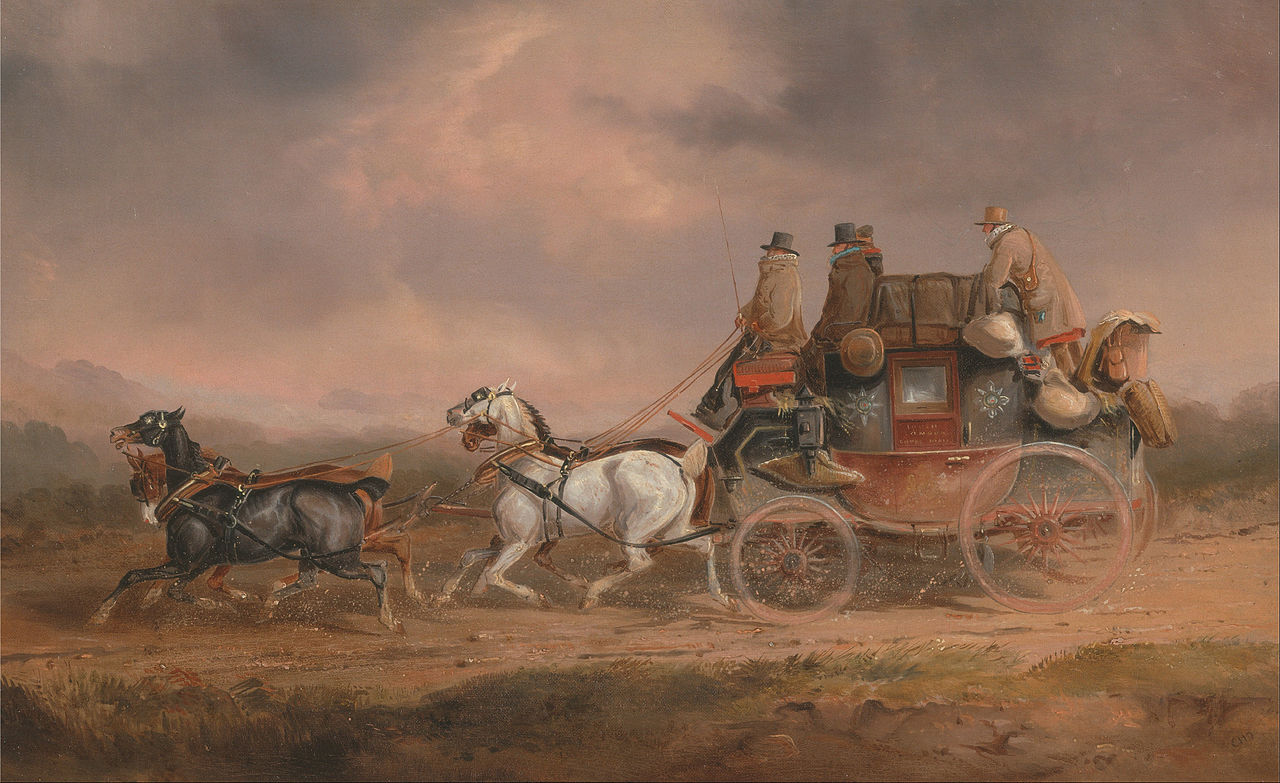
Between 1719 and 1763, Ralph Allen, postmaster at Bath, signed a series of contracts with the post office to develop and expand Britain's postal network. He organised mail coaches which were provided by both Wilson & Company of London and Williams & Company of Bath. The early Royal Mail Coaches were similar to ordinary family coaches, but with Post Office livery.
The first mail coach ran in 1784, operating between Bristol and London. Delivery staff received uniforms for the first time in 1793, and the Post Office Investigation Branch was established. The first mail train ran in 1830, on the Liverpool and Manchester Railway. The Post Office's money order system was introduced in 1838.
Uniform penny postage
In December 1839, the first substantial reform started when postage rates were revised by the short-lived Uniform Fourpenny Post.

Rowland Hill, an English teacher, inventor and social reformer, became disillusioned with the postal service, and wrote a paper proposing reforms that resulted in an approach that would go on to change not only the Royal Mail, but also be copied by postal services around the world. His proposal was refused at the first attempt, but he overcame the political obstacles, and was appointed to implement and develop his ideas. He realised that many small purchases would fund the organisation and implemented this by changing it from a receiver-pays to a sender-pays system. This was used as the model for other postal services around the world, but also spilled over to the modern-day crowd-funding approach.
Greater changes took place when the Uniform Penny Post was introduced on 10 January 1840, whereby a single rate for delivery anywhere in Great Britain and Ireland was pre-paid by the sender. A few months later, to certify that postage had been paid on a letter, the sender could affix the first adhesive postage stamp, the Penny Black, which was available for use from 6 May the same year. Other innovations were the introduction of pre-paid William Mulready designed postal stationery letter sheets and envelopes.
As Britain was the first country to issue prepaid postage stamps, British stamps are the only stamps that do not bear the name of the country of issue on them.

By the late 19th century, there were between six and twelve mail deliveries per day in London, permitting correspondents to exchange multiple letters within a single day.
The first trial of the London Pneumatic Despatch Company was made in 1863, sending mail by underground rail between postal depots. The Post Office began its telegraph service in 1870.
Pillar boxes
The first Post Office pillar box was erected in 1852 in Jersey. Pillar boxes were introduced in mainland Britain the following year. British pillar boxes traditionally carry the Latin initials of the reigning monarch at the time of their installation, for example: VR for Victoria Regina or GR for Georgius Rex. Such branding was not used in Scotland for most of the reign of Queen Elizabeth II, due to a dispute over the monarch's title: some Scottish nationalists argue that Queen Elizabeth II should have simply been Queen Elizabeth, as there had been no previous Queen Elizabeth of Scotland or of the United Kingdom of Great Britain and Northern Ireland (Elizabeth I was only Queen of the pre-1707 Kingdom of England). The dispute involved vandalism and attacks on pillar and post boxes introduced in Scotland which displayed EIIR. To avoid the issue, pillar boxes in Scotland were either marked 'Post Office' or used the Scots Crown.

A national telephone service was opened by the Post Office in 1912. In 1919, the first international airmail service was developed by Royal Engineers (Postal Section) and Royal Air Force. The London Post Office Railway was opened in 1927.
In 1941, an airgraph service was introduced between Britain and Egypt. The service was later extended to Canada (1941), East Africa (1941), Burma (1942), India (1942), South Africa (1942), Australia (1943), New Zealand (1943), Ceylon (now Sri Lanka) (1944), and Italy (1944).
Postcodes were extended across Great Britain and Northern Ireland between 1959 and 1974. The two-class postal system was introduced in 1968, using first-class and second-class services. The Post Office opened the National Giro Bank that year.
In April 2025, Royal Mail announced that they were trialling two versions of a new solar-powered "postbox of the future" with a barcode reader and an electronically unlockable hatch to accept small parcels. By August, they decided to deploy 3500 of the red-topped version around the United Kingdom.
Statutory corporation
Under the Post Office Act 1969 the General Post Office was changed from a government department to a statutory corporation, known simply as the Post Office. The office of Postmaster General was abolished and replaced with the positions of chairman and chief executive in the new company. In 1971, postal services in Great Britain were suspended for two months between January and March as the result of a national postal strike over a pay claim.
British Telecom was separated from the Post Office in 1980, and emerged as an independent business in 1981. In 1986 the Post Office was subdivided into four businesses: Royal Mail Letters, Royal Mail Parcels, Post Office Counters and the National Girobank. Girobank was sold to Alliance & Leicester in 1990, but the remaining business continued under public ownership as privatisation of this was deemed to be too unpopular. That same year, Royal Mail Parcels was rebranded as Parcelforce as part of an attempt to compete with international courier firms, which were fast expanding into the European market.
Postal workers held their first national strike for 17 years in 1988, after walking out over bonuses being paid to recruit new workers in London and the South East. Royal Mail established Romec (Royal Mail Engineering & Construction) in 1989 to deliver facilities maintenance services to its business. Romec was 51% owned by Royal Mail, and 49% by Haden Building Management Ltd, which became Balfour Beatty WorkPlace and is now Cofely UK, part of GDF Suez in a joint venture.
In the 1990s the President of the Board of Trade, Michael Heseltine, began to look again at privatisation, and eventually a Green Paper on Postal Reform was published in May 1994, outlining various possible options. The ideas, however, proved controversial, and were dropped from the 1994 Queen's Speech after a number of Conservative MPs warned Heseltine that they would not vote for the legislation.
In 1998, Royal Mail launched RelayOne as an email to postal service system. In 1999, Royal Mail launched a short-lived e-commerce venture, ViaCode Limited, aimed at providing encrypted online communications services. However, it failed to make a profit and closed in 2002.
In 1999 Royal Mail acquired German Parcel, incorporating it into a newly formed holding company, General Logistics Systems B.V., which over the next few years was used to establish an international network of parcel couriers ('through acquisitions and the founding of companies in numerous countries'). In 2002 the GLS brand was launched, which later went on to function as Royal Mail's European parcels business.
Headquarters
The Post Office had its headquarters in St. Martin's Le Grand, in the City of London, until 1984. Then the headquarters division moved out to 33 Grosvenor Place (lately vacated by British Steel). After 1986 separate headquarters were established elsewhere for each of the three subdivisions of the Post Office, leaving a much reduced corporate head office (with just thirty staff) who in 1990 moved to 30 St James's Square; two years later it was again moved, to be co-located with the Letters head office in Royal Mail House (148 Old Street).
Public limited company
Following a change of government in 1997, New Labour decided to keep the Post Office state-owned, but with more commercial freedom. This led to the Postal Services Act 2000, whereby the Post Office became a public limited company in which the Secretary of State for Trade and Industry owned a special share, and the Treasury Solicitor held an ordinary share. As part of the 2000 Act, the government set up a postal regulator, the Postal Services Commission, known as Postcomm, which offered licences to private companies to deliver mail. In 2001, the Consumer Council for Postal Services, known as Postwatch, was created for consumers to express any concerns they may have with the postal service in Britain.
Consignia plc
The company was renamed Consignia Public Limited Company in 2001, a name that was invented by the consultancy company Dragon Brands, and the new name was intended to show that the company did more than deliver mail; however, the change was very unpopular with both the general public and employees. The Communication Workers Union (CWU) boycotted the name, and the following year, it was announced that the company would be renamed Royal Mail Group plc. In 2002 Consignia discussed a potential merger with Dutch postal operator TPG, but the plans did not proceed after the two companies failed to agree terms.
Royal Mail Group plc
The company began operating under its 'new' name, Royal Mail Group plc, on 4 November 2002. Use of the Post Office brand was afterwards restricted to the counters business ('Post Office Counters Ltd' since 1987), which was duly renamed Post Office Limited; it continued to operate as a wholly owned subsidiary of Royal Mail Group plc until 2012, when the two were separated in preparation for the latter's privatisation.
In 2004, the second daily delivery was scrapped in an effort to reduce costs and improve efficiency, meaning a later single delivery would be made. The same year, the travelling post office mail trains were also axed. In 2005, Royal Mail signed a contract with GB Railfreight to operate an overnight rail service between London and Scotland (carrying bulk mail, and without any on-train sorting); this was later followed by a London-Newcastle service.
On 1 January 2006, the Royal Mail lost its 350-year monopoly, and the British postal market became fully open to competition. Competitors were allowed to collect and sort mail, and pass it to Royal Mail for delivery, a service known as downstream access. Royal Mail introduced Pricing in Proportion (PiP) for first and second class inland mail, whereby prices are affected by the size as well as weight of items. It also introduced an online postage service, allowing customers to pay for postage online.
Royal Mail Group Ltd
In 2007, the Royal Mail Group plc became Royal Mail Group Ltd, in a slight change of legal status. Royal Mail ended Sunday collections from pillar boxes that year.
On 1 October 2008, Postwatch was merged into the new consumer watchdog Consumer Focus.
In 2008, due to a continuing fall in mail volumes, the government commissioned an independent review of the postal services sector by Richard Hooper CBE, the former deputy chairman of Ofcom. The recommendations in the Hooper Review led Business Secretary Peter Mandelson to seek to part privatise the company by selling a minority stake to a commercial partner. However, despite legislation for the sale passing the House of Lords, it was abandoned in the House of Commons after strong opposition from backbench Labour MPs. The government later cited the difficult economic conditions for the reason behind the retreat.
Following the departure of Adam Crozier to ITV plc on 27 May 2010, Royal Mail appointed Canadian Moya Greene as chief executive, the first woman to hold the post.
On 6 December 2010, a number of paid-for services including Admail, post office boxes and private post boxes were removed from the Inland Letter Post Scheme (ILPS) and became available under contract. Several free services, including petitions to parliament and the sovereign, and poste restante, were removed from the scheme.
Privatisation
Following the 2010 general election, the new Business Secretary in the coalition government, Vince Cable, asked Richard Hooper CBE to expand on his previous report, to take into account EU Directive 2008/6/EC which called for the postal sector to be fully open to competition by 31 December 2012. Based on the updated Hooper Review, Parliament passed the Postal Services Act 2011. The act allowed for up to 90% of Royal Mail to be privatised, with at least 10% of shares to be held by Royal Mail employees.
As part of the 2011 Act, Postcomm was merged into the communications regulator Ofcom on 1 October 2011, with Ofcom introducing a new simplified set of regulations for postal services on 27 March 2012. On 31 March 2012, the government took over the historic assets and liabilities of the Royal Mail pension scheme, relieving Royal Mail of its huge pensions deficit. On 1 April 2012, Post Office Limited became independent of Royal Mail Group, and was reorganised to become a subsidiary of Royal Mail Holdings, with a separate management and board of directors. A 10-year inter-business agreement was signed between the two companies to allow Post Offices to continue issuing stamps and handling letters and parcels for Royal Mail. The act also contained the option for Post Office Ltd to become a mutual organisation in the future.
In July 2013, Cable announced that Royal Mail was to be floated on the London Stock Exchange, and confirmed that postal staff would be entitled to free shares. A new holding company, Royal Mail plc, was established in September 2013, in anticipation of its initial public offering on the London Stock Exchange. Applications for members of the public to buy shares opened on 27 September 2013, ahead of the company's listing on the London Stock Exchange on 15 October 2013. Trading as Royal Mail, and continuing to serve as the UK's designated Universal Service Provider, the company operated through two divisions: UKPIL (UK Parcels, International & Letters) 'Royal Mail's core UK and international parcels and letter delivery businesses under the Royal Mail and Parcelforce Worldwide brands' and GLS (General Logistics Systems) 'the Group's European parcels business'; (between 2016 and 2020, GLS would expand beyond Europe and into North America). Throughout this time, Royal Mail Group Limited continued to operate as a 'wholly owned subsidiary of Royal Mail plc', running the UKPIL side of the operation.
At its annual general meeting on 20 July 2022, the company announced that the holding company responsible for both Royal Mail and GLS would change its name to International Distributions Services (IDS) plc. It was also suggested that the board of directors might look to separate GLS in order to distance the profitable company from Royal Mail, which was in negotiations with the CWU over both pay and future changes to ways of working. The name change was filled in the Companies House on 28 September 2022 and registered on 3 October. In March 2023, talks over pay were reportedly collapsing.
Ownership under EP Group
In December 2024, the British government approved the £3.6 billion sale of IDS to Daniel Křetínský's EP Group, marking the first time the 508-year-old postal service had come under foreign ownership. The deal, reviewed under national security laws, included commitments to retain the universal service obligation, UK headquarters, and tax residency, while barring dividends unless financial and service targets were met. Despite concerns over declining letter volumes and scrutiny of Křetínský's Russian business ties, the agreement, supported by unions, aimed to stabilise and reform Royal Mail. The acquisition was completed in April 2025.
Royal Mail Group Ltd continues to function as a wholly owned subsidiary: "The Company makes up a significant part of the Royal Mail UK segment ('Royal Mail') within the IDS plc Group", running parcels and letter delivery businesses under the Royal Mail and Parcelforce Worldwide brands.
Services
Universal service
Royal Mail is required by law to maintain the universal service, whereby items of a specific size can be sent to any location within the United Kingdom for a fixed price, not affected by distance. The Postal Services Act 2011 guaranteed that Royal Mail would continue to provide the universal service until at least 2021.