
The Roman legion (Latin: legiō, Latin: [ˈɫɛɡioː]) was the largest military unit of the Roman army, composed of Roman citizens serving as legionaries. During the Roman Republic the manipular legion comprised 4,200 infantry and 300 cavalry. In late Republican times the legions were formed of 5,200 men and were restructured around 10 cohorts, the first cohort being double strength. This structure persisted throughout the Principate and middle Empire, before further changes in the fourth century resulted in new formations of around 1,000 men.
Size
The size of a typical legion varied throughout the history of ancient Rome, with complements ranging from 4,200 legionaries and 300 equites (drawn from the wealthier classes – in early Rome all troops provided their own equipment) in the Republic, to 5,500 in the Imperial period, when most legions were led by a Roman Imperial Legate.
A legion had 4,800 legionaries (in 10 cohorts of 6 centuries of 80 legionaries) from the late republic to the time of Julius Caesar. It expanded to 5,280 men plus 120 auxiliaries in the Imperial period (split into 10 cohorts, nine of 480 men each, with the first cohort being almost double-strength at 800 men). These are typical field strengths while "paper strength" was slightly higher (e.g. 600 and 1,200 respectively for Imperial cohorts).

In the early Roman Kingdom the term legion may have meant the entire Roman army, but sources on this period are few and unreliable. The subsequent organisation of legions varied greatly over time but legions were typically composed of around five thousand soldiers. During much of the republican era, a legion was divided into three lines, each of ten maniples. In the late Republic and much of the imperial period (from about 100 BC), a legion was divided into ten cohorts, each of six (or five) centuries. Legions also included a small ala, or cavalry unit. By the third century AD, the legion was a much smaller unit of about 1,000 to 1,500 men, and there were more of them. In the fourth century AD, East Roman border guard legions (limitanei) may have become even smaller. In terms of organization and function, the republican era legion may have been influenced by the ancient Greek and Macedonian phalanx.
Function and constitution
For most of the Roman Imperial period, the legions formed the Roman army's elite heavy infantry, recruited exclusively from Roman citizens, while the remainder of the army consisted of auxiliaries, who provided additional infantry and the vast majority of the Roman cavalry (provincials who aspired to Roman citizenship gained it when honourably discharged from the auxiliaries). The Roman army, for most of the Imperial period, consisted mostly of auxiliaries rather than legions.
Longevity
Many of the legions founded before 40 BC were still active until at least the fifth century, notably Legio V Macedonica, which was founded by Augustus in 43 BC and was in Egypt in the seventh century during the Islamic conquest of Egypt.

On the other hand, Legio XVII ("Seventeenth Legion"), Legio XVIII ("Eighteenth Legion") and Legio XIX ("Nineteenth Legion"), founded by Augustus around 41 BC, were destroyed by a Germanic alliance led by Arminius in the Varian Disaster (September 9, AD 9) and never raised again by the Romans thereafter.
Quintili Vare, legiones redde! (Quintilius Varus, give me back my legions!)
Evolution
Almost nothing is known about the legion of the Roman Kingdom period that could have included 1000 men from each of the three original Roman tribes. The earliest surviving detailed description comes from Polybius, who was writing c. 150 BC and his account most likely was influenced by the organization of the Roman army after the defeat of Hannibal in the Punic wars some 50 years earlier.

The legions of the Republic were only conscripted in times of conflict and usually limited to four legions, two to be commanded by each consul, though more could be levied if needed. Legionaries lacked the opportunity of a military career; they were not paid well, their primary form of income being what they could loot from the battlefield, and were simply called upon when needed and returned to their civilian lives when they were no longer required.
In terms of organization and function, the early Republican era military was inherited from the Etruscans and seemingly influenced by the ancient Greek and Macedonian phalanx.
After a crushing defeat at the Battle of the Allia, in 387 BC the military structure was reformed. Under the Camillan system the legions were initially structured based on social class, with the poorest being the first line of the formation. The legionaries most often fought with hastae (spears) and scuta (large rectangular shields) in a checkered maniple formation with assistance from skirmishers. The exception to this was the triarii, the final line of the formation who instead fought as hoplites, using Greek clipei and whose wealth could afford them gladii in the case of a broken spear.

By the 3rd century BC, this system was seen to be inefficient. Under the new Polybian system the ranks were no longer structured by wealth, and instead by age and experience. All legionaries had their hastae replaced by gladii, along with two pila, which were used as an opening volley before melee. The former classes of poor legionaries, the accensi, rorarii, and leves were replaced by the velites. Unit sizes were also expanded.
Non-citizens or peregrini were also offered a position in the military as auxiliaries.
The Republican legion evolved from 3,000 men in the Roman Republic to over 5,200 men in the Roman Empire, consisting of centuries as the basic units. Until the middle of the first century AD, ten cohorts made up a Roman legion. This was later changed to nine cohorts of standard size (with six centuries at 80 men each) with the first cohort being of double strength (five double-strength centuries with 160 men each).
By the fourth century AD, the legion was a much smaller unit of about 1,000 to 1,500 men, and there were more of them. This had come about as the large formation legion and auxiliary unit, 10,000 men, was broken down into smaller units – originally temporary detachments – to cover more territory.
In the fourth century AD, East Roman border guard legions (limitanei) may have become even smaller.
History
Roman Kingdom (c. 752 to 509 BC)
In the period before the raising of the legio and the early years of the Roman Kingdom and the Roman Republic, forces are described as being organised into centuriae of roughly one hundred men. These centuries were grouped together as required and answered to the leader who had hired or raised them. Such independent organisation persisted until the 2nd century BC amongst light infantry and cavalry, but was discarded completely in later periods with the supporting role taken instead by allied troops. The roles of century leader (later formalised as a centurion), second in command and standard bearer are referenced in this early period.

Rome's early period is undocumented and shrouded in myths, but those myths tell that during the rule of Servius Tullius, the census (from Latin: censeō – accounting of the people) was introduced. With this all Roman able-bodied, property-owning male citizens were divided into five classes for military service based on their wealth and then organised into centuries as sub-units of the greater Roman army or legio (multitude). Joining the army was both a duty and a distinguishing mark of Roman citizenship; the wealthiest land owners performed the most years of military service. These individuals would have had the most to lose should the state have fallen.
Mid Republic (509–107 BC)
At some point after the overthrow of the Roman monarchy the legio was subdivided into two separate legions, each one ascribed to one of the two consuls. In the first years of the Republic, when warfare was mostly concentrated on raiding, it is uncertain if the full manpower of the legions was summoned at any one time. In 494 BC, when three foreign threats emerged, the dictator Manius Valerius Maximus raised ten legions which Livy says was a greater number than had been raised previously at any one time.
Also, some warfare was still conducted by Roman forces outside the legionary structure, the most famous example being the campaign in 479 BC by the clan army of gens Fabia against the Etruscan city of Veii (in which the clan was annihilated). Legions became more formally organised in the 4th century BC, as Roman warfare evolved to more frequent and planned operations, and the consular army was raised to two legions each.
In the Republic, legions had an ephemeral existence. Except for Legio I to IV, which were the consular armies (two per consul), other units were levied by campaign. Rome's Italian allies were required to provide approximately ten cohorts (auxilia were not organised into legions) to support each Roman Legion.
In the middle of the Republic, legions were composed of the following units:
Equites (cavalry): the cavalry was originally the most prestigious unit, where wealthy young Roman men displayed their skill and prowess, laying the foundation for an eventual political career. Cavalry equipment was purchased by each of the cavalrymen and consisted of a round shield, helmet, body armour, sword and one or more lances. The cavalry was outnumbered in the legion. In a total of c. 3,000 men (plus the velites that normally enlarged the number to about 4,200), the legion only had around 300 horsemen, divided into ten units (turmae) of 30 men. These men were commanded by decurions. In addition to heavy cavalry, there would be the light cavalry levied from poor citizens and wealthy young citizens not old enough to be in the hastati or the equites. In battle, they were used to disrupt and outflank enemy infantry formations and to fight off enemy cavalry. In the latter type of engagement, they would often (though not always) dismount some or all of the horsemen to fight a stationary battle on foot, an unusual tactic for the time, but one that offered significant advantages in stability and agility in a time before stirrups.
Velites (light infantry): these were mainly poorer citizens who could not afford to equip themselves properly. Their primary function was to act as skirmishers – javelin-throwers, who would engage the enemy early in order either to harass them or to cover the movement of troops behind them. After throwing their javelins, they would retreat through the gaps between the maniples, screened from the attack of the enemy by the heavy infantry lines. With the shortage of cavalry in the army of the early to mid Republican army, the velites were also used as scouts. They did not have a precise formal organisation or formation.
Heavy infantry: this was the principal unit of the legion. The heavy infantry was composed of citizen legionaries that could afford the equipment composed of a bronze helmet, shield, sword, armour and pilum, a heavy javelin whose range was about 30 metres. After the Second Punic War, the preferred weapon for the hastati and principes was the gladius, a short sword. Their hobnailed sandals (caligae) were also an effective weapon against a fallen enemy. Heavy infantry was subdivided, according to experience, into three separate lines of troops:
The hastati (sing.: hastatus): these consisted of raw or inexperienced soldiers, considered to be less reliable than legionaries of several years' service. The Hastati were placed at the front for several reasons. One reason is the city of Rome could ill-afford to lose experienced soldiers, so they put the greenest soldiers at the front. If they survived, the hastati would gain invaluable experience. Another reason is if the newest soldiers succumbed to battle nerves and broke and tried to run, then there were experienced soldiers behind them to stiffen their resolve.
The principes (sing.: princeps): these were the more experienced soldiers, often better equipped than the hastati, and having more experience on the battlefield, they would take up the second line in the battle in the event the Hastati failed or fled. They were the second wave in an early Republican Legion.
The triarii (sing.: triarius): these were the veteran soldiers, to be used in battle only in extreme situations; they rested one knee down when not engaged in combat. The triarii served primarily as reserves or barrier troops designed to backstop the hastati and principes, and were equipped with long hastae (spears) rather than the pilum and gladius (the hastati and principes stopped using spears in 387 BC). Thus armed, they fought in a phalanx formation. The sight of an advancing armored formation of triarii legionaries frequently discouraged exultant enemies in pursuit of retreating hastati and principes troops. Ad triarios redisse – To fall back upon the triarii – was a Roman idiom meaning to use one's last resort.
Each of these three lines was subdivided into (usually ten) chief tactical units called maniples. A maniple consisted of two centuries and was commanded by the senior of the two centurions. At this time, each century of hastati and principes consisted of 60 men; a century of triarii was 30 men. These 3,000 men (twenty maniples of 120 men, and ten maniples of 60 men), together with about 1,200 velites and 300 cavalry gave the mid Republican ("manipular") legion a nominal strength of about 4,500 men.
Late Republic (107–27 BC)
Each century had its own standard and was made up of ten units (contubernia) of eight men who shared a tent, a millstone, a mule and cooking pot.
Full Roman citizenship was open to all the regions of Italy. At the same time, the three different types of heavy infantry were replaced by a single, standard type based on the principes: armed with two heavy javelins called pila (singular pilum), the short sword called gladius, chain mail (lorica hamata), helmet and rectangular shield (scutum).
The role of allied legions would eventually be taken up by contingents of allied auxiliary troops, called auxilia. Auxilia contained immunes (specialist units), engineers and pioneers, artillerymen and craftsmen, service and support personnel and irregular units made up of non-citizens, mercenaries and local militia. These were usually formed into complete units such as light cavalry, light infantry or velites, and labourers. There was also a reconnaissance squad of ten or more light mounted infantry called speculatores, who could also serve as messengers or even as an early form of military intelligence service.
A typical legion of this period had 5,120 legionaries as well as a large number of camp followers, servants and slaves. Legions could contain as many as 11,000 fighting men when including the auxiliaries. During the Later Roman Empire, the legion was reduced in size to 1,000 to allow for easier provisioning and to expand the regions under surveillance. Numbers would also vary depending on casualties suffered during a campaign; Julius Caesar's legions during his campaign in Gaul often only had around 3,500 men.
Tactics were not very different from the past, but their effectiveness was largely improved because of the professional training of the soldiers.
Throughout the history of Rome's Late Republic, the legions played an important political role. By the 1st century BC, the threat of the legions under a demagogue was recognised. Roman governors were not allowed to leave their provinces with their legions. When Julius Caesar broke this rule, leaving his province of Gaul and crossing the Rubicon into Italy, he precipitated a constitutional crisis. This crisis and the civil wars which followed brought an end to the Republic and led to the foundation of the Empire under Augustus in 27 BC.
Early Empire (27 BC–AD 284)
Generals, during the recent Republican civil wars, had formed their own legions and numbered them as they wished. During this time, there was a high incidence of Gemina (twin) legions, where two legions were consolidated into a single organisation (and was later made official and put under a legatus and six duces). At the end of the civil war against Mark Antony, Augustus was left with around fifty legions, with several double counts (multiple Legio Xs for instance). For political and economic reasons, Augustus reduced the number of legions to 28 (which shrank to 25 after the Battle of the Teutoburg Forest, in which three legions were completely destroyed).
Beside streamlining the army, Augustus also regulated the soldiers' pay. At the same time, he greatly increased the number of auxiliaries to the point where they were equal in number to the legionaries. He also created the Praetorian Guard along with a permanent Roman navy where served the liberti, or freed slaves.
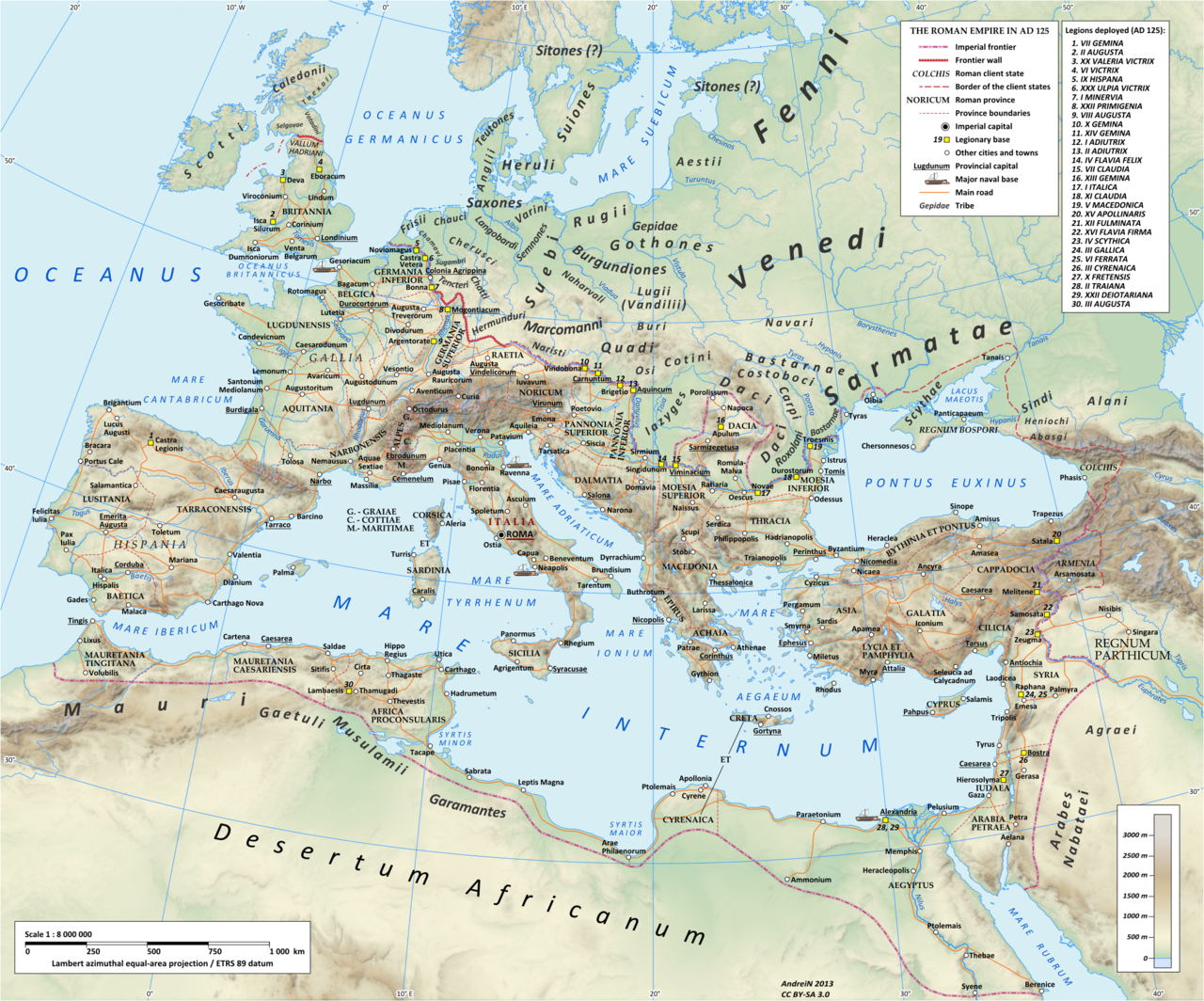
The legions also became permanent at this time, and not recruited for particular campaigns. They were also allocated to static bases with permanent castra legionaria (legionary fortresses).
Augustus' military policies proved sound and cost effective, and were generally followed by his successors. These emperors would carefully add new legions, as circumstances required or permitted, until the strength of the standing army stood at around 30 legions (hence the wry remark of the philosopher Favorinus that It is ill arguing with the master of 30 legions). With each legion having 5,120 legionaries usually supported by an equal number of auxiliary troops (according to Tacitus), the total force available to a legion commander during the Pax Romana probably ranged from 11,000 downwards, with the more prestigious legions and those stationed on hostile borders or in restive provinces tending to have more auxiliaries. By the time of the emperor Severus, 193–211, the auxiliaries may have composed 55 to 60% of the army, 250,000 of 447,000. Some legions may have even been reinforced at times with units making the associated force near 15,000–16,000 or about the size of a modern division.
Throughout the Imperial era, the legions played an important political role. Their actions could secure the empire for a usurper or take it away. For example, the defeat of Vitellius in the Year of the Four Emperors was decided when the Danubian legions chose to support Vespasian.
In the Empire, the legion was standardised, with symbols and an individual history where men were proud to serve. The legion was commanded by a legatus or legate. Aged around thirty, he would usually be a senator on a three-year appointment. Immediately subordinate to the legate would be six elected military tribunes – five would be staff officers and the remaining one would be a noble heading for the Senate (originally this tribune commanded the legion). There would also be a group of officers for the medical staff, the engineers, record-keepers, the praefectus castrorum (commander of the camp) and other specialists such as priests and musicians.
Later Empire (from 284 AD)
In the Later Roman Empire, the number of legions was increased and the Roman army expanded. There is no evidence to suggest that legions changed in form before the Tetrarchy, although there is evidence that they were smaller than the paper strengths usually quoted. The final form of the legion originated with the elite legiones palatinae created by Diocletian and the Tetrarchs. These were infantry units of around 1,000 men rather than the 5,000, including cavalry, of the old legions. The earliest legiones palatinae were the Lanciarii, Joviani, Herculiani and Divitenses.
The 4th century saw a very large number of new, small legions created, a process which began under Constantine II. In addition to the elite palatini, other legions called comitatenses and pseudocomitatenses, along with the auxilia palatina, provided the infantry of late Roman armies. The Notitia Dignitatum lists 25 legiones palatinae, 70 legiones comitatenses, 47 legiones pseudocomitatenses and 111 auxilia palatina in the field armies, and a further 47 legiones in the frontier armies. Legion names such as Honoriani and Gratianenses found in the Notitia suggest that the process of creating new legions continued through the 4th century rather than being a single event. The names also suggest that many new legions were formed from vexillationes or from old legions. In addition, there were 24 vexillationes palatini, 73 vexillationes comitatenses; 305 other units in the Eastern limitanei and 181 in the Western limitanei. A rare instance of apparent direct continuity between the legions of the early Empire and those of the post-6th century army was Legion V Macedonica; created in 43 BC, recorded in the Notitia Dignitatum as a legione comitatense under the title of Quinta Macedonica and surviving in Egypt until the Arab conquest of 637 AD.
According to the late Roman writer Vegetius' De re militari, each century had a ballista and each cohort had an onager, giving the legion a formidable siege train of 59 ballistae and 10 onagers, each manned by 10 libritors (artillerymen) and mounted on wagons drawn by oxen or mules. In addition to attacking cities and fortifications, these would be used to help defend Roman forts and fortified camps (castra) as well. They would even be employed on occasion, especially in the later Empire, as field artillery during battles or in support of river crossings.
Despite a number of organisational changes, the legion system survived the fall of the Western Roman Empire. It was continued within the Eastern Roman Empire until the 7th century, when reforms begun by Emperor Heraclius to supply the increasing need for soldiers resulted in the Theme system. Despite this, the Eastern Roman armies continued to be influenced by the earlier Roman legions, and were maintained with similar levels of discipline, strategic prowess, and organization.
Legionary ranks
Aside from the rank and file legionary (who received the base wage of 10 assēs a day or 225 denarii a year), the following list describes the system of officers which developed within the legions from the late republic (100s BC) until the military reforms of Diocletian (c. 290).
Senior officers
Legatus Augusti pro praetore (imperial legate): the commander of two or more legions. The imperial legate also served as the governor of the province in which the legions he commanded were stationed. Of senatorial rank, the imperial legate was appointed by the emperor and usually held command for 3 or 5 years.