
Maximilien François Marie Isidore de Robespierre (; French: [maksimiljɛ̃ ʁɔbɛspjɛʁ]; 6 May 1758 – 28 July 1794) was a French lawyer and statesman, widely recognised as one of the most influential figures of the French Revolution. Robespierre fervently campaigned for the voting rights of all men and their unimpeded admission to the National Guard. Additionally, he advocated the right to petition, the right to bear arms in self-defence, and the abolition of the Atlantic slave trade.
A radical Jacobin leader, Robespierre was elected as a deputy to the National Convention in September 1792, and in July 1793, he was appointed a member of the Committee of Public Safety. Robespierre faced growing disillusionment with other revolutionaries which led him to argue for the harsh measures of the Reign of Terror. Increasingly, members of the Convention turned against him, and accusations of excesses came to a head on 9 Thermidor. Robespierre was arrested and with around 90 others, he was executed without trial.
A deeply divisive figure during his lifetime, Robespierre's views and policies continue to evoke controversy. His legacy has been heavily influenced by his actual and perceived participation in repression of the Revolution's opponents, but he is notable for his progressive views for the time. Academic and popular discourse continues to engage in debates surrounding his legacy and reputation, particularly his ideas of virtue in regard to the revolution and its violence.

Early life
Maximilien de Robespierre was baptised on 6 May 1758 in Arras, Artois (modern day Hauts-de-France). His father, François Maximilien Barthélémy de Robespierre, a lawyer, married Jacqueline Marguerite Carrault, the daughter of a brewer, in January 1758. Maximilien, the eldest of four children, was born four months later. His siblings were Charlotte Robespierre, Henriette Robespierre, and Augustin Robespierre.
Robespierre's mother died on 16 July 1764, after delivering a stillborn son at age 29. Charlotte's memoirs indicate that she believed that the death of their mother had a major effect on her brother. About three years after the death of his wife, their father left the children in Arras. Maximilien and his brother were raised by their maternal grandparents and his sisters were raised by their unmarried paternal aunts.
Demonstrating literacy at an early age, Maximilien commenced his education at the Arras College when he was eight. In October 1769, recommended by the bishop Louis-Hilaire de Conzié, he secured a scholarship at the prestigious Collège Louis-le-Grand in Paris. Among his peers were Camille Desmoulins and Stanislas Fréron. During his schooling, he developed a profound admiration for the Roman Republic and the rhetorical skills of Cicero, Cato and Lucius Junius Brutus. In 1776 he earned the first prize for rhetoric.

His appreciation for the classics inspired him to aspire to Roman virtues, particularly the embodiment of Rousseau's citizen-soldier. Robespierre was drawn to the concepts of the influential philosophe regarding political reforms expounded in his work, The Social Contract. Aligning with Rousseau, he considered the general will of the people as the foundation of political legitimacy. While some claim Robespierre coincidentally met Rousseau before the latter's passing, others argue that this account was apocryphal.
Formative years, 1780–1789
During his three-year study of law at the Sorbonne, Robespierre distinguished himself academically, culminating in his graduation in July 1780, where he received a special prize of 600 livres for his exceptional academic achievements and exemplary conduct. Admitted to the bar, he was appointed as one of the five judges in the local criminal court in March 1782. However, Robespierre soon resigned, due to his ethical discomfort in adjudicating capital cases, stemming from his opposition to the death penalty.
Robespierre was elected to the literary Academy of Arras in November 1783. The following year, the Academy of Metz honoured him with a medal for his essay pondering collective punishment, thus establishing him as a literary figure. (Pierre Louis de Lacretelle and Robespierre shared the prize.)

In 1786 Robespierre passionately addressed inequality before the law, criticising the indignities faced by illegitimate or natural children, and later denouncing practices like lettres de cachet (imprisonment without a trial) and the marginalisation of women in academic circles. Robespierre's social circle expanded to include influential figures such as the lawyer Martial Herman, the officer and engineer Lazare Carnot and the teacher Joseph Fouché, all of whom would hold significance in his later endeavours. His role as the secretary of the Academy of Arras connected him with François-Noël Babeuf, a revolutionary land surveyor in the region.
In August 1788, King Louis XVI summoned the Estates-General to convene on 1 May 1789. Robespierre advocated in his Address to the Nation of Artois that following the customary mode of election by the members of the provincial estates would fail to adequately represent the people of France in the new Estates-General. In his electoral district, Arras, Robespierre began to assert his influence in politics through his Notice to the Residents of the Countryside in 1789, targeting local authorities and garnering the support of rural electors. On 26 April 1789, Robespierre secured his place as one of 16 deputies representing French Flanders in the Estates-General.
1789
On 6 June, Robespierre delivered his introductory speech in the Estates General, targeting the hierarchical structure of the church. His impassioned oratory prompted observers to comment, "This young man is as yet inexperienced; unaware of when to cease, but possesses an eloquence that sets him apart from the rest." By 13 June, Robespierre aligned with deputies, who later proclaimed themselves the National Assembly, asserting representation for 96% of the nation. On 9 July, the Assembly relocated to Paris and began deliberating a new constitution and taxation system. On 13 July, the National Assembly proposed reinstating the "bourgeois militia" in Paris to quell the unrest. The following day, the populace demanded weapons and stormed both the Hôtel des Invalides and the Bastille. The local militia transitioned into the National Guard, a move that distanced the most impoverished citizens from active involvement. During an altercation with Lally-Tollendal who advocated law and order, Robespierre reminded the citizens of their "recent defense of liberty", which paradoxically restricted their access to it.
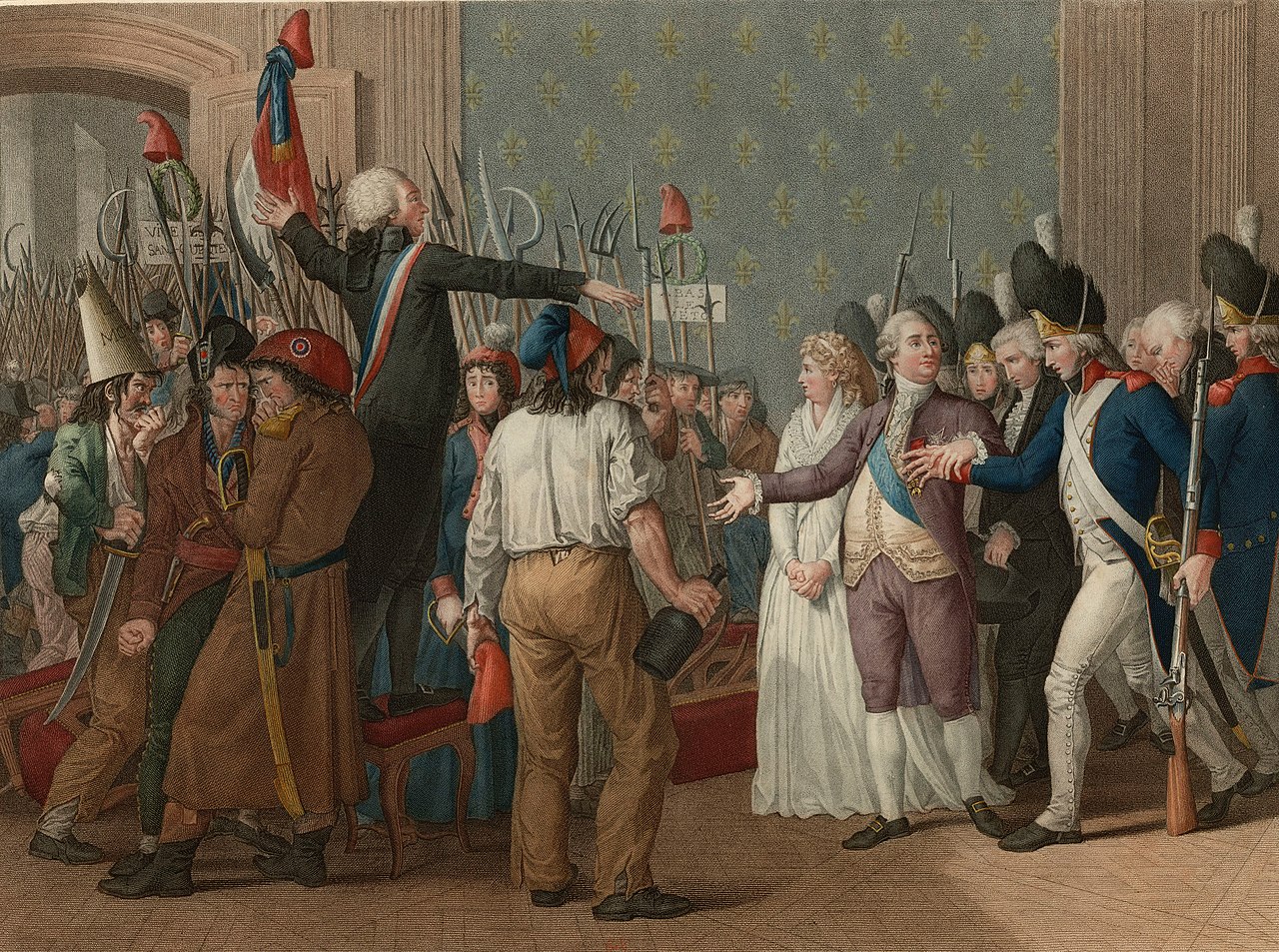
In October, alongside Louvet, Robespierre supported Maillard following the Women's March on Versailles. That same month, while the Constituent Assembly deliberated on male census suffrage on 22 October, Robespierre and a select few deputies opposed property requirements for voting and holding office. Through December and January Robespierre notably drew attention from marginalised groups, particularly Protestants, Jews, people of African descent, domestic servants, and actors. A frequent orator in the Assembly, Robespierre championed the ideals in the Declaration of the Rights of Man and of the Citizen, but his views rarely garnered majority support among fellow deputies.
Despite his commitment to democratic principles, Robespierre did not adopt the change of dress influenced by the Revolution; instead he persistently donned knee-breeches and retained a meticulously groomed appearance with a curled, perfumed, and powdered wig tied in a queue in line with the old-fashioned style of the 18th century. Some accounts described him as "nervous, timid, and suspicious".
Following the forcible relocation of the King and National Constituent Assembly from Versailles to Paris, Robespierre lived at 30 Rue de Saintonge in Le Marais, a district with relatively wealthy inhabitants. He shared an apartment on the third floor with Pierre Villiers who was his secretary for several months. Robespierre associated with the new Society of the Friends of the Constitution, commonly known as the Jacobin Club. Among these 1,200 men, Robespierre found a sympathetic audience. Equality before the law was the keystone of the Jacobin ideology. Beginning in October and continuing through January he made several speeches in response to proposals for property qualifications for voting and officeholding under the proposed constitution. This was a position he vigorously opposed, arguing in a speech on 22 October the position that he derived from Rousseau: ... sovereignty resides in the people, in all the individuals of the people. Each individual therefore has the right to participate in making the law which governs him and in the administration of the public good which is his own. If not, it is not true that all men are equal in rights, that every man is a citizen.

1790
During the continuing debate on suffrage, Robespierre ended his speech of 25 January 1790 with a demand that "all Frenchmen must be admissible to all public positions without any other distinction than that of virtues and talents." On 31 March 1790 he was elected as president of the Jacobin Club. Robespierre supported the cooperation of all the National Guards in a general federation on 11 May. On 19 June he was elected secretary of the National Assembly. In July Robespierre demanded "fraternal equality" in salaries. Before the end of the year, he was seen as one of the leaders of the small body of the extreme left of the Assembly, known as "the thirty voices".
On 5 December Robespierre delivered another speech on the National Guard. "To be armed for personal defence is the right of every man, to be armed to defend freedom and the existence of the common fatherland is the right of every citizen." Robespierre also coined the famous motto "Liberté, égalité, fraternité" by adding the word fraternity on the flags of the National Guard.
1791
In 1791, Robespierre gave 328 speeches, almost one a day. On 28 January, in the Assembly, he spoke on the organisation of the National Guard, On 27 and 28 April, Robespierre opposed plans to reorganise it and to restrict its membership to active citizens. He demanded that it should be reconstituted on a democratic basis, with an end to military decorations and an equal number of officers and soldiers in courts martial. He argued that the National Guard had to become the instrument of defending liberty rather than a threat to it.

In the same month Robespierre published a pamphlet in which he argued the case for universal manhood suffrage. On 15 May, the Constituent Assembly declared full and equal citizenship for all free people of colour. In the debate Robespierre said: "I feel that I am here to defend the rights of men; I cannot consent to any amendment and I ask that the principle be adopted in its entirety." He descended from the rostrum in the middle of the repeated applause of the left and of all the galleries.
On 16–18 May when the elections began, Robespierre proposed and carried the motion that no deputy who sat in the Constituent assembly could sit in the succeeding Legislative assembly. A tactical purpose of this self-denying ordinance was to block the ambitions of the old leaders of the Jacobins, Antoine Barnave, Adrien Duport, and Alexandre de Lameth, who aspired to create a constitutional monarchy roughly similar to that of England. On 28 May, Robespierre proposed all Frenchmen should be declared active citizens and eligible to vote. On 30 May, he delivered a speech on abolishing the death penalty, which the Assembly did not support. Hillary Mantel described his speech as "perfectly constructed, a brilliant fusion of logic and emotion, as much a work of art as a building or a piece of music could be."
On 10 June, Robespierre delivered a speech on the state of the police and proposed to dismiss officers. On 11 June 1791 he was elected or nominated as (substitute) public prosecutor in the criminal tribunal preparing indictments. On 15 June, Pétion de Villeneuve became president of the "tribunal criminel provisoire", after Duport refused to work with Robespierre.
After Louis XVI's flight to Varennes, the Assembly suspended the king from his duties on 25 June. Robespierre declared in the Jacobin Club on 13 July: "The current French constitution is a republic with a monarch. She is therefore neither a monarchy nor a republic. She is both."
After the Champ de Mars massacre, the authorities ordered numerous arrests. Robespierre, after attending the Jacobin club, did not go back to the Rue Saintonge where he lodged, and asked Laurent Lecointre if he knew a patriot near the Tuileries who could put him up for the night. Lecointre suggested Duplay's house and took him there. Maurice Duplay, a cabinetmaker and ardent admirer, lived at 398 Rue Saint-Honoré near the Tuileries.
After a few days, Robespierre decided to move in permanently, motivated by a desire to live closer to the Assembly and the Jacobin club. Robespierre took up residence in the back house where he was distracted by the noises of work.
In September, the French Constitution of 1791 was accepted and the Assembly had therefore completed its task. On 30 September, the day of the dissolution of the Assembly, Robespierre opposed Jean Le Chapelier, who wanted to proclaim an end to the revolution and restrict freedom of expression. He succeeded in getting any requirement for inspection out of the constitution's guarantee of freedom of expression: "The freedom of every man to speak, to write, to print and publish his thoughts, without the writings having to be subject to censorship or inspection prior to their publication..." Pétion and Robespierre were brought back in triumph to their homes. Madame Roland labelled Pétion de Villeneuve, François Buzot, and Robespierre the "incorruptibles" in honour of their principles, their modest ways of living, and their refusal to take bribes.
On 16 October, Robespierre delivered a speech in Arras; one week later in Béthune. On 28 November, he was back in the Jacobin club, where he met with a triumphant reception. Collot d'Herbois gave his chair to Robespierre, who presided that evening. On 5 December he gave a speech on the organisation of the Garde National, which he saw as a unique institution born from the ideals of the French Revolution. On 11 December, Robespierre was finally installed as accusateur public.
Opposition to war with Austria, 1791–1792
The Declaration of Pillnitz issued by Austria and Prussia on 27 August 1791 warned the people of France not to harm Louis XVI or these nations would "militarily intervene". Brissot rallied the support of the Legislative Assembly for war with Austria. As Jean-Paul Marat, Georges Danton and Robespierre had not been elected in the new legislature, thanks to the Self-Denying Ordinance, anti-war politics mainly took place outside the Assembly. On 18 December 1791, Robespierre gave a second speech at the Jacobin club against war, warning against the threat of dictatorship stemming from it:
If they are Caesars, Catilines or Cromwells, they seize power for themselves. If they are spineless courtiers, uninterested in doing good yet dangerous when they seek to do harm, they go back to lay their power at their master's feet and help him to resume arbitrary power on condition they become his chief servants.
At the end of December, Guadet, the chairman of the Assembly, suggested that a war would be a benefit to the nation and boost the economy. Marat and Robespierre opposed him, arguing that victory would create a dictatorship, while defeat would restore the king to his former powers.
The most extravagant idea that can arise in a politician's head is to believe that it is enough for a people to invade a foreign country to make it adopt its laws and their constitution. No one loves armed missionaries... The Declaration of the Rights of Man... is not a lightning bolt that strikes every throne at the same time... I am far from claiming that our Revolution will not eventually influence the fate of the world... But I say that it will not be today (2 January 1792).
This opposition from expected allies irritated the Girondins, and the war became a major point of contention between the factions. In his third speech on the war, Robespierre countered on 25 January 1792 in the Jacobin club, "A revolutionary war must be waged to free subjects and slaves from unjust tyranny, not for the traditional reasons of defending dynasties and expanding frontiers..." Robespierre argued such a war could only favour the forces of counter-revolution, since it would play into the hands of those who opposed the sovereignty of the people. The risks of Caesarism were clear: "in troubled periods of history, generals often became the arbiters of the fate of their countries." Robespierre failed to gather a majority, but his speech was nevertheless published and sent to all clubs and Jacobin societies of France.
On 10 February 1792, Robespierre gave a speech on how to save the State and Liberty. He advocated specific measures to strengthen, not so much the national defences as the forces that could be relied on to defend the revolution. Robespierre promoted a people's army, continuously under arms and able to impose its will on Feuillants and Girondins in the Constitutional Cabinet of Louis XVI and the Legislative Assembly. The Jacobins decided to study his speech before deciding whether it should be printed.
On 26 March, Guadet accused Robespierre of superstition, relying on divine providence. Shortly after Robespierre was accused by Brissot and Guadet of "trying to become the idol of the people". Being against the war, Robespierre was also accused of acting as a secret agent for the "Austrian Committee". The Girondins planned strategies to out-maneuver Robespierre's influence among the Jacobins. On 27 April, as part of his speech responding to the accusations by Brissot and Guadet against him, he threatened to leave the Jacobins, claiming he preferred to continue his mission as an ordinary citizen.
On 17 May, Robespierre released the first issue of his weekly periodical Le Défenseur de la Constitution (The Defender of the Constitution). In this publication, he criticised Brissot and expressed his scepticism over the war movement. The periodical, printed by his neighbour Nicolas, served multiple purposes: to print his speeches, to counter the influence of the royal court in public policy, to defend him from the accusations of Girondist leaders; and to give voice to the economic and democratic interests of the broader masses in Paris and defend their rights.
Insurrectionary Commune of Paris, 1792
February–July 1792
On 15 February, Robespierre failed to get elected to the city council (Conseil général); on the same day the installation of the criminal trial court of the department of Paris took place. For Robespierre this meant a thankless position as public prosecutor. Robespierre was responsible for the coordination of the local and the federal police in the department and the sections.
When the Legislative Assembly declared war against Austria on 20 April 1792, Robespierre stated that the French people must arm themselves, whether to fight abroad or to prevent despotism at home. An isolated Robespierre responded by working to reduce the political influence of the officer class and the king. On 23 April Robespierre demanded that Marquis de Lafayette, the head of the Army of the Centre, step down. While arguing for the welfare of common soldiers, Robespierre urged new promotions to mitigate the domination of the officer class by the aristocratic and royalist École Militaire and the conservative National Guard. Along with other Jacobins, he urged the creation of an armée révolutionnaire in Paris, consisting of at least 20,000–23,000 men, to defend the city, "liberty" (the revolution), maintain order and educate the members in democratic and republican principles, an idea he borrowed from Jean-Jacques Rousseau. According to Jean Jaures, he considered this even more important than the right to strike.
On 29 May 1792, the Assembly dissolved the Constitutional Guard, suspecting it of royalist and counter-revolutionary sympathies. In early June 1792, Robespierre proposed an end to the monarchy and the subordination of the Assembly to the general will. The monarchy faced an abortive demonstration of 20 June.
Because French forces suffered disastrous defeats and a series of defections at the onset of the war, Robespierre and Marat feared the possibility of a military coup d'état. One was led by Lafayette, head of the National Guard, who at the end of June advocated the suppression of the Jacobin Club. Robespierre publicly attacked him in scathing terms: General, while from the midst of your camp you declared war upon me, which you had thus far spared for the enemies of our state, while you denounced me as an enemy of liberty to the army, National Guard and Nation in letters published by your purchased papers, I had thought myself only disputing with a general... but not yet the dictator of France, arbitrator of the state.
On 2 July, the Assembly authorised the National Guard to go to the Festival of Federation on 14 July, circumventing a royal veto. On 11 July, the Jacobins won an emergency vote in the wavering Assembly, declaring the nation in danger and drafting all Parisians with pikes into the National Guard. On 15 July, Billaud-Varenne in the Jacobin club outlined the program for the next insurrection: the deportation of the Bourbons and "enemies of the people", the cleansing of the National Guard, the election of a Convention, the "transfer of the Royal veto to the people", and exemption of the poorest from taxation. On 24 July a "Central Office of Co-ordination" was formed and the sections received the right to be in a "permanent" session. On 25 July, according to the Logographe , Carnot promoted the use of pikes and provided to every citizen. On 29 July Robespierre called for the deposition of the King and the election of a Convention.
August 1792
On 1 August, the Assembly voted on Carnot's proposal, enforcing the distribution of pikes to all citizens, excluding vagabonds. By 3 August, the mayor and 47 sections demanded the removal of the king. On 5 August Robespierre disclosed the discovery of a plan for the king to escape to Château de Gaillon. Aligning with Robespierre's stance, almost all sections in Paris rallied for the dethronement of the king and issued a decisive ultimatum. Brissot urged the preservation of the constitution, advocating against both the dethronement of the king and the election of a new assembly. Simultaneously, the Council of Ministers recommended the arrest of Danton, Marat and Robespierre if they attended the Jacobin club.
In the early hours of Friday, 10 August 30,000 Fédérés (volunteers hailing from the countryside) and sans-culottes (militant citizens from the Paris) mounted a successful assault upon the royal palace of the Tuileries. Robespierre considered it a triumph for the "passive" (non-voting) citizens. The Assembly, rattled by the events, suspended the king's powers and authorised the election of a new National Convention in the light of the changing role of the monarchy. On the night of 11 August, Robespierre secured a position in the Paris Commune, representing the Section de Piques, his residential district. The governing committee advocated universal male suffrage in the election of the new National Convention. Despite Camille Desmoulins' belief that the turmoil had concluded, Robespierre asserted that it marked merely the beginning. By 13 August, Robespierre openly opposed the reinforcement of the départements. Subsequently, Danton invited him to join the Council of Justice. Robespierre published the twelfth and final edition of Le Défenseur de la Constitution, serving as an account and political testament.
On 16 August, Robespierre submitted a petition to the Legislative Assembly, endorsed by the Paris Commune, urging the establishment of a provisional Revolutionary Tribunal specifically tasked with dealing with perceived "traitors" and "enemies of the people". The following day, he was appointed as one of eight judges for this tribunal. However, citing a lack of impartiality, Robespierre declined to preside over it. This decision drew criticism.
The Prussian army crossed the French frontier on 19 August. To fortify defence, the Paris armed sections were integrated into 48 battalions of the National Guard under Santerre's command. The Assembly decreed that all the nonjuring priests must leave Paris within a week and leave the country within two weeks. On 28 August, the assembly ordered a curfew for the next two days. The city gates were closed; all communication with the country was stopped. At the behest of Justice Minister Danton, thirty commissioners from the sections were ordered to search every suspect house for weapons, munitions, swords, carriages, and horses. "As a result of this inquisition, more than 1,000 "suspects" were added to the immense body of political prisoners already confined in the jails and convents of the city". Marat and Robespierre both disliked Condorcet who proposed that the "enemies of the people" belonged to the whole nation and should be judged constitutionally in its name. On 30 August the interim minister of Interior Roland and Guadet tried to suppress the influence of the Commune because the searches of suspect houses had been completed. The Assembly, tired of the pressures, declared the Commune illegal and suggested the organisation of communal elections.
Robespierre was no longer willing to cooperate with Brissot and Roland. On Sunday morning 2 September the members of the Commune, gathering in the town hall to proceed the election of deputies to the National Convention, decided to maintain their seats and have Roland and Brissot arrested.
National Convention
Elections
On 2 September, the 1792 French National Convention election began. Meanwhile Paris was organising its defence against the Prussians, but there was a lack of arms for the thousands of volunteers. Danton delivered a speech in which he said: "We ask that anyone who refuses to serve in person, or surrender their weapons, is punished with death." His speech acted as a call for direct action among the citizens, as well as a strike against the external enemy. Not long after, the September Massacres began. Robespierre and Manuel, the public prosecutor, responsible for the police administration, visited the Temple prison to check on the safety of the royal family.
In Paris, suspected Girondin and royalist candidates were excluded both before and after the vote due to "Robespierre's unabashed vote rigging"; Robespierre contributed to the failure of Brissot and his associates Pétion and Condorcet to be elected in Paris. On 5 September, Robespierre was elected deputy to the National Convention but Danton and Collot d'Herbois received more votes than Robespierre. Madame Roland wrote to a friend: "We are under the knife of Robespierre and Marat, those who would agitate the people." The election was not the triumph for the Jacobins that they had anticipated, but during the next nine months they gradually eliminated their opponents and gained control of the Convention.
The Mountain
On 21 September, the Convention gathered for the first time. The Jacobins and Cordeliers took the high benches at the back of the former Salle du Manège, giving them the label the Montagnards ("the Mountain"); below them were the "Manège" of the Girondists, the moderate Republicans. The majority, known as the Plain, was formed by independents like Barère, Cambon and Carnot. The deputies decided to abolish the monarchy and founded the First French Republic. On 25 and 26 September, Barbaroux and the Girondist Lasource accused Robespierre of wanting to form a dictatorship.
On 30 September, Robespierre advocated several laws; the registration of marriages, births, and burials was taken away from the church. On 29 October, Louvet de Couvrai attacked Robespierre. He accused him of governing the Paris "Conseil Général" and of having done nothing to stop the September massacre; instead, according to him, he had used it to have more Montagnards elected; allegedly paying the septembriseurs to gain more votes. Robespierre, who was sick, was given a week to respond. On 5 November, Robespierre defended himself, the Jacobin Club, and his supporters: