Reed College is a private liberal arts college in Portland, Oregon, United States. Founded in 1908, Reed is a residential college with a campus in the Eastmoreland neighborhood, Tudor-Gothic style architecture, and a forested canyon nature preserve at its center. Reed alumni include 32 Rhodes scholars, 123 Fulbright Scholars, 73 Watson Fellows, and three Churchill Scholars.
History
The Reed Institute (the legal name of the college) was founded in 1908 and held its first classes in 1911. Reed is named for Oregon pioneers Simeon Gannett Reed (1830–1895) and Amanda Reed (died 1904). Simeon was an entrepreneur involved in several enterprises, including trade on the Willamette and Columbia Rivers with his close friend and associate, former Portland Mayor William S. Ladd. Unitarian minister Thomas Lamb Eliot, who knew the Reeds from the church choir, is credited with convincing Reed of the need for the school. Reed's will provided for the gift, and Ladd's son, William Mead Ladd, donated 40 acres from the Ladd Estate Company to build the new college. Reed's first president (1910–1919) was William Trufant Foster, a former professor at Bates College and Bowdoin College.
Reed was founded explicitly as a reaction against the "prevailing model of East Coast, Ivy League education", its lack of varsity athletics, fraternities, and exclusive social clubs – as well as its coeducational, nonsectarian, and egalitarian status – intended to foster an intensely academic and intellectual college.
During the 1930s, President Dexter Keezer was concerned about the fraternization among male and female students and the consumption of alcohol by students. A large portion of the Student Council took the position that Oregon's liquor laws did not apply to Reed's campus. Policies restricting the ability of students from visiting the dormitories of the opposite sex were fiercely resisted.
After World War II the college saw its enrollment numbers dramatically increase as veterans began enrolling in the college.
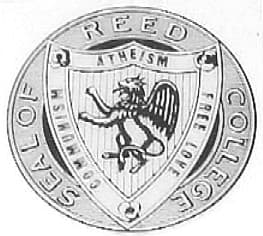
The college has developed a reputation for the political progressivism of its student body.
Reading level
Audio Summary
Played with your browser's voice. Studio-quality audio can be added with a text-to-speech service.
Ask about this article
📝 Quick Quiz1 / 4
What is "Reed College" primarily known for?
Vocix Daily — In Your Inbox
Top stories, deep-dive articles, and "On This Day" history — one crisp digest delivered every morning.
Sources & references
Reference material for this entry is drawn from the open encyclopedic record, including Wikipedia , available under the CC BY-SA 4.0 license. Images are credited individually beside each photo.
According to sociologist Burton Clark, Reed is one of the most unusual institutions of higher learning in the United States, featuring a traditional liberal arts and natural sciences curriculum. It requires freshmen to take Humanities 110, an intensive introduction to multidisciplinary inquiry, covering ancient Greece and Rome, the Hebrew Bible and ancient Jewish history, and as of 2019, Ancient Mesoamerica and the Harlem Renaissance. Reed also has a TRIGA research reactor on campus, making it the only school in the United States to have a nuclear reactor operated primarily by undergraduates. Reed also requires all students to complete a thesis (a two-semester-long research project conducted under the guidance of professors) during the senior year as a prerequisite of graduation. Upon completion of the senior thesis, students must also pass an oral defense of ninety minutes related to the thesis topic and how the thesis relates to the larger context of the student's studies.
Reed maintains a 9:1 student-to-faculty ratio.
Although letter grades are given to students, grades are de-emphasized at Reed and focus is placed on a narrative evaluation. According to the school, "a conventional letter grade for each course is recorded for every student, but the registrar's office does not distribute grades to students, provided that work continues at satisfactory (C or higher) levels. Unsatisfactory grades are reported directly to the student and the student's adviser. Papers and exams are generally returned to students with lengthy comments but without grades affixed." Students can request copies of their official transcript from the registrar. There is no dean's list or honor roll per se, but students who maintain a GPA of 3.5 or above for an academic year receive academic commendations at the end of the spring semester which are noted on their transcripts. Reed is singled out as having little to no grade inflation over the years; only ten students graduated with a perfect 4.0 GPA in the period from 1983 to 2012. (Transcripts are accompanied by a card contextualizing Reed's grading approach so as not to penalize students' graduate school applications.) Although Reed does not award Latin honors to graduates, it confers several awards for academic achievement at commencement, including naming students to Phi Beta Kappa.
Reed has no fraternities or sororities and few NCAA sports teams although physical education classes (which range from kayaking to juggling to capoeira) are required for graduation. Reed also has several intercollegiate athletic clubs, notably the basketball, rugby, Ultimate Frisbee, and soccer teams.
Academics
Reed categorizes its academic program into five Divisions and the Humanities program. Overall, Reed offers five Humanities courses, twenty-six department majors, twelve interdisciplinary majors, six dual-degree programs with other colleges and universities, and programs for pre-medical and pre-veterinary students. Its three most popular majors, based on 2023 graduates, were Psychology, Biology/Biological Sciences, and Computer and Information Sciences.
Divisions
Division of Arts: includes the Art (Art History and Studio Art), Dance, Music, and Theatre Departments;
Division of History and Social Sciences: includes the Anthropology, Economics, History, Political Science, and Sociology Departments, as well as the International Affairs & Public Policy program;
Division of Literature and Languages: includes the Chinese, English, French, German, Greek, Latin, and Ancient Mediterranean Studies (GLAM), Russian, and Spanish Departments, as well as the Creative Writing and Comparative Literature programs;
Division of Mathematics and Natural Sciences: includes the Biology, Chemistry, Computer Science, Mathematics and Statistics, and Physics Departments, as well as the Biochemistry & Molecular Biology, Mathematics-Computer Science, and Neuroscience programs, and
Division of Philosophy, Religion, Psychology, and Linguistics: includes the Linguistics, Philosophy, Psychology, and Religion Departments.
Humanities program
Reed President Richard Scholz in 1922 called the educational program as a whole "an honest effort to disregard old historic rivalries and hostilities between the sciences and the arts, between professional and cultural subjects, and, ... the formal chronological cleavage between the graduate and the undergraduate attitude of mind". The Humanities program, which came into being in 1943 (as the union of two year-long courses, one in "world" literature, the other in "world" history) is one manifestation of this effort. One change to the program was the addition of a course in Chinese Civilization in 1995. The faculty has also recently approved several significant changes to the introductory syllabus. These changes include expanding the parameters of the course to include more material regarding urban and cultural environments.
Reed's Humanities program includes the mandatory freshman course Introduction to Western Humanities covering ancient Greek and Roman literature, history, art, religion, and philosophy. Sophomores, juniors, and seniors may take Early Modern Europe covering Renaissance thought and literature; Modern Humanities covering the Enlightenment, the French Revolution, the Industrial Revolution, and Modernism, and/or Foundations of Chinese Civilization. There is also a Humanities Senior Symposium.
Reed also offers interdisciplinary programs in American studies, Environmental Studies, Biochemistry and Molecular Biology, Chemistry-Physics, Classics-Religion, Dance/Theatre, History-Literature, International and Comparative Policy Studies (ICPS), Literature-Theatre, Mathematics-Economics, and Mathematics-Physics.
Reed offers dual-degree programs in Computer Science (with University of Washington), Engineering (with Caltech, Columbia University, and Rensselaer Polytechnic Institute), Forestry or Environmental Management (with Duke University), and Fine Art (with the Pacific Northwest College of Art).
Rankings
In 1995, Reed College refused to participate in the U.S. News & World Report "best colleges" rankings, making it the first educational institution in the United States to refuse to participate in college rankings. According to Reed's Office of Admissions the school's refusal to participate is based in 1994 disclosures by The Wall Street Journal about institutions flagrantly manipulating data in order to move up in the rankings in U.S. News and other popular college guides. U.S. News maintains that their rankings are "a very legitimate tool for getting at a certain level of knowledge about colleges." In 2019, a team of statistics students recreated the formula used by U.S. News and were able to identify and quantify the penalty imposed on Reed. The students found the college to be ranked an estimated 52 places below an unbiased application of the U.S. News scoring rubric.
Money magazine ranked Reed 512th in the U.S. out of 623 schools evaluated for its 2022 "Best Colleges for Your Money" edition.
Reed is ranked as tied for the 63rd best liberal arts college by U.S. News & World Report in its 2025 rankings, and tied for 23rd in "Best Undergraduate Teaching", tied for 23rd in "Most Innovative Schools", and tied for 174th in "Top Performers on Social Mobility".
In 2006, Newsweek magazine named Reed as one of twenty-five "New Ivies", listing it among "the nation's elite colleges". In 2012, Newsweek ranked Reed the 15th "most rigorous" college in the nation.
Reed College ranked in the bottom 6% of four year colleges nationwide in the Brookings Institution's rating of U.S. colleges by incremental impact on alumni earnings 10 years post-enrollment.
An episode of Canadian writer Malcolm Gladwell's podcast Revisionist History examines the flaws in the U.S. News system of university rankings. The episode features a project done by a Reed professor of statistics and her students to investigate the mechanics of the ranking algorithm, attempting to see if Reed's ranking had been purposefully devalued because the school refused to submit its information to U.S. News. Previous investigations by Reed students to re-create U.S. News's statistical ranking algorithm found that Reed's correct 2019 rank was #38 instead of its assigned rank of #90.
Admissions
Undergraduate
The entering class in 2024 was drawn from 9,023 applicants, with 2321 accepted, and 303 students admitted. Median SAT scores were 690 math and 730 reading. Since 2018, to increase student enrollment from historically underrepresented minorities, Reed encourages application to the college's "Discover Reed Fly-In Program", an all-inclusive, all-expenses-paid, multi-day campus tour and open to all high school seniors who are US citizens or permanent residents, regardless of race or ethnicity.
Tuition and finances
The total direct cost for the 2022–23 academic year, including tuition, fees and room-and-board, was $80,710. Indirect costs (books, supplies, transportation, personal expenses) could be another $3,950. For the 2022–23 academic year, the average financial aid package was $52,284. In 2022–23 over half of students received financial aid from the college. In 2004, 1.4% of Reed graduates defaulted on their student loans – below the national Cohort Default Rate average of 5.1%.
Reed's endowment as of June 30, 2023, was $764 million. In the economic downturn that began in late 2007, Reed's total endowment had declined from $455 million in June 2007 to $311 million in June 2009. By the end of 2013, however, the endowment surpassed the $500 million mark.
Academic honors
Reed College administrators claim that the college has the second-highest number of Rhodes scholars among its alumni for any liberal arts college—32—as well as over one hundred Fulbright Scholars, over seventy Watson Fellows, and three MacArthur ("Genius") Award winners. A very high proportion of Reed graduates go on to earn PhDs, particularly in the natural sciences, history, political science, and philosophy. Reed is ranked third in the percentage of graduates who go on to earn PhDs in all disciplines, after only Caltech and Harvey Mudd. In 1961, Scientific American declared that second only to Caltech, "This small college in Oregon has been far and away more productive of future scientists than any other institution in the U.S." Reed is ranked first in producing PhDs in biology, second in chemistry and humanities, third in history, foreign languages, and political science, fourth in science and mathematics, fifth in physics and social sciences, sixth in anthropology, seventh in area and ethnic studies and linguistics, and eighth in English literature and medicine.
Loren Pope, former education editor for The New York Times, wrote about Reed in his 1996 book Colleges That Change Lives, saying, "If you're a genuine intellectual, love the life of the mind, and want to learn for the sake of learning, the place most likely to empower you is not Harvard, Yale, Princeton, Chicago, or Stanford. It is the most intellectual college in the country — Reed in Portland, Oregon."
Drug use
Since the 1960s, Reed has had a reputation for tolerating open drug use among its students. The Insider's Guide to the Colleges, written by the staff of Yale Daily News, notes an impression among students of institutional permissiveness: "According to students, the school does not bust students for drug or alcohol use unless they cause harm or embarrassment to another student."
In April 2008, student Alex Lluch died of a heroin overdose in his on-campus dorm room. His death prompted revelations of several previous incidents, including the near-death heroin overdose of another student only months earlier. College president Colin Diver said "I don't honestly know" whether the drug death was an isolated incident or part of a larger problem. "When you say Reed," Diver said, "two words often come to mind. One is brains. One is drugs." Local reporter James Pitkin of the newspaper Willamette Week editorialized that "Reed College, a private school with one of the most prestigious academic programs in the U.S., is one of the last schools in the country where students enjoy almost unlimited freedom to experiment openly with drugs, with little or no hassles from authorities", though Willamette Week stated the following week concerning Pitkin's editorial: "As of press time, almost 500 responses, many expressing harsh criticism of Willamette Week, had been posted on our website."
In March 2010, another student died of drug-related causes in his off-campus residence. This led The New York Times to conclude that "Reed ... has long been known almost as much for its unusually permissive atmosphere as for its impressively rigorous academics." Law enforcement authorities promised to take action, including sending undercover agents to Reed's annual Renn Fayre celebration.
In February 2012, the Reed administration chose to call the police following the discovery of "two to three pounds of marijuana and a small amount of ecstasy and LSD in the on-campus apartment of two juniors". Following campus debate, Reed's president at the time, Colin Diver, issued a letter to students and staff, saying the college would not tolerate illegal drug use on campus: "Such behavior endangers the health and welfare of the entire community, attracts potentially dangerous criminal activity on campus, undermines the academic mission of the college, and violates the college's obligations under state and federal law."
Political and social activism
Reed has a reputation for being politically left-of-center.
During the McCarthy era of the 1950s, then-president Duncan Ballantine fired Marxist philosopher Stanley Moore, a tenured professor, for his failure to cooperate with the House Un-American Activities Committee (HUAC) investigation. According to an article in the college's alumni magazine, "because of the decisive support expressed by Reed's faculty, students, and alumni for the three besieged teachers and for the principle of academic freedom, Reed College's experience with McCarthyism stands apart from that of most other American colleges and universities. Elsewhere in the academic world both tenured and nontenured professors with alleged or admitted communist party ties were fired with relatively little fuss or protest. At Reed, however, opposition to the political interrogations of the teachers was so strong that some believed the campus was in danger of closure." A statement of "regret" by the Reed administration and board of trustees was published in 1981, formally revising the judgment of the 1954 trustees. In 1993, then-President Steve Koblik invited Moore to visit the college, and in 1995 the last surviving member of the Board that fired Moore expressed his regret and apologized to him.
Reedies Against Racism
On September 26, 2016, students organized a boycott of all college operations in participation with the National Day of Boycott, a national day of protest which was proposed by actor Isaiah Washington on Twitter in response to the issue of police brutality against African-Americans. Following the boycott, students created an activist group called Reedies Against Racism (RAR) and presented a list of demands for the college they described as being on behalf of students from marginalized backgrounds. The primary demand concerned Reed's mandatory freshman humanities course, proposing that the course either be changed to be more inclusive of world literature and classics or to be made not mandatory. One element of the class deemed racist by the protestors was the use of the 1978 Steve Martin song "King Tut" in a discussion about cultural appropriation. Students began a protest campaign against the curriculum by sitting in during lectures with signs with quotations from various African-American and non-white academics. Other protests separate from the humanities course also included efforts to shout down speakers, including Kimberly Peirce after she was accused of profiting from transphobia while making the film Boys Don't Cry. The group eventually focused on Reed's banking relationship with Wells Fargo, based on allegations that the bank had invested in the Dakota Access Pipeline project and the private prison industry, and staged an occupation of Reed's Eliot Hall.
There was some opposition to the lecture protests, notably by Reed professor of English Lucía Martínez Valdivia, who stated that a protest during her lecture on Sappho would amplify her pre-existing case of PTSD. In November 2017, Chris Bodenner of The Atlantic wrote about growing student resentment toward the tactics of RAR. In response to protests the faculty decided to undergo the decennial review process a year early, as well as to complete the process in three months instead of the usual year. In January 2018, Humanities 110 chair professor Libby Drumm announced in a campus-wide email that the course curriculum would be restructured after years of faculty discussion and in response to student feedback as well as input from an external review committee composed of humanities faculty from other institutes, adopting a "four-module structure" that would include texts from the Americas and allow greater flexibility in the curriculum which would be integrated beginning fall 2018. The external review had not in fact been completed nor reviewed at the time of the announcement.
Following "a contentious year of protests, including an anti-racism sit-in in Kroger's office", college president John Kroger resigned, effective June 2018.
Campus
The Reed College campus was established on a tract of land in southeast Portland known in 1910 as Crystal Springs Farm, a part of the Ladd Estate, formed in the 1870s from original land claims. The college's grounds include 116 acres (0.47 km2) of contiguous land, including a wooded wetland known as Reed Canyon.
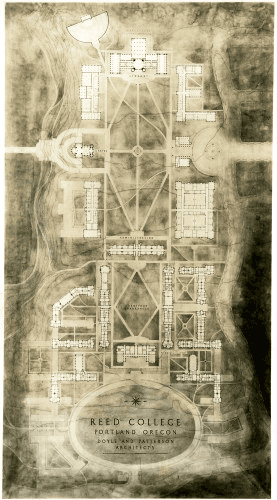
Portland architect A. E. Doyle developed a plan, never implemented in full, modeled on the University of Oxford's St. John's College. The original campus buildings (including the Library, the Old Dorm Block, and what is now the primary administration building, Eliot Hall) are brick Tudor Gothic buildings in a style similar to Ivy League campuses. In contrast, the science section of campus, including the physics, biology, and psychology (originally chemistry) buildings, were designed in the Modernist style. The Psychology Building, completed in 1949, was designed by Modernist architect Pietro Belluschi at the same time as his celebrated Equitable Building in downtown Portland.
The campus and buildings have undergone several phases of growth and there are now 21 academic and administrative buildings and 18 residence halls. Since 2004, Reed's campus has expanded to include adjacent properties beyond its historic boundaries, such as the Birchwood Apartments complex and former medical administrative offices on either side of SE 28th Avenue, and the Parker House, across SE Woodstock from Prexy. At the same time the Willard House (donated to Reed in 1964), across from the college's main entrance at SE Woodstock and SE Reed College Place, was converted from faculty housing to administrative use. Reed announced on July 13, 2007, that it had purchased the Rivelli farm, a 1.5-acre (0.61 ha) tract of land south of the Garden House and west of Botsford Drive. Reed's "immediate plans for the acquired property include housing a small number of students in the former Rivelli home during the 2007–08 academic year. Longer term, the college anticipates that it may seek to develop the northern portion of the property for additional student housing".
Residence halls
Reed houses 945 students in 18 residence halls on campus and several college-owned houses and apartment buildings on or adjacent to campus. Residence halls on campus range from the traditional (i.e., Gothic Old Dorm Block, referred to as "ODB") to the eclectic (e.g., Anna Mann, a Tudor-style cottage built in the 1920s by Reed's founding architect A. E. Doyle, originally used as a women's hall), language houses (Spanish, Russian, French, German, and Chinese), "temporary" housing, built in the 1960s (Cross Canyon – Chittick, Woodbridge, McKinley, Griffin), to more recently built dorms (Bragdon, Naito, Sullivan). Reed also offers three interest-based housing options as of 2026: The Sustainability and Environmental Justice Collective in Garden House, the Students of Color Community, and the Queer Collective. Before the COVID-19 Pandemic, the school offered a wider range of interest-based housing including everything from substance-free living to Japanese culture to music to a dorm for students interested in outdoors activities (hiking, climbing, bicycling, kayaking, skiing, etc.). The college's least-loved complex (as measured by applications to the college's housing lottery), MacNaughton and Foster-Scholz, is known on campus as "Asylum Block" because of its post-World War II modernist architecture and interior spaces dominated by long, straight corridors lined with identical doors, said by students to resemble that of an insane asylum. Until 2006, it was thought that these residence halls had been designed by architect Pietro Belluschi.