
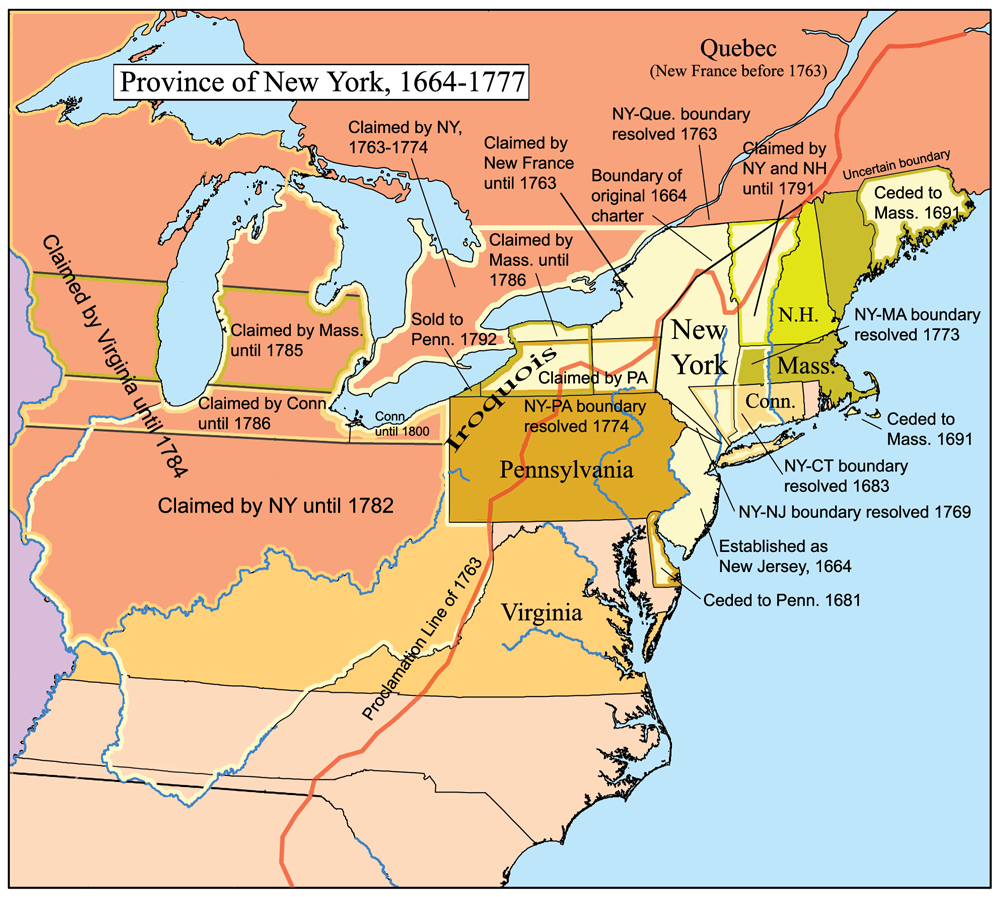
The Province of New York was a British proprietary colony and later a royal colony on the northeast coast of North America from 1664 to 1783. It extended from Long Island on the Atlantic, up the Hudson River and Mohawk River valleys to the Great Lakes and North to the colonies of New France and claimed lands further west.
In 1664, Charles II of England and his brother James, Duke of York raised a fleet to take the Dutch colony of New Netherland, then under the Directorship of Peter Stuyvesant. Stuyvesant surrendered to the English fleet without recognition from the Dutch West India Company. The province was renamed for the Duke of York, as its proprietor. England's rule was established de facto following military control in 1664, and became established de jure as sovereign rule in 1667 in the Treaty of Breda and the Treaty of Westminster (1674). It was not until 1674 that English common law was applied in the colony.
In the late 18th century, colonists in New York rebelled along with the other Thirteen Colonies, and supported the American Revolutionary War that led to the founding of the United States. British claims in New York were ended by the 1783 Treaty of Paris, with New York establishing its independence from the crown. The final evacuation of New York City by the British Army was followed by the return of General George Washington's Continental Army on November 25, 1783, in a grand parade and celebration.
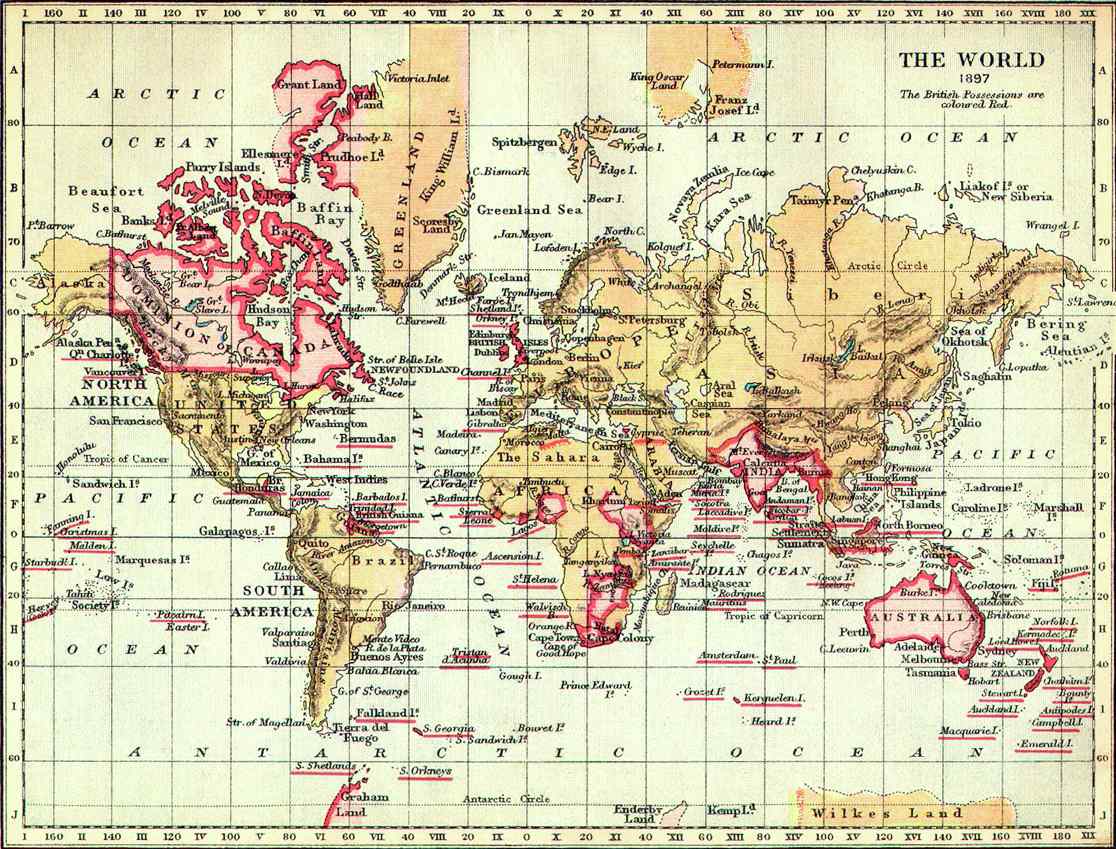
Geography
This British crown colony was established after the former Iroquois nation and then Dutch colony of New Netherland, with its core being York Shire, in what today is typically known as Downstate New York.
History
New Amsterdam and Dutch Rule (1617-1664)
In 1617, officials of the Dutch West India Company in New Netherland created a settlement at present-day Albany, and in 1624 founded New Amsterdam, on Manhattan Island. The Dutch colony included claims to an area comprising all of the present U.S. states of New York, New Jersey, Delaware, and Vermont, along with inland portions of Connecticut, Massachusetts, and Maine in addition to eastern Pennsylvania.
Proprietary government (1664–1685)
New Amsterdam surrendered to Colonel Richard Nicholls on August 27, 1664; he renamed it New York. On September 24 Sir George Carteret accepted the capitulation of the garrison at Fort Orange, which he called Albany, after another of the Duke of York's titles. The capture was confirmed by the Treaty of Breda in July 1667.
Easing the transition to British rule, the Articles of Capitulation guaranteed certain rights to the Dutch; among these were: liberty of conscience in divine worship and church discipline, the continuation of their own customs concerning inheritances, and the application of Dutch law to bargains and contracts made prior to the capitulation.
In 1664, James, Duke of York, was granted a proprietary colony which included New Netherland and present-day Maine. The New Netherland claim included western parts of present-day Massachusetts (to an extent that varied depending on whether the reference was the States General claim of all lands as far east as Narragansett Bay or the Treaty of Hartford negotiated by the English and Dutch colonies in 1650 but not recognized by either the Dutch or English governments) putting the new province in conflict with the Massachusetts charter. In general terms, the charter was equivalent to a conveyance of land conferring on him the right of possession, control, and government, subject only to the limitation that the government must be consistent with the laws of England. The Duke of York never visited his colony and exercised little direct control of it. He elected to administer his government through governors, councils, and other officers appointed by himself. No provision was made for an elected assembly.
Also in 1664, the Duke of York gave the part of his new possessions between the Hudson River and the Delaware River to Sir George Carteret in exchange for settlement of a debt. The territory was named after the Island of Jersey, Carteret's ancestral home. The other section of New Jersey was sold to Lord Berkeley of Stratton, who was a close friend of the Duke. As a result, Carteret and Berkeley became the two English Lords Proprietors of New Jersey.

The Province of New Jersey was created, but the border was not finalized until 1765 (see New York-New Jersey Line War). In 1667, territories between the Byram River and Connecticut River were split off to become the western half of Connecticut.
The acquired territory land designations were reassigned by the crown, leaving the territory of the modern State of New York, including the valleys of the Hudson and Mohawk Rivers, and future Vermont. The territory of western New York was disputed with the indigenous Iroquois Confederacy, and also disputed between the English and the French from their northern colonial province of New France (modern eastern Canada). The province remained an important military and economic link to Canada throughout its history. Vermont was disputed with the Province of New Hampshire to the east.
The first governor Richard Nicolls was known for writing "The Duke's Laws" which served as the first compilation of English laws in colonial New York. Nicholls returned to England after an administration of three years, much of which was taken up in confirming the ancient Dutch land grants. Francis Lovelace was next appointed Governor and held the position from May 1667 until the return of the Dutch in July 1673. A Dutch fleet recaptured New York and held it until it was traded to the English by the Treaty of Westminster. A second grant was obtained by the Duke of York in July 1674 to perfect his title.

Upon conclusion of the peace in 1674, the Duke of York appointed Sir Edmund Andros as Governor of his territories in America. Governor Edmund Andros in 1674 said "permit all persons of what religion soever, quietly to inhabit within the precincts of your jurisdiction" Nonetheless, he made the Quakers of West Jersey pay toll on the Delaware, but they applied to England and were redressed. He was followed by Colonel Thomas Dongan in 1682. Dongan was empowered, on the advice of William Penn, to summon "...a general assembly of all the freeholders, by such persons they should choose to represent them to consult with you and said council what laws are fit and necessary to be made..."
A colonial Assembly was created in October 1683. New York was the last of the English colonies to have an assembly. The assembly passed the Province of New York constitution on October 30, the first of its kind in the colonies. This constitution gave New Yorkers more rights than any other group of colonists including the protection from taxation without representation. On November 1, 1683, the government was reorganized, and the state was divided into twelve counties, each of which was subdivided into towns. Ten of those counties still exist (see above), but two (Cornwall and Dukes) were in territory purchased by the Duke of York from the Earl of Stirling, and are no longer within the territory of the State of New York, having been transferred by treaty to Massachusetts. While the number of counties has been increased to 62, the pattern still remains that a town in New York State is a subdivision of a county, similar to New England.
An act of the assembly in 1683 naturalized all those of foreign nations then in the colony professing Christianity. To encourage immigration, it also provided that foreigners professing Christianity may, after their arrival, be naturalized if they took the oath of allegiance as required.
The Duke's Laws established a non-denominational state church.
The British replaced the Dutch in their alliance with the Iroquois against New France, with an agreement called the Covenant Chain.
The colony was one of the Middle Colonies, and ruled at first directly from England. When the Duke of York ascended to the throne of England as James II in 1685, the province became a royal colony.
Royal province (1686–1775)
In 1664, after the Dutch ceded New Netherland to Britain, it became a proprietary colony under James, Duke of York. When James ascended the throne in February 1685 and became King James II, his personally owned colony became a royal province.
In May 1688, the Province of New York was made part of the Dominion of New England. However, in April 1689, when news arrived that King James had been overthrown in the Glorious Revolution, Bostonians overthrew their government and imprisoned Dominion Governor Edmund Andros. The province of New York rebelled in May in what is known as Leisler's Rebellion. King William's War with France began during which the French attacked Schenectady. In July, New York participated in an abortive attack on Montreal and Quebec. A new governor Henry Sloughter arrived in March 1691. He had Jacob Leisler arrested, tried, and executed.
New York's charter was re-enacted in 1691 and was the constitution of the province until the creation of the State of New York.
The first newspaper to appear in New York was the New-York Gazette, started November 8, 1725, by William Bradford. It was printed on a single sheet, published weekly.
During Queen Anne's War with France from 1702 to 1713, the province had little involvement with the military operations, but benefited from being a supplier to the British fleet. New York militia participated in two abortive attacks on Quebec in 1709 and 1711.
Dutch
When the British took over, the great majority of Dutch families remained, with the exception of government officials and soldiers. However, new Dutch arrivals became very few. While the Netherlands was a small country, the Dutch Empire was large, meaning that emigrants leaving the mother country had a wide variety of choices under full Dutch control. The major Dutch cities were centers of high culture, but they sent few immigrants. Most Dutch arrivals to the New World in the 17th century had been farmers from villages who on arrival in New Netherland scattered into widely separated villages that had little cross contact with each other. Even inside a settlement, different Dutch groups had minimal interaction.
With very few new arrivals, the result was an increasingly traditional system cut off from the forces for change. The folk maintained their popular culture, revolving around their language and their Calvinist religion. The Dutch brought along their own folklore, most famously Sinterklaas, which evolved into the modern day Santa Claus. They maintained their distinctive clothing and food preferences. They introduced some new foods to America, including beets, endive, spinach, parsley, and cookies. After the British takeover, rich Dutch families in Albany and New York City emulated the English elite, purchasing English furniture, silverware, crystal, and jewelry. They were proud of the Dutch language, which was strongly reinforced through the church, but were much slower than the Yankees in setting up schools for their children. They finally set up Queens College, which is now Rutgers University in New Brunswick, New Jersey. They published no newspapers, and published no books and only a handful of religious tracts annually.
Germans
Nearly 2,800 Palatine German emigrants were transported to New York by Queen Anne's government in ten ships in 1710, the largest single group of immigrants before the Revolutionary War. By comparison, Manhattan then had only 6,000 people. Initially, the Germans were employed in the production of naval stores and tar along the Hudson River near Peekskill. In 1723 they were allowed to settle in the central Mohawk Valley west of Schenectady as a buffer against the Native Americans and the French. They also settled in areas such as Schoharie and Cherry Valley. Many became tenant farmers or squatters. They kept to themselves, married their own, spoke German, attended Lutheran churches, and retained their own customs and foods. They emphasized farm ownership. Some mastered English to become conversant with local legal and business opportunities.
Black slaves
The first slaves were introduced to the colonies by the Dutch, and thereafter by the British, largely bought from African tribal chiefs who exploited prisoners taken during the numerous tribal wars of that period. In the 1690s, New York was the largest importer of the colonies of slaves and a supply port for pirates.
The black population became a major element in New York City, and on large upstate farms. With its shipping and trades, New York had use for skilled African labor as artisans and domestic servants. New York sold these slaves using slave markets, giving slaves to the highest bidder at an auction.
Two notable slave revolts occurred in New York in 1712 and 1741.
The numbers of slaves imported to New York increased dramatically from the 1720s through 1740s. By the 17th century, they established the African burial ground in Lower Manhattan, which was used through 1812. It was discovered nearly two centuries later during excavation before the construction of the Ted Weiss Federal Building at 290 Broadway. Historians estimated 15,000–20,000 Africans and African Americans had been buried in the approximately 8 acres surrounding there. Because of the extraordinary find, the government commissioned a memorial at the site, where the National Park Service has an interpretive center. It has been designated a National Historic Landmark and National Monument. Excavation and study of the remains has been described as the "most important historic urban archaeological project undertaken in the United States."
King George's War
This province, as a British colony, fought against the French during King George's War. The assembly was determined to control expenditures for this war and only weak support was given. When the call came for New York to help raise an expeditionary force against Louisburg, the New York assembly refused to raise troops and only appropriated a token £3,000. The assembly was opposed to a significant war effort because it would interrupt trade with Quebec and would result in higher taxes. The French raid on Saratoga in 1745 destroyed that settlement, killing and capturing more than one hundred people. After this attack the assembly was more generous and raised 1,600 men and £40,000.
French and Indian War
Upstate New York was the scene of fighting during the French and Indian War, with British and French forces contesting control of Lake Champlain in association with Native American allies. Sir William Johnson, 1st Baronet, and other agents in upstate New York brought about the participation of the Iroquois. The French and their Indian allies laid siege to Fort William Henry at the southern end of Lake George in 1757. The British forces surrendered to the French, but many prisoners were then massacred by the Indians. Some prisoners had smallpox, and when Indians took the scalps to their home villages, they spread a disease that killed large numbers. In the end the British won the war and took over all of Canada, thereby ending French-sponsored Indian attacks.
One of the largest impressment operations occurred in New York in the spring of 1757 when three thousand British troops cordoned off the city and impressed nearly eight hundred persons they found in taverns and other gathering places of sailors. New York was the centre for privateering. Forty New York ships were commissioned as privateers in 1756 and in the spring of 1757 it was estimated the value of French prizes brought into New York was two hundred thousand pounds. By 1759, the seas had been cleaned of French vessels and the privateers were diverted into trading with the enemy. The ending of the war caused a severe recession in New York.
Sir William Johnson, 1st Baronet, negotiated an end to Pontiac's Rebellion. He promoted the Proclamation of 1763 and the Treaty of Fort Stanwix to protect the Indians from further English settlement in their lands. The treaty established a boundary line along the West Branch Delaware River and the Unadilla River, with Iroquois lands to the west and colonial lands to the east.
Political parties
During the middle years of the 18th century, politics in New York revolved around the rivalry of two great families, the Livingstons and the De Lanceys. Both of these families had amassed considerable fortunes. New York City had an inordinate influence on New York province politics because several of the assembly members lived in New York City rather than in their district. In the 1752 election, De Lanceys' relatives and close friends controlled 12 of the 27 seats in the assembly. The De Lanceys lost control of the assembly in the election of 1761.
Governor Cadwallader Colden tried to organize a popular party to oppose the great families, thus earning the hatred of the city elite of both parties. The Livingstons looked to the imperial ties as a means of controlling the influence of James De Lancey. The De Lanceys regarded imperial ties to be a tool for personal advantage.
Stamp Act
Parliament passed the Stamp Act 1765 to raise money from the colonies. New York had previously passed its own stamp act from 1756 to 1760 to raise money for the French and Indian war. The extraordinary response to the Stamp Act can only be explained by the build-up of antagonisms on local issues. New York was experiencing a severe recession from the effects of the end of the French and Indian war. The colonies were experiencing the effects of a very tight monetary policy caused by the trade deficit with Britain, a fiscal crisis in Britain restricting credit, and the Currency Act, which prevented the issuing of paper currency to provide liquidity.
From the outset, New York led the protests in the colonies. Both New York political factions opposed the Stamp Act of 1765. In October, at what became Federal Hall in New York, representatives of several colonies met in the Stamp Act Congress to discuss their response. The New York assembly petitioned the British House of Commons on December 11, 1765, for the Americans' right of self taxation. In August, the intimidation and beating of stamp agents was widely reported. The New York stamp commissioner resigned his job.
The act went into effect on November 1. The day before, James De Lancey organized a meeting at Burns Tavern of New York merchants, where they agreed to boycott all British imports until the Stamp Act was repealed. A leading moderate group opposing the Stamp Act were the local Sons of Liberty headed by Isaac Sears, John Lamb and Alexander McDougall. Historian Gary B. Nash wrote of what was called the "General Terror of November 1–4":
But New York's plebeian element was not yet satisfied. Going beyond the respectable leaders of the Sons of Liberty, the lower orders rampaged through the town for four days. Some two thousand strong, they threatened the homes of suspected sympathizers of British policy, attacked the house of the famously wealthy governor Cadwallader Colden, paraded his effigy around town, and built a monstrous bonfire in the Bowling Green into which the shouting crowd hurled the governor's luxurious two sleighs and horse-drawn coach.
Historian Fred Anderson contrasted the mob actions in New York with those in Boston. In Boston, after the initial unrest, local leaders such as the Loyal Nine (a precursor to the Sons of Liberty) were able to take control of the mob. In New York, however, the "mob was largely made up of seamen, most of whom lacked deep community ties and felt little need to submit to the authority of the city's shorebound radical leaders." The New York Sons of Liberty did not take control of the opposition until after November 1.
On November 1st, the crowd destroyed a warehouse and the house of Thomas James, commander at Fort George. A few days later the stamps stored at Fort George were surrendered to the mob. Nash notes "whether the Sons of Liberty could control the mariners, lower artisans, and laborers remained in doubt," and "they came to fear the awful power of the assembled lower-class artisans and their maritime compatriots."
On January 7, 1766, the merchant ship Polly carrying stamps for Connecticut was boarded in New York Harbor and the stamps destroyed. Up to the end of 1765 the Stamp Act disturbances had largely been confined to New York City, but in January the Sons of Liberty also stopped the distribution of stamps in Albany.
In May 1766, when news arrived of the repeal of the Stamp Act the Sons of Liberty celebrated by the erection of a Liberty Pole. It became a rallying point for mass meetings and an emblem of the American cause. In June, two regiments of British regulars arrived in New York and were quartered in the upper barracks. These troops cut down the liberty pole on August 10. A second and third pole were erected and also cut down. A fourth pole was erected and encased in iron to prevent similar action.
In 1766, widespread tenant uprisings occurred in the countryside north of New York City centered on the Livingston estates. They marched on New York expecting the Sons of Liberty to support them. Instead, the Sons of Liberty blocked the roads and the leader of the tenants was convicted of treason.
Quartering Act
In the last years of the French and Indian War London approved a policy of keeping twenty regiments in the colonies to police and defend the back country. The enabling legislation took the form of the Quartering Act which required colonial legislatures to provide quarters and supplies for the troops. The Quartering Act stirred little controversy and New Yorkers were ambivalent about the presence of the troops. The assembly had provided barracks and provisions every year since 1761.
However, the tenant riots of 1766 showed the need for a police force in the colony. The Livingston-controlled New York assembly passed a quartering bill in 1766 to provide barracks and provisions in New York City and Albany which satisfied most, but not all of the requirements of the Quartering Act. London suspended the assembly for failure to comply fully, and Governor Moore dissolved the House of Assembly, February 6, 1768. The next month New Yorkers went to the polls for a new assembly. In this election, with the Sons of Liberty support, the De Lancey faction gained seats, but not enough for a majority.