
Protestantism is the largest grouping of Christians in the United States, with its combined denominations comprising about 43% of the country's population (or 141 million people) in 2019. Other estimates suggest that 48.5% of the U.S. population (or 157 million people) is Protestant. This is the largest Protestant population of any country, around 20% of the world's total Protestant population. Baptists comprise about one-third of American Protestants. The Southern Baptist Convention is the largest single Protestant denomination in the U.S., comprising one-tenth of American Protestants. Twelve of the original Thirteen Colonies were Protestant, with only Maryland having a sizable Catholic population due to Lord Baltimore's religious tolerance.
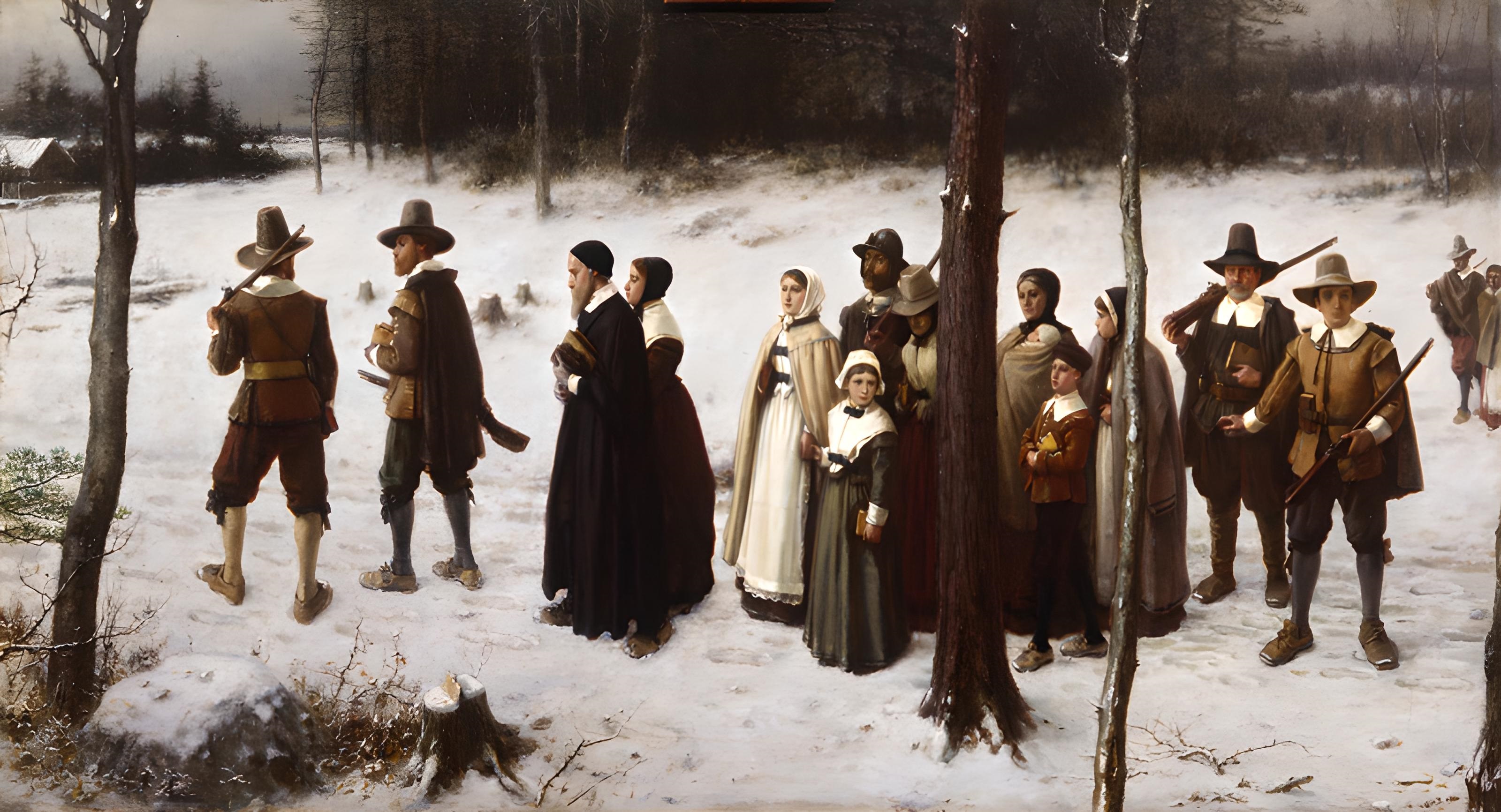
The country's history is often traced back to the Pilgrim Fathers whose Brownist beliefs motivated their move from England to the New World. These English Dissenters, who also happened to be Puritans—and therefore Calvinists—were first to settle in what was to become the Plymouth Colony. America's Calvinist heritage is often underlined by various experts, researchers and authors, prompting some to declare that the United States was "founded on Calvinism", while also underlining its exceptional foundation as a Protestant majority nation. American Protestantism has been diverse from the very beginning with large numbers of early immigrants being Anglican, various Reformed, Lutheran, and Anabaptist. In the next centuries, it diversified even more with the Great Awakenings throughout the country.
Protestants are divided into many different denominations, which are generally classified as either "mainline" or "evangelical", although some may not fit easily into either category. Some historically African-American denominations are also classified as Black churches. Protestantism had undergone an unprecedented development on American soil, diversifying into multiple branches, denominations, several interdenominational and related movements, as well as many other developments. All have since expanded on a worldwide scale mainly through missionary work.

Statistics
Branches
Baptists
Baptists are the largest Protestant grouping in the United States accounting for one-third of all American Protestants.
Baptist churches were organized, starting in 1814, as the Triennial Convention. In 1845, most southern congregations split, founding the Southern Baptist Convention, which is now the largest Protestant denomination in the U.S., with 12.3 million members as of 2025. The Triennial Convention was reorganized into what is now American Baptist Churches USA and includes 1.1 million members and 5,057 congregations.
African American Baptists, excluded from full participation in white Baptist organizations, have formed several denominations, of which the largest are the National Baptist Convention, and the more liberal Progressive National Baptist Convention.

There are numerous smaller bodies, some recently organized and others with long histories, such as the two original strands: the Particular Baptists and General Baptists, and the Free Will Baptists, Primitive Baptists, Strict Baptists, Old Regular Baptists, Two-Seed-in-the-Spirit Predestinarian Baptists, Independent Baptists, Seventh Day Baptists and others.
Baptists have been present in the part of North America that is now the United States since the early 17th century. Both Roger Williams and John Clarke, his compatriot in working for religious freedom, are credited with founding the Baptist faith in North America. In 1639, Williams established a Baptist church in Providence, Rhode Island (First Baptist Church in America) and Clarke began a Baptist church in Newport, Rhode Island (First Baptist Church in Newport). According to a Baptist historian who has researched the matter, "There is much debate over the centuries as to whether the Providence or Newport church deserved the place of 'first' Baptist congregation in America. Exact records for both congregations are lacking."
Largest Baptist denominations
The Handbook of Denominations in the United States identifies and describes 31 Baptist groups or conventions in the United States. A partial list follows. (Unless otherwise noted, statistics are taken from the Baptist World Alliance website, and reflect 2006 data.)
Southern Baptist Convention: 46,608 congregations, 12.3 million members (2025)
National Baptist Convention, USA, Inc.: 31,000 congregations, 7.5 million members (African-American) (2013)
National Baptist Convention of America, Inc.: 12,000 congregations, 3.1 million members (African-American)

Progressive National Baptist Convention: 1,200 congregations, 2.5 million members (African-American)
Baptist General Convention of Texas: 4,200 congregations, 1.7 million members
Baptist Bible Fellowship International: 3,400 congregations, 1.4 million members
American Baptist Churches USA: 5,100 congregations, 1.1 million members
Presbyterian
Presbyterians largely came from Scotland or Ulster (Northern Ireland today) to the Middle Colonies, most commonly Pennsylvania. Princeton University was established in 1746 by Presbyterians (Particularly Jonathan Dickinson and Aaron Burr Sr.) to rigorously educate clergymen in alignment to the theology pioneered by William Tennent, and later went on to produce the "Princeton Theologians" such as Charles Hodge.
Under the influence of Scottish theologians like Samuel Rutherford and John Knox, Presbyterians largely believed in the idea that "Resistance to tyranny is obedience to God." Vastly in fervent support of the American Revolution, the Revolutionary War was dubbed the "Presbyterian Rebellion" by King George III and other loyalists.
The first ministers were recruited from Northern Ireland. While several Presbyterian churches had been established by the late 1600s, they were not yet organized into presbyteries and synods until the early 1700s.
Presbyterian Church (U.S.A.) mainline church has approximately 1,141,000 members and 8,700 congregations. It adopted the Book of Confessions which include the Westminster Confession. Headquarters is in Louisville, Kentucky.
Presbyterian Church in America Evangelical, Calvinist church, adheres to the Westminster Confession of Faith. The denomination has 374,000 members and 1912 congregations and several congregation outside the United States, in Germany, Japan, Cayman Islands, etc. Headquarters is located in Lawrenceville, Georgia.
Evangelical Presbyterian Church (United States) has more than 600 congregations and 145,000 members. Adhere to the Westminster Confession.
Evangelical Reformed Church in America
Orthodox Presbyterian Church was formed in 1936 under the influence of John Gresham Machen, has 31,000 members.
Evangelical Covenant Order, 60,000 members in 357 congregations.
Bible Presbyterian Church
Associate Reformed Presbyterian Church
Free Presbyterian Church in North America
Reformed Presbyterian Church in North America
Cumberland Presbyterian Church
Cumberland Presbyterian Church in America
Free Reformed Church in North America
Reformed Church in America
Christian Reformed Church in North America
Netherlands Reformed Congregations
Hungarian Reformed Church in America
Lutheranism
With 2.7 million members, the Evangelical Lutheran Church in America (ELCA) is the largest American Lutheran denomination, followed by the Lutheran Church–Missouri Synod (LCMS) with 1.7 million members, and the Wisconsin Evangelical Lutheran Synod (WELS) with 344,000 members. The differences between the Evangelical Lutheran Church in America (ELCA) and the Lutheran Church–Missouri Synod (LCMS) largely arise from historical and cultural factors, although some are theological in character. The ELCA tends to be more involved in ecumenical endeavors than the LCMS.
When Lutherans came to North America, they started church bodies that reflected, to some degree, the churches left behind. Many maintained their immigrant languages until the early 20th century. They sought pastors from the "old country" until patterns for the education of clergy could be developed in America. Eventually, seminaries and church colleges were established in many places to serve the Lutheran churches in North America and, initially, especially to prepare pastors to serve congregations.
The LCMS sprang from German immigrants fleeing the forced Prussian Union, who settled in the St. Louis area and has a continuous history since it was established in 1847. The LCMS is the second largest Lutheran church body in North America (1.7 million). It identifies itself as a church with an emphasis on biblical doctrine and faithful adherence to the historic Lutheran confessions. Insistence by some LCMS leaders on a strict reading of all passages of Scripture led to a rupture in the mid-1970s, which in turn resulted in the formation of the Association of Evangelical Lutheran Churches, now part of the ELCA.
Although its strongly conservative views on theology and ethics might seem to make the LCMS politically compatible with other Evangelicals in the U.S., the LCMS as an organization largely eschews political activity, partly out of its strict understanding of the Lutheran distinction between the Two Kingdoms. It does, however, encourage its members to be politically active, and LCMS members are often involved in political organizations such as Lutherans for Life.
The earliest predecessor synod of the Evangelical Lutheran Church in America was constituted on August 25, 1748, in Philadelphia. It was known as the Ministerium of Pennsylvania and Adjacent States. The ELCA is the product of a series of mergers and represents the largest (3.0 million members) Lutheran church body in North America. The ELCA was created in 1988 by the uniting of the 2.85-million-member Lutheran Church in America, 2.25-million-member American Lutheran Church, and the 100,000-member Association of Evangelical Lutheran Churches. The ALC and LCA had come into being in the early 1960s, as a result of mergers of eight smaller ethnically based Lutheran bodies.
The ELCA, through predecessor church bodies, is a founding member of the Lutheran World Federation, World Council of Churches and the National Council of Churches USA. The LCMS, maintaining its position as a confessional church body emphasizing the importance of full agreement in the teachings of the Bible, does not belong to any of these. However, it is a member of the International Lutheran Council, made up of over 30 Lutheran Churches worldwide that support the confessional doctrines of the Bible and the Book of Concord. The WELS, along with the Evangelical Lutheran Synod (ELS), are part of the international Confessional Evangelical Lutheran Conference (CELC).
Pentecostalism
Pentecostalism is a renewalist religious movement within Protestantism, that places special emphasis on a direct personal experience of God through the baptism of the Holy Spirit. The term Pentecostal is derived from Pentecost, a Greek term describing the Jewish Feast of Weeks. For Christians, this event commemorates the descent of the Holy Spirit and Pentecostals tend to see their movement as reflecting the same kind of spiritual power, worship styles and teachings that were found in the early church.
Pentecostalism is an umbrella term that includes a wide range of different theological and organizational perspectives. As a result, there is no single central organization or church that directs the movement. Most Pentecostals consider themselves to be part of broader Christian groups; for example, most Pentecostals identify as Protestants. Many embrace the term Evangelical, while others prefer Restorationist. Pentecostalism is theologically and historically close to the Charismatic Movement, as it significantly influenced that movement; some Pentecostals use the two terms interchangeably.
Within classical Pentecostalism there are three major orientations: Wesleyan-Holiness, Higher Life, and Oneness. Examples of Wesleyan-Holiness denominations include the Church of God in Christ (COGIC) and the International Pentecostal Holiness Church (IPHC). The International Church of the Foursquare Gospel is an example of the Higher Life branch, while the Assemblies of God (AG) was influenced by both groups. Some Oneness Pentecostal (Nontrinitarian) churches include the United Pentecostal Church International (UPCI) and Pentecostal Assemblies of the World (PAW). Many Pentecostal sects are affiliated with the Pentecostal World Conference.
Assemblies of God, Evangelical
Mainline vs. evangelical
In typical usage, the term mainline is contrasted with evangelical. The distinction between the two can be due as much to sociopolitical attitude as to theological doctrine, although doctrinal differences may exist as well. Theologically conservative critics accuse the mainline churches of "the substitution of leftist social action for Christian evangelizing, and the disappearance of biblical theology", and maintain that "All the Mainline churches have become essentially the same church: their histories, their theologies, and even much of their practice lost to a uniform vision of social progress."
The Association of Religion Data Archives (ARDA) counts 26,344,933 members of mainline churches versus 39,930,869 members of evangelical Protestant churches. There is evidence of a shift in membership from mainline denominations to evangelical churches.
As shown in the table below, some denominations with similar names and historical ties to evangelical groups are considered mainline. For example, while the American Baptist Churches, the Evangelical Lutheran Church in America, and the Presbyterian Church (USA) are mainline, the Southern Baptist Convention, Lutheran Church–Missouri Synod, and the Presbyterian Church in America are grouped as evangelical. However, many confessional denominations within the Magisterial Protestant traditions (such as the LCMS for Lutheranism) do not accurately fit under either categorization.
Mainline Protestantism
Mainline Protestant Christian denominations are those Protestant denominations that were brought to the United States by its historic immigrant groups; for this reason they are sometimes referred to as heritage churches. The largest are the Episcopal (English), Presbyterian (Scottish), Methodist (English and Welsh), and Lutheran (German and Scandinavian) churches.
Many mainline denominations teach that the Bible is God's word in function, but tend to be open to new ideas and societal changes. They have been increasingly open to the ordination of women. Mainline churches tend to belong to organizations such as the National Council of Churches and World Council of Churches.